
General U1.18 - Employer Obligations
Overview
Dotpoint 18: employer obligations.
Employer obligations are the responsibilities a business must meet when it employs workers.
Employing people brings legal and financial responsibilities. A business must make sure employees are paid correctly, receive required superannuation contributions and can access the leave entitlements that apply to them.
This dotpoint focuses on:
1. Payroll
2. Superannuation
3. Leave entitlements

💵 Payroll
Payroll is the process a business uses to calculate, record and pay employees for the work they perform.
Payroll may be managed by the business owner, an accountant, an office manager or payroll software. Regardless of who manages it, the employer remains responsible for paying employees correctly and meeting legal requirements.
Key payroll responsibilities
Recording employee information
Keep accurate employee details and records of hours worked.
Calculating correct wages
Calculate wages, penalty rates, loadings, allowances and permitted deductions.
Paying employees
Pay employees the correct amount and on time.
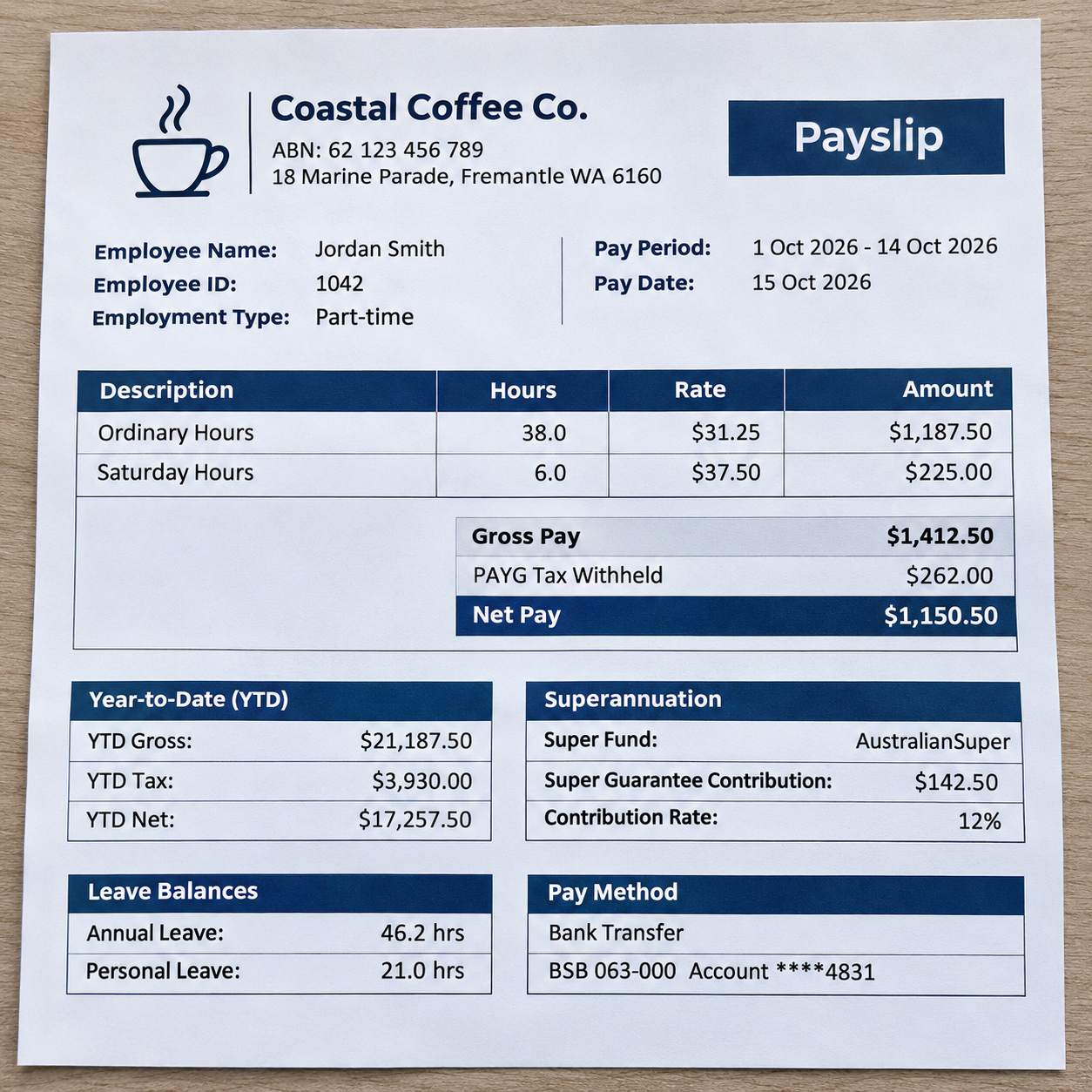
Providing pay slips
Issue pay slips within one working day of pay day, showing relevant pay and deduction details.
PAYG withholding
Withhold income tax where required and report payroll information to the Australian Taxation Office.
Maintaining records
Keep accurate records of pay, hours, leave and superannuation. Under the national system, time and wage records are generally kept for seven years.
☕ Real-life example: a local café
A small Perth café employs six casual workers who work different shifts each week. The owner uses payroll software to record their hours, calculate wages and applicable penalty rates, withhold PAYG tax and issue pay slips.
By managing payroll correctly, employees receive their proper pay and the café meets its legal obligations. The business also reduces the risk of underpayment disputes and penalties while supporting positive relationships with employees.
Why payroll matters
Accurate payroll helps employees receive their correct entitlements, reduces the risk of legal penalties and supports positive employee relationships.
🏦 Superannuation
Superannuation (super) is money contributed to an employee's super fund to help provide income during retirement.
Understanding superannuation
Superannuation is a compulsory retirement savings system in Australia. Employers must generally contribute money into a superannuation fund for eligible employees, in addition to their normal wages.
A super fund invests this money in assets such as shares, property and bonds to help the savings grow over time. Employees usually cannot access the money until they reach retirement age or meet another legal condition of release.
The purpose of superannuation is to help employees build savings during their working lives so they have money to support themselves when they stop working.
How superannuation works
Key superannuation responsibilities
Employers must meet several requirements to ensure eligible employees receive their correct superannuation entitlements.
Identify eligible employees
Most employees aged 18 and over are entitled to employer super contributions, including casual workers. Employees under 18 generally qualify if they work more than 30 hours a week.
Calculate contributions
The current Super Guarantee rate is 12% of an employee's qualifying earnings. Employers must calculate the correct amount for each pay period, subject to applicable rules.
Pay the correct super fund
Contributions must be paid into the employee's chosen or otherwise applicable super fund, rather than directly into their personal bank account.
Pay super on time
Since 1 July 2026, Payday Super requires employers to pay super each payday. Contributions must generally reach the employee's super fund within seven business days.
Maintain accurate records
Keep records of super contribution amounts, payment dates, pay periods and the super funds receiving the money.
🛠 Real-life example: a cabinet-making workshop
A small Perth cabinet-making business employs a full-time workshop assistant who earns $2,000 in qualifying earnings each fortnight. The employer must contribute an additional 12% into the employee's super fund.
The $240 is paid into the employee's super fund rather than added to their take-home wages. As a result, the business must budget for an additional employment cost of $240 each fortnight, while the employee builds savings for retirement.
What could $240 a fortnight grow to?
This illustration assumes the same $240 employer contribution is invested every fortnight from age 18 to 65 and earns an average 6% per year. It ignores fees, taxes, wage changes and changes to super rules, so it is a teaching example rather than a forecast.
| Age | Total employer contributions | Illustrative balance | Investment growth |
|---|---|---|---|
| 18 | $0 | $0 | $0 |
| 20 | $12,480 | $13,243 | $763 |
| 25 | $43,680 | $54,207 | $10,527 |
| 30 | $74,880 | $109,484 | $34,604 |
| 35 | $106,080 | $184,074 | $77,994 |
| 40 | $137,280 | $284,724 | $147,444 |
| 45 | $168,480 | $420,541 | $252,061 |
| 50 | $199,680 | $603,812 | $404,132 |
| 55 | $230,880 | $851,116 | $620,236 |
| 60 | $262,080 | $1,184,827 | $922,747 |
| 65 | $293,280 | $1,635,133 | $1,341,853 |
Examples of major Australian super funds
Super funds do not pay a fixed interest rate. Investment returns rise and fall. The table below shows published 10-year annualised returns for balanced-style options to 30 June 2026.
| Fund / option | 10-year average return p.a. |
|---|---|
| Hostplus Balanced | 8.90% |
| Australian Retirement Trust Balanced | 8.69% |
| AustralianSuper Balanced | 8.47% |
| Aware Super Balanced | 8.22% |
| Simple average of these four examples | 8.57% |
Past performance is not a guarantee of future returns. Figures are published long-term returns for the named options and are included only as real-world context.
Why superannuation matters
Superannuation helps employees build financial security for retirement. For employers, it is an additional staffing cost that must be included in cash-flow planning.
Failing to calculate or pay super correctly can leave the business with unpaid obligations, extra administration and possible financial penalties. For a small business, this means super needs to be treated as a normal employment cost rather than an optional extra.
🌴 Leave entitlements
Leave entitlements are periods when an employee is allowed to be away from work under workplace laws, awards, agreements or other employment conditions.
Different types of employees can have different leave entitlements. Full-time and part-time employees generally receive more paid leave entitlements than casual employees.
Common leave entitlements
| Leave type | What it allows | General entitlement |
|---|---|---|
| Annual leave | Paid time away from work for holidays or rest. | Full-time and part-time employees generally accumulate 4 weeks of paid annual leave each year, with part-time leave based on ordinary hours. Casual employees do not receive paid annual leave. |
| Sick and carer’s leave | Time away when the employee is sick or injured, or needs to care for an immediate family or household member. | Full-time employees generally receive 10 days of paid sick and carer’s leave each year. Part-time employees receive a pro-rata amount. |
| Compassionate leave | Time away following certain serious illnesses, injuries, deaths, miscarriages or stillbirths involving immediate family or household members. | Employees can generally access 2 days per qualifying occasion. It is paid for full-time and part-time employees and unpaid for casual employees. |
| Family and domestic violence leave | Time away to deal with the impact of family and domestic violence. | Employees, including casuals, can generally access 10 days of paid family and domestic violence leave each year. |
| Other leave | Can include parental leave, community service leave and long service leave. | Eligibility and payment rules depend on the type of leave and the employee’s circumstances. |

Casual employees are different
Casual employees generally do not receive paid annual leave or paid sick and carer’s leave. Instead, casuals usually receive a higher hourly rate through casual loading to compensate for some entitlements they do not receive.
Casual employees still have access to some leave entitlements, including paid family and domestic violence leave and certain forms of unpaid leave.
Example: leave at a small hair salon
A small hair salon employs one full-time stylist, two part-time stylists and two casual assistants. The full-time stylist becomes ill and tells the owner that they cannot work for three days.
If the stylist has enough accumulated paid sick and carer’s leave, the owner records the absence against that entitlement and continues to pay the employee for the eligible leave period. The owner may also need to rearrange appointments or ask another stylist to cover some clients while the employee is away.
If one of the casual assistants became ill for the same three days, that worker would not usually receive paid sick leave. This is why the owner needs accurate employee records and a clear understanding of each worker’s employment type before processing leave and payroll.

🎧 Prefer listening?
Listen to the Employer Obligations podcast for another way to revise this dotpoint.
🎥 Prefer watching?
Watch the Employer Obligations video to reinforce the key ideas.
🧑🏫 Class Activities
Hands-on activities
These activities are designed to help you apply the full content to real businesses through research, decision-making and practical classroom tasks.
How this section could be used: teachers could place students into small groups and allocate different activities, ask students to complete one or two activities each week, or use the activities at the end of each syllabus point so groups can take turns completing and presenting one task to the class. Activities can also be used as extension work, revision, or as a starting point for short class discussions.

1. Payroll and Pay Slip Check
Coastal Coffee Co. has six casual employees. One worker completes 24 hours during the week, but only 20 hours are entered into payroll.
- Identify which payroll responsibility has not been completed correctly.
- Explain what the owner should do to correct the error.
- Identify three pieces of information that should appear on the corrected pay slip.
Output: complete a Problem → Payroll Action → Employee Outcome table.
2. Real Business Research: Woolworths Payroll
Woolworths Group has faced major payroll underpayment proceedings involving salaried store managers. Use a reliable source such as the Fair Work Ombudsman to research the case.
- Identify what payroll problem occurred.
- Identify at least two employee entitlements or payroll records involved.
- Explain one consequence for Woolworths.
- State one lesson a small business could learn from the case.
Output: prepare a one-slide research summary with Problem, Employer Obligation, Consequence and Small-Business Lesson.
3. Super Now and Later
Harbour Cabinets pays a worker $2,000 in qualifying earnings each fortnight.
- Calculate the 12% employer super contribution.
- Calculate the employer’s annual super contribution if the same amount is paid for 26 fortnights.
- Use the projection table to describe what long-term investment growth can do to retirement savings.
Output: show the calculations and write a three-sentence explanation.
4. Comparing Super Returns
The page shows examples of published 10-year returns from several major Australian super funds.
- Identify the highest and lowest example returns.
- Calculate the difference in percentage points.
- Explain why past returns do not guarantee future returns.
Output: prepare a short comparison table plus one caution sentence.
5. Leave Entitlement Match
Match each situation to the most relevant leave type:
- a full-time employee wants a two-week holiday
- a part-time employee is too sick to work
- an employee needs time after the death of an immediate family member
- an employee needs time to deal with family and domestic violence
Output: complete a four-row table with Situation, Leave Type and Why It Applies.
6. Small Salon Leave Decision
Harbour Hair Studio employs a full-time stylist and a casual assistant. Both are unable to work for two days because they are ill.
- Compare their general paid sick-leave entitlements.
- Explain what records the owner should check.
- Explain one operational problem the absences could create for the salon.
Output: write a short comparison explaining how the owner should manage the two employees differently.
✍️ Short Answer Questions
Practice questions
Answer each question before opening the sample answer. Use the command term carefully and apply the marketing decision to the context provided.
Show sample answer
Payroll is the process a business uses to calculate, record and pay employees for the work they perform.
Show sample answer
Three payroll responsibilities are recording employee hours and information accurately, calculating and paying the correct wages, and providing employees with pay slips showing the required pay information.
Show sample answer
A small business should not assume that payroll is correct simply because software, an accountant or a salary system is being used. Hours, wage rates and employee entitlements still need to be checked against the work actually performed. As a result, regular payroll checks can reduce the risk of underpayments, back-payments and damage to employee trust.
Show sample answer
Employers regularly contribute money into an eligible employee’s super fund, and the fund invests those contributions in assets such as shares, property and bonds. Investment earnings can then be reinvested and earn further returns over time. As a result, a long period of contributions and compounding can make the final retirement balance much larger than the contributions alone.
Show sample answer
Super funds invest in assets whose values can rise and fall, so investment performance changes from year to year. A fund’s historical average shows what happened in the past rather than what must happen in the future. As a result, past returns can provide context but cannot guarantee the return an employee will receive later.
Show sample answer
Different employment types can receive different leave entitlements. Full-time and part-time employees generally accumulate paid annual leave and paid sick and carer’s leave, while casual employees generally do not receive those paid entitlements. As a result, the employer needs accurate employment records so the correct leave and payment are applied.
Show sample answer
If employees are underpaid or do not receive required super contributions, they lose money or retirement savings they are entitled to receive. The business may then need to make back-payments, correct records and deal with complaints or penalties. The implication is that failing to meet these obligations can harm employees directly while also creating financial, legal and relationship problems for the business.
Show sample answer
One advantage of prioritising payroll is that employees depend on receiving the correct wages on time, and errors can quickly create financial stress and workplace disputes. However, correct payroll does not remove the employer’s responsibility to pay superannuation and provide the leave entitlements that apply to employees. Overall, payroll is a critical employer obligation, but a small business must manage payroll, superannuation and leave together because failing in any one area can harm employees and create problems for the business.
🃏 Flashcards
Card 1 of 12
🎮 Revision Games
💰 Obligations Millionaire
Climb the ladder by mastering payroll, super and leave.
🧩 Obligation Match
Match each workplace situation to Payroll, Super or Leave.
⚡ 60 Second Showdown
Race through employer obligations before the clock expires.
Biz Fact: The hidden cost of hiring: An employee earning $80,000 in qualifying wages can cost a business an extra $9,600 annually in compulsory super contributions.