
U2.21 — Characteristics of Motivation Theories
Overview
Dotpoint 21: characteristics of the following motivation theories.
Motivation theories are models that try to explain why employees choose to put effort into their work and what managers can do to influence employee behaviour.
Each theory looks at motivation from a different angle. Some theories focus on employee needs, some focus on satisfaction, some focus on rewards, and some focus on fairness. Together, they help managers understand why the same reward or workplace strategy may motivate one employee but not another.
In this dotpoint, the four motivation theories looked at are:
- Maslow’s Hierarchy of Needs
- Herzberg’s Motivation-Hygiene Theory
- Vroom’s Expectancy Theory
- Adams’ Equity Theory
🔺 Maslow’s Hierarchy of Needs
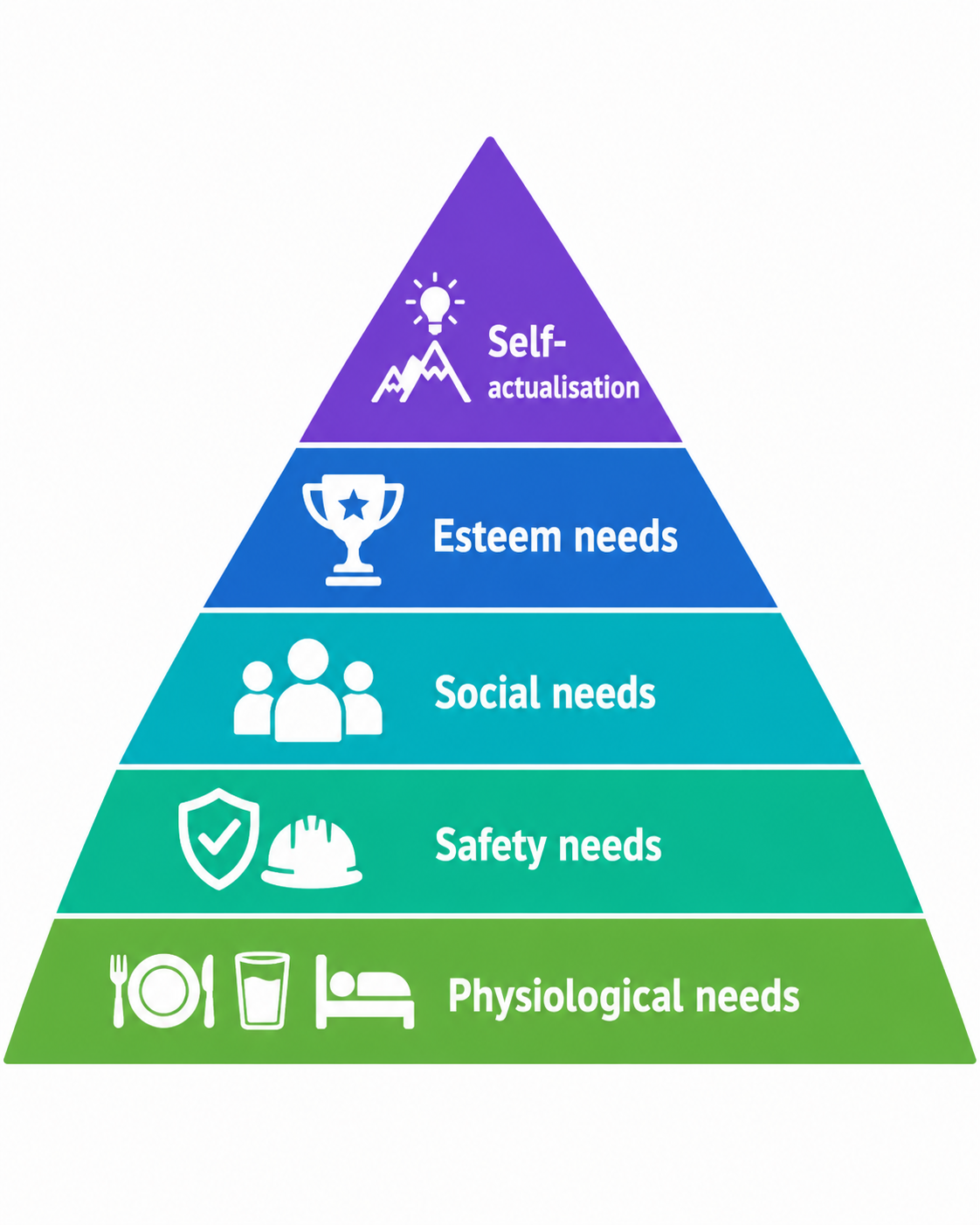
Maslow’s Hierarchy of Needs is a motivation theory that suggests employees are motivated by different levels of needs, moving from basic survival and security needs towards belonging, esteem and personal growth.
Summary of the model
Abraham Maslow, an American psychologist, developed the Hierarchy of Needs in 1943. His model suggests that people have different levels of needs and that lower-level needs generally need to be satisfied before higher-level needs become strong motivators.
The theory is usually shown as a pyramid. At the bottom are basic needs such as pay, rest and physical safety. Once these needs are reasonably met, employees may become more motivated by belonging, recognition, respect, responsibility and personal growth.
In business, this means managers should not assume all employees are motivated by the same thing. An employee worried about pay or job security may not care much about recognition or self-development yet. However, an employee whose basic needs are already met may be more motivated by promotion, autonomy or meaningful work.
- Lower-level needs usually come first.
- Higher-level needs become more important once basic needs are satisfied.
- Employees may move up or down the hierarchy depending on their situation.
- The theory helps managers match motivation strategies to employee needs.
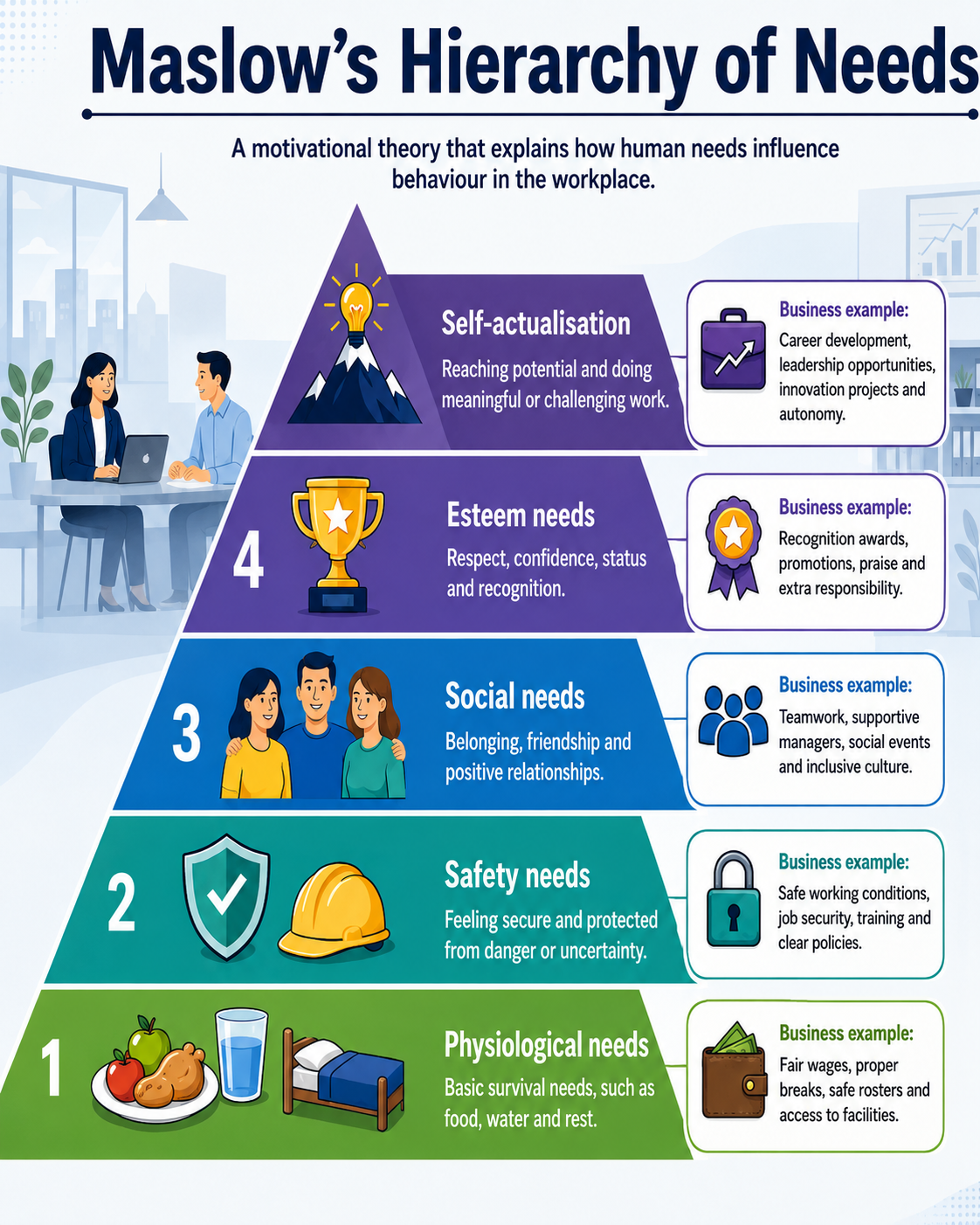
The five levels in a workplace
| Need | Meaning | Business example |
|---|---|---|
| Physiological needs | Basic survival needs, such as food, water and rest. | Fair wages, proper breaks, safe rosters and access to facilities. |
| Safety needs | Feeling secure and protected from danger or uncertainty. | Safe working conditions, job security, training and clear policies. |
| Social needs | Belonging, friendship and positive relationships. | Teamwork, supportive managers, social events and inclusive culture. |
| Esteem needs | Respect, confidence, status and recognition. | Recognition awards, promotions, praise and extra responsibility. |
| Self-actualisation | Reaching potential and doing meaningful or challenging work. | Career development, leadership opportunities, innovation projects and autonomy. |
How it is applied in business
- A business can start by making sure employees receive fair pay, safe conditions and reliable hours.
- Managers can build social belonging through teamwork, mentoring and a positive workplace culture.
- Recognition and reward can be used to meet esteem needs because employees feel valued.
- Skill improvement training can help meet higher-level needs because employees see a pathway for growth.
- Career pathways and challenging tasks can motivate ambitious employees who want to achieve their potential.
Australian business examples
- BHP can support lower-level needs through strong safety systems because mining work can involve physical risk.
- Atlassian can support higher-level needs through teamwork, innovation and opportunities for skilled employees to solve complex problems.
- Australian hospitals can use training, teamwork and career pathways to help nurses and health workers feel secure, valued and able to grow.
Limitations of the model
- Not all employees move through the needs in the same order.
- Some employees may value higher-level needs, such as recognition or purpose, even if lower-level needs are not fully satisfied.
- The model is quite general and may not explain every individual employee’s motivation.
- It can be difficult for managers to know exactly which level an employee is currently at.
🧼 Herzberg’s Motivation-Hygiene Theory
Herzberg’s Motivation-Hygiene Theory argues that some workplace factors prevent dissatisfaction, while other factors create true motivation and job satisfaction.
Summary of the model
Frederick Herzberg, an American psychologist, developed the Motivation-Hygiene Theory after studying what made workers feel satisfied or dissatisfied at work. His theory is also called the Two-Factor Theory.
Herzberg argued that workplace factors can be separated into two groups: hygiene factors and motivators. Hygiene factors are the basic conditions of the job, such as pay, safety, policies and supervision. If these are poor, employees become dissatisfied. However, improving them does not always create strong motivation; it often just removes complaints.
Motivators are the factors that can create real satisfaction and stronger effort. These include achievement, recognition, responsibility, promotion and personal growth. In business, this theory suggests managers should not rely only on pay or conditions. They should also design jobs so employees feel valued, trusted and challenged.
- Hygiene factors prevent dissatisfaction.
- Motivators create stronger satisfaction and effort.
- Pay matters, but pay alone may not create long-term motivation.
- Employees are more likely to be motivated when they experience recognition, responsibility and achievement.
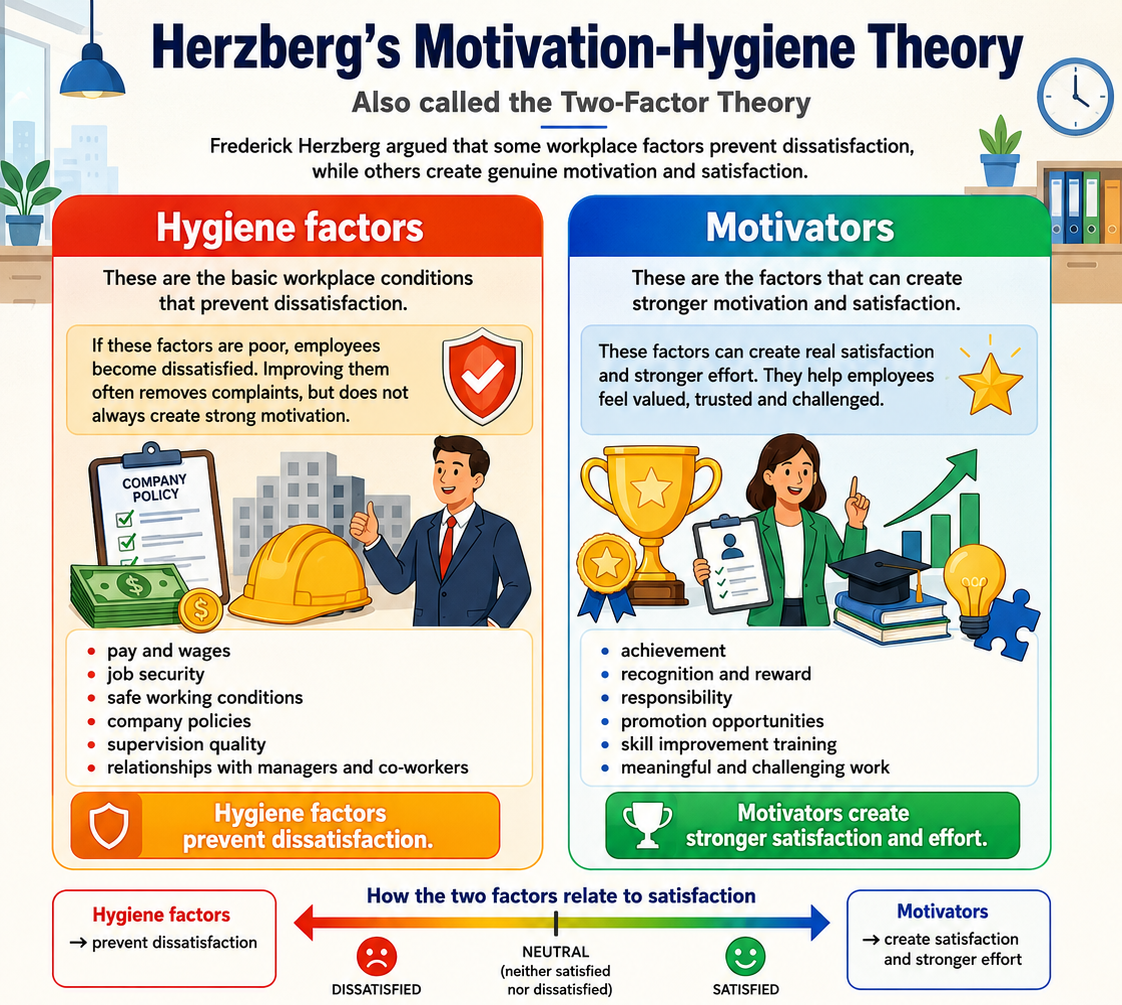
Hygiene factors
These are the basic workplace conditions that prevent dissatisfaction.
- pay and wages
- job security
- safe working conditions
- company policies
- supervision quality
- relationships with managers and co-workers
Motivators
These are the factors that can create stronger motivation and satisfaction.
- achievement
- recognition and reward
- responsibility
- promotion opportunities
- skill improvement training
- meaningful and challenging work
How it is applied in business
- A business should first remove major sources of dissatisfaction, such as unsafe conditions, unclear policies or unfair pay.
- Once hygiene factors are acceptable, the business should add motivators such as recognition, responsibility and training.
- Managers can improve motivation by giving employees more ownership over their work, not just increasing pay.
- Recognition programs can motivate employees because they feel their effort is noticed.
- Promotion pathways and skill development can motivate employees because they can see future growth.
Australian business examples
- Qantas can reduce dissatisfaction by improving rostering, safety procedures and communication with staff.
- Canva can use motivators such as meaningful work, responsibility and recognition to keep skilled employees engaged.
- McDonald’s Australia can use training pathways and crew recognition to give young employees achievement and development opportunities.
Common mistakes about pay
Students often write that pay always motivates employees. Herzberg would argue that pay is mainly a hygiene factor. Poor pay can make employees unhappy, but higher pay alone may not create long-term motivation if the job has no recognition, responsibility or growth.

Limitations of the model
- The difference between hygiene factors and motivators is not always clear.
- Some employees may still be strongly motivated by pay, even though Herzberg classed pay mainly as a hygiene factor.
- The theory may oversimplify motivation because employees can value different things at different stages of life.
- It can be difficult for managers to redesign jobs or offer responsibility in workplaces with strict procedures.
🎯 Vroom’s Expectancy Theory
Vroom’s Expectancy Theory suggests employees are motivated when they believe effort will improve performance, performance will lead to a reward, and the reward is something they value.
Summary of the model
Victor Vroom, a Canadian psychologist, developed Expectancy Theory in the 1960s. His model explains motivation as a decision-making process. Employees think about whether extra effort is worth it before they decide how hard to work.
The theory has three key parts: expectancy, instrumentality and valence. Expectancy means the employee believes effort will lead to better performance. Instrumentality means the employee believes good performance will lead to a reward. Valence means the employee values the reward being offered.
If all three parts are strong, motivation is likely to be stronger. If one part is weak, motivation may fall. For example, an employee may not work harder if the target seems impossible, if they do not trust the business to reward them, or if the reward is something they do not care about.
- Effort must feel connected to performance.
- Performance must feel connected to reward.
- The reward must be valuable to the employee.
- Motivation falls if any link in the chain is weak.
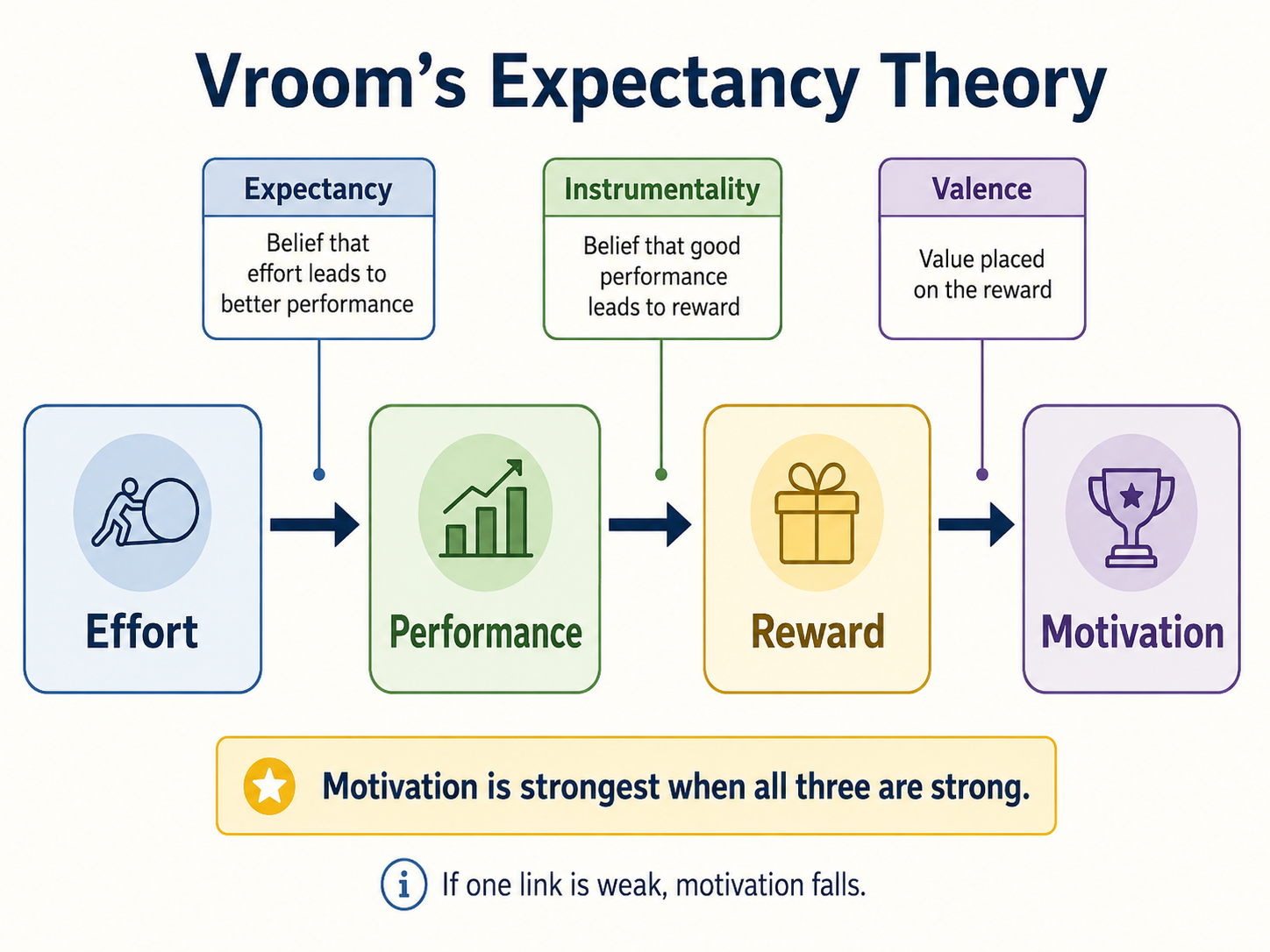
The three parts of Vroom’s theory
| Part | Meaning | Simple question employees ask |
|---|---|---|
| Expectancy | The belief that effort will lead to better performance. | If I try harder, can I actually perform better? |
| Instrumentality | The belief that good performance will lead to a reward. | If I perform well, will the business actually reward me? |
| Valence | The value the employee places on the reward. | Do I actually want the reward being offered? |
How it is applied in business
- Managers should set clear performance targets so employees understand what they need to achieve.
- Training should be provided so employees believe they can reach the target.
- Rewards should be linked clearly to performance, such as sales bonuses for meeting sales targets.
- The reward should be something employees value, such as money, extra leave, recognition or flexible work.
- The business must deliver the reward when targets are met, or employees may stop believing the system is fair.
Australian business examples
- Real estate agencies often use sales commissions because agents can see a clear link between effort, sales performance and financial reward.
- Harvey Norman and other sales-focused retailers can use commission-style incentives where employees are motivated by clear reward links.
- Fitness businesses may reward trainers for signing up new members or retaining clients, but the reward must be valuable enough to increase effort.
Limitations of the model
- The theory assumes employees make logical decisions about effort, performance and rewards.
- Employees may not always clearly understand the link between effort and reward.
- Rewards that motivate one employee may not motivate another.
- If managers do not communicate targets clearly, the theory becomes difficult to apply.
⚖️ Adams’ Equity Theory
Adams’ Equity Theory suggests employees are motivated when they believe they are being treated fairly compared with others.
Summary of the model
John Stacey Adams, an American workplace psychologist, developed Equity Theory in the 1960s. His theory argues that employees are strongly influenced by whether they believe they are being treated fairly compared with other people.
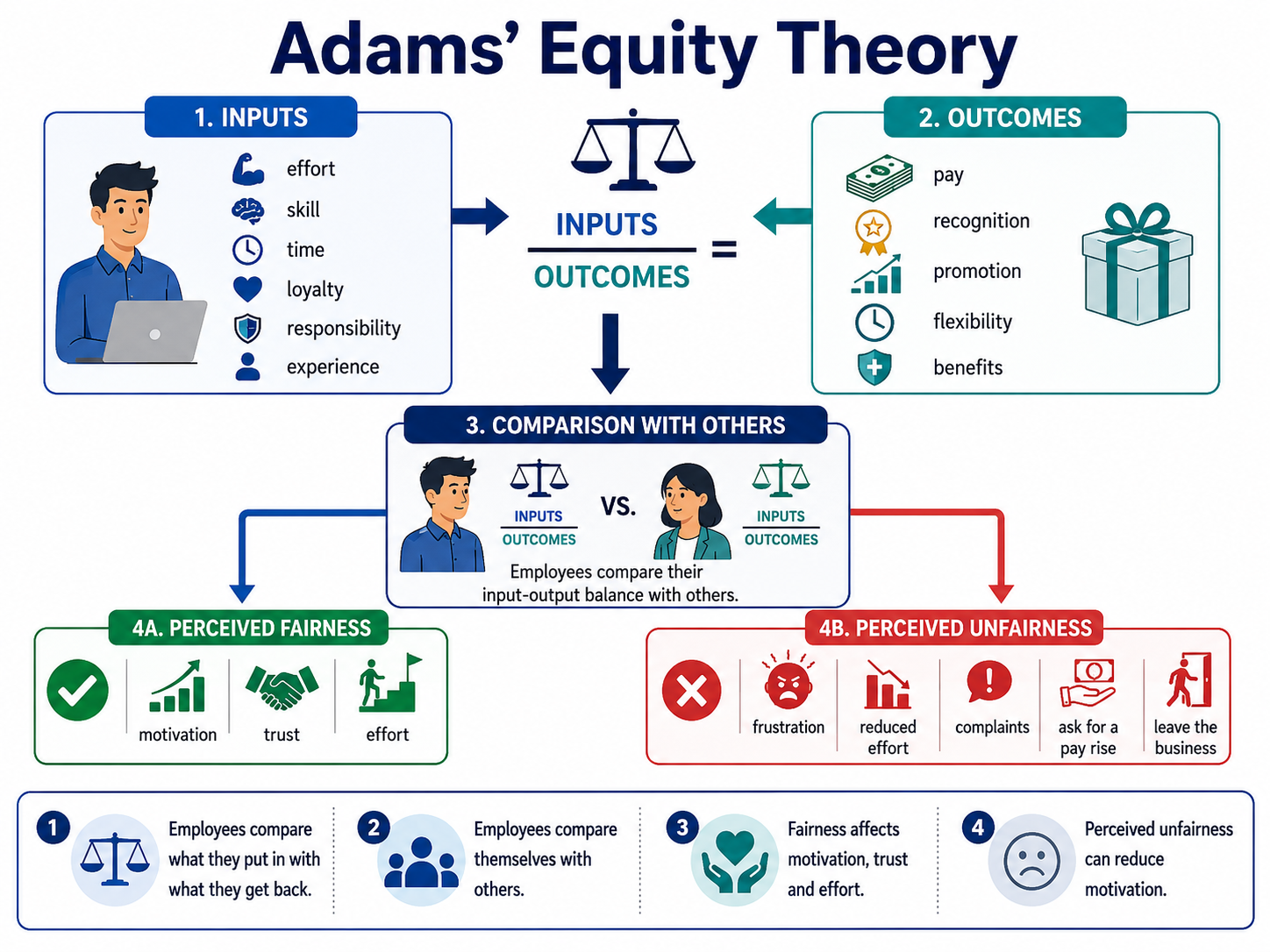
The theory says employees compare their inputs and outcomes. Inputs are what employees contribute, such as effort, skill, time, loyalty, responsibility and experience. Outcomes are what employees receive, such as pay, recognition, promotion, flexibility and benefits.
Employees then compare their input-output balance with another employee or group. If they believe the comparison is fair, they are more likely to stay motivated. If they believe it is unfair, they may become frustrated, reduce their effort, complain, ask for a pay rise or leave the business.
- Employees compare what they put in with what they get back.
- Employees compare themselves with others.
- Fairness affects motivation, trust and effort.
- Perceived unfairness can reduce motivation even if the business believes the system is reasonable.
| Part | Meaning | Workplace example |
|---|---|---|
| Inputs | What the employee contributes. | Effort, experience, skill, time, loyalty, reliability and responsibility. |
| Outcomes | What the employee receives. | Pay, bonuses, praise, promotion, training, benefits and flexibility. |
| Comparison | The employee compares their situation with others. | A worker compares their pay and recognition with another worker doing similar work. |
| Equity or inequity | The employee judges whether the situation feels fair. | If two workers contribute similar effort but receive different rewards, one may feel unfairly treated. |
How it is applied in business
- Businesses should make pay, bonuses and promotions as fair and transparent as possible.
- Managers should explain why employees receive different rewards, especially if responsibilities or performance differ.
- Recognition should not always go to the same people, or other employees may feel ignored.
- Training and promotion opportunities should be offered fairly, not only to favourites.
- If employees believe the system is fair, they are more likely to stay motivated and trust management.
Australian business examples
- Mining businesses in WA need fair pay and conditions because workers often compare wages, rosters and allowances across similar roles.
- Public sector workplaces often use pay bands and clear promotion criteria to reduce perceptions of unfair treatment.
- Sporting clubs need to manage perceived fairness because players may compare contracts, selection decisions and leadership opportunities.
When inequity occurs
- an employee works harder than others but receives the same reward
- an employee receives less pay than someone doing similar work
- training opportunities are only given to favourites
- promotions appear unfair or based on popularity
- recognition is given unevenly even when effort is similar
Limitations of the model
- Fairness is based on employee perception, so two employees may see the same situation differently.
- Employees may compare themselves with the wrong person or only see part of the situation.
- It can be hard for businesses to make every reward feel perfectly fair.
- The theory focuses heavily on fairness, but employees may also be motivated by achievement, growth, purpose or belonging.
🎧 Prefer listening?
If you prefer listening to the content in podcast format:
🎥 Prefer watching?
If you prefer watching the content in video format:
Biz Fact: Adams’ Equity Theory explains why two employees doing the same job can become demotivated if one finds out the other is paid more.