
U3.06 — Features and Role of Free Trade Agreements
Overview
Dotpoint 6: features and role of free trade agreements, including AANZFTA and ANZCERTA.
A free trade agreement, or FTA, is a treaty between two or more countries that aims to reduce barriers to trade and investment. FTAs usually make it easier, cheaper and more predictable for businesses to buy, sell, invest and operate across member countries.
This dotpoint focuses on two specific agreements:
- ASEAN-Australia-New Zealand Free Trade Agreement (AANZFTA)
- Australia New Zealand Closer Economic Relations Trade Agreement (ANZCERTA)
The key exam skill is being able to identify the features of each agreement and explain the role those features play in encouraging international trade.
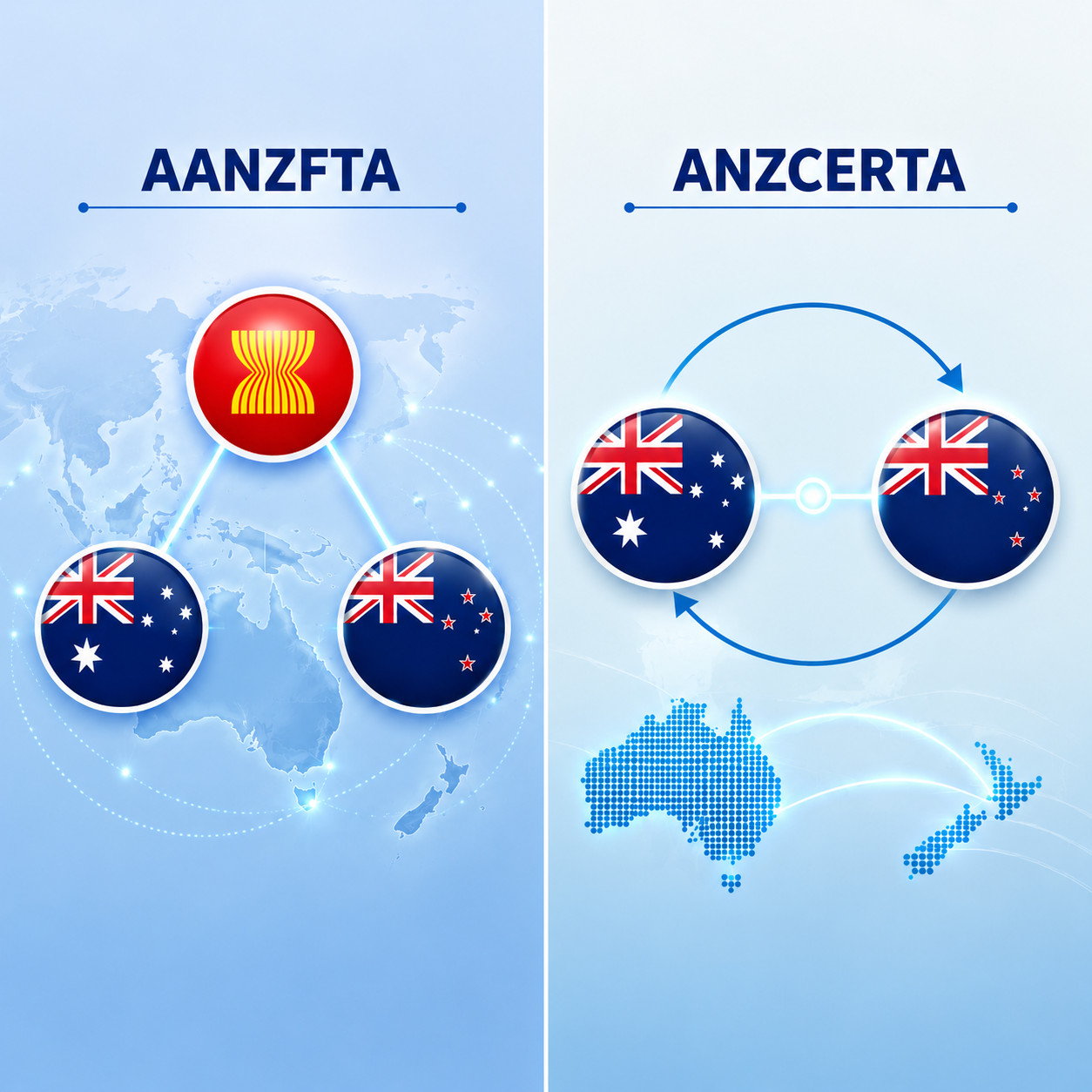
🤝 FTAs in Australia
The role of free trade agreements
The role of free trade agreements is to encourage trade and investment between member countries by reducing trade barriers and creating clearer rules for businesses.
FTAs can reduce tariffs, remove quotas, simplify trade rules, improve access to overseas markets, support trade in services and provide more certainty for investors. This can make it easier for Australian businesses to export goods, import inputs, provide services overseas, invest in foreign markets and build international supply chains.
For consumers, FTAs can increase access to cheaper or more varied imported products. For businesses, FTAs can lower costs, increase market size and improve competitiveness. However, businesses still need to meet the specific rules of the agreement, such as rules of origin, product standards and documentation requirements.
Australia’s major free trade agreements
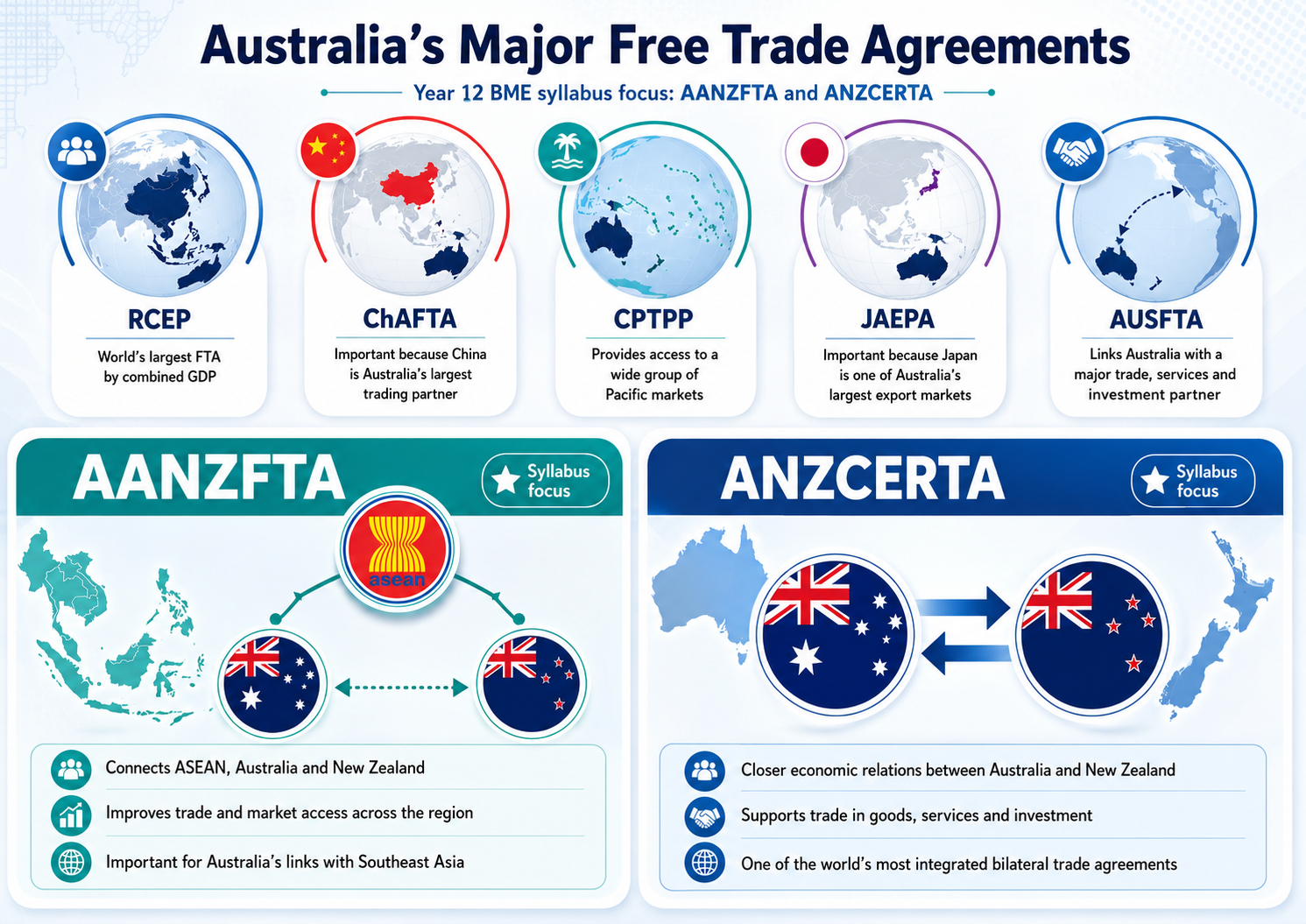
Australia has a number of major free trade agreements, each with different member countries, rules and areas of trade coverage.
Regional Comprehensive Economic Partnership (RCEP) – the world’s largest FTA by members’ combined GDP, covering China, Japan, South Korea, New Zealand and ASEAN countries.
China–Australia Free Trade Agreement (ChAFTA) – highly important because China is Australia’s largest trading partner and export market.
Comprehensive and Progressive Agreement for Trans-Pacific Partnership (CPTPP) – provides access to a large group of Pacific markets, including Japan, Canada, Mexico, Vietnam and the United Kingdom.
Japan–Australia Economic Partnership Agreement (JAEPA) – important because Japan is one of Australia’s largest export markets.
Australia–United States Free Trade Agreement (AUSFTA) – provides access to one of Australia’s largest trade, services and investment partners.
However, the Year 12 BME syllabus focuses on two specific agreements:
- ASEAN–Australia–New Zealand Free Trade Agreement (AANZFTA)
- Australia–New Zealand Closer Economic Relations Trade Agreement (ANZCERTA)
These two agreements will be covered in greater detail in the next two accordions.
🌏 ASEAN-Australia-New Zealand Free Trade Agreement (AANZFTA)
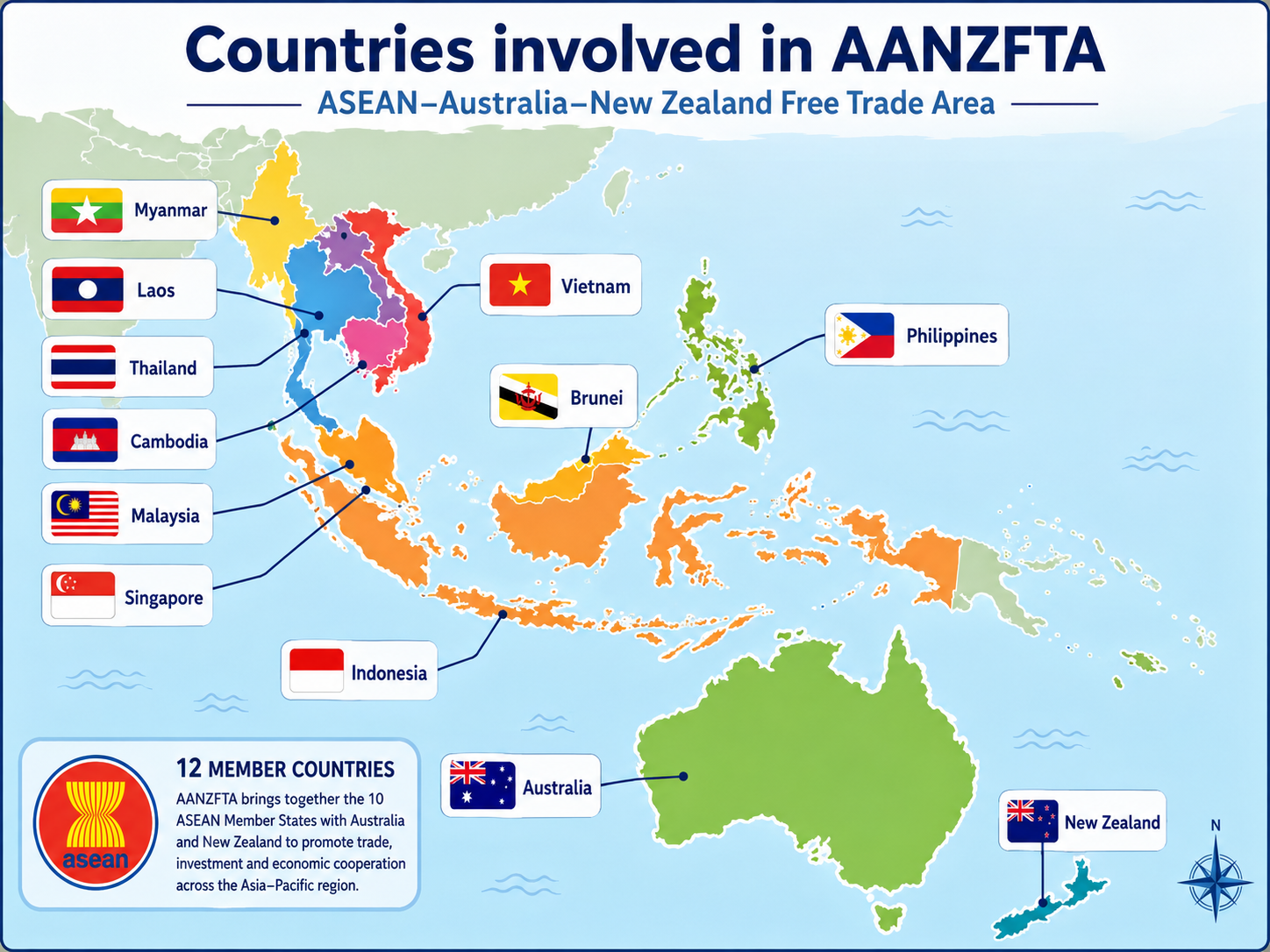
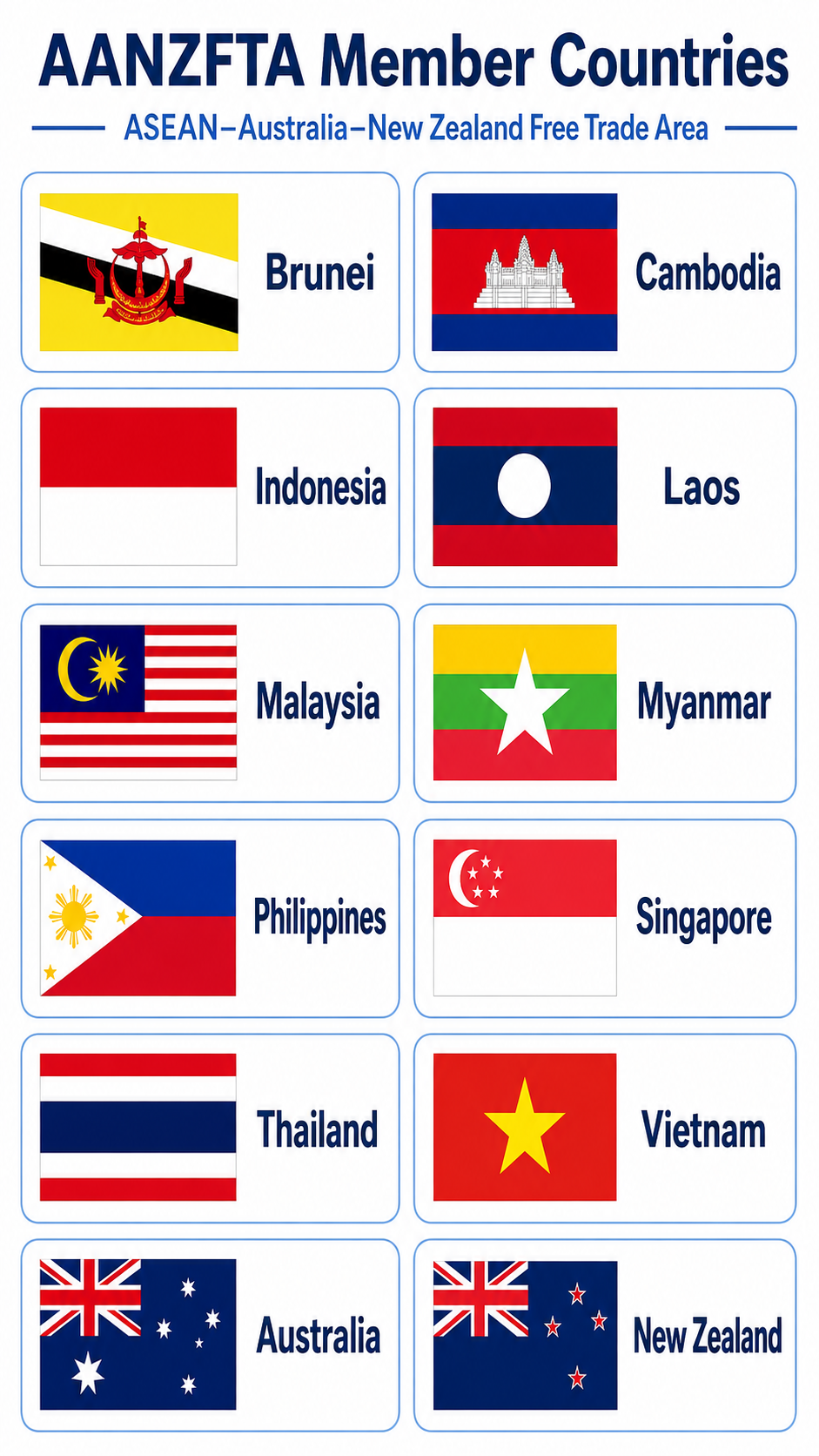
AANZFTA is a free trade agreement between Australia, New Zealand and the ten ASEAN member countries. It entered into force for Australia in January 2010. It is a comprehensive regional agreement that covers goods, services, investment and wider trade-related rules.
Role of AANZFTA
Main role
The role of AANZFTA is to strengthen trade and investment links between Australia, New Zealand and Southeast Asia by reducing barriers and creating more predictable rules for businesses.
For Australian businesses, AANZFTA can improve access to fast-growing ASEAN markets such as Singapore, Malaysia, Thailand, Vietnam, Indonesia and the Philippines.
Business result: Australian exporters may gain access to larger markets, lower tariffs, clearer trade rules and more opportunities to participate in regional supply chains.
Key features of AANZFTA
1. Tariff reduction and elimination for eligible goods
AANZFTA reduces or removes tariffs on a large range of goods traded between Australia, New Zealand and ASEAN member countries. DFAT (Department of Foreign Affairs and Trade) has noted that by 2020, 96% of Australia’s current goods exports were expected to be tariff-free under AANZFTA.
This can apply to many goods exported from Australia into ASEAN markets, including resources, agricultural products, processed food, manufactured goods, machinery, equipment and some clothing or specialised products.
Business result: if an Australian product qualifies for lower tariffs, it may become cheaper for overseas customers and more competitive against products from non-member countries.
2. Rules of origin and proof of origin
Rules of origin are the rules used to decide whether a product is genuinely from an AANZFTA member country. This matters because only goods that meet these rules can receive the lower tariff under the agreement.
A simple example is an Australian beef exporter. If the beef is produced in Australia, it is likely to be considered Australian origin. A more complicated example is clothing, because fabric, buttons, zips and packaging may come from different countries. The business must prove the final product has enough Australian or AANZFTA-region content or has been sufficiently changed during production.
Proof of origin is the paperwork that shows customs authorities the product qualifies. This may include a certificate of origin, supplier documents, production records or evidence showing where the product was made and how it was transformed.
Business result: rules of origin stop non-member countries from simply sending goods through Australia to get lower tariffs, while still allowing genuine Australian exporters to access tariff benefits.
3. Trade in services
AANZFTA covers trade in services, not just physical goods. This can assist Australian businesses in sectors such as education, engineering, accounting, architecture, professional services, health, tourism, logistics, finance and digital services.
The agreement aims to provide more predictable conditions for service suppliers, including rules around market access and treatment of foreign service providers.
Business result: Australian service businesses may find it easier to operate in ASEAN markets because the rules are clearer and some restrictions may be reduced.
4. Investment rules and protections
AANZFTA includes investment rules that aim to create more stable and predictable conditions for investors across member countries.
This is important because Australian businesses may want to establish branches, offices, factories, partnerships or distribution networks in ASEAN markets.
The agreement supports investor confidence by improving transparency and setting clearer expectations around the treatment of investors.
Business result: Australian businesses may feel more confident investing in countries such as Singapore, Vietnam, Malaysia or Thailand because the investment rules are more predictable.
5. Intellectual property and e-commerce rules
AANZFTA includes rules relating to intellectual property and e-commerce. These are important for businesses that rely on brands, designs, software, online platforms, digital services, copyrighted material or confidential business information.
This can be especially useful for Australian businesses selling digital services, online products, software, education services, designs, creative products or branded goods into ASEAN markets.
Business result: the agreement can create more confidence for businesses that trade digitally or rely on protecting their brand, designs or technology overseas.
6. Regional supply chains and economic cooperation
AANZFTA supports regional supply chains by making it easier for businesses to trade inputs, components and finished goods across the region.
For example, a business may source inputs from one member country, manufacture or add value in another, and sell the finished product into another AANZFTA market.
The agreement also promotes economic cooperation, including trade facilitation, customs cooperation and business engagement.
Business result: Australian businesses may have more opportunities to connect with suppliers, customers and production networks across Southeast Asia.
Most useful AANZFTA features for exams
The safest features to remember are:
1. tariff reduction and elimination for eligible goods
2. rules of origin and proof of origin
3. coverage of goods, services and investment
4. intellectual property, e-commerce and economic cooperation
🇦🇺🇳🇿 Australia New Zealand Closer Economic Relations Trade Agreement (ANZCERTA)
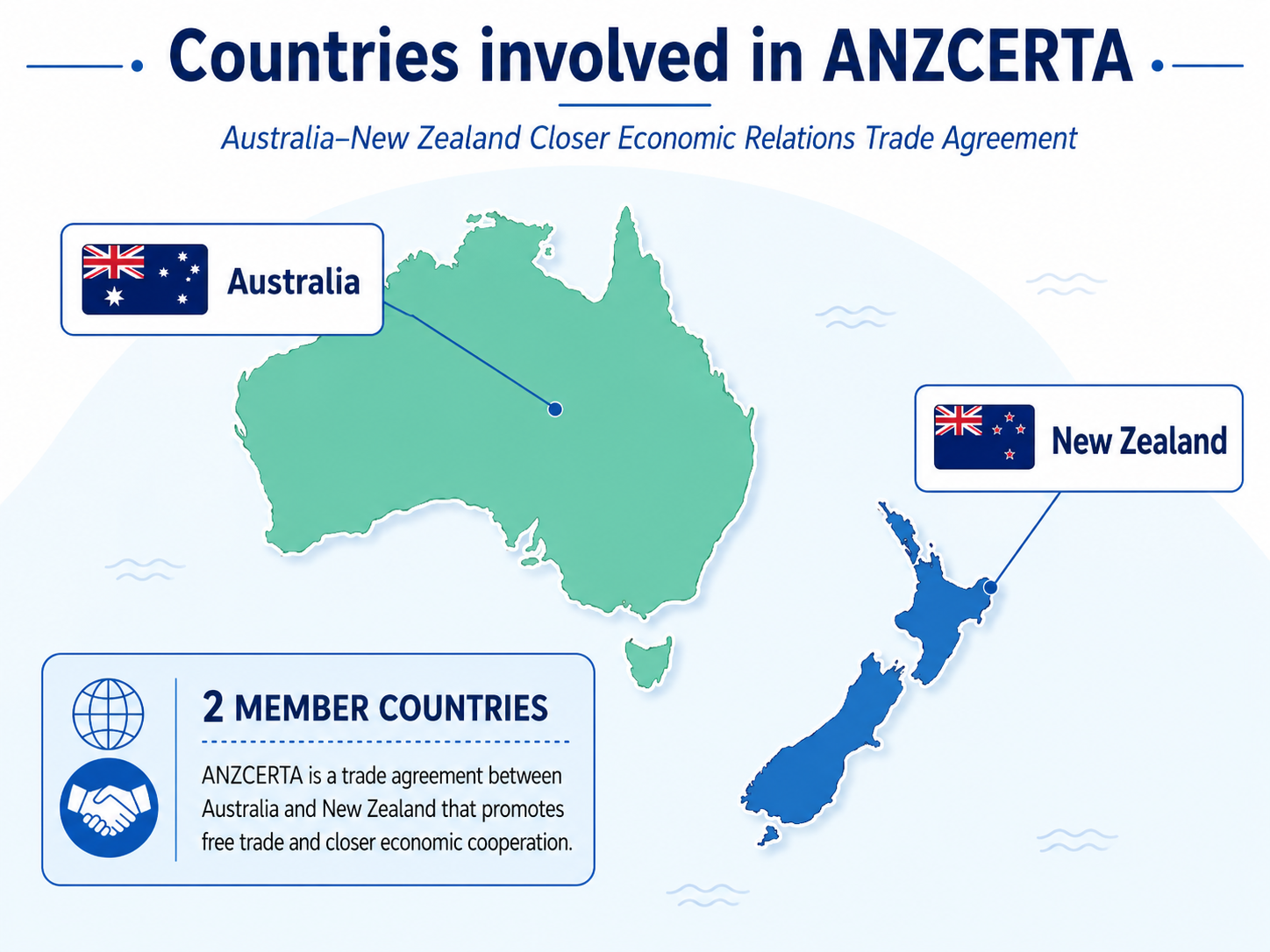
ANZCERTA, also called CER, is Australia’s free trade agreement with New Zealand. It entered into force in 1983 and is one of Australia’s most important and long-standing trade agreements.
ANZCERTA is a bilateral agreement, meaning it is an agreement between two countries: Australia and New Zealand.
Role of ANZCERTA
Main role
The role of ANZCERTA is to strengthen the economic relationship between Australia and New Zealand by removing trade barriers and creating a more integrated trans-Tasman market.
It supports the movement of goods, services and business activity between Australia and New Zealand.
Business result: Australian businesses can trade with New Zealand more easily, face lower costs and enter the New Zealand market with fewer barriers.
Key features of ANZCERTA
1. No tariffs on qualifying goods
ANZCERTA removes tariffs on goods that qualify as Australian or New Zealand goods under the agreement’s rules of origin.
To qualify, the product must be genuinely connected to Australia or New Zealand. It may qualify because it is wholly obtained in Australia or New Zealand, such as agricultural goods, minerals or locally produced raw materials. If the product uses imported parts or materials, it must meet product-specific rules showing it has been sufficiently changed or manufactured in Australia or New Zealand.
Example: Australian wine grown, produced and bottled in Australia may qualify more easily than wine imported from a non-member country and simply relabelled or repackaged in Australia.
Business result: qualifying Australian products can enter New Zealand without tariff costs, making them more price competitive.
2. No quantitative import or export restrictions
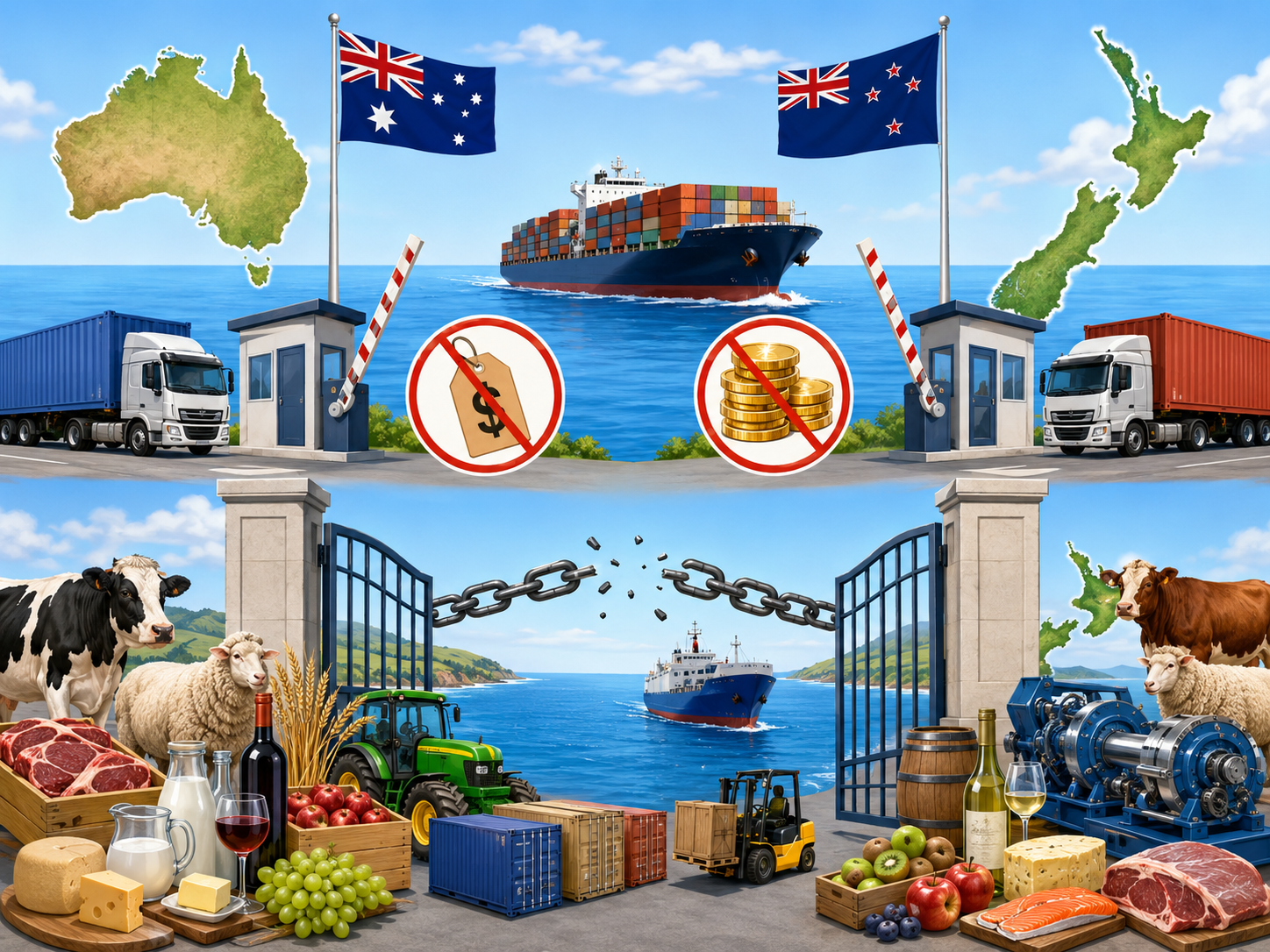
ANZCERTA prohibits quantitative restrictions on qualifying goods traded between Australia and New Zealand. This means member countries cannot generally limit trade through quotas or artificial volume restrictions.
This is important because even if tariffs are removed, quotas could still restrict how much a business can sell. ANZCERTA reduces this barrier.
Business result: an Australian business can expand sales into New Zealand without being limited by a set quantity of eligible goods.
3. Rules of origin
Rules of origin explain which goods count as Australian or New Zealand goods for the purpose of receiving ANZCERTA benefits.
This prevents businesses from importing finished products from a non-member country, making only a minor change in Australia, and then claiming tariff-free access into New Zealand. The product must either be wholly obtained in Australia or New Zealand, or meet specific rules showing it has been substantially transformed.
Business result: rules of origin protect the agreement from being misused while giving genuine Australian and New Zealand producers access to tariff-free trade.
4. Trade in services
ANZCERTA includes trade in services, which helps businesses that provide services between Australia and New Zealand.
This can include areas such as design, consulting, education, tourism, logistics, professional services, online services, finance and business support.
Business result: Australian service businesses may find New Zealand easier to enter because the agreement supports closer services trade between the two countries.
5. Harmonised Trans-Tasman food standards
Australia and New Zealand have closely aligned food regulation through the broader trans-Tasman economic relationship. Many food products are regulated under shared or closely aligned food standards, which can make food trade easier than entering a completely unfamiliar market.
Real-world example: an Australian food business such as Bega, Sanitarium or Carman’s may find New Zealand a more manageable export market because packaging, ingredients, nutrition information and product safety expectations are more familiar than in many other countries.
Business result: food exporters may face lower compliance costs because they are less likely to need major product changes for each market.
6. Mutual recognition and closer business conditions
Mutual recognition arrangements linked to the wider Australia-New Zealand relationship can reduce barriers for goods and occupations. In simple terms, if many goods can be legally sold in Australia, they can often be sold in New Zealand, and vice versa. Many occupations can also have qualifications recognised more easily across the two countries.
This matters for businesses because product approvals, recognised standards and skilled labour can create barriers when expanding overseas. Mutual recognition helps reduce some of these barriers.
Business result: an Australian business opening a New Zealand branch may face fewer set-up barriers, lower compliance costs and smoother operations than entering a less familiar overseas market.

Important exam warning
Do not confuse ANZCERTA with every arrangement between Australia and New Zealand. For example, travel and migration arrangements are part of the wider trans-Tasman relationship, but the strongest ANZCERTA features for BME exams are tariffs, quotas, rules of origin, services trade, food standards and mutual recognition.
Most useful ANZCERTA features for exams
The safest features to remember are:
1. no tariffs on qualifying goods
2. no quantitative import or export restrictions
3. rules of origin
4. trade in services, harmonised food standards or mutual recognition arrangements
🎧 Prefer listening?
If you prefer listening to the content in podcast format:
🎥 Prefer watching?
If you prefer watching the content in video format:
🃏 Flashcards
Card 1 of 8
🎮 Revision Games
💰 BME Millionaire
Climb the money ladder by mastering free trade agreements, AANZFTA and ANZCERTA.
Biz Fact: ANZCERTA is one of Australia’s oldest and deepest trade agreements, helping make New Zealand one of the easiest overseas markets for many Australian businesses to enter.
Past Exam Questions
Use these past exam questions to see how this dotpoint has been assessed. Pay close attention to the command term, the number of marks and whether the question is Section 1 or Section 2.
Section 1 Questions
2018 — Section 1 — Question 4(a) — 2 marks
Context
In Australia, one purpose of the Department of Foreign Affairs and Trade is the establishment of an expanding network of free trade agreements across the world.
4(a): Outline the role of free trade agreements. (2 marks)
Command term focus: Outline
Outline: state the main role of free trade agreements and provide brief clarification.
See the full command term guide here: Command Terms.
4(a) Sample answer
The role of free trade agreements is to reduce barriers to trade between member countries, such as tariffs, quotas and other restrictions. This encourages international trade by making it easier and cheaper for businesses to export, import and invest across those countries.
2021 — Section 1 — Question 4(a) — 3 marks
Context
A free trade agreement (FTA) is a treaty between two or more countries. As of 2021, Australia has 15 FTAs in force.
4(a): One of Australia’s FTAs is the ASEAN-Australia-New Zealand Free Trade Agreement (AANZFTA). State three features of the AANZFTA. (3 marks)
One:
Two:
Three:
Command term focus: State
State: give three direct features of AANZFTA. No explanation is required.
See the full command term guide here: Command Terms.
4(a) Sample answer
One: AANZFTA reduces or eliminates tariffs on many goods traded between Australia, New Zealand and ASEAN member countries.
Two: AANZFTA covers trade in goods, services and investment.
Three: AANZFTA includes rules of origin, which determine whether goods qualify for preferential tariff treatment.
2024 — Section 1 — Question 2(a) — 3 marks
Context
Participation in global markets offers Australian businesses opportunities for growth but also exposes the businesses to challenges that must be navigated.
2(a): Identify three features of the ASEAN-Australia-New Zealand Free Trade Agreement (AANZFTA). (3 marks)
One:
Two:
Three:
Command term focus: Identify
Identify: name three features of AANZFTA directly.
See the full command term guide here: Command Terms.
2(a) Sample answer
One: Tariff reduction and elimination between member countries.
Two: Rules of origin for goods seeking preferential tariff treatment.
Three: Coverage of goods, services and investment between Australia, New Zealand and ASEAN member countries.
Section 2 Questions
2018 — Section 2 — Question 8(c) — 5 marks
Case study / context
Watch Out Clothing, located in Western Australia, is a very successful clothing business that commenced trading and enjoyed significant growth during the mining expansion. Its business vision is to produce innovative, high quality clothing and personal protective equipment. Its range of clothing includes high-vision safety shirts, jackets and work boots at reasonable prices. Innovations in its clothing range include breathable fibres, quick drying fabrics and flame-resistant technology.
The owners are considering expanding into the Asian market as a result of the downturn of the mining industry in Western Australia. Singapore’s construction industry has experienced a strong growth period and has similar occupational safety and health laws that require workers to wear personal protective clothing. Watch Out Clothing is aware of the long-standing business relationships between Singapore and Australia. To ensure the quality of the innovative products manufactured by Watch Out Clothing, operations would remain in Australia.
Referring to the source information and your own knowledge, prepare a report or an essay addressing the following:
8(c): Explain one feature of the ASEAN-Australia-New Zealand Free Trade Agreement and how this feature could benefit Watch Out Clothing. (5 marks)
Command term focus: Explain
Explain: show cause and effect by linking one AANZFTA feature to a benefit for Watch Out Clothing. Section 2 requires application.
See the full command term guide here: Command Terms.
8(c) Sample answer
One feature of AANZFTA is tariff reduction or elimination on eligible goods traded between Australia and ASEAN member countries, including Singapore. This could benefit Watch Out Clothing because its high-visibility safety shirts, jackets and work boots may be cheaper for Singaporean construction businesses to import if the products meet the rules of origin. This would make Watch Out’s Australian-made protective clothing more price competitive in Singapore while still allowing production to remain in Australia. As a result, Watch Out may increase sales, reduce its reliance on the Western Australian mining industry and expand into the growing Asian construction market.
2019 — Section 2 — Question 8(a) — 3 marks
Case study / context
Utterly Uggalicious is an Australian business that sells sheepskin boots. Currently the wool for the boots is sourced from Australia and New Zealand to ensure the highest-quality materials are used. The boots are manufactured in Australia and sold locally.
Utterly Uggalicious has been operating for five years and has experienced a huge increase in the demand for its products. It believes this is due to their high quality and ethical production policies.
As the business has become more and more popular, Utterly Uggalicious has had to significantly increase production, employ more staff and look for a bigger manufacturing location. While the business is keen to continue to use Australian and New Zealand materials, it is considering the advantages of moving its production offshore. Hence, the business has started to research the benefits of moving its wool processing and manufacturing to Asia.
In making this strategic decision, the business must also consider the negative human and environmental factors that may impact Utterly Uggalicious. Currently, the business has a corporate social responsibility strategy in place; however, a move to Asia could hinder the business’ ability to follow this strategy.
8(a): State three features of the Australia New Zealand Closer Economic Relations Trade Agreement (ANZCERTA). (3 marks)
Command term focus: State
State: give three direct features of ANZCERTA. No explanation is required.
See the full command term guide here: Command Terms.
8(a) Sample answer
One: Goods that meet ANZCERTA rules of origin can be traded between Australia and New Zealand free of tariffs.
Two: ANZCERTA removes quantitative restrictions, such as quotas, on qualifying goods traded between Australia and New Zealand.
Three: ANZCERTA includes trade in services between Australia and New Zealand.
2022 — Section 2 — Question 8(c) — 4 marks
Case study / context
Starting in 2010 as a café in Perth, Jensenze has since grown to five branches around the metropolitan area. Owners Kath and Lao attribute the success of their business to the growing demand for their organic fruit juices. Jensenze has been producing these juices from locally sourced ingredients and Kath’s own recipes. Jensenze has also developed a website for customers to order their products online.
The popularity of these products has increased in recent years as a result of many of their customers switching to healthier diets and lifestyles. Kath says “there has been so much in the news regarding the health benefits of organic fruit juices. The ingredients used in the production of our fruit juices are grown with no pesticides. More importantly, organic juices are a rich source of antioxidants and Vitamins A and C. The antioxidants play an important role in strengthening bones and promoting better vision. Our customers are totally on board with living a healthy lifestyle and are reaping the benefits.” Lao adds “Over the past two years, we have seen an increase in online orders for our fruit juices and, given the success and growth of our business, we are now thinking of selling our products to a global market”.
Kath and Lao met while at university in New Zealand and often travel back to visit friends. The samples of their organic juices they have taken with them on these visits have been well received. During these visits, Kath and Lao have also noticed a lack of organic fruit juices on the market and have been wondering if they should consider filling this gap. Their friends often ask them if they would set up a café in New Zealand, mentioning that Australia has an ongoing free trade agreement with the country. After giving it much thought, Kath and Lao are ready to venture into the New Zealand market to sell their organic fruit juices. At this stage, they are unsure if they should begin selling their products online or start up their first café in New Zealand.
Referring to the case study and your own knowledge, answer the questions below.
8(c): Describe two features of the Australia New Zealand Closer Economic Relations Trade Agreement (ANZCERTA). (4 marks)
Command term focus: Describe
Describe: give the main characteristics of two ANZCERTA features. Section 2 requires application to Jensenze.
See the full command term guide here: Command Terms.
8(c) Sample answer
One feature of ANZCERTA is that qualifying goods can be traded between Australia and New Zealand without tariffs. This could help Jensenze because its Australian-made organic fruit juices may be cheaper to sell into New Zealand if they meet the rules of origin, making online sales or café supply more affordable.
A second feature is the close alignment of Australia and New Zealand food standards through the broader trans-Tasman economic relationship. This could reduce compliance costs for Jensenze because it may not need to significantly change its organic juice ingredients, labelling or product standards before selling into New Zealand.
2025 — Section 2 — Question 8(a) — 5 marks
Case study / context
Aura and Ash founded their online greeting card business, AuraAsh Designs in Perth in 2022, offering both custom-made and general greeting cards for all occasions. The business quickly gained popularity due to its unique designs and personalised options, attracting a loyal customer base. With the success of their online platform, Aura and Ash are now looking to expand their operations into the New Zealand market. They are aware of the benefits provided by Australia’s free trade agreement with New Zealand, which could facilitate smoother entry into the New Zealand market through reduced trade barriers.
Aura and Ash are planning to open a physical branch in New Zealand after recognising the potential for the business’ future growth. This branch will act as a local base for production and distribution in New Zealand. This will ensure faster delivery times for their New Zealand customers. Aura and Ash intend to hire a small team of local employees, who understand the market dynamics and customer preferences, to manage operations at the New Zealand branch. This team will handle everything from production to customer support and help establish a strong presence for AuraAsh Designs.
Technology will play an important role in AuraAsh Designs’ expansion into New Zealand. Aura and Ash are aiming to use their existing online platform to reach a wider audience and simplify operations. Aura and Ash plan to use innovative e-commerce software to manage inventory, process orders and track shipments efficiently. Additionally, the business will use social media and digital marketing strategies to promote their brand and engage with customers in New Zealand to build a strong online community. However, Aura and Ash are aware that they will need to address security and privacy issues to protect customer data and ensure compliance with local regulations. They aim to implement strong cybersecurity measures and comprehensive privacy policies.
By combining the benefits of the free trade agreement, a local physical presence and advanced technology, Aura and Ash are well positioned to successfully expand their greeting card business into the New Zealand market. They hope their strategic approach will not only enhance the business’ operational efficiency, but also provide a personalised and smooth experience for their new customers.
8(a): Identify the free trade agreement that Australia solely has with New Zealand and outline two features of this agreement. (5 marks)
Command term focus: Identify and Outline
Identify and Outline: identify ANZCERTA, then state two features and briefly clarify them. Section 2 requires application to AuraAsh Designs.
See the full command term guide here: Command Terms.
8(a) Sample answer
The free trade agreement Australia solely has with New Zealand is the Australia New Zealand Closer Economic Relations Trade Agreement, or ANZCERTA.
One feature is that qualifying goods can be traded between Australia and New Zealand free of tariffs and quantitative restrictions. This could help AuraAsh Designs because greeting cards or related products that meet the rules of origin may enter New Zealand with fewer trade barriers, making it cheaper and easier to supply New Zealand customers.
A second feature is that ANZCERTA supports closer trade in services and a more integrated trans-Tasman business environment. This could help AuraAsh Designs because the business plans to use online platforms, digital marketing, inventory systems and a New Zealand branch, so clearer trans-Tasman trade rules may support smoother operations and customer service in New Zealand.