
U3.07 — Benefits and Challenges to Australian-Owned Businesses as a Result of FTAs
Overview
Dotpoint 7: benefits and challenges to Australian-owned businesses as a result of free trade agreements.
Free trade agreements can create major opportunities for Australian-owned businesses, but they can also create pressure. The same agreement that helps one business export more easily may expose another business to stronger overseas competition.
This dotpoint focuses on:
- benefits — lower trade costs, larger markets, cheaper inputs, more export opportunities and greater business certainty
- challenges — increased foreign competition, lower profit margins, adjustment costs, compliance requirements and exposure to overseas risks
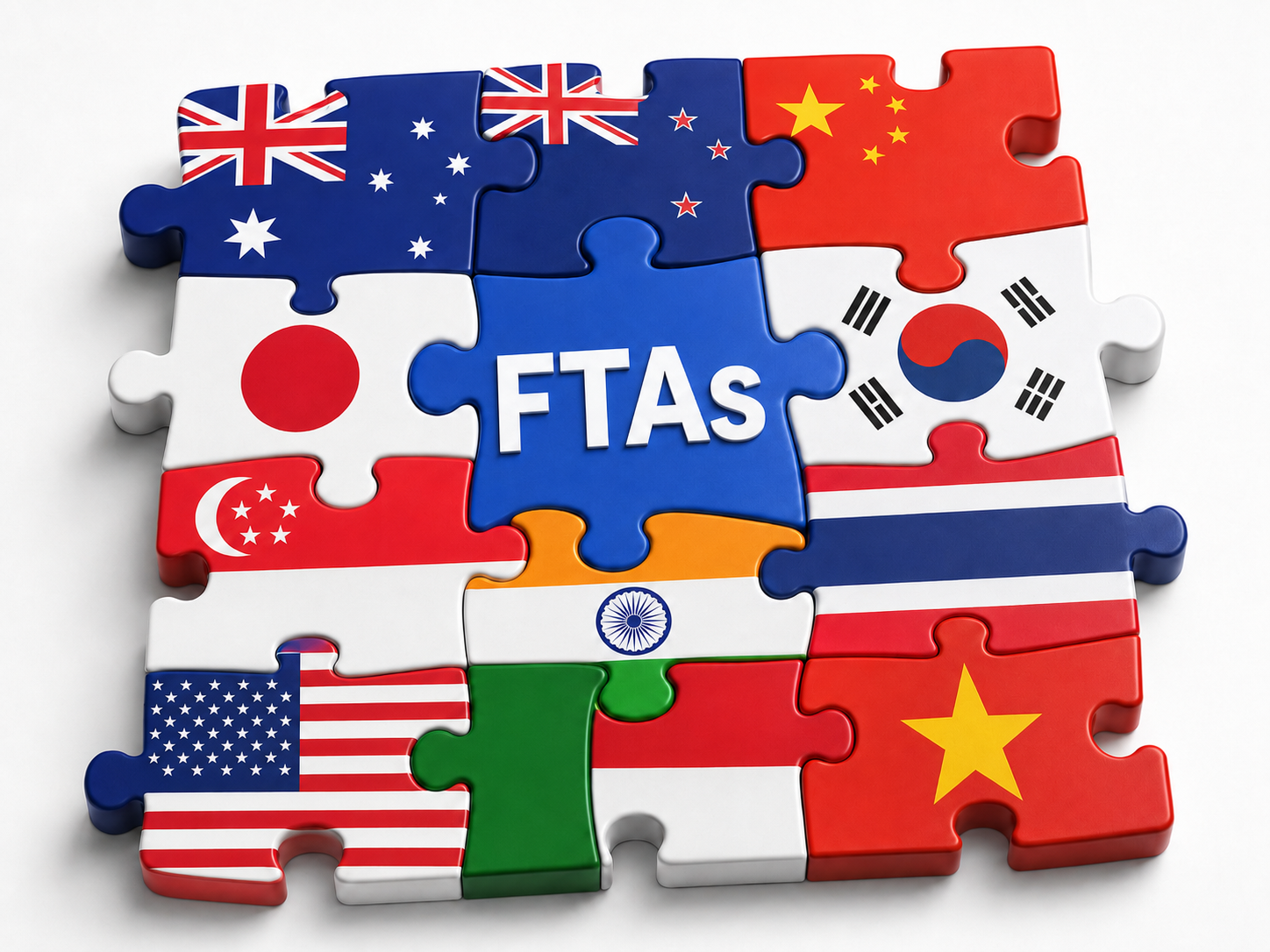
✅ Benefits of FTAs for Australian-owned businesses
FTAs benefit Australian-owned businesses when they reduce trade barriers and make international markets easier or cheaper to access. The strongest answers explain how the FTA feature creates a business outcome.
1. Access to larger overseas markets
FTAs can make it easier for Australian-owned businesses to sell into member countries by reducing barriers and improving market access.
Business result: the business can reach more customers, increase sales revenue and reduce reliance on the Australian domestic market.
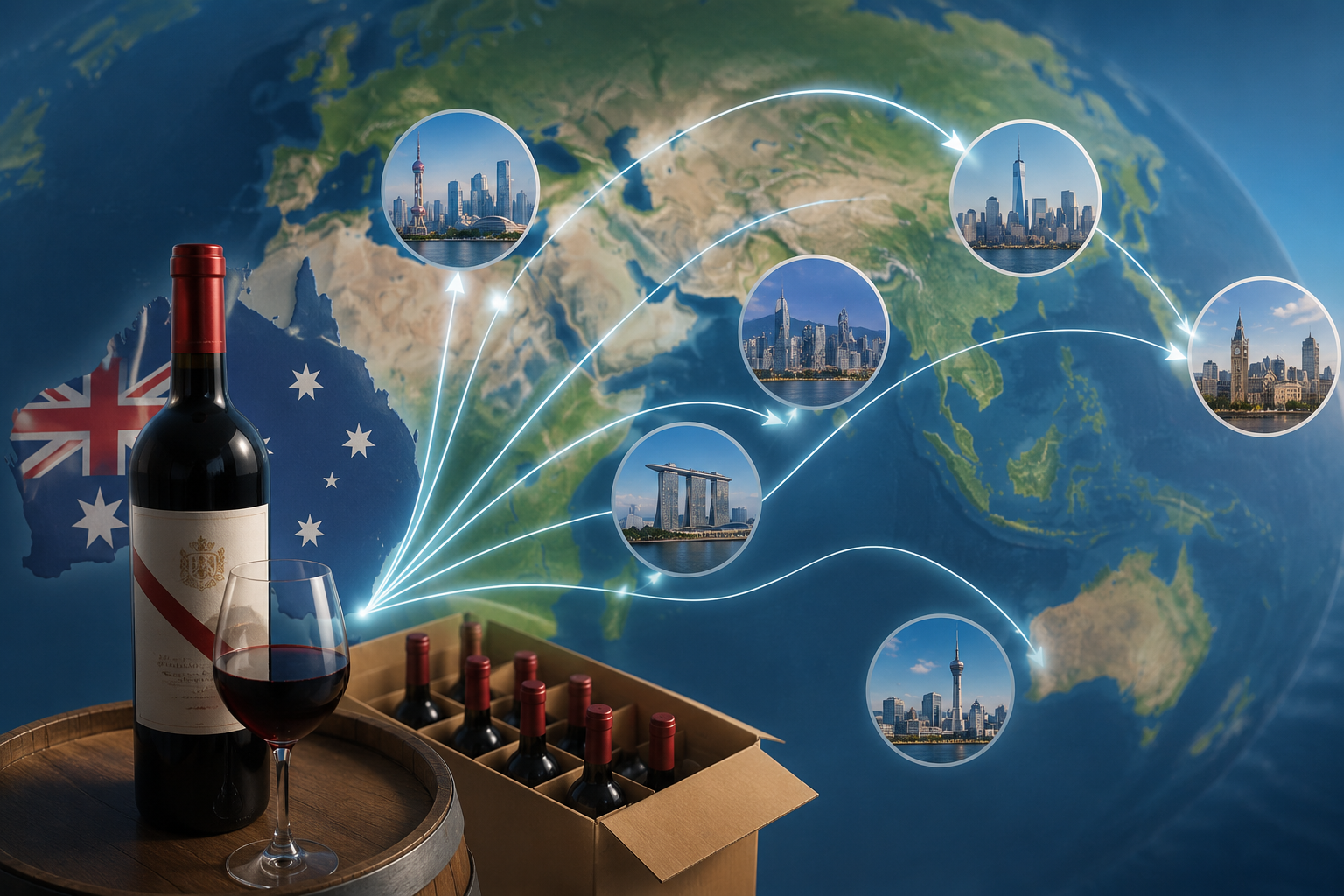
Real-world example: Treasury Wine Estates, owner of Penfolds, can benefit from improved trade access when Australian wine becomes easier to sell into overseas FTA markets. Larger market access gives premium Australian wine brands more potential customers beyond Australia.
2. Lower tariffs make exports more price competitive
When tariffs are reduced or removed, Australian exports may become cheaper for overseas customers to buy.
Business result: the business may be able to compete more effectively on price, increase demand and grow export sales.
Real-world example: Blundstone exports Australian-designed boots to many international markets. Lower tariffs under relevant FTAs can make exported footwear more price competitive against overseas brands.
3. Cheaper imported inputs and materials
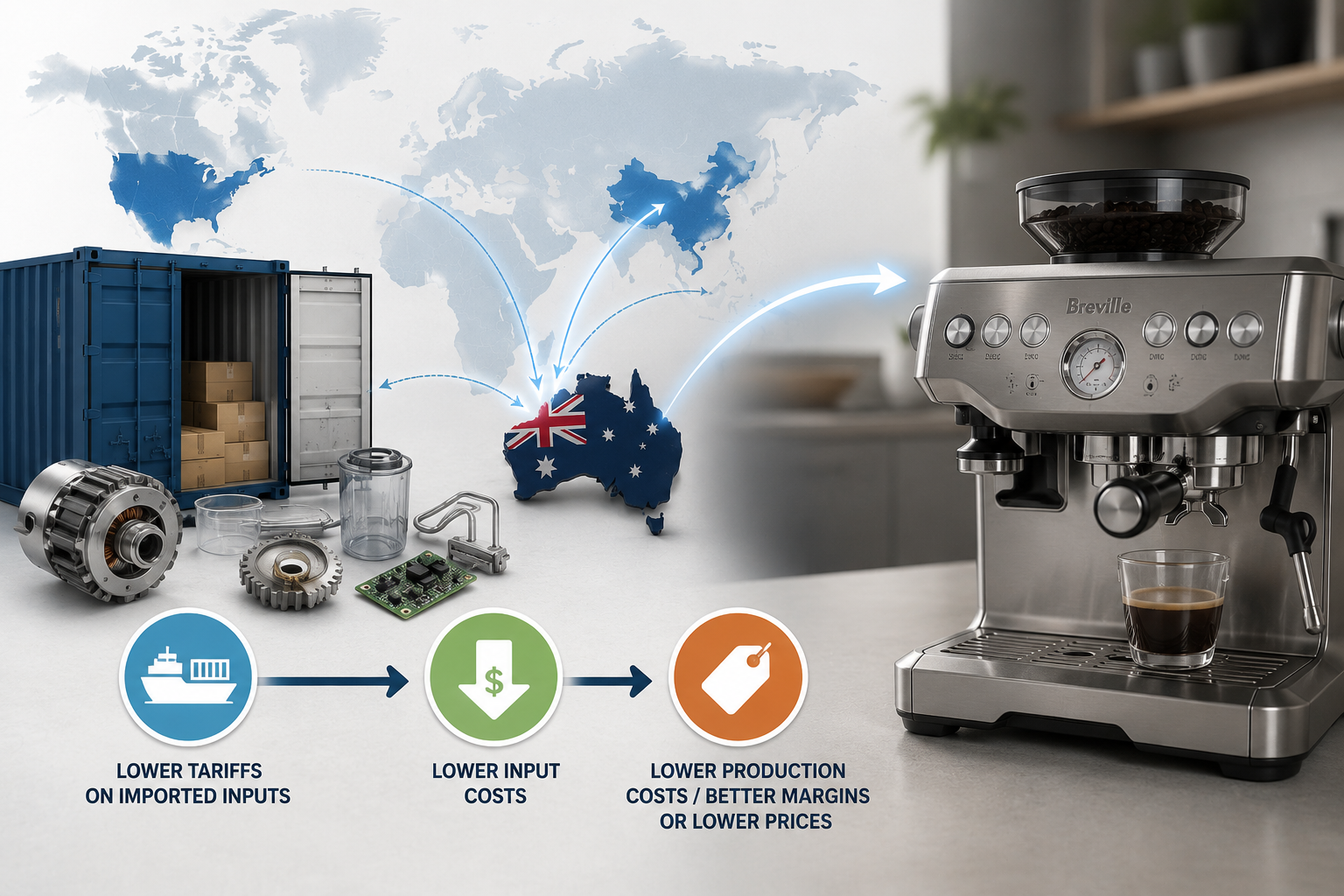
FTAs can also reduce the cost of imported inputs, machinery, components or raw materials used by Australian-owned businesses.
Business result: lower input costs can reduce production costs, improve profit margins or allow the business to offer lower prices.
Real-world example: Breville designs and sells appliances globally. If eligible imported parts, components or accessories are cheaper due to lower trade barriers, this can reduce input costs and support more competitive pricing.
4. Economies of scale
FTAs can help businesses sell to a larger customer base. If demand increases, the business may produce or sell more units.
Business result: fixed costs such as rent, equipment, marketing and management can be spread across more units, reducing average costs.
Real-world example: Blackmores has historically targeted Asian health and vitamin markets. Stronger access to overseas customers can support larger production runs and help spread marketing, packaging and management costs across more sales.
5. Market diversification and reduced risk
FTAs can help businesses enter multiple overseas markets rather than relying only on Australia.
Business result: if demand falls in one market, the business may still earn revenue from another market.
Real-world example: A2 Milk built major sales in overseas infant formula and dairy markets. Selling across more than one country can reduce reliance on a single domestic market, although it also creates exposure to overseas market changes.

6. Greater certainty for services, investment and online business
Modern FTAs often include rules for services, investment, e-commerce and intellectual property. This can create clearer conditions for businesses operating overseas.
Business result: the business may feel more confident investing, selling online, protecting its brand or establishing a branch overseas.
Real-world example: Canva is an Australian-founded technology business with global users. Clearer digital trade, services and intellectual property rules can support businesses that rely on online platforms, brand protection and cross-border digital services.
How to write a benefit in an exam
Do not just write “FTAs increase trade.” Be specific.
Strong structure: FTA feature → lower cost or better market access → business result.
Example: “A benefit is lower tariffs. This makes the Australian product cheaper for overseas customers, which may increase demand, sales revenue and export growth.”
⚠️ Challenges of FTAs for Australian-owned businesses
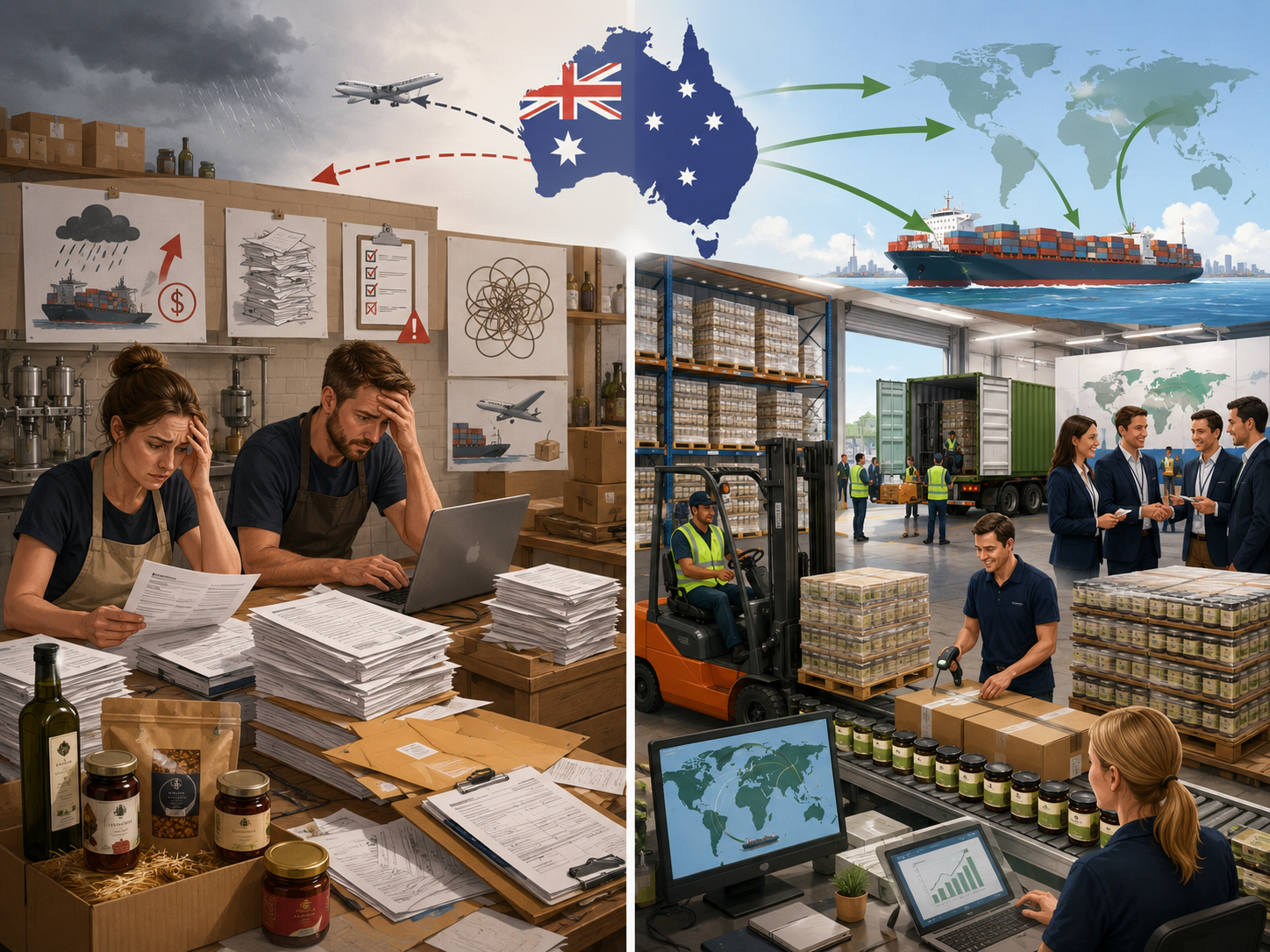
FTAs can also create challenges for Australian-owned businesses. These challenges usually occur when trade barriers fall and businesses face stronger competition, more compliance requirements or greater exposure to overseas conditions.
1. Increased foreign competition
FTAs can make it easier for overseas businesses to sell into Australia. This means Australian-owned businesses may compete with cheaper or better-known international brands.
Business result: local businesses may lose customers, sales revenue and market share.
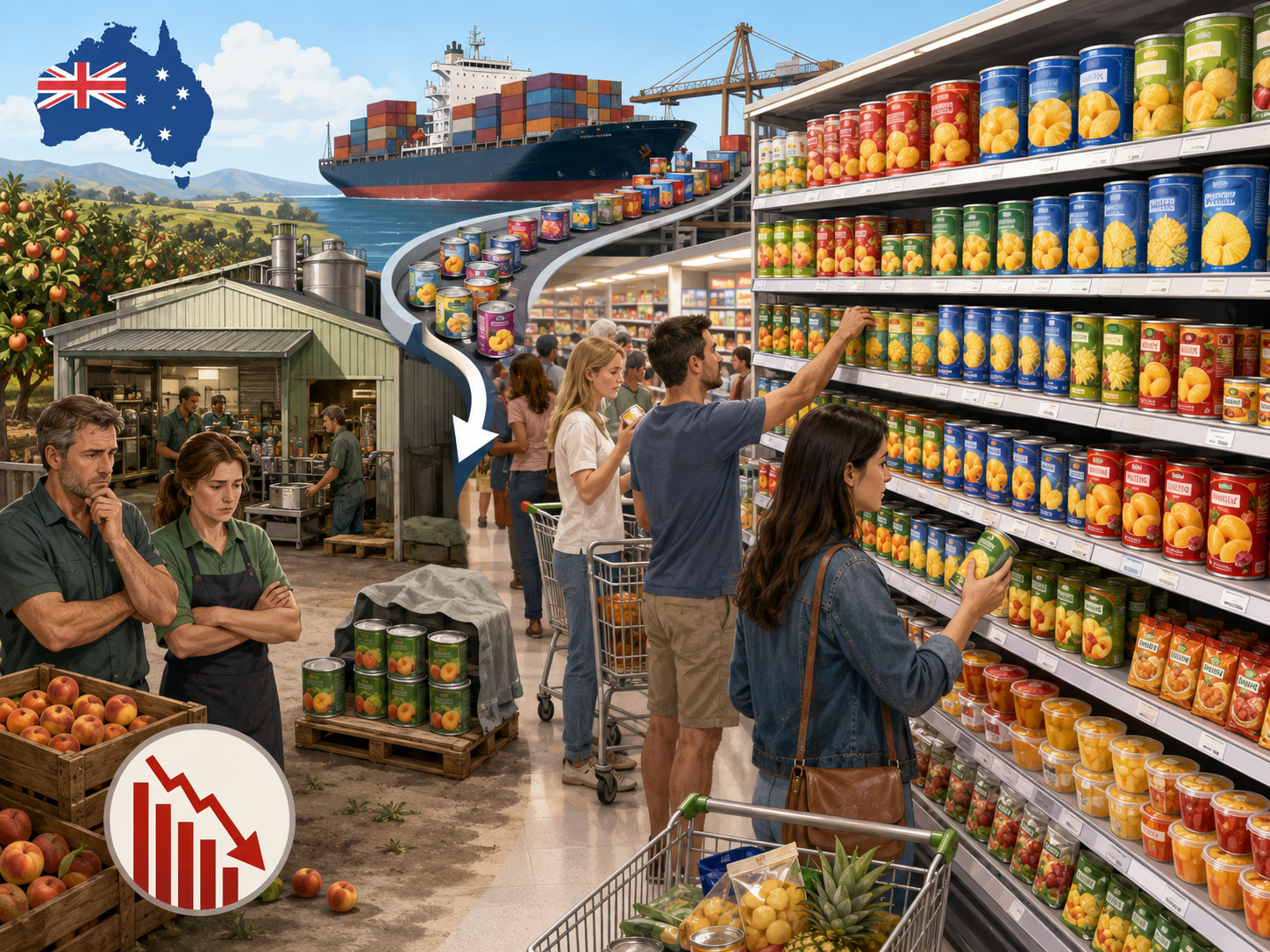
Real-world example: SPC has faced strong competition from cheaper imported canned fruit and food products. When imports become easier or cheaper, Australian food manufacturers may struggle to compete on price.
2. Pressure on prices and profit margins
When cheaper imports enter the market, Australian-owned businesses may need to lower their prices to stay competitive.
Business result: lower prices can reduce profit margins, especially for smaller businesses with higher labour, rent or production costs.
Real-world example: Australian clothing and footwear businesses often compete against lower-cost imported products. This can put pressure on local brands to discount, outsource or reposition as premium products.
3. Structural change and job losses
Some Australian industries may find it difficult to compete once trade barriers are reduced. Businesses may need to restructure, reduce staff, close parts of the business or invest in new technology.
Business result: this can lead to retraining costs, redundancy costs, lower morale and short-term disruption.
Real-world example: Holden, Ford and Toyota ended large-scale car manufacturing in Australia after years of pressure from global competition, high local production costs and changing market conditions. This shows how exposed industries may struggle in a more open trading environment.

4. Rules of origin and compliance costs
To access FTA benefits, businesses often need to prove their products meet rules of origin. This can involve paperwork, certificates, supplier records and product-specific rules.
Business result: compliance can increase administration costs and may be difficult for small businesses with limited staff.
Real-world example: Cotton On sources and sells products across international supply chains. For clothing businesses, proving where fabric, zips, buttons, labels and final assembly occurred can create extra compliance work when trying to access FTA benefits.
5. Exposure to overseas economic conditions
FTAs can encourage businesses to rely more heavily on overseas customers, suppliers and markets. This can create risks if overseas demand falls, exchange rates move or supply chains are disrupted.
Business result: the business may face unstable revenue, higher costs or delays.
Real-world example: Australian wine exporters experienced the risk of heavy reliance on China when trade restrictions disrupted sales. This shows that overseas market access can be valuable, but concentrated export exposure can create major risk.
6. Uneven benefits for small businesses
Larger businesses may have more resources to understand trade rules, complete documentation, attend trade events and establish overseas operations.
Business result: small Australian-owned businesses may not fully benefit from FTAs if they lack export knowledge, finance or staff.
Real-world example: a small Australian specialty food producer may have a strong product but still struggle with overseas labelling rules, freight costs, distributor negotiations and customs paperwork compared with larger exporters such as Bega or Treasury Wine Estates.
How to write a challenge in an exam
Do not just write “there is more competition.” Explain the business effect.
Strong structure: FTA feature → increased competition or compliance requirement → business result.
Example: “A challenge is increased foreign competition. This may force the Australian business to lower prices, which can reduce profit margins and market share.”
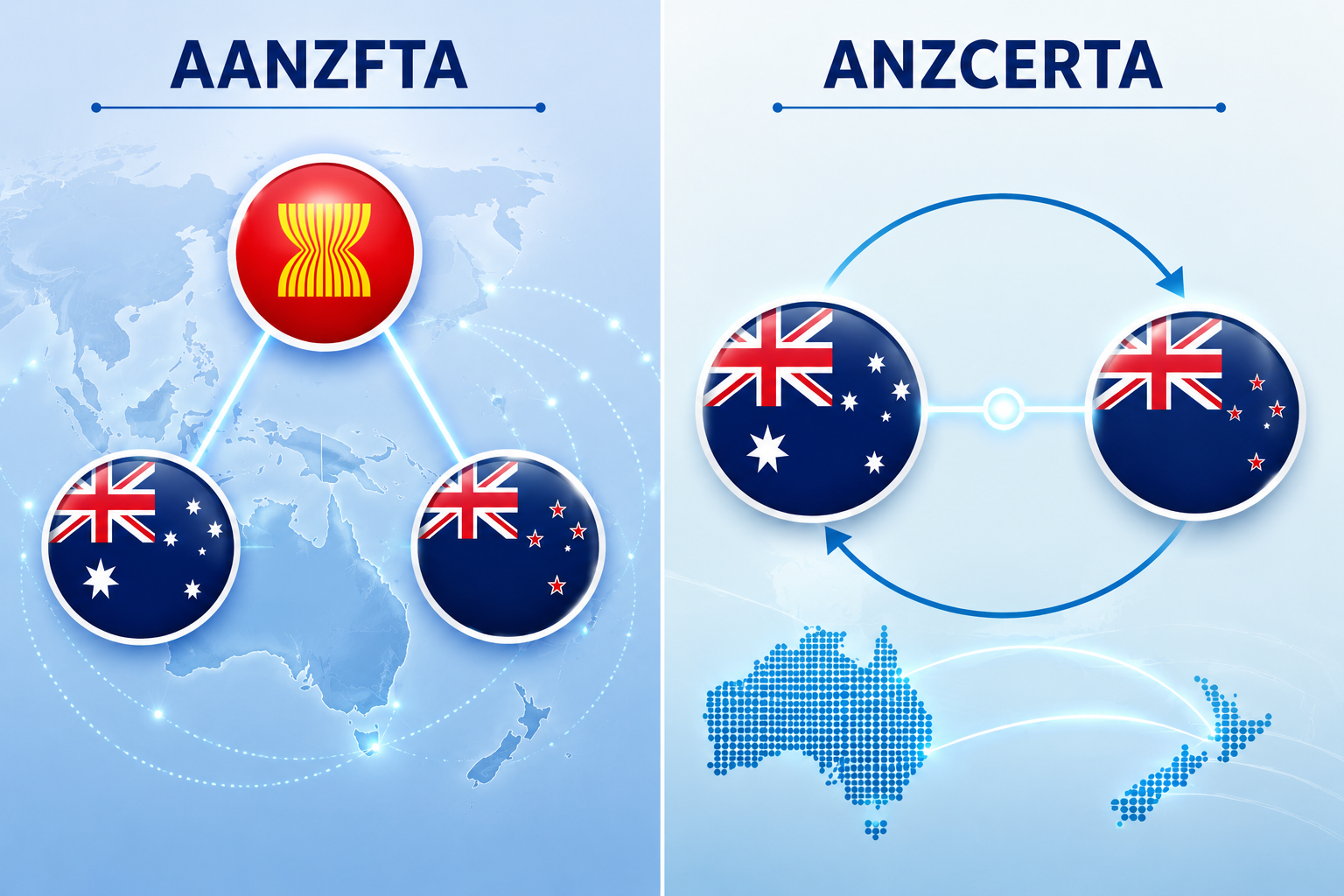
🌏 Specific benefits and challenges of AANZFTA and ANZCERTA
When a question refers to a specific FTA, the best answers should use specific features of that agreement rather than generic free trade points.
AANZFTA: benefits and challenges
Benefits:
- Access to ASEAN markets, including Singapore, Malaysia, Thailand, Vietnam, Indonesia and the Philippines.
- Tariff reduction and elimination on eligible Australian exports.
- Improved opportunities for Australian service providers in areas such as education, tourism, finance, engineering and professional services.
- Support for regional supply chains, including sourcing inputs or components from member countries.
Challenges:
- Increased competition from lower-cost ASEAN producers.
- Rules of origin can create paperwork and compliance costs.
- Australian businesses may need to understand different legal systems, languages, cultures and business practices across ASEAN countries.
- Exposure to overseas risks such as exchange-rate changes, shipping delays and political or economic instability.
ANZCERTA: benefits and challenges
Benefits:
- No tariffs on qualifying goods traded between Australia and New Zealand.
- No quantitative import or export restrictions on qualifying goods.
- New Zealand is a nearby and culturally familiar market for many Australian-owned businesses.
- Closer food standards and mutual recognition arrangements can reduce technical barriers to trade.
Challenges:
- New Zealand businesses can also enter Australia more easily, increasing competition.
- Australian businesses may still need to meet rules of origin before receiving tariff benefits.
- New Zealand is smaller than many Asian, European or North American markets, limiting potential growth.
- Expansion still involves costs such as freight, staffing, marketing, rent, legal advice and local customer support.
🎧 Prefer listening?
If you prefer listening to the content in podcast format:
🎥 Prefer watching?
If you prefer watching the content in video format:
🃏 Flashcards
Card 1 of 8
🎮 Revision Games
💰 BME Millionaire
Climb the prize ladder. Use your lifelines wisely.
👔 Business Boss
Make 10 FTA decisions. Balance market access, costs, competition, compliance and risk.
⚡ 60 Second Showdown
A varied 60-second challenge covering the major benefits and challenges created by FTAs.
Biz Fact: Australia currently has 19 free trade agreements covering more than 20 countries.
Past Exam Questions
Use these past exam questions to see how this dotpoint has been assessed. Pay close attention to the command term, the number of marks and whether the question is Section 1 or Section 2.
Section 1 Questions
2018 — Section 1 — Question 4(b) — 4 marks
Context
In Australia, one purpose of the Department of Foreign Affairs and Trade is the establishment of an expanding network of free trade agreements across the world.
4(b): Describe a benefit and a challenge that free trade agreements might have for Australian-owned businesses. (4 marks)
Benefit:
Challenge:
Command term focus: Describe
Describe: give the main characteristics of one benefit and one challenge, including the business effect.
See the full command term guide here: Command Terms.
4(b) Sample answer
Benefit: A benefit of FTAs is that they can reduce tariffs on Australian exports. This can make Australian-owned businesses more price competitive in overseas markets, increasing sales and export revenue.
Challenge: A challenge is increased foreign competition. If cheaper imported products enter Australia, Australian-owned businesses may lose customers, reduce prices and experience lower profit margins.
2021 — Section 1 — Question 4(b) — 4 marks
Context
A free trade agreement (FTA) is a treaty between two or more countries. As of 2021, Australia has 15 FTAs in force.
4(b): Describe two challenges to Australian owned businesses as a result of FTAs. (4 marks)
One:
Two:
Command term focus: Describe
Describe: give the main characteristics of two separate challenges and the effect each may have on an Australian-owned business.
See the full command term guide here: Command Terms.
4(b) Sample answer
One: One challenge is increased foreign competition. FTAs can make it easier for overseas businesses to sell into Australia, which may reduce sales and market share for Australian-owned businesses.
Two: Another challenge is rules of origin and compliance costs. Australian businesses may need to complete paperwork and prove their products qualify for FTA benefits, which can increase administration costs and make exporting more difficult.
2024 — Section 1 — Question 2(b) — 4 marks
Context
Participation in global markets offers Australian businesses opportunities for growth but also exposes the businesses to challenges that must be navigated.
2(b): Outline, using an example for each, one benefit and one challenge to Australian-owned businesses as a result of free trade agreements. (4 marks)
Benefit:
Challenge:
Command term focus: Outline
Outline: state one benefit and one challenge, briefly clarify each, and include an example for both.
See the full command term guide here: Command Terms.
2(b) Sample answer
Benefit: A benefit is access to larger overseas markets. For example, AANZFTA can help an Australian protective clothing business sell into ASEAN markets such as Singapore, increasing potential sales revenue.
Challenge: A challenge is increased foreign competition. For example, Australian clothing manufacturers may face cheaper imports from lower-cost overseas producers, reducing local sales and profit margins.
Section 2 Questions
2017 — Section 2 — Question 9 — 4 marks
Case study / context
Amy Wong plans to grow her business by importing quality silk products from China. Silk is used to manufacture a wide range of products. Amy has undertaken market research and identified the silk-bedding market, including silk quilts and pillows, as having significant growth potential.
While popular for centuries in China, her research shows that silk-bedding products are now becoming better known in Western markets.
The increasing popularity of silk and its associated reputation has developed due to a combination of factors, including its excellent thermal properties, light weight, resistance to insects and natural hypoallergenic properties. Also, silk does not require any processing chemicals during its manufacturing process. Consequently, it is considered an environmentally-friendly product.
Amy thinks that growth in Western markets, customer demand for natural products, introduction of free trade agreements (FTAs) and the increase in production of quality silk products from China provides the basis for a successful global business. Given the scope of potential changes to her current business, Amy may need to review her strategic plan.
Prepare a short report or essay for Amy, addressing the following points:
9: Describe one benefit and one challenge for Australian businesses as a result of free trade agreements (FTAs). (4 marks)
Command term focus: Describe
Describe: give the main characteristics of one benefit and one challenge. Section 2 requires application to Amy Wong.
See the full command term guide here: Command Terms.
9 Sample answer
One benefit of FTAs is that they can reduce the cost of importing goods. This could benefit Amy Wong because silk quilts and pillows imported from China may become cheaper to source if trade barriers are reduced. This could lower Amy’s purchasing costs and allow her to sell silk bedding at a more competitive price in Australia.
One challenge is increased foreign competition. If FTAs make it easier for other businesses to import silk bedding from China, Amy may face more competitors selling similar natural silk products. This could reduce her market share or force her to lower prices, reducing profit margins.
2022 — Section 2 — Question 8(d) — 8 marks
Case study / context
Starting in 2010 as a café in Perth, Jensenze has since grown to five branches around the metropolitan area. Owners Kath and Lao attribute the success of their business to the growing demand for their organic fruit juices. Jensenze has been producing these juices from locally sourced ingredients and Kath’s own recipes. Jensenze has also developed a website for customers to order their products online.
The popularity of these products has increased in recent years as a result of many of their customers switching to healthier diets and lifestyles. Kath says “there has been so much in the news regarding the health benefits of organic fruit juices. The ingredients used in the production of our fruit juices are grown with no pesticides. More importantly, organic juices are a rich source of antioxidants and Vitamins A and C. The antioxidants play an important role in strengthening bones and promoting better vision. Our customers are totally on board with living a healthy lifestyle and are reaping the benefits.” Lao adds “Over the past two years, we have seen an increase in online orders for our fruit juices and, given the success and growth of our business, we are now thinking of selling our products to a global market”.
Kath and Lao met while at university in New Zealand and often travel back to visit friends. The samples of their organic juices they have taken with them on these visits have been well received. During these visits, Kath and Lao have also noticed a lack of organic fruit juices on the market and have been wondering if they should consider filling this gap. Their friends often ask them if they would set up a café in New Zealand, mentioning that Australia has an ongoing free trade agreement with the country. After giving it much thought, Kath and Lao are ready to venture into the New Zealand market to sell their organic fruit juices. At this stage, they are unsure if they should begin selling their products online or start up their first café in New Zealand.
Referring to the case study and your own knowledge, answer the questions below.
8(d): Analyse one benefit and one challenge to Australian-owned businesses as a result of free trade agreements (FTAs). (8 marks)
Command term focus: Analyse
Analyse: identify the benefit or challenge, explain two linked relationships and then draw out the implication. Section 2 requires application to Jensenze.
See the full command term guide here: Command Terms.
8(d) Sample answer
Benefit: One benefit of FTAs for Jensenze is improved access to overseas markets, particularly New Zealand through ANZCERTA. Lower trade barriers between Australia and New Zealand can make it easier for Jensenze to sell its organic fruit juices beyond Perth, either through online orders or a New Zealand café. This could increase Jensenze’s growth opportunities by allowing the business to reach health-conscious New Zealand customers who have already responded positively to product samples. As a result, Jensenze may increase sales revenue, reduce reliance on its five Perth branches and build a stronger long-term international presence if the New Zealand expansion succeeds.
Challenge: One challenge of FTAs for Jensenze is increased competition in the New Zealand market. Lower trade barriers make it easier for businesses in both countries to compete, meaning New Zealand juice brands, cafés and health drink businesses may already have strong local customer loyalty and market knowledge. This could increase Jensenze’s costs because the business may need to spend more on marketing, product differentiation, delivery speed and customer service to stand out. As a result, Jensenze’s profit margins may be reduced if the costs of competing in New Zealand are higher than expected or if local competitors respond strongly.