
U3.13 — Sources of Financial Risk in Export Markets
Overview
Dotpoint 13: sources of financial risk in export markets, including currency fluctuations and non-payment of monies.
Financial risk in export markets refers to the possibility that a business may lose money, receive less revenue than expected, face higher costs or experience cash flow problems when selling goods or services overseas.
Exporting occurs when a business sells goods or services to customers in another country.
Exporting can increase sales and allow a business to reach larger overseas markets. However, it also exposes the business to financial risks that may affect revenue, costs, profit and cash flow.
The syllabus focuses on two major sources of financial risk:
- currency fluctuations
- non-payment of monies

💱 Currency fluctuations
Currency fluctuations occur when the value of one currency changes against another currency. In export markets, this can affect the price competitiveness, revenue, costs and profit of an Australian business selling overseas.
Key currency terms
Exchange rate
An exchange rate is the value of one currency compared with another currency. For example, it shows how much one Australian dollar is worth in another currency.
Appreciation
Appreciation occurs when the Australian dollar increases in value compared with another currency.
Depreciation
Depreciation occurs when the Australian dollar decreases in value compared with another currency.
Why currency fluctuations are a financial risk
When an Australian exporter sells overseas and charges in Australian dollars, changes in the exchange rate can make its products appear more expensive or cheaper to overseas buyers.
This affects export competitiveness. If the Australian dollar appreciates, Australian exports become more expensive for overseas buyers, which can reduce demand, sales revenue and profit. If the Australian dollar depreciates, Australian exports become cheaper for overseas buyers, which can increase demand and export sales.
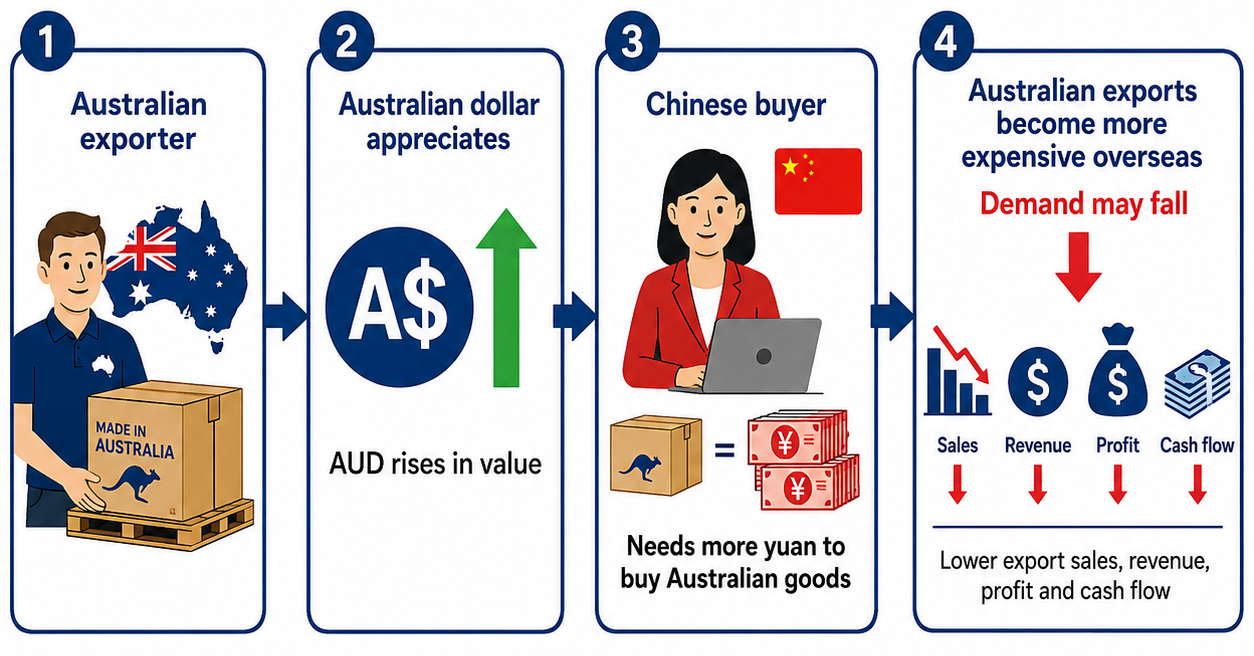
Effect of an appreciation of the Australian dollar
Australian exports become more expensive overseas
When the Australian dollar appreciates, overseas buyers need more of their own currency to purchase Australian goods and services priced in Australian dollars.
This means Australian exports become more expensive for overseas customers. As a result, demand for the exporter’s products may fall because overseas buyers may switch to cheaper local products or cheaper exports from other countries.
This can reduce export sales, revenue, profit and cash flow for the Australian business.
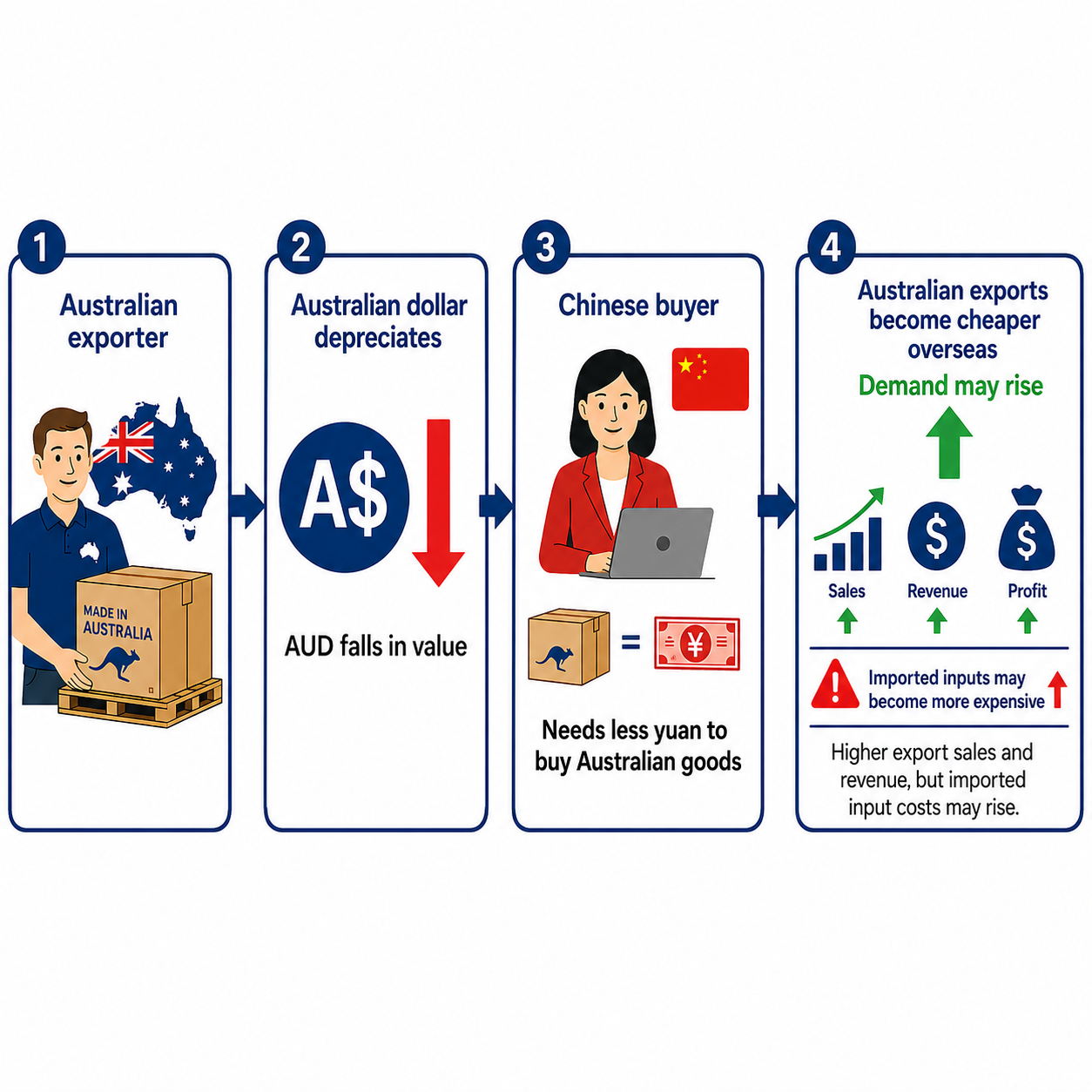
Effect of a depreciation of the Australian dollar
Australian exports become cheaper overseas
When the Australian dollar depreciates, overseas buyers need less of their own currency to purchase Australian goods and services priced in Australian dollars.
This means Australian exports become cheaper for overseas customers. As a result, demand for the exporter’s products may increase because Australian exports become more price competitive.
This can increase export sales, revenue and cash flow for the Australian business.
Imported inputs can also be affected
Appreciation and imported inputs
When the Australian dollar appreciates, imported inputs such as packaging, machinery, ingredients, technology or components may become cheaper for an Australian business to buy. This can reduce costs and improve profit margins.
Depreciation and imported inputs
When the Australian dollar depreciates, imported inputs may become more expensive. This can increase production costs and reduce profit, even if the business becomes more price competitive overseas.
Business impacts of currency fluctuations
1. Lower demand
An appreciation of the Australian dollar can make exports more expensive, reducing demand from overseas buyers.
2. Lower export revenue
If demand falls, the exporter may sell fewer units overseas, reducing revenue and cash inflows.
3. Reduced profit
Lower sales revenue or higher imported input costs can reduce profit margins.
4. Higher production costs
If the Australian dollar depreciates, imported materials, packaging, technology or machinery may become more expensive.
5. Pricing uncertainty
Fluctuating exchange rates make it harder for exporters to set stable prices for overseas customers.
6. Cash flow pressure
If revenue falls or costs rise unexpectedly, the exporter may struggle to pay suppliers, wages, freight or loan repayments.
Real-world example
Australian apparel exports: R.M.Williams
R.M.Williams is an Australian clothing and footwear brand that sells products to overseas customers. If R.M.Williams products are priced in Australian dollars and the Australian dollar appreciates, overseas customers need more of their own currency to buy the same boots, clothing or accessories.
This makes the products more expensive compared with local alternatives or competitors from other countries. As a result, overseas demand may fall, reducing export sales, revenue and profit.
If the Australian dollar depreciates, R.M.Williams products become cheaper for overseas buyers. This may make the brand more price competitive, increase demand and increase export sales.

Example of how to write this risk in an exam
One source of financial risk in export markets is currency fluctuations. If the Australian dollar appreciates, Australian exports priced in Australian dollars become more expensive for overseas buyers. This can reduce demand for the exporter’s products, lowering export sales, revenue and profit. If the Australian dollar depreciates, exports may become cheaper for overseas buyers, which can increase demand and export sales.
💸 Non-payment of monies
Non-payment of monies occurs when an overseas customer does not pay the exporter the money owed for goods or services, or pays late, partly or only after costly follow-up.
Why non-payment is a financial risk
When a business exports, it may need to manufacture goods, package them, pay employees, organise freight, arrange insurance and ship the order before receiving full payment from the overseas customer.
If the customer does not pay, pays late or disputes the invoice, the exporter may have already paid most of the costs but not received the expected revenue. This can create serious cash flow problems, especially for small and medium-sized exporters.

How this risk occurs
1. Buyer refuses to pay
The overseas customer may refuse to pay because of a dispute over quality, delivery time, specifications or documentation.
2. Buyer becomes insolvent
The overseas customer may run out of money or go out of business before paying the invoice.
3. Weak credit checks
The exporter may not properly check the overseas buyer’s reputation, financial position or payment history.
4. Long payment terms
The exporter may allow the customer to pay 30, 60 or 90 days after delivery, increasing the risk of late or missed payment.
5. Legal recovery is difficult
If the customer is overseas, it may be expensive and time-consuming to recover money through another country’s legal system.
6. Political or banking barriers
Payment may be delayed or blocked by currency controls, banking problems, sanctions, conflict or instability in the buyer’s country.
Business impacts of non-payment
1. Cash flow shortage
The exporter may not have enough cash to pay wages, suppliers, freight, rent, loan repayments or future production costs.
2. Bad debts
The unpaid amount may need to be written off as a bad debt, directly reducing profit.
3. Lost goods and costs
The exporter may lose the goods, packaging, freight costs, insurance costs and production costs connected to the unpaid order.
4. Lower ability to grow
Unpaid invoices can reduce the business’s ability to fund future export orders, marketing, staff or overseas expansion.
Real-world example
Australian food exports: Bega Cheese
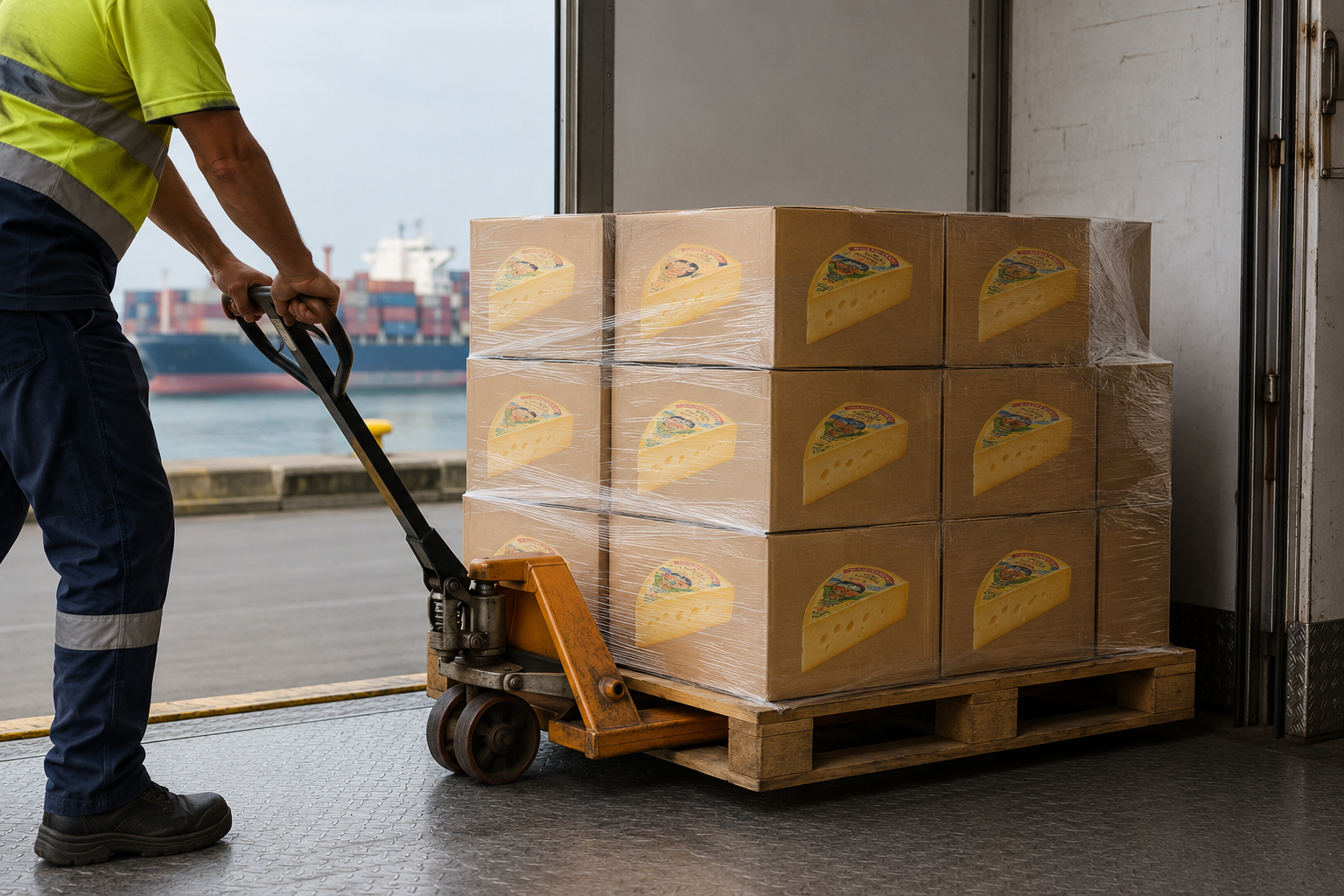
Bega Cheese is an Australian food business that could sell dairy products to an overseas distributor on credit terms, such as payment 60 days after delivery. Before receiving the money, the business may already have paid for production, packaging, labour, transport and insurance.
If the overseas distributor pays late, only pays part of the invoice or fails to pay, Bega Cheese may not receive the expected revenue from the export sale. This could create cash flow pressure because the costs of producing and shipping the goods have already been paid.
As a result, the exporter may face bad debts, reduced profit and less cash available to fund future export orders.
Example of how to write this risk in an exam
One source of financial risk in export markets is non-payment of monies. This occurs when an overseas customer does not pay, pays late or only pays part of the invoice after the exporter has already produced and shipped the goods. As a result, the exporter may experience cash flow problems, bad debts and reduced profit, especially because recovering money from a customer in another country can be costly and difficult.
🎧 Prefer listening?
If you prefer listening to the content in podcast format:
🎥 Prefer watching?
If you prefer watching the content in video format:
🃏 Flashcards
Card 1 of 11
🎮 Revision Games
💰 BME Millionaire
Climb the money ladder by mastering financial risk in export markets.

Biz Fact: A sudden rise in the Australian dollar can make Australian manufactured goods more expensive for overseas buyers.
Past Exam Questions
Use these past exam questions to see how this dotpoint has been assessed. Pay close attention to the command term, the number of marks and whether the question is Section 1 or Section 2.
Section 1 Questions
2017 — Section 1 — Question 6(a) — 2 marks
Context
Elk and Frazer are optometrists specialising in eyewear and contact lenses. Given the massive increase in the demand for glasses and contact lenses in all demographics, their business is booming and they are now exporting eyewear to many Asian countries.
6(a): Outline one source of financial risk in export markets. (2 marks)
Command term focus: Outline
Outline: state one source of financial risk and briefly clarify its main features.
See the full command term guide here: Command Terms.
6(a) Sample answer
One source of financial risk is currency fluctuations. This refers to changes in the exchange rate between the Australian dollar and another currency. For Elk and Frazer, this may affect the price of their Australian eyewear and contact lenses when selling to buyers in Asian markets. A stronger Australian dollar may make their exports appear more expensive overseas.
2018 — Section 1 — Question 3(a) — 4 marks
Context
The export of skin care products, for men and women, to China has shown vigorous growth. This is due to the increase in disposable income in China. As a result, an Australian skin care business is investigating the possibility of developing an online retail store to export its skin care products to China.
3(a): Outline two sources of financial risk that this skin care business might encounter in trading with China. (4 marks)
One:
Two:
Command term focus: Outline
Outline: state both financial risks and briefly clarify how each could affect the skincare exporter.
See the full command term guide here: Command Terms.
3(a) Sample answer
One: Currency fluctuations are a source of financial risk. This refers to changes in the value of the Australian dollar compared with another currency. For the skin care business, this may affect the price competitiveness of its exports to China, especially if the Australian dollar appreciates and makes its skincare products more expensive for Chinese customers.
Two: Non-payment of monies is another source of financial risk. This occurs when an overseas customer does not pay, pays late or only pays part of the amount owed after the exporter has supplied the goods. For the skincare business, this could occur if Chinese online customers or distributors receive products but do not pay the full invoice on time.
2023 — Section 1 — Question 1(a) — 4 marks
Context
Exporting can bring opportunities and benefits to global businesses, but also has its challenges. Success comes from making the most of the opportunities while minimising the risks.
1(a): Outline two sources of financial risk in export markets. (4 marks)
One:
Two:
Command term focus: Outline
Outline: state currency fluctuations and non-payment of monies, then briefly clarify the main feature of each risk.
See the full command term guide here: Command Terms.
1(a) Sample answer
One: Currency fluctuations are a source of financial risk. This occurs when exchange rates change between currencies, such as when the Australian dollar appreciates or depreciates against another currency. For exporters, this can change the overseas price of goods and affect export competitiveness.
Two: Non-payment of monies is a source of financial risk. This occurs when an overseas buyer does not pay the exporter, pays late or only pays part of the invoice. This is a risk because exporters may have already produced, packaged and shipped the goods before receiving payment.
2025 — Section 1 — Question 4(a) — 4 marks
Context
Expansion into global markets comes with inherent risk. To identify and assess this risk is to future-proof and protect a business.
4(a): Outline two sources of financial risk in export markets. (4 marks)
One:
Two:
Command term focus: Outline
Outline: state both sources of financial risk and briefly clarify why each can affect an exporter.
See the full command term guide here: Command Terms.
4(a) Sample answer
One: Currency fluctuations are a source of financial risk. This refers to movements in exchange rates, such as an appreciation or depreciation of the Australian dollar against another currency. For a business expanding globally, this can change how expensive its Australian exports appear to overseas buyers.
Two: Non-payment of monies is a source of financial risk. This refers to an overseas customer failing to pay, paying late or only paying part of the money owed to the exporter. This is particularly risky in export markets because the buyer may be located in another country, making payment recovery more difficult.
Section 2 Questions
2020 — Section 2 — Question 7(c) — 4 marks
Case study / context
Tartology Ltd is a Western Australian business that specialises in manufacturing premium handmade chocolate tarts using locally-sourced ingredients. Founded in 2013, Tartology Ltd initially began as a home-based business and opened its first store in 2015. Over the past five years, Tartology Ltd has expanded both its business and the range of chocolate tarts it sells. At present, Tartology Ltd sells through various retail stores across Australia and through its website and Instagram page.
The increasing popularity of the chocolate tarts within both Western Australia and Australia has seen a huge growth in Tartology Ltd’s customer base, sales and profits. Tartology Ltd has been analysing the current economic climate and is now considering entering the New Zealand market. It is seeking to buy a warehouse facility in New Zealand which will focus on the production of tarts to sell to various patisseries in large cities. Ethical practice is important to Tartology Ltd, so it is keen to employ a diverse range of employees in its warehouse and to connect with the local community.
Tartology Ltd believes that moving into the New Zealand market is a good business decision due to that country’s growing middle-income population. This would mean an increase in the number of people who can afford to spend money on luxury items such as Tartology Ltd’s chocolate tarts. There are also good trade relations between Australia and New Zealand and the Australian dollar is relatively close in value to the New Zealand dollar. Interest rates in Australia are at an all-time low and this would allow Tartology Ltd to take advantage of the benefits of investing more into the business.
To assist in the expansion into New Zealand, Tartology Ltd is considering seeking additional funding. These funds will provide support for Tartology Ltd in purchasing the warehouse facility and extra machinery to increase the efficiency of producing and packaging the chocolate tarts in New Zealand.
Referring to the source information and your own knowledge, prepare a report or essay in which you answer the question parts below.
7(c): Describe two sources of financial risks that Tartology Ltd could face if it decides to enter the New Zealand market. (4 marks)
Command term focus: Describe
Describe: give the main characteristics of both risks and link each clearly to Tartology Ltd’s New Zealand expansion.
See the full command term guide here: Command Terms.
7(c) Sample answer
One source of financial risk is currency fluctuations. This refers to changes in the value of one currency compared with another currency. For Tartology Ltd, the Australian dollar and New Zealand dollar may change in value while the business is operating in the New Zealand market. This is relevant because the case states that the Australian dollar is relatively close in value to the New Zealand dollar, meaning exchange rates are an important financial consideration.
A second source of financial risk is non-payment of monies. This refers to an overseas customer not paying, paying late or only paying part of the amount owed. For Tartology Ltd, this could involve New Zealand patisseries receiving chocolate tarts but not paying the invoice on time. This is relevant because Tartology Ltd is planning to sell to various patisseries in large New Zealand cities.
2024 — Section 2 — Question 8(a) — 4 marks
Case study / context
Smart Agriculture Solutions (SAS) has made a name for itself in the Australian agriculture industry for quality products and services. North America and countries in Europe are showing increasing interest in SAS, indicating untapped market potential abroad.
This surge in international interest brings opportunities and challenges for SAS. Currency changes can directly impact profits, making it essential for SAS to have a clear understanding and plan in place. Another pressing concern is payment defaults, a potential threat that could strain the business’s finances. As such, SAS needs to consider ways to minimise financial risks when exporting its products.
SAS is keen to infuse innovation into its offerings, aiming to make its products and services appealing and relevant to international clients. SAS believes that by doing this, they can boost sales and expand their global reach.
As SAS contemplates its global expansion, the team behind it is aware of the various legal challenges they are likely to encounter in different countries. Each country has its own set of rules and regulations, from competition norms to patent rights and product safety standards. SAS is committed to understanding and adhering to these legal frameworks, ensuring compliance and protecting its reputation.
With a blend of financial expertise, innovative ideas and strategic planning, SAS is gearing up to make its mark on the global stage, but will need to navigate challenges and seize opportunities along the way to ensure its success.
Refer to the case study and your own knowledge to answer the questions below:
8(a): Describe two sources of financial risk SAS might encounter in exporting its products to international markets. (4 marks)
Command term focus: Describe
Describe: give the main characteristics of both risks and link each clearly to SAS exporting to international markets.
See the full command term guide here: Command Terms.
8(a) Sample answer
One source of financial risk is currency fluctuations. This refers to changes in exchange rates between currencies. For SAS, this is relevant because it is considering exporting to North America and Europe, meaning it may deal with foreign currencies such as US dollars, Canadian dollars, euros or pounds. The case also states that currency changes can directly impact profits.
A second source of financial risk is non-payment of monies. This occurs when an overseas customer does not pay, pays late or only pays part of the amount owed. For SAS, this could involve international clients receiving agricultural products or services but defaulting on payment. The case directly identifies payment defaults as a concern that could strain the business’s finances.