
The BME Exam
The BME exam is divided into two main sections: Section 1 Short Answer Questions and Section 2 Extended Answer Questions. Each section requires a different approach to structure, depth, application and responding to command terms.
This page explains how each section of the exam works, including mark allocations, expected answer length and the importance of applying syllabus knowledge to case-study information.
It also provides practical exam-writing advice to help students structure answers clearly, use appropriate business language and maximise marks.
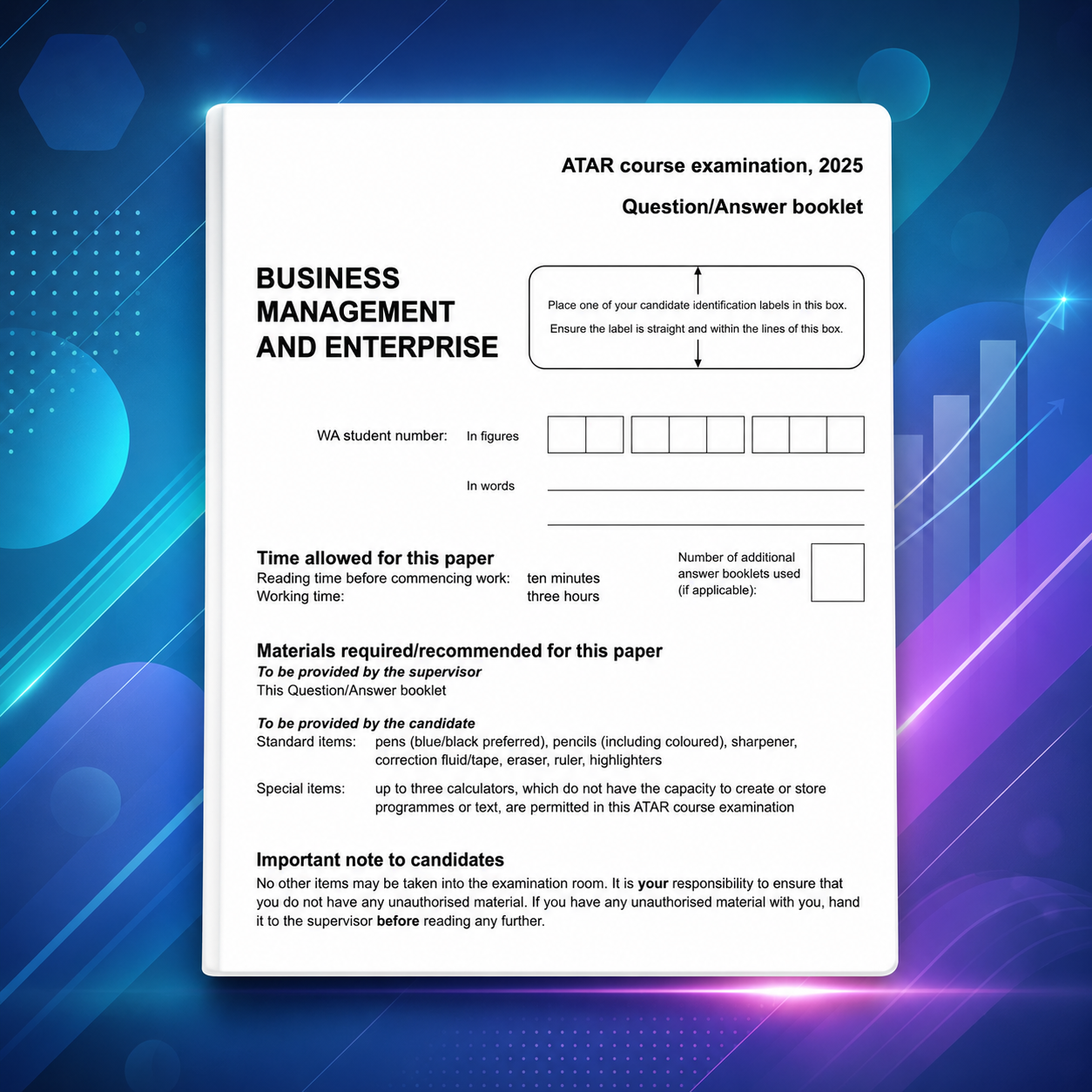
🟦 Section 1 of the exam — Short Answer Questions (60%)
- Worth 60 marks (60% of the exam)
- Questions are not attached to a case study
- Require minimal application (real-world examples may be used)
- Limited writing space
- Typically 2–4 lines for 2-mark questions
- Typically 3–9 lines for 3–5 mark questions
Answers must be concise, direct, and clearly match the command term. Every sentence should earn marks.

🟩 Section 2 of the exam — Extended Answer Questions (40%)
- Worth 40% of the exam
- Students choose two questions from three
- Each extended question is worth 25 marks
- Broken into 4–5 sub-questions (2–12 marks each)
- Based on a case study, scenario, quote or supporting material
There is no line limit and answers must include strong application.
Most students believe application simply means naming the business and copying figures from the case study. This is only one form of application, and it is often the weakest.

⭐ How to Score High Application Marks in BME
High-scoring BME answers do more than explain theory.
They show the examiner that you understand this business, in this situation, at this point in time.
👉 Application marks are earned by linking theory directly to the case study.
📘 Case Study: Fizzology
Fizzology is an Australian beverage manufacturer operating in a highly competitive drinks market. In recent years, consumer preferences have shifted away from traditional high-sugar soft drinks towards healthier and more environmentally-conscious alternatives.
In response to these changes, Fizzology has decided to invest heavily in research and development (R&D) to create new product ranges, including kombucha, reduced-sugar soft drinks, and flavoured tea beverages. This strategy aims to revitalise declining sales in the Australian market while also creating opportunities for future international expansion, with a planned product launch overseas in 2027.
Internally, this decision requires changes to production processes and increased staff training, as employees and middle managers must develop new skills to support the new product lines. As a result, some stakeholders may experience increased workload and uncertainty during the transition period.
To manage resistance to change and encourage employee buy-in, Fizzology is applying Kotter’s 8-Step Change Model, focusing on communication and building support for innovation. While this strategy aligns the brand with sustainability and health trends, it also exposes Fizzology to strong competition from established kombucha and sugar-free beverage brands.
✅ Application Checklist Using the Fizzology Case Study
Before submitting your answer, check every box below.
☐ I clearly referred to Fizzology
☐ I avoided writing only “the business” or “the company”
Example: Fizzology is responding to changing consumer preferences…
☐ I used real products, strategies or dates
☐ I did not invent examples
Strong Fizzology details include: kombucha; reduced-sugar soft drinks; flavoured teas; Australian market; international launch in 2027.
Example: Fizzology has invested in R&D to develop kombucha and reduced-sugar beverages.
☐ I named specific stakeholders
☐ I explained how they are affected in this case
Common stakeholders you can use:
- customers
- employees
- middle managers
- senior management / directors
- owners / shareholders
- suppliers
- local community
- government / regulators
Example: Employees and middle managers at Fizzology may face increased pressure as they adjust to new production processes and undergo training for kombucha and flavoured tea production.
Any recommendation, strategy, advice or justification must be clearly grounded in the case study.
Marks are awarded when ideas are specific to this business, this market and this point in time — not generic business advice.
If the recommendation could apply to any beverage company, application marks will be limited.
Example — Weak application
Fizzology should invest in marketing to increase sales.
Why this is weak:
This recommendation is generic and could apply to almost any business. It does not reflect the specific changes or constraints in the case study.
Example — Strong application
Fizzology should prioritise digital and influencer-based promotion for its new kombucha and reduced-sugar product ranges, as health-conscious consumers are more likely to engage with social media platforms when researching wellness and sustainable products. This form of promotion supports the brand’s repositioning towards healthier alternatives and builds awareness ahead of the planned international product launch in 2027.
☐ I avoided words like: things, good / bad, make more money
☐ I used precise business terms instead: revitalise sales; respond to declining demand; increase brand alignment with health trends
☐ If I removed the word “Fizzology”, my answer would no longer make sense.
If your answer still works without the case study, it is not applied.
⭐ Core Exam Writing Tips (Both Sections)
Underline the command term + key words
Many students lose marks by writing relevant information that does not answer the question asked.
Rule: If the answer starts wandering, re-read the question and adjust the next sentence so it directly answers the task.
Start answering immediately
Intro paragraphs waste time and do not earn marks.
Better: Start with a clear point sentence and build from there.
One clear idea per paragraph or group of sentences
Write one point, then develop it. New point = new paragraph (or a new line in short answer space).
Replace vague language
| Conversational | Exam-appropriate |
|---|---|
| like | such as / for example |
| stuff / things | factors / elements / aspects |
| basically | primarily / in essence |
| a lot | significantly / substantially |
| really big | significant / substantial |
| really small | minimal / limited |
| helps | contributes to / supports |
| gets worse | deteriorates |
| gets better | improves |
Write objectively (no “I” or “we”)
Avoid: I think the business will make more profit if it expands into China.
Use: The business is likely to increase profitability if it expands into China.
Use evaluative wording
| Over-certain (avoid) | Evaluative (better) |
|---|---|
| will increase profits | may increase profitability |
| will lose money | may incur financial losses |
| will succeed | is likely to be successful |
| will fail | may be unsuccessful |
| will reduce costs | may reduce operating costs |
| will grow market share | has the potential to increase market share |
Most exam questions are directly drawn from a dotpoint and its sub-dotpoints
Rule: When a question asks for “one factor”, “reasons”, or “influences”, the best answers are usually the sub-syllabus points.
Example: If the question asks for one factor driving global business development, a strong answer is one of the syllabus sub-points, such as: financial growth opportunities and/or loss minimisation; consumer purchasing and spending patterns; World Trade Organisation (WTO) regulations and sanctions; deregulation of the financial market.