U1.03 — The environments of business
Overview
Every business operates within a set of surroundings that affect how it runs and how successful it can be.
These surroundings are known as the business environments, and they can influence decisions, profits, and long-term growth.
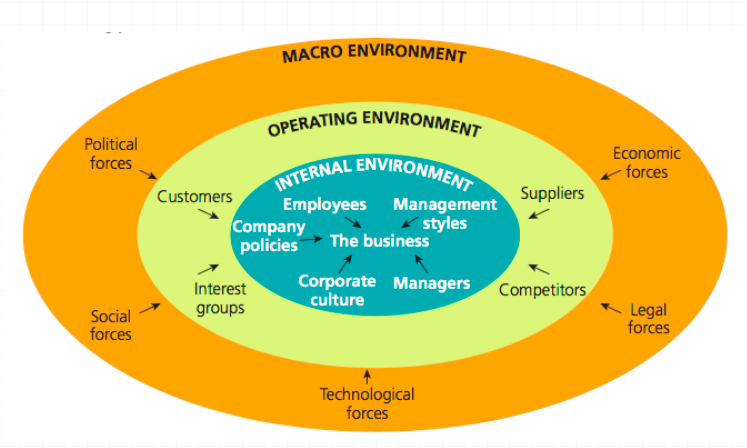
Businesses are affected by three key environments:
- 👉 Macro Environment
- 👉 Operating Environment
- 👉 Internal Environment
Each level involves different factors, ranging from global economic trends to the actions of a business’s own employees.
1. The Macro Environment
Definition:
The macro environment includes external factors that affect all businesses but are beyond their direct control. These are broad forces such as government policy, economic conditions, technology, and social trends.
Explanation:
Businesses in Perth and around the world must adapt to these external influences to survive. They can’t control these factors but can respond to them through good planning and innovation.
The macro environment is often analysed using the PESTLE framework — Political, Economic, Sociocultural, Technological, Legal, and Environmental factors.
Examples:
Political:
- The WA Government’s payroll tax relief helps small businesses reduce costs.
- Trade agreements like AUKUS and ASEAN partnerships affect Australian exports and supply chains.
Economic:
- Interest rate rises by the Reserve Bank of Australia (RBA) increase borrowing costs for local small businesses.
- Global inflation impacts prices of fuel, food, and imported goods.
Sociocultural:
- Growing demand in Perth for sustainable and local products influences retailers.
- Shift toward remote work and work–life balance changes employee expectations.
Technological:
- Adoption of AI and automation in industries like mining (e.g. Rio Tinto’s autonomous trucks in WA).
- Rise of e-commerce and online delivery apps (like Uber Eats and DoorDash).
Legal:
- Introduction of workplace health and safety laws (Work Health and Safety Act 2020 (WA)).
- National privacy and consumer protection laws (ACCC oversight).
Environmental:
- Push for net zero emissions influences energy, transport, and construction sectors.
- Water scarcity issues affect WA agriculture and farming operations.
Local Example (WA):
The mining boom is driven by global demand for iron ore, particularly from China — a clear example of how global economic trends shape WA businesses.
Climate change policies are pushing Perth companies to adopt renewable practices, such as solar power installations and electric vehicle fleets.
2. The Operating Environment
Definition:
The operating environment includes the external stakeholders that directly interact with a business.
These are groups that a business can influence — but not fully control — such as customers, suppliers, competitors, and local communities.
Explanation:
This environment is closer to the business’s day-to-day operations.
For example, a café in Fremantle must respond to customer tastes, supplier prices, and nearby competition.
Success often depends on how well a business builds relationships and adapts to its operating environment.
Examples:
Customers:
- Changing preferences for plant-based and organic food affect local restaurants.
- Perth gyms offering flexible memberships to meet consumer demand for convenience.
Competitors:
- Local coffee shops competing with large chains like Starbucks or Dome.
- Independent electricians competing for contracts with larger Perth firms.
Suppliers:
- WA farmers supplying fresh produce to city restaurants rely on strong logistics links.
- Supply disruptions (e.g. during COVID-19) caused stock shortages for WA retailers.
Creditors and Banks:
- Access to small business loans from Bankwest or Commonwealth Bank supports start-ups.
Community and Local Groups:
- Businesses in regional WA sponsor local sporting clubs or school events to build reputation.
- Environmental groups pressure companies to reduce waste and emissions.
Local Example (WA):
Little Creatures Brewery (Fremantle) relies on relationships with local suppliers for ingredients and must stay competitive with other WA craft breweries like Gage Roads.
HBF (Health Insurance) adapts its marketing to respond to customer expectations for better digital services.
3. The Internal Environment
Definition:
The internal environment refers to all factors within the business that the owner or management can directly control.
This includes employees, management structure, culture, resources, and company policies.
Explanation:
The internal environment shapes how effectively a business operates day to day.
Strong leadership, good communication, and motivated employees can lead to high productivity and customer satisfaction.
In WA, many small and medium-sized businesses succeed because of close-knit teams and strong workplace culture.
Examples:
Employees:
- A local café with friendly, well-trained staff attracts repeat customers.
- Mining companies in WA invest in training and safety programs to improve performance.
Management:
- Effective leadership in Perth start-ups helps teams stay innovative and agile.
- Family-run businesses often rely on clear planning and delegation.
Company Culture:
- Businesses like Atlassian (national example) promote open communication and flexibility.
- Local tradie firms in WA that build supportive work cultures retain staff longer.
Resources:
- Physical assets such as tools, vehicles, or office space.
- Financial resources and cash flow determine stability.
- Technology — such as accounting software or e-commerce systems — increases efficiency.
Policies and Procedures:
- Having clear workplace health and safety, HR, and customer service policies ensures compliance and consistency.
Local Example (WA):
Perth Zoo maintains strong internal systems for staff training, animal welfare, and sustainability.
Dome Café Group, based in WA, uses consistent policies and strong team culture to maintain quality across all locations.
Summary Table
| Environment | Control Level | Key Factors | Examples (WA + Beyond) |
|---|---|---|---|
| Macro Environment | No control | Political, economic, social, technological, legal, environmental | RBA interest rates, climate change, COVID-19, government policy |
| Operating Environment | Limited control | Customers, competitors, suppliers, creditors, local community | Local cafés, Perth trades, supplier networks |
| Internal Environment | Full control | Employees, management, culture, resources, policies | Small family businesses, Perth Zoo, Dome Café Group |