
General U1.08 - Classification of Businesses
Overview
Dotpoint 8: classification of businesses.
A business classification is the way a business is grouped according to how it is owned and operated.
The most suitable structure will depend on factors such as how many people own the business, the amount of money required, how much control the owners want, the level of risk they are prepared to accept and whether the business is intended to earn profit for owners or achieve a community purpose.
The main business classifications covered in this dotpoint are:
- Sole trader
- Partnership
- Private company (Pty Ltd)
- Not-for-profit organisation
- Franchise

💼 Sole trader
Sole trader: a business owned and operated by one person.
Key features
- One owner: the business is owned by one person, although employees can still be hired.
- No separate legal entity: the owner and the business are legally the same.
- Full control: the owner can make decisions about prices, products, staffing, suppliers and operating hours without consulting other owners.
- Tax treatment: business profit is included in the owner’s personal income tax return rather than being taxed as a separate company.
- Unlimited liability: the owner is personally responsible for business debts and legal claims, meaning personal assets may be at risk if the business cannot meet its obligations.
- Simple structure: it is generally cheaper and easier to establish and operate than a company.

- Relatively low establishment costs and fewer formalities.
- The owner has complete control over the direction of the business.
- Decisions can be made quickly because approval from other owners is not required.
- The owner keeps all profits after expenses and tax.
- The structure can suit small businesses that rely heavily on the owner’s skills and customer relationships.
- Unlimited liability means personal assets may be exposed if the business cannot pay its debts.
- Access to finance can be limited because the business relies heavily on the owner’s financial position.
- The owner may face a heavy workload because they are responsible for many different business functions.
- The business may be disrupted if the owner is sick, unavailable or unable to work.
- Growth may become difficult if one person cannot continue managing all areas of the business.
Australian example
A self-employed electrician, mobile dog groomer, photographer or market-stall operator may operate as a sole trader.
🤝 Partnership
Partnership: a business owned by two or more people who share responsibility for operating the business.
Key features
- Shared ownership: two or more people contribute money, skills and labour to the business.
- Shared profits and responsibilities: partners divide profits and business duties according to an agreed arrangement.
- Shared decision-making: important decisions may require consultation between partners.
- Partnership agreement: a written agreement can set out profit-sharing, responsibilities, decision-making procedures and what happens if a partner leaves.
- Binding actions: decisions or contracts entered into by one partner can create obligations for the whole partnership.
- Unlimited liability: in a general partnership, partners can be personally responsible for partnership debts and legal obligations.
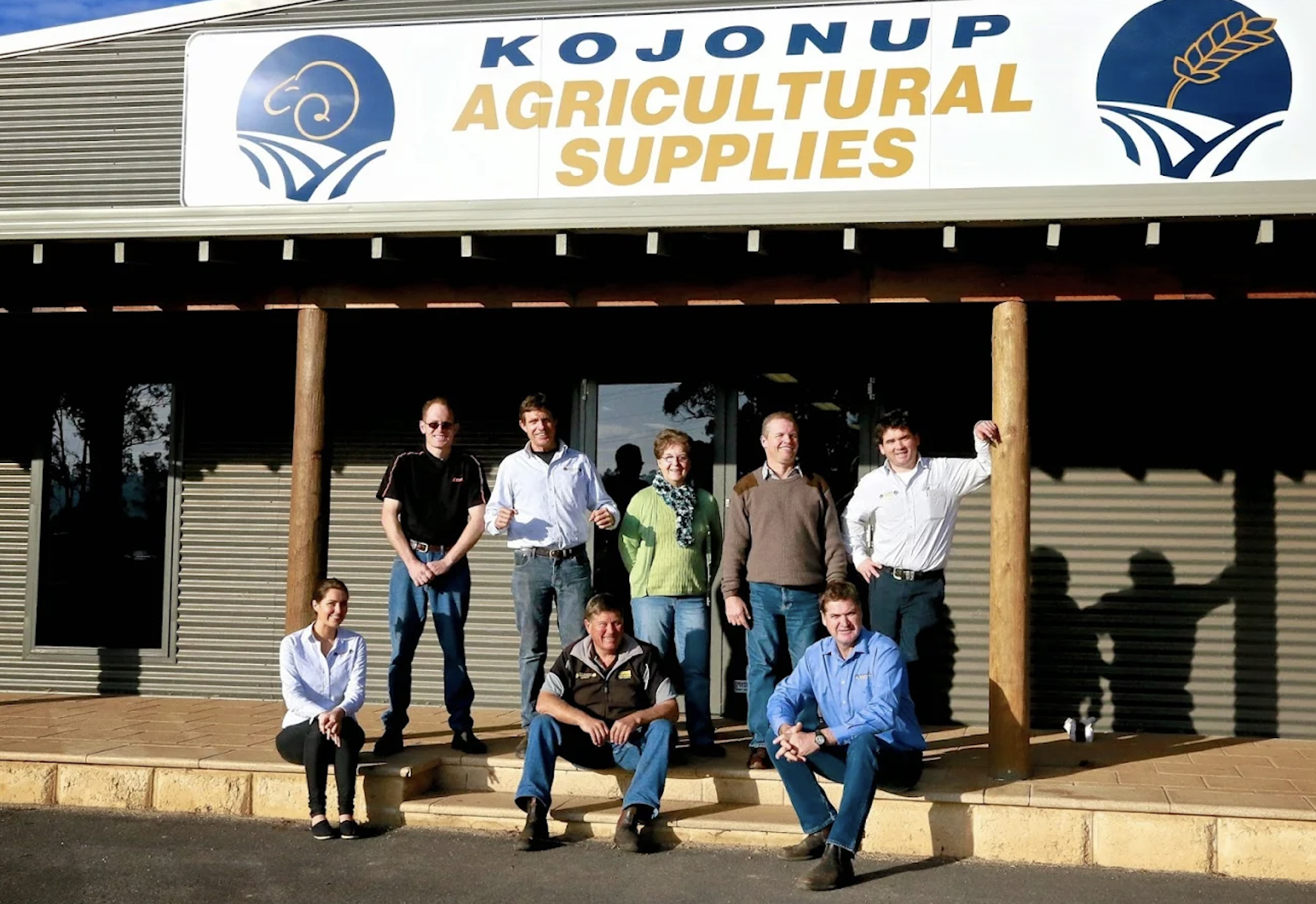
Kojonup Agricultural Supplies — a partnership servicing the Great Southern farming community since 1986.
- Workload and responsibilities can be shared between the owners.
- Partners can bring different skills, experience and ideas to the business.
- More owners may provide greater access to finance than a sole trader.
- Partners can specialise in different areas such as marketing, finance or operations.
- Owners can support each other when making difficult decisions.
- Profits must be shared between partners rather than kept by one owner.
- Disagreements about money, workload or business direction can damage the partnership.
- General partners usually have unlimited liability.
- One partner may make a decision or enter a contract that creates obligations for the other partners.
- Changes in ownership can become complicated if a partner wants to leave or sell their share.
Australian example
Partnerships are common in businesses such as dental practices, accounting firms, family cafés and small building businesses.
🏢 Private company (Pty Ltd)
Private company (Pty Ltd): a business that is legally separate from its owners and is owned by shareholders.
Key features
- Separate legal entity: the company exists legally apart from its owners and can own assets, enter contracts, borrow money and be sued in its own name.
- Ownership and management: the company is owned by shareholders and managed by directors.
- Limited liability: shareholders generally risk only the amount they have invested in the company, although directors can still have legal responsibilities.
- Continuity: the company can continue operating even when shareholders or directors change.
- Access to finance: a company structure can make it easier to attract investment and support business growth.
- More regulation: companies face additional legal, accounting, reporting and compliance requirements.

Bathers Beach House in Fremantle is registered as a Private Company.
- Limited liability generally protects shareholders’ personal assets from company debts.
- The business may find it easier to attract investors and obtain finance for expansion.
- The company can continue operating even if ownership changes.
- The structure can improve credibility with banks, suppliers and larger customers.
- It provides a clearer structure for employing staff and expanding operations.
- It is more expensive and time-consuming to establish than a sole trader or partnership.
- The business must meet additional legal, reporting and record-keeping requirements.
- Directors have legal duties and may face penalties if these duties are breached.
- Accounting, taxation and administration are more complex.
- Some company information is available through public registers.
Australian example
A growing construction business, technology company, retailer or hospitality business may operate as a private company.
🌱 Not-for-profit organisation
Not-for-profit organisation: an organisation established to achieve a community, social or other purpose rather than distribute profits to owners.
Key features
- Purpose: the organisation exists to achieve a social, cultural, sporting, environmental or community objective.
- No profit distribution to owners: any surplus is reinvested into the organisation’s purpose, services or facilities.
- Governance: the organisation is commonly overseen by a board or committee rather than private owners.
- Funding: income may come from grants, donations, membership fees, fundraising, sponsorship and the sale of services.
- Volunteers and employees: many not-for-profits use volunteers but can also employ paid staff.
- Accountability: organisations receiving grants or donations may need strong reporting and governance systems.

Cottesloe Surf Life Saving — example of a WA not-for-profit community organisation.
- Can build strong community support.
- May receive grants and donations.
- Can attract volunteers.
- Focuses on achieving a community purpose.
- Funding may be uncertain.
- May rely heavily on volunteers.
- Decision-making can be slower.
- Growth may depend on extra funding.
WA example
Surf Life Saving clubs, community sporting clubs and charities are common examples of not-for-profit organisations.
🍔 Franchise
Franchise: a business arrangement where a franchisee pays for the right to use the franchisor's brand, products and business system.
Key features
- Brand and business system: the franchisee operates using the franchisor’s established name, products and procedures.
- Fees: the franchisee commonly pays an initial franchise fee plus ongoing royalties and marketing contributions.
- Support: the franchisor may provide training, approved suppliers, advertising, systems and ongoing guidance.
- Consistency: franchisees must follow rules about branding, products, customer service and operating procedures.
- Reduced independence: the franchisee owns the individual business but cannot operate it with complete freedom.
- Reputation: the actions of one outlet can affect customer perceptions of the wider franchise network.

- Established brand and customer recognition.
- Training and business support.
- Proven systems and procedures.
- Marketing support from the franchisor.
- High start-up fees and ongoing royalties.
- Less independence.
- Must follow franchisor rules.
- Problems at other outlets can affect the whole brand.
Australian examples
Boost Juice, Subway, Domino's, Bakers Delight, Anytime Fitness and Jim's Mowing are well-known franchise systems.
📊 Summary table — quick comparison
| Business type | Ownership | Liability | Main strength | Main limitation |
|---|---|---|---|---|
| Sole trader | One owner | Unlimited | Simple and full control | Personal financial risk |
| Partnership | Two or more owners | Usually unlimited | Shared skills, finance and workload | Conflict and shared liability |
| Private company | Shareholders | Usually limited | Protection and growth potential | More cost and regulation |
| Not-for-profit | Governed by board/committee | Depends on structure | Community purpose and support | Funding can be uncertain |
| Franchise | Franchisee operates under franchisor | Depends on legal structure | Established brand and support | Fees and reduced independence |
🎧 Prefer listening?
If you prefer listening to the content in Podcast format:
🎥 Prefer watching?
If you prefer watching the content in video format:
🧑🏫 Class Activities
Hands-on activities
These activities are designed to help you apply the full content to real businesses through research, decision-making and practical classroom tasks.
How this section could be used: teachers could place students into small groups and allocate different activities, ask students to complete one or two activities each week, or use the activities at the end of each syllabus point so groups can take turns completing and presenting one task to the class. Activities can also be used as extension work, revision, or as a starting point for short class discussions.

1. Local Business Detective
Choose five businesses from your local area, shopping centre or suburb and investigate how they are structured.
- Record the business name, location and what product or service it provides.
- Research whether it appears to operate as a sole trader, partnership, private company, not-for-profit or franchise.
- Find evidence such as a Pty Ltd name, franchise branding, an About Us page, ASIC information or ownership details.
- For each business, identify one advantage of that structure for the way the business operates.
- Present your findings as a table, poster or short class presentation.
2. Structure Match-Up
Work in a group to match each business scenario to the most suitable business classification.
- Scenario A: Mia wants to run a mobile dog-grooming business by herself and keep full control over decisions.
- Scenario B: Two physiotherapists want to open a clinic together and share finance, workload and decision-making.
- Scenario C: A growing Perth technology business wants outside investment and stronger protection for the owners' personal assets.
- Scenario D: A local surf club raises money through memberships and fundraising and reinvests any surplus into patrols, equipment and training.
- Scenario E: An owner wants to open a juice store using an established brand, training and proven operating systems.
For each scenario, choose the most suitable structure, give at least two reasons for your choice and identify one possible limitation. Compare your decisions with another group and be prepared to defend one choice to the class.
3. Franchise Investigation
Select one Australian franchise such as Boost Juice, Subway, Bakers Delight, Anytime Fitness or Jim's Mowing and investigate what a potential franchisee would actually be buying.
- Identify the products or services sold and the target customer.
- Research the type of training, marketing, systems or supplier support provided by the franchisor.
- Find any publicly available information about establishment costs, franchise fees or ongoing royalties.
- Identify two advantages and two limitations for someone buying into the franchise.
- Finish with a recommendation: would you invest in this franchise? Give reasons.
4. Build Your Own Business
Create a realistic small-business idea that could operate in Western Australia.
- Create a business name, product or service, target customer and basic location or sales channel.
- Decide whether the business should operate as a sole trader, partnership, private company, not-for-profit or franchise.
- Explain how the structure affects ownership, control, liability and access to finance.
- Identify two advantages and two limitations of your chosen structure.
- Explain one situation that might cause the business to change structure in the future.
- Pitch your business and structure choice to the class in 60–90 seconds.
5. Not-for-Profit Research
Research one WA not-for-profit organisation such as a Surf Life Saving club, sporting club, charity or community organisation.
- State the organisation's purpose and identify the group or community it supports.
- Investigate how it raises revenue, such as donations, grants, fundraising, membership fees or service income.
- Find evidence of how money is reinvested into programs, facilities or services.
- Identify the role of volunteers, employees, boards or committees.
- Compare the organisation with a profit-making business operating in a similar area.
- Prepare a one-page profile or three-slide presentation summarising your findings.
6. Business Structure Ranking
Imagine a Year 11 student wants to start a weekend car-detailing business, travelling to customers' homes and operating with a small amount of equipment.
- Rank the five classifications from most to least suitable for this business.
- Create four criteria for judging each option, such as start-up cost, control, financial risk and ease of operation.
- Give each business classification a score out of 5 for each criterion.
- Calculate an overall score and explain why your highest-ranked structure is the strongest option.
- Explain how your ranking might change if the student later added a business partner, employed staff or needed significant finance to expand.
- Compare rankings with another student or group and discuss why your results differ.
✍️ Short Answer Questions
Practice questions
Answer each question before opening the sample answer. The mark allocation is based on the command term and the amount of content being requested.
Show sample answer
A sole trader is a business owned and operated by one person.
Show sample answer
One characteristic of a private company is that it is a separate legal entity, meaning the company can own assets, enter contracts and be responsible for its own debts. A second characteristic is that the company is owned by shareholders and managed by directors, with shareholders generally receiving limited liability for company debts.
Show sample answer
Advantage: A partnership allows the owners to combine their finance, skills and experience, giving the business access to more resources than one owner may have alone.
Limitation: General partners usually have unlimited liability, meaning they can be personally responsible for partnership debts if the business cannot pay them.
Show sample answer
Unlimited liability means there is no legal separation between the sole trader and the business. If the business cannot pay its debts, the owner may be personally responsible and personal assets may be used to repay creditors.
Show sample answer
Both sole traders and general partnerships are relatively simple business structures and normally involve unlimited liability for the owners. However, a sole trader has one owner who keeps control and profits, while a partnership has two or more owners who share decision-making, responsibilities and profits.
Show sample answer
A private company is owned by shareholders and can distribute profit to its owners, while a not-for-profit organisation exists to achieve a community or social purpose and reinvests any surplus into that purpose. A private company is generally managed by directors on behalf of shareholders, whereas a not-for-profit is commonly governed by a board or committee.
Show sample answer
For: One advantage is that the franchisee receives an established brand and proven business system, which can make it easier to attract customers and reduce some of the uncertainty involved in starting a completely new business.
Against: One disadvantage is that the franchisee must pay fees and follow the franchisor’s rules, which can reduce profit and limit the owner’s independence when making decisions.
Show sample answer
One benefit of operating as a private company is limited liability. This is important because the company is legally separate from its shareholders, so shareholders are generally not personally responsible for company debts beyond the amount they have invested. As a result, the owners’ personal assets are usually better protected if the business experiences financial difficulties.
Show sample answer
One benefit of buying a franchise is access to an established brand and proven business system. This is important because customers may already recognise and trust the brand, while the franchisee also receives training, procedures and marketing support. As a result, the franchisee may attract customers more quickly and reduce some of the uncertainty involved in starting a completely new business.
Show sample answer
I recommend that the two friends establish the studio as a partnership. This is appropriate because they both want to contribute to the business, share the workload and combine their start-up finance. As a result, a partnership would allow them to share responsibilities, skills and profits while operating the studio together.
Show sample answer
I recommend that the student operate as a sole trader. This is appropriate because the student will be the only owner, wants low establishment costs and needs a simple structure that allows quick decisions. As a result, a sole trader structure would allow the student to keep full control while operating the small weekend business.
Show sample answer
I recommend that the business operate as a private company (Pty Ltd). This is appropriate because a company can attract investment through shareholders and is a separate legal entity that generally provides limited liability. As a result, the business can support future growth while reducing the owners’ personal exposure to company debts.
🃏 Flashcards
Card 1 of 17
🎮 Revision Games
💰 BME Millionaire
Climb the prize ladder by mastering business ownership structures.
🏗️ Business Builder
Work through five realistic Australian small-business briefs, balance control, risk, finance and growth, and choose the best structure.
⚡ 60 Second Showdown
A fast 60-second sprint covering ownership structures, liability, advantages, limitations and business scenarios.

Biz Fact: Around 97% of all Australian businesses are small businesses (0–19 employees).