
General U1.17 - Role of Human Resources in Business
Overview
Dotpoint 17: role of human resources in business.
Human resources (HR) refers to the people who work for a business and the way the business manages those people.
HR helps a business attract suitable employees, help them settle into the workplace, support their performance, retain good staff and manage employees appropriately when they leave. In a small business, this is often handled by the owner or manager, while larger businesses may have dedicated HR staff or a full HR department.
This dotpoint introduces the overall role of HR in business, especially in a small-business context, where the way people are managed can have a direct effect on productivity, teamwork and customer service.

👤 Who looks after HR in a business?
Small businesses often do not have an HR department
In a small business, the owner or manager may personally handle tasks such as hiring staff, showing new employees what to do, giving feedback and dealing with workplace problems.
As a business grows and employs more people, these tasks can become more complex. The business may then employ someone to help with HR or eventually create a dedicated HR team.
How HR support can change as a business grows
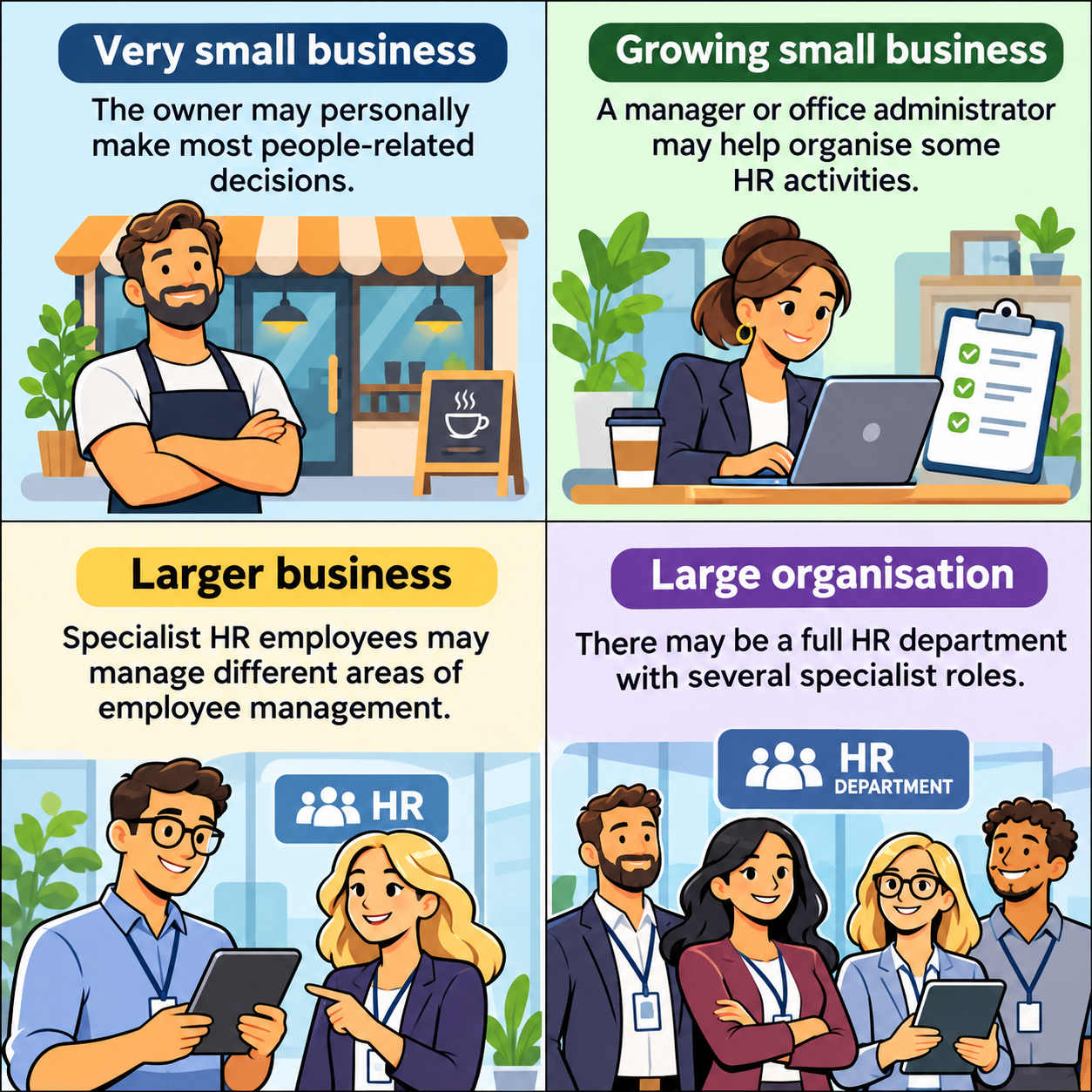
Very small business
The owner may personally make most people-related decisions.
Example: a five-person bakery owner interviews new staff and handles training.
Growing small business
A manager or office administrator may help organise some HR activities.
Example: a two-location gym uses a manager to help organise rosters, training and staff issues.
Larger business
Specialist HR employees may manage different areas of employee management.
Example: a regional retail business may employ an HR adviser to support managers across several stores.
Large organisation
There may be a full HR department with several specialist roles.
Example: a national supermarket chain may have separate teams for recruitment, training and employee relations.
Example: a local landscaping business
A landscaping business begins with the owner and three employees. The owner interviews new workers, explains how jobs are completed and deals with day-to-day staff issues personally.
After the business grows to twelve employees, coordinating rosters, training new staff and keeping work standards consistent takes much more time. The owner begins using a supervisor to help brief workers and support day-to-day staff management. As a result, HR work becomes more organised even though the business still does not have a separate HR department.
🧑🤝🧑 The main role of HR
The employee lifecycle
HR can be understood as managing employees through five broad stages, from finding suitable people through to managing the end of employment when they leave.
1. Find
The business attracts applicants and chooses people who are suitable for the work. In a small business, the owner may handle most of this personally.
- advertise a vacancy or ask for applicants
- review applications
- interview suitable people
- choose who to employ
2. Start
New employees are helped to understand how the business operates, what is expected and how to complete their work.
- introduce the employee to the workplace
- explain duties and expectations
- show important procedures
- provide initial training
3. Support
Employees are supported so they can perform their work effectively and improve when problems arise.
- provide training and guidance
- give feedback on performance
- communicate clear expectations
- help resolve workplace issues
4. Keep
The business tries to retain capable employees rather than constantly replacing and retraining staff.
- recognise good performance
- provide development opportunities
- maintain good communication
- support positive workplace relationships
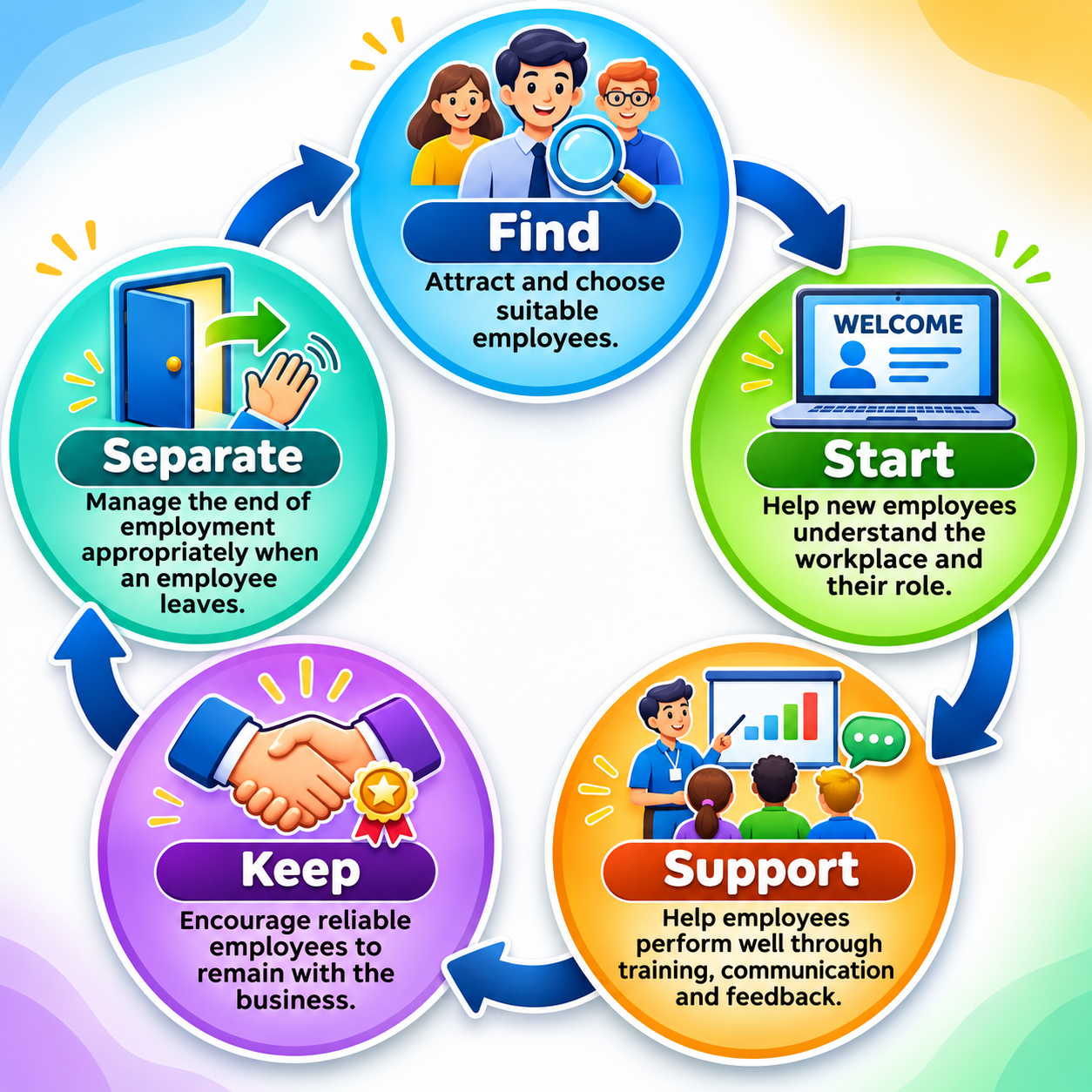
5. Separate
Employees may resign, retire or finish their employment. The business needs to manage the end of employment appropriately and reduce disruption.
- organise a handover of unfinished work
- update staff records and rosters
- recover keys, equipment or access
- prepare for a replacement if needed
📈 Why good HR matters to a small business
Why employees matter in a small business
Employees can have a major effect on a small business because there are usually fewer staff and each person may have a noticeable influence on customers, productivity and teamwork.
How effective HR can help a small business
- Better productivity: employees who understand their work can complete tasks more efficiently.
- Fewer mistakes: training and clear expectations can improve consistency.
- Better customer service: capable employees can provide faster and more reliable service.
- Lower staff turnover: supported employees may be more likely to stay with the business.
- Easier continuity: when people are managed well, the business can cope better when staff join, stay or leave.
Example: a bicycle-repair workshop
A bicycle-repair workshop has strong demand, but repairs are taking too long, different employees are completing jobs to different standards and customers are starting to complain about delays.
The owner responds by setting clearer expectations for how common repairs should be completed, giving junior employees extra practical training and checking in regularly to provide feedback. More experienced workers are also asked to help newer staff with difficult jobs.
Over time, employees become more confident and consistent, fewer repairs need to be redone and the workshop can move jobs through more quickly. As a result, waiting times can fall, customer satisfaction can improve and the business may be able to complete more repairs without immediately needing extra staff.

🎧 Prefer listening?
If you prefer listening to the content in podcast format:
🎥 Prefer watching?
If you prefer watching the content in video format:
🧑🏫 Class Activities
Hands-on activities
These activities are designed to help you apply the full content to real businesses through research, decision-making and practical classroom tasks.
How this section could be used: teachers could place students into small groups and allocate different activities, ask students to complete one or two activities each week, or use the activities at the end of each syllabus point so groups can take turns completing and presenting one task to the class. Activities can also be used as extension work, revision, or as a starting point for short class discussions.
1. Who Handles HR?
Decide who is most likely to handle HR in each business:
- Beachside Bakery: owner + 4 employees
- Coastline Fitness: 2 locations + 22 employees
- National Retail Group: 80 stores + thousands of employees
Output: complete a three-row table with Business, Who Likely Handles HR and Why.
2. Employee Lifecycle Sort
Classify each action:
- interviewing applicants for a new role
- showing a new worker how the booking system works
- giving feedback after repeated mistakes
- offering a reliable worker more responsibility
- organising a handover when an employee resigns
- providing extra training
Output: place each action under Find, Start, Support, Keep or Separate.
3. Café Team Plan
Morning Lane Café is preparing for a busy summer. The owner needs two new staff, wants them trained quickly and hopes to keep reliable employees after the holiday period.
- Choose one action the owner should take at the Find stage.
- Choose one action for the Start or Support stage.
- Explain how these actions could help the café.
Output: complete a two-row table with HR Action, Employee Effect and Business Effect.
4. Small Business HR Problem
Westside Landscaping has 10 employees. New workers are often unclear about tasks and experienced workers are frustrated because they constantly have to correct them.
Output: identify two HR actions the owner could take and explain how each could improve the situation.
5. When an Employee Leaves
Harbour Hair Studio has six employees. One experienced stylist gives notice and will leave in two weeks.
- Identify two problems this could create.
- Explain one HR action the owner should take before the stylist leaves.
- Explain why separation needs to be managed carefully.
Output: write a short paragraph explaining how the business should respond.
6. Owner as HR Manager
Northside Auto Care has eight employees and no HR department. The owner is responsible for hiring, training, feedback and workplace issues.
Your group acts as advisers to the owner.
Output: prepare one slide showing Three HR Priorities, Why Each Matters and Expected Business Effect. Present for about 90 seconds.
✍️ Short Answer Questions
Practice questions
Answer each question before opening the sample answer. Marks are based on the command term and the number of separate points requested.
Show sample answer
Human resources refers to the people who work for a business and the way the business manages those people.
Show sample answer
Two parts of the HR role are finding suitable employees and supporting employees to perform well.
Show sample answer
A small business still needs to make decisions about hiring, training, feedback and employee problems even if it has no HR department. These tasks may be completed by the owner or manager instead. As a result, HR is still important because employees need to be managed effectively for the business to operate successfully.
Show sample answer
Helping new employees get started can show them how orders are handled, what customer service standards are expected and how tasks should be completed. This can reduce confusion and mistakes during busy shifts. As a result, the café may provide faster and more consistent service to customers.
Show sample answer
Experienced employees already understand the business, its customers and how work should be completed. If they stay, the owner spends less time replacing and training new staff. As a result, the business can keep valuable knowledge and maintain more consistent service.
Show sample answer
When an employee leaves, the business still needs to organise rosters, update records and manage any handover of work. If this is done poorly, the business may lose information or face disruption. As a result, managing separation is part of HR because it helps the business continue operating smoothly.
Show sample answer
Training and clear work expectations can help employees complete bicycle repairs more efficiently and to a more consistent standard, increasing the number of jobs completed. Better feedback can also reduce mistakes and delays that frustrate customers. The implication is that good HR can improve internal productivity while also improving the customer experience.
Show sample answer
One advantage of finding suitable employees is that the business is more likely to choose people who can perform the work effectively, reducing future staffing problems. However, hiring suitable employees is not enough if they receive poor training, little feedback or no support after they start. The business also needs to retain good employees and manage staff appropriately when they leave. Overall, finding suitable employees is an important starting point, but effective HR requires several people-management stages rather than just recruitment alone.
🃏 Flashcards
Card 1 of 12
🎮 Revision Games
💰 HR Millionaire
Climb the ladder by mastering the role of human resources.
👥 Find, Start, Support, Keep or Separate?
Match each people-management situation to the best HR role.
⚡ 60 Second Showdown
Race through HR roles, effects and business situations.
Biz Fact: In many small businesses, the owner is effectively the HR manager as well as the boss, salesperson, problem-solver and everything in between.