
U4.01 — The Impact of Cultural Considerations on Global Business Practice
Overview
Dotpoint 1: the impact of cultural considerations on global business practice.
Businesses that expand overseas cannot assume that customers, employees, suppliers and business partners will behave the same way as they do in Australia. Culture can affect what people buy, how they communicate, how decisions are made and what is considered respectful or appropriate.
Cultural considerations are the values, beliefs, customs, behaviours, communication styles and social expectations that influence how people live, work, buy, negotiate and do business in different countries.
This dotpoint focuses on six cultural considerations:
- levels of education
- customs
- holidays and celebrations
- religious beliefs
- business etiquette
- communication protocols

🌏 Cultural considerations in global business practice
Global business practice refers to the way a business operates, communicates, negotiates, markets, manages staff and serves customers across international markets.
Cultural considerations can impact global business practice because customers, employees, suppliers and governments in different countries may have different expectations about language, respect, religion, time, hierarchy, negotiation and acceptable behaviour.
Key idea
Culture does not usually stop a business from expanding overseas, but it can change how the business should operate.
For example, an Australian business may be used to direct communication, casual meetings and quick decision-making. In some Asian markets, business relationships may take longer to build, communication may be more indirect and formal respect for hierarchy may matter more.
If the business adapts to these differences, it may build stronger relationships and customer trust. If it ignores them, it may offend stakeholders, misunderstand customers or weaken its chance of global success.
The six cultural considerations
Common Australian business approach compared with overseas markets
| Cultural consideration | Common Australian business approach | Possible overseas difference | Impact on global business practice |
|---|---|---|---|
| Levels of education | Businesses often assume customers can access English information, digital systems and written instructions. | Some markets may have different English literacy, digital confidence, technical knowledge or business education. | Businesses may need translations, visual instructions, local examples, simpler training or extra customer support. |
| Customs | Australian business culture often values convenience, informality, clear product information and direct service. | Other markets may have different expectations around family roles, gift giving, modesty, colours, food, design or personal space. | Products, packaging, advertising, service style and store design may need to be adapted. |
| Holidays and celebrations | Christmas, Easter, January holidays and major sporting events can influence staffing and sales. | Ramadan, Eid, Lunar New Year, Golden Week, Diwali and local national days may be more important in other markets. | Businesses must plan stock, rosters, delivery schedules, marketing campaigns and product launches around local calendars. |
| Religious beliefs | Religion may be less visible in everyday business practice for many Australian businesses. | In countries such as Indonesia and Malaysia, religion may strongly influence food, ingredients, prayer times, holidays and marketing. | Businesses may need halal certification, respectful advertising, flexible rosters, product changes and religious awareness training. |
| Business etiquette | Meetings may be relatively informal, first names may be used quickly and direct negotiation may be common. | Some cultures may expect formal greetings, titles, hierarchy, business card etiquette and relationship-building before agreements. | Managers may need cultural training before trade visits, negotiations, partnerships or overseas store openings. |
| Communication protocols | Communication is often direct, practical and relatively informal. | Some cultures may use indirect communication to preserve harmony, avoid embarrassment or show respect. | Businesses may need local staff, translators, adjusted feedback methods and more careful communication processes. |
🎓 Levels of education
Levels of education refer to the literacy, numeracy, language ability, digital skills, technical knowledge and qualifications of people in a target market.
This can include the education level of customers, employees, suppliers or business partners.
Impact on global business practice
Different education levels can affect how easily customers understand product information, instructions, websites, contracts, training materials and marketing messages.
They can also affect employee training, workplace safety, technical production processes and customer service. A business may need to spend more time explaining how a product works or training staff to meet quality standards.

Australia compared with overseas markets
| Common Australian business approach | Examples of overseas difference |
|---|---|
| Australian businesses may assume customers can follow English product information, navigate websites and understand written instructions. | In markets such as Vietnam, Indonesia or China, customers may prefer local language content, more visual explanations or simpler step-by-step guidance. |
| Businesses may assume employees can use digital systems and complete structured training in a familiar workplace style. | In some markets, employees may have strong technical skills but different English ability, or they may require more practical training and clearer workplace demonstrations. |
| Australian online education or service businesses may use Australian examples, business language and literacy expectations. | International students or customers may need translated materials, local examples and simpler explanations to engage successfully with the product or service. |
Business responses
Translate and simplify information
Product instructions, websites, contracts and training materials may need to be translated or written in clearer language.
Use visuals and demonstrations
Videos, diagrams, icons and demonstrations can help customers or employees understand complex information.
Adapt staff training
The business may need extra training programs if local employees have different technical knowledge or workplace experience.
Example of how to write this in an exam
Levels of education can impact global business practice because customers and employees in different countries may have different levels of English literacy, numeracy, digital ability or technical knowledge. For example, an Australian online education business may need to translate course content, add subtitles or include more visual learning activities if students in foreign markets do not have the same English literacy as Australian students. This could increase development costs, but it may also improve customer understanding and course completion. As a result, levels of education can affect product development, marketing and customer support in global markets.
🧩 Customs
Customs are the usual behaviours, traditions and social practices of a culture. This may include food habits, clothing expectations, gift giving, family roles, greetings, personal space, attitudes to time, design preferences and customer behaviour.
Impact on global business practice
Customs can affect product design, advertising, packaging, store layout, customer service, employee behaviour and how a business presents itself in a new market.
If a business ignores local customs, customers may view the product as unsuitable or disrespectful. If it understands customs, it can adapt its offer and build stronger local acceptance.
Australia compared with overseas markets
| Common Australian business approach | Examples of overseas difference |
|---|---|
| Australian businesses may emphasise practicality, convenience and relatively informal customer service. | In markets such as Japan or South Korea, service expectations may be more formal, precise and detail-oriented. |
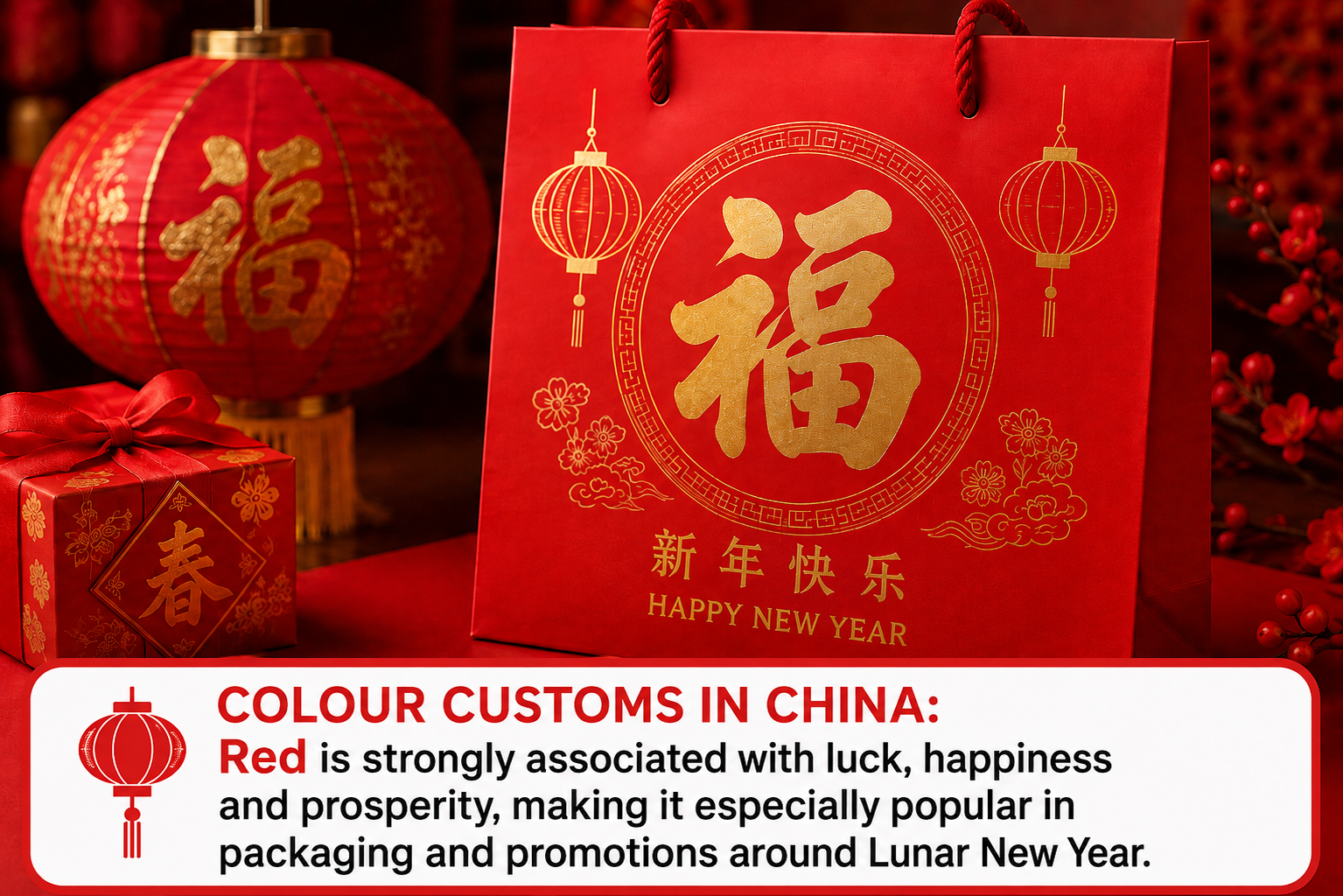
| Packaging and design may be developed for Australian homes, lifestyles and tastes. | In markets such as China, red and gold packaging may be used to signal luck and prosperity, especially around gift giving and Lunar New Year. |
| Australian advertising may use humour or a casual tone. | In some markets, humour may not translate well, and businesses may need a more respectful, family-focused or status-conscious message. |
Business responses
Adapt products and packaging
Colours, images, sizes, designs, ingredients or materials may need to be changed to suit local preferences.
Use local market research
Businesses can research local habits, family roles, buying patterns and design expectations before entering the market.
Train staff in local customs
Employees may need to understand greetings, clothing expectations, customer service behaviour and respectful conduct.
Example of how to write this in an exam
Customs can impact global business practice because different cultures may have different expectations about colours, gift giving, greetings, family roles, personal space and customer service. For example, an Australian business selling premium gift hampers into China may need to use red or gold packaging around Lunar New Year because these colours are commonly associated with luck and prosperity. This would affect packaging and promotion because the business cannot assume Australian-style branding will carry the same meaning overseas. As a result, respecting customs can make the product feel more appropriate for the local market and improve customer acceptance.
🎉 Holidays and celebrations
Holidays and celebrations are important religious, cultural or national events that influence when people work, shop, travel, celebrate and spend money.
Examples include Christmas, Easter, Ramadan, Eid, Lunar New Year, Diwali, Golden Week, national days and local festivals.
Impact on global business practice
Holidays and celebrations can affect trading hours, staffing, production schedules, delivery times, tourism demand, marketing campaigns and product launches.
They can create risks, such as supply chain delays or staff shortages, but they can also create opportunities through seasonal promotions and peak spending periods.
Australia compared with overseas markets
| Common Australian business approach | Examples of overseas difference |
|---|---|
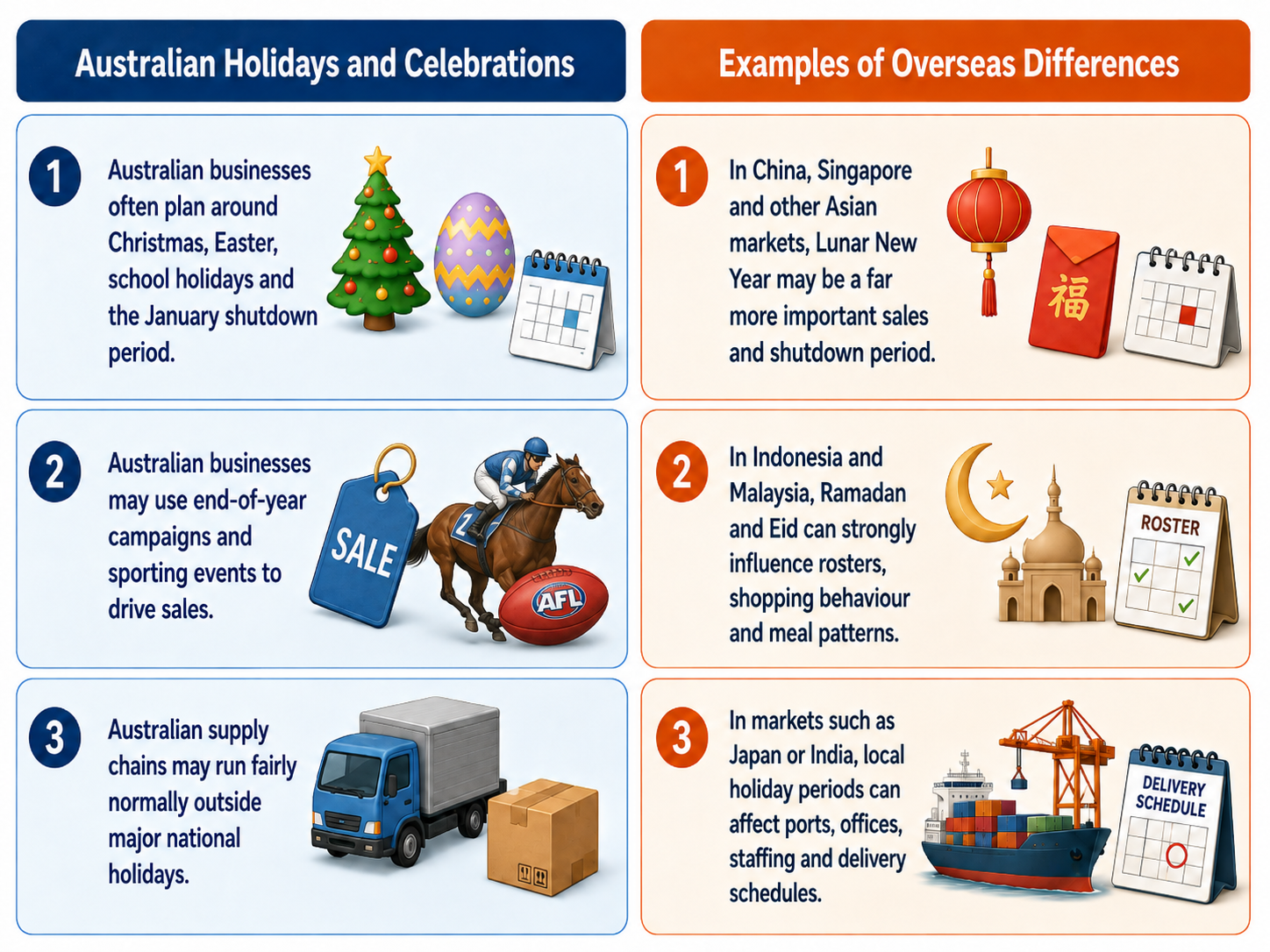
| Australian businesses often plan around Christmas, Easter, school holidays and the January shutdown period. | In China, Singapore and other Asian markets, Lunar New Year may be a far more important sales and shutdown period. |
| Australian businesses may use end-of-year campaigns and sporting events to drive sales. | In Indonesia and Malaysia, Ramadan and Eid can strongly influence rosters, shopping behaviour and meal patterns. |
| Australian supply chains may run fairly normally outside major national holidays. | In markets such as Japan or India, local holiday periods can affect ports, offices, staffing and delivery schedules. |
Business responses
Plan rosters and operations
The business may need to adjust staffing, trading hours, production and delivery around local holidays.
Time marketing campaigns
Promotions can be timed around local celebrations, gift-giving periods or peak tourism demand.
Prepare for supply delays
Major holidays can affect ports, factories, couriers, suppliers and government offices.
Example of how to write this in an exam
Holidays and celebrations can impact global business practice because they affect when people work, travel, buy products, attend meetings and receive deliveries. For example, a business operating in China may need to plan around Lunar New Year, while a business operating in Indonesia or Malaysia may need to plan around Ramadan and Eid. As a result, the business may need to change trading hours, staffing rosters, marketing campaigns, production schedules and delivery dates to avoid disruption and take advantage of peak spending periods.
🙏 Religious beliefs
Religious beliefs are faith-based values, practices and rules that may influence food, ingredients, clothing, working hours, prayer, product use and acceptable marketing.
Impact on global business practice
Religious beliefs can affect product ingredients, certification, advertising, uniforms, rosters, workplace policies, customer service and supplier practices.
Businesses that respect religious expectations can build trust. Businesses that ignore religion may offend customers or damage their brand reputation.

Australia compared with overseas markets
| Common Australian business approach | Examples of overseas difference |
|---|---|
| Religion may be less visible in everyday business practice for many Australian businesses. | In Indonesia and Malaysia, religion can strongly influence food, ingredients, certification, dress and trading expectations. |
| Food, skincare or health products may be sold without specific religious certification. | In Muslim-majority markets, customers may want halal-friendly products and trustworthy labelling. |
| Australian workplaces may not regularly structure operations around prayer times or fasting periods. | In some markets, businesses may need to consider prayer, fasting, religious leave and respectful promotion during sacred periods. |
Business responses
Adapt products and ingredients
Food, skincare, cosmetics and health products may need to avoid ingredients that conflict with religious expectations.
Consider certification
Businesses may need halal certification or other approvals to reassure customers in certain markets.
Respect prayer and holidays
Rosters, meetings and trading hours may need to consider prayer times, religious holidays or fasting periods.
Example of how to write this in an exam
Religious beliefs can impact global business practice because they may influence product ingredients, working hours, holidays, advertising and customer expectations. For example, an Australian skincare business may need to ensure its products are halal-friendly when entering Indonesia or Malaysia. This could affect labelling, certification and marketing because customers may want reassurance that products match their religious expectations. As a result, religious beliefs can affect product design and customer trust in global markets.
🤝 Business etiquette
Business etiquette refers to the expected behaviour in professional settings, including greetings, meeting style, punctuality, formality, dress, gift giving, negotiation style, business cards and respect for authority.
Impact on global business practice
Business etiquette can affect negotiations, trade visits, partnerships, staff management and first impressions. A meeting style that seems normal in Australia may seem too casual, too direct or disrespectful in another culture.
Correct etiquette can help build trust and credibility. Poor etiquette can weaken negotiations and damage relationships before business begins.
Australia compared with overseas markets
| Common Australian business approach | Examples of overseas difference |
|---|---|
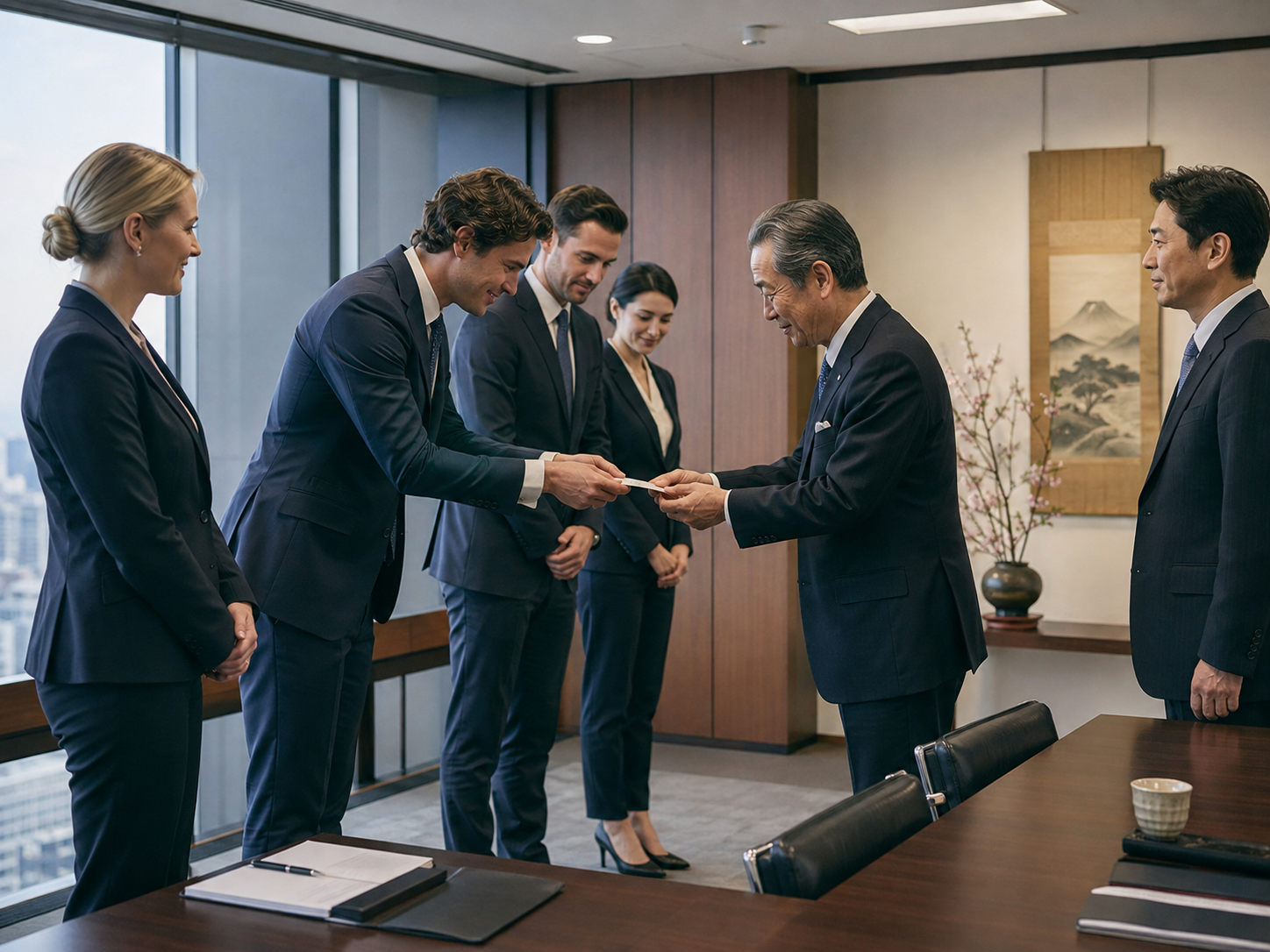
| Australian business meetings are often relatively informal, with first names used quickly and direct discussion common. | In Japan, meetings may be more formal, titles matter more and business cards are handled carefully as a sign of respect. |
| Australian managers may focus quickly on the business deal. | In markets such as Indonesia or China, relationship-building may occur before detailed negotiation. |
| Australian negotiation may be practical and time-efficient. | In some cultures, patience, hierarchy and consensus are more important than speed. |
Business responses
Train managers before negotiations
Managers should understand local meeting style, greetings, titles, formality and relationship-building expectations.
Use local advisers or partners
Local advisers can guide managers on respectful behaviour and help avoid cultural mistakes.
Allow time to build trust
In some markets, decisions may require relationship-building before contracts are signed.
Example of how to write this in an exam
Business etiquette can impact global business practice because meeting style, negotiation, formality, hierarchy and decision-making can differ between countries. For example, Australian managers may be used to direct and informal meetings, while Japanese, Indonesian or Malaysian partners may expect more formality and relationship-building. This could affect the timing of negotiations and the way managers communicate with local stakeholders. As a result, business etiquette can influence whether the business builds trust and secures strong overseas relationships.
💬 Communication protocols
Communication protocols are the accepted ways people exchange information, give feedback, negotiate, use language and show respect in a business setting.
This includes spoken language, written communication, translation, tone, directness, body language, silence, feedback and meeting behaviour.
Impact on global business practice
Communication protocols can affect negotiations, staff management, training, customer service, advertising, contracts and digital communication.
Australian managers may be used to direct feedback and practical communication. In some cultures, indirect communication may be used to preserve harmony, show respect or avoid embarrassment.
Australia compared with overseas markets
| Common Australian business approach | Examples of overseas difference |
|---|---|
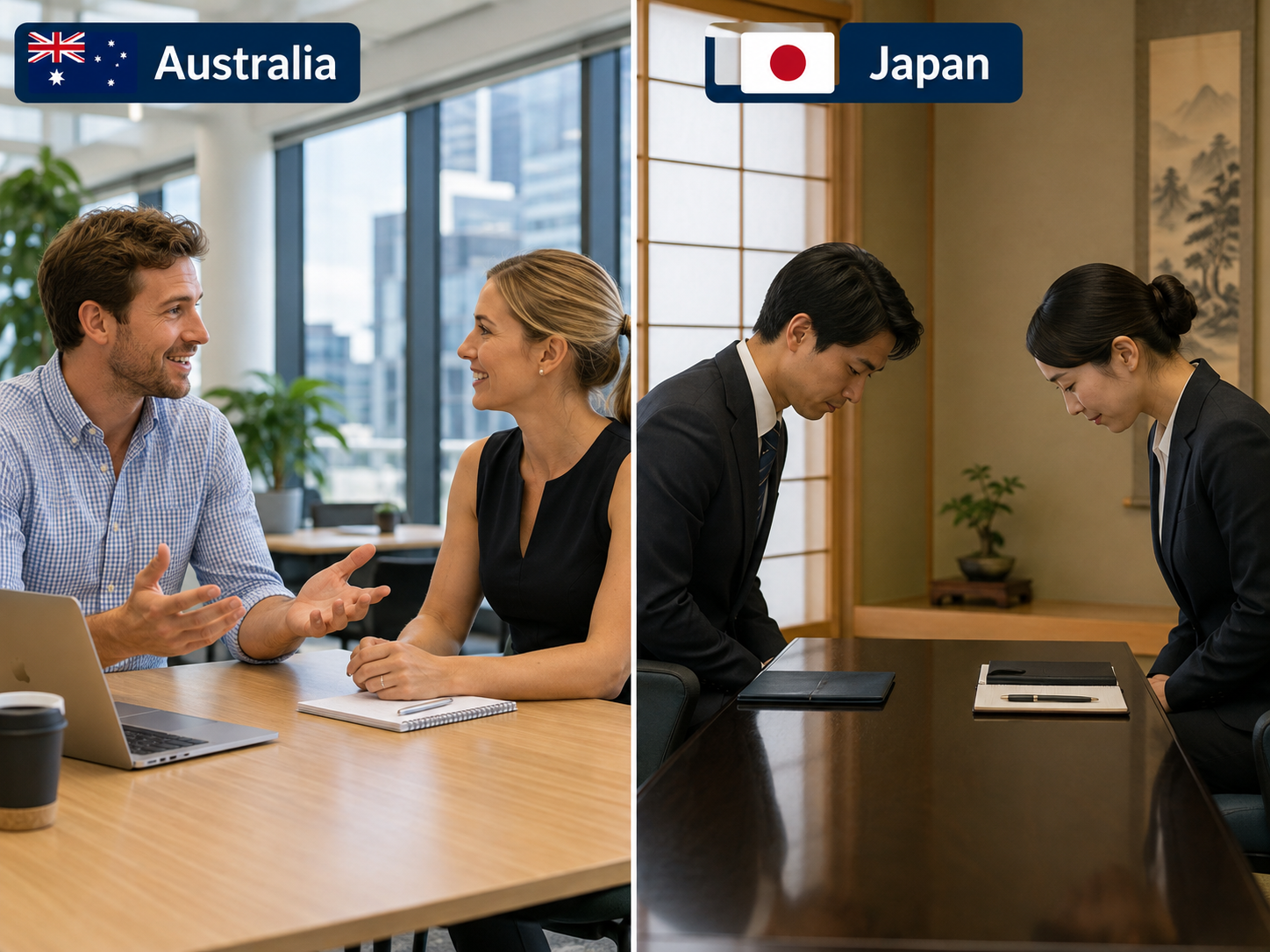
| Communication in Australia is often direct, practical and relatively informal. | In countries such as Japan, communication may be more indirect, with greater emphasis on politeness, silence and reading context. |
| Australian managers may give feedback openly and clearly. | In some cultures, especially parts of Asia, criticism may need to be delivered more privately or indirectly to avoid embarrassment. |
| Businesses may rely heavily on English websites, contracts and product information. | In many international markets, communication may need translation, localisation and more culturally appropriate wording. |
Business responses
Use translation and localisation
Websites, contracts, training materials, advertisements and instructions may need translation and local examples.
Adjust feedback style
Managers may need to avoid blunt criticism and use more private or indirect feedback in some cultures.
Employ local staff
Local staff can help interpret language, tone, silence, gestures and customer expectations.
Example of how to write this in an exam
Communication protocols can impact global business practice because different countries may have different expectations about language, tone, feedback and negotiation. For example, an Australian exporter may need to use translators or adapt its communication style when discussing products with buyers in Japan, Korea or France. This could affect how the business presents quality, supply capacity and pricing information. As a result, effective communication protocols can reduce misunderstandings and improve the chance of successful export relationships.
🎧 Prefer listening?
If you prefer listening to the content in podcast format:
🎥 Prefer watching?
If you prefer watching the content in video format:
🃏 Flashcards
Card 1 of 18
🎮 Revision Games
💰 BME Millionaire
Climb the prize ladder. Use your lifelines wisely.
👔 Business Boss
Make 10 global decisions. Balance cultural fit, communication, customer acceptance and relationship strength.
⚡ 60 Second Showdown
A varied 60-second challenge covering the six cultural considerations and their business impacts.

Biz Fact: In Japan, business cards are usually given and received with two hands, and immediately stuffing one into your pocket can seem disrespectful.
Past Exam Questions
Use these past exam questions to see how this dotpoint has been assessed. Pay close attention to the command term, the number of marks and whether the question is Section 1 or Section 2.
Section 1 Questions
2016 — Section 1 — Question 3(b) — 6 marks
Context
After a sustained period of strategic global business growth, an international hotel chain reviews its ethical decisions and business practices.
3(b): Analyse the impact of two cultural considerations on the global business practice of the hotel chain. (6 marks)
One:
Two:
Command term focus: Analyse
Analyse: identify the variables, explain two linked relationships and draw out the implication.
See the full command term guide here: Command Terms.
3(b) Sample answer
One cultural consideration that could affect the global business practice of an international hotel chain is religious beliefs. The relationship is that religious beliefs influence the services and facilities that guests may expect, as some customers may require halal food, prayer spaces, alcohol-free areas or sensitivity around religious holidays such as Ramadan. This also affects staff training and marketing decisions, as employees may need to understand how to serve guests respectfully across different religious environments. The implication is that customer satisfaction and repeat bookings may be limited over time if the hotel chain does not respect local religious expectations.
A second cultural consideration is communication protocols. The relationship is that communication protocols influence service quality, as customers and staff in different countries may have different expectations about language, tone, feedback and formality. This also affects operational consistency, as the hotel may need multilingual staff, translated information and cultural training to reduce misunderstandings across different locations. The implication is that the hotel chain’s international reputation may be weakened over time if poor communication leads to inconsistent service or customer complaints.
2017 — Section 1 — Question 3(c) — 4 marks
Context
The board of MIXT Enterprises is looking to expand operations internationally and employ a new management team.
3(c): Management is the process of ‘getting things done through other people to achieve the goals and objectives of the business’. Local culture plays an important role in management around the world. Outline two cultural considerations in global business practice. (4 marks)
One:
Two:
Command term focus: Outline
Outline: state each cultural consideration and briefly clarify how it affects global business practice.
See the full command term guide here: Command Terms.
3(c) Sample answer
One cultural consideration is business etiquette. This refers to expected professional behaviour, such as greetings, meeting style, dress, formality, punctuality and respect for hierarchy. MIXT Enterprises would need to understand local etiquette so managers can build trust and avoid offending overseas employees or partners.
A second cultural consideration is communication protocols. This refers to the accepted way people share information, give feedback and negotiate. MIXT Enterprises may need to adapt its communication style when managing international employees because direct Australian communication may not suit every culture.
2023 — Section 1 — Question 6 — 9 marks
Context
Cultural differences can be a source of conflict for many businesses operating globally. Successful organisations therefore need to consider culture when planning and implementing business strategies.
6: Explain the impact of the following on global business practice.
Levels of education:
Holidays and celebrations:
Command term focus: Explain
Explain: show cause and effect by explaining how each cultural consideration changes business practice and the result.
See the full command term guide here: Command Terms.
6 Sample answer
Levels of education: Levels of education can impact global business practice because customers or employees in different countries may have different literacy, numeracy, language or technical skills. This means a business may need to adjust training, instructions, product information, websites or customer support. For example, an Australian online education business may need translated course content, visual examples or simpler instructions for some overseas markets. As a result, levels of education can affect product development and communication because the business must make sure customers and employees understand the information provided.
Holidays and celebrations: Holidays and celebrations can impact global business practice because they affect when people work, travel, buy products, attend meetings and receive deliveries. For example, a business operating in China may need to plan around Lunar New Year, while a business operating in Indonesia or Malaysia may need to plan around Ramadan and Eid. As a result, the business may need to change trading hours, staffing rosters, marketing campaigns, production schedules and delivery dates to avoid disruption and take advantage of peak spending periods.
2025 — Section 1 — Question 5 — 9 marks
Context
A successful business considers cultural impacts when operating in a global environment.
5: Explain the impact of the following cultural considerations on global business practice.
Religious beliefs:
Customs:
Business etiquette:
Command term focus: Explain
Explain: show cause and effect by linking each cultural consideration to a change in global business practice and the result.
See the full command term guide here: Command Terms.
5 Sample answer
Religious beliefs: Religious beliefs can impact global business practice because they may influence product ingredients, working hours, holidays, advertising and customer expectations. For example, a business operating in Indonesia or Malaysia may need to consider halal requirements and avoid marketing that conflicts with Muslim consumer expectations. As a result, the business may need to adapt products, rosters, packaging and promotion to build trust in the local market.
Customs: Customs can impact global business practice because different cultures may have different expectations about greetings, gift giving, family roles, colours, personal space, service style and customer behaviour. For example, an Australian gift business selling into China may need to adjust colours, packaging and promotional messages around Lunar New Year. As a result, understanding customs can help the business avoid offence and make products more appealing to customers.
Business etiquette: Business etiquette can impact global business practice because meeting style, negotiation, formality, hierarchy and decision-making can differ between countries. For example, Australian managers may be used to direct and informal meetings, while Japanese, Indonesian or Malaysian partners may expect more formality and relationship-building. As a result, the business may need to train managers in local etiquette so they can build strong overseas relationships and negotiate successfully.
Section 2 Questions
2018 — Section 2 — Question 7(c) — 6 marks
Case study / context
Daisy has been operating a surf and yoga camp in the small beach town of Yallingup in Western Australia. She is very happy with the success of the business, which attracts both local and international tourists. She is thinking of expanding to Bali, Indonesia. This appears to be an ideal location, due to its popularity as a holiday destination, the availability of affordable flights, diverse culture, good surf and the fact that there are already established surf and yoga camps successfully operating in Bali. Daisy has also learned the Indonesian language during her past visits to Bali. She decides she needs to assess the strategic direction of her business and will need to consider whether it is worth expanding overseas.
Through market research, Daisy has discovered Bali has a multi-religious population, with a rich dance and music culture. She has also found that it is important to build relationships before starting business negotiations. Australia and Indonesia are strategic partners and cooperate in a range of areas, including politics, economics, tourism and education.
Referring to the source information and your own knowledge, prepare a report or essay addressing the following:
7(c): Explain two cultural considerations that might affect the success of Daisy’s surf and yoga camp. (6 marks)
Command term focus: Explain
Explain: show cause and effect by linking each cultural consideration to Daisy’s Bali operations and the result.
See the full command term guide here: Command Terms.
7(c) Sample answer
One cultural consideration is religious beliefs. Bali has a multi-religious population, so Daisy would need to respect local places of worship, ceremonies, religious offerings and days of significance. This could affect the camp’s timetable, marketing, clothing expectations and behaviour around local communities. As a result, respecting religious beliefs could help Daisy build trust and avoid offending local residents or customers.
A second cultural consideration is business etiquette. The case states that it is important to build relationships before starting business negotiations. This means Daisy should not rely only on quick, direct Australian-style business discussions. She may need to spend time building trust with local suppliers, landlords, staff and tourism partners. As a result, understanding business etiquette could improve the success of her Bali expansion by strengthening local relationships.
2019 — Section 2 — Question 9(a) — 4 marks
Case study / context
Aussie-Homestead Foods has been supplying the restaurant and retail markets for several years. After reading the following article, its management is considering the establishment of a native foods division and is currently in discussions with potential buyers in other countries.
Native bush food demand outstripping supply
The demand for Australian native foods across the country is by far exceeding supply, according to the industry’s peak body, Australian Native Food and Botanicals (ANFAB), who is encouraging new producers to enter the industry and existing growers to plant more crops. A spokesperson says, “We’re a supply-poor industry at the moment. The buyers are there; Asia is our neighbour and their interest in our native food products for culinary use is huge”.
An Australian exporter has been growing finger limes on her property at Possum Creek, in the far north coast of New South Wales, for more than 15 years. She started exporting her crop to the European Union (EU) 10 years ago. There has also been Asian interest in finger limes coming from Korea, Taiwan, Singapore and Hong Kong. “The fine food market in Asia has just gone nuts, absolutely nuts, and it’s a lot closer to home”, she said.
Established native food growers say there is plenty of room for growth in the industry. One grower who has been in the industry since 2000 exports lemon myrtle around the world. Korea is his biggest market for herbal tea, with some further interest from Japan and France. The potential for growth in the industry is limitless. Another Australian exporter says about her products, “The potential for our native plant products is enormous and everybody and anybody, especially foreigners who taste or see the food, fall in love with the food instantly”.
9(a): Outline two cultural considerations that Aussie-Homestead Foods would need to consider while undertaking discussions with potential buyers, if it plans to enter the native foods export industry. (4 marks)
Command term focus: Outline
Outline: state each cultural consideration and briefly clarify its effect on discussions with overseas buyers.
See the full command term guide here: Command Terms.
9(a) Sample answer
One cultural consideration is business etiquette. Aussie-Homestead Foods would need to understand how buyers in countries such as Korea, Japan, Singapore or France expect meetings, greetings, negotiations and relationship-building to occur. This would help the business appear professional and respectful during export discussions.
A second cultural consideration is communication protocols. The business may need to consider language differences, translation, tone and how directly buyers expect information to be presented. Clear and culturally appropriate communication would help avoid misunderstandings about native food quality, supply capacity, pricing and delivery.
2021 — Section 2 — Question 7(c) — 8 marks
Case study / context
Smoothex is a Perth company specialising in producing organic skin care and make-up for men and women. It currently has two stores in Perth. Founded in 2010 by Chief Executive Officer (CEO) Rani, Smoothex began by producing 100% natural make-up and has expanded its range to now include daily essentials such as facial cleansers, creams and serums. The business’ main ingredients are locally sourced coconut oil, rose water, sandalwood and lemon myrtle. From 2018, the business has ensured that its products are vegan to cater for this fast-growing market sector. Smoothex prides itself on being environmentally sustainable and a supporter of various local charities.
Smoothex has tailored its products to suit a wide range of skin types and conditions, and has been advertising through its social media pages of Facebook and Instagram. The products have grown in popularity due to the business’ online skin care and make-up tutorials, which it posts on these platforms. Rani has noticed increased engagement from consumers in South-East Asia, in particular a growing customer base in Indonesia and Malaysia. Due to the success of Smoothex, Rani is thinking of opening stores in both Indonesia and Malaysia.
Smoothex believes that entering these South-East Asian markets will be a sound business decision, in particular due to the growing number of females who are becoming a part of the workforce in these countries. This means there is likely to be a high demand for Rani’s skin care and make-up products. With low inflation and all-time low interest rates in Australia, Smoothex would be able to access funding to invest in these overseas markets. Fluctuations in the exchange rates between the three nations have also been low, and both Indonesia and Malaysia are members of the Association of South East Asian Nations (ASEAN). Rani is also aware that Australia has free trade agreements (FTAs) with both Indonesia and Malaysia and is keen to take advantage of these benefits.
Referring to the case study and your own knowledge, prepare a report or essay in which you answer the questions below.
7(c): Analyse two cultural considerations that could affect the success of Smoothex in the Indonesian and/or Malaysian markets. (8 marks)
Command term focus: Analyse
Analyse: identify the variables, explain two linked relationships and draw out the implication. Section 2 requires application.
See the full command term guide here: Command Terms.
7(c) Sample answer
One cultural consideration that could affect Smoothex’s success in Indonesia and Malaysia is religious beliefs, particularly expectations around halal compliance. The relationship is that religious beliefs influence customer trust and purchasing decisions, as some consumers may avoid cosmetic products that do not align with halal requirements. This also affects product and marketing decisions, as Smoothex may need to adjust ingredients, labelling and certification to meet local expectations. The implication is that sales growth and brand acceptance may be limited over time if cultural expectations are not adequately addressed.
A second cultural consideration is customs. The relationship is that customs may affect how Smoothex presents its skincare and make-up products because beauty routines, modesty expectations, social media content and customer service expectations may differ between Perth, Indonesia and Malaysia. This also affects marketing decisions, as Smoothex may need local models, local language captions and culturally appropriate tutorials on Facebook and Instagram. The implication is that adapting to local customs could help Smoothex turn its existing South-East Asian online engagement into stronger store sales and customer loyalty.
2022 — Section 2 — Question 9(c) — 8 marks
Case study / context
EduOz.com is an Australian owned website that has been providing online courses in business skill development for the past five years. These courses are designed for young people wanting to enhance their business skills and knowledge. These courses, currently written in English, comprise a set of individual topic modules with written content, videos and learning activities that relate to starting up a business enterprise. Domestically, EduOz.com has been successful in attracting a strong customer base. It now wants to expand its reach globally by introducing its online courses into foreign markets. The focus of EduOz.com is on becoming a global brand leader in business skill development for budding entrepreneurs around the world who want to start their own businesses.
In developing its online products, EduOz.com is aware that it needs to take into consideration various cultural issues, business regulations and local industry rivalry. The developers are unsure whether to create courses in different languages or to remain with their current courses written in English. Course content could be modified to reflect the diverse cultures, economic environments, government policies and legal requirements of a variety of countries. Currently, prospective students need to have a basic level of understanding of English literacy and numeracy to complete the current courses. EduOz.com needs to invest time and research into developing course content addressing business practices in the countries where it intends to sell its courses. It is also considering whether it should re-brand its products by creating a new name and catchy slogan for its entry into this market.
Referring to the case study and your own knowledge, answer the questions below.
9(c): Analyse how two cultural considerations might impact EduOz.com’s global business practice in developing courses. (8 marks)
Command term focus: Analyse
Analyse: identify the variables, explain two linked relationships and draw out the implication for EduOz.com’s course development.
See the full command term guide here: Command Terms.
9(c) Sample answer
One cultural consideration that could affect EduOz.com’s global business practice is levels of education. The relationship is that different levels of English literacy, numeracy and business knowledge may affect whether students in foreign markets can understand the current English course content. This also affects product development, as EduOz.com may need to create courses in different languages, simplify written content, add subtitles and include more visual learning activities. The implication is that EduOz.com may struggle to become a global brand leader if its courses are not accessible to students with different education levels.
A second cultural consideration is communication protocols. The relationship is that communication protocols may affect how EduOz.com explains business ideas because language, tone, examples and teaching style may not transfer easily from Australia to every foreign market. This also affects branding, as a new name, slogan or course examples may need to be adapted so they are clear and appropriate in different cultures. The implication is that culturally suitable communication could make EduOz.com’s courses more credible and useful in global markets over time.
2024 — Section 2 — Question 9(d) — 8 marks
Case study / context
Crafted Haven Furniture (CHF) is an iconic furniture business, based in Albany, Western Australia (WA), which specialises in creating custom furniture. The business takes pride in manufacturing unique pieces that are innovatively designed and produced with great attention to detail and expert craftsmanship. The business ensures that it keeps up-to-date with the latest quality management and production techniques in order to maintain its competitive edge.
Starting out in 2010, CHF initially appealed to customers from the Great Southern region of WA, but since 2015, CHF has grown in popularity and now sells to customers around Australia with display showrooms in each of the major cities. Over the past five years, CHF’s exceptional furniture designs have also sparked growing interest internationally, prompting owners May and Sun to think about opening their first overseas store. They are considering initially expanding into Indonesia.
CHF would like to set up a manufacturing base in Indonesia, as well as two stores in the country. The business prioritises ethical production methods and is renowned for leading environmental sustainability in Australia. May and Sun plan to visit their business consultant to explore ways of maintaining a high standard of ethical practice in their expansion to Indonesia. They are also aware that CHF will need to be culturally considerate if they are to be successful in Indonesia. Additionally, they would like to analyse the financial information below with their consultant.
Financial ratios
Current ratio: 2022 — 125%; 2023 — 175%
Debt to equity ratio: 2022 — 55%; 2023 — 60%
Profit ratio: 2022 — 12%; 2023 — 14%
Return on equity ratio: 2022 — 8%; 2023 — 11%
Expense ratio: 2022 — 60%; 2023 — 55%
Refer to the case study and your own knowledge to answer the questions below:
9(d): Analyse the impact of cultural customs and business etiquette on the success of CHF’s operations in Indonesia. (8 marks)
Command term focus: Analyse
Analyse: identify the variables, explain two linked relationships and draw out the implication for CHF’s success in Indonesia.
See the full command term guide here: Command Terms.
9(d) Sample answer
Cultural customs could impact CHF’s success in Indonesia. The relationship is that local customs may influence customer expectations about furniture design, home layout, materials, colours, family living arrangements and customer service. This also affects CHF’s operations and marketing, as the business may need to adapt its custom furniture and showroom presentation while still maintaining its Australian quality, craftsmanship and sustainability reputation. The implication is that culturally suitable products are more likely to build customer acceptance, repeat sales and successful expansion in Indonesia over time.
Business etiquette could also impact CHF’s success. The relationship is that May and Sun may need to build respectful relationships with Indonesian suppliers, employees, landlords, manufacturers and government contacts before the manufacturing base and two stores can operate smoothly. This also affects CHF’s ability to maintain ethical production methods, as strong local relationships may make it easier to communicate expectations around quality management, environmental sustainability and workplace standards. The implication is that good business etiquette can help CHF protect the ethical reputation and competitive edge that made it successful in Australia.