U4.15 — Features of Quality Management
Overview
Dotpoint 15: features of quality management.
Quality management is the organised approach a business uses to maintain and improve the quality of its products, services and processes so that required standards and customer expectations are met.
Quality management combines activities that detect defects, prevent defects and continually improve performance.
The three types of quality management in this dotpoint are:
- quality control — checking outputs and detecting defects
- quality assurance — building quality into processes to prevent defects
- quality improvement — continually improving products, services and processes over time

🔎 Quality control
What is quality control?
Quality control is the use of inspection, testing and measurement to check whether products, services or processes meet established quality standards and specifications.
It is mainly reactive, because it focuses on detecting defects, errors or non-conformance that have already occurred. Quality control checks may take place during production or after production and can involve visual inspections, product testing, sampling and performance checks.
If a problem is identified, the business may correct, repair, rework or reject the output before it reaches the customer. This helps reduce defective products, customer complaints, returns and damage to the business’s reputation.
Features of quality control
Inspection
Products, services or production stages are checked against required quality standards or specifications.
Testing
Products may be tested for performance, safety, durability, reliability, size, temperature or other measurable requirements.
Sampling
A sample from a larger batch may be inspected to make conclusions about the quality of the whole batch.
Measurement
Actual results are compared with predetermined tolerances, specifications or quality criteria.
Performance and final checks
Visual inspections, performance checks and final product checks help verify that required quality requirements have been met before delivery.
Benefits and limitations
Benefits
- Detects defective or non-conforming outputs before they reach customers.
- Helps reduce customer complaints, returns and damage to reputation.
- Provides evidence about whether required quality standards are being met.
- Can identify patterns in defects that require further investigation.
Limitations
- Defects have already occurred, so materials, labour and time may already have been wasted.
- Inspection and testing can increase production costs and slow output.
- Rework, scrap and rejected products can reduce efficiency.
- Sampling may not identify every defect in a larger batch.
Case study — Fortescue
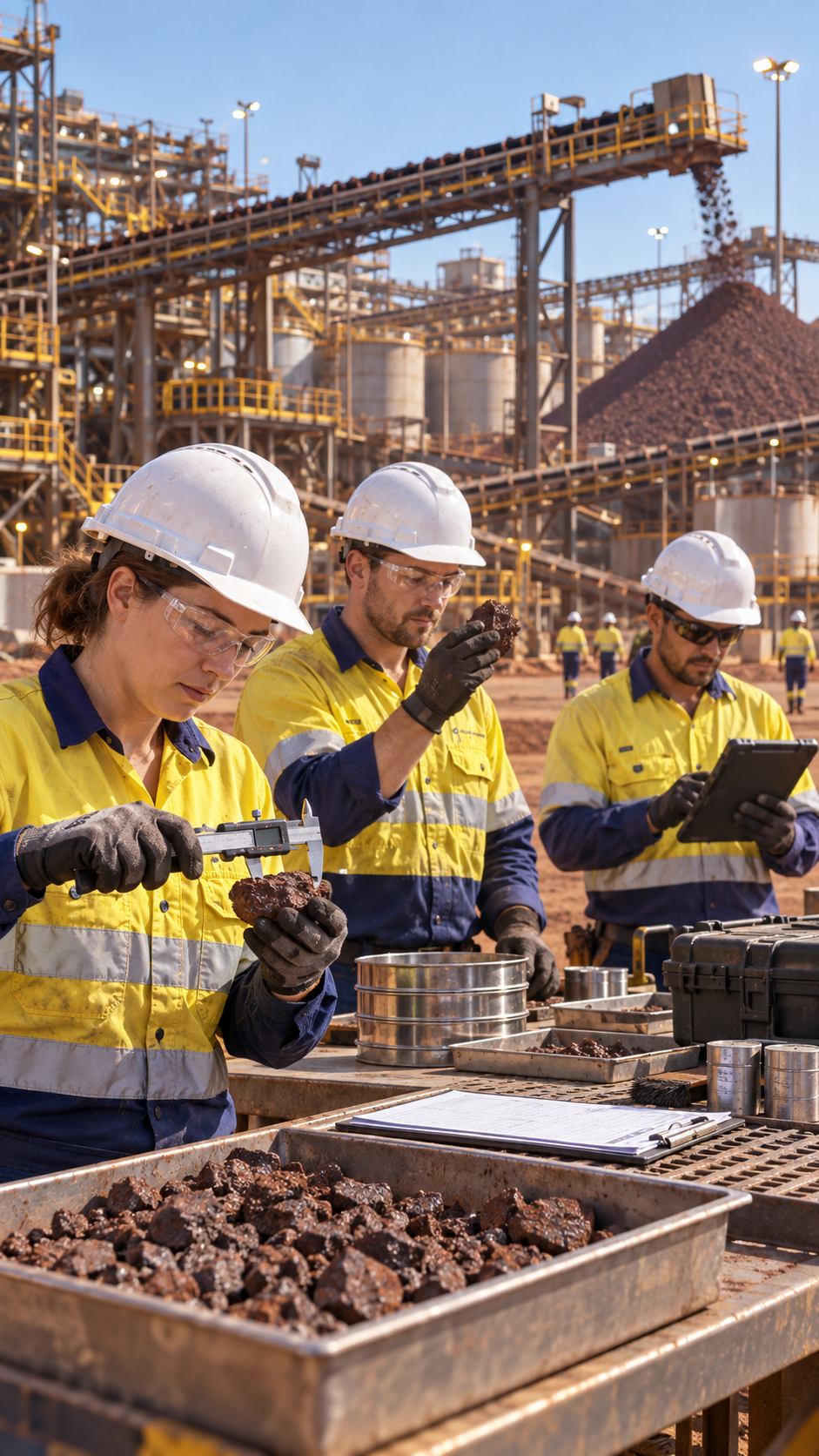
Fortescue operates large-scale iron ore mining, processing and export operations where product specifications and operational reliability are important. Quality control can be used at different points in the production process to check whether output meets required standards.
For example, Fortescue can sample and test iron ore to measure characteristics such as grade, moisture and other specifications before shipment. Equipment and processing outputs can also be inspected against required operating standards, while loading and transport processes can be checked to reduce the risk of incorrect or non-conforming shipments.
This is quality control because Fortescue is checking actual outputs and results against predetermined standards. If a shipment or production output does not meet the required specification, it can be corrected, blended, reprocessed or withheld before delivery. This helps protect customer satisfaction and Fortescue’s reputation, although testing, rework and delays can add cost.

How to write this in an exam
Quality control is the use of inspection, testing and measurement to check whether products, services or processes meet established quality standards. It can include visual inspections, product testing, sampling and performance checks during or after production. Quality control is mainly reactive because it focuses on defects or non-conformance that have already occurred. This will lead to defective outputs being corrected, repaired, reworked or rejected before they reach customers, helping reduce complaints and protect the reputation of the business.
🛡️ Quality assurance
What is quality assurance?
Quality assurance is a systematic and process-driven approach used to ensure products, services and processes consistently meet established quality standards and requirements.
It is mainly proactive, because it focuses on preventing defects and errors before they occur by building quality into the way work is performed. Quality assurance operates throughout the production process and product lifecycle through documented procedures, standards, employee training, audits, monitoring and clearly defined responsibilities.
If weaknesses are identified, the business can change procedures, improve training or strengthen controls before poor-quality outputs are produced. This helps improve consistency, reduce defects and rework, lower costs and strengthen customer confidence in the business.
Features of quality assurance
Policies and procedures
Clear quality policies, documented procedures and standard operating instructions guide how work should be performed.
Standards
Processes are assessed against predetermined internal or external quality standards and specifications.
Training and employee responsibility
Employees are trained in required procedures and are expected to self-check their work and take responsibility for quality throughout the process.
Audits, monitoring and reviews
Processes and systems are monitored and reviewed to check whether agreed quality procedures are being followed consistently and effectively.
Certification and ISO 9001
A business may use recognised external quality-management standards and seek independent certification.
ISO 9001 is an internationally recognised quality-management-system standard. It focuses on consistent processes, meeting customer and applicable requirements, monitoring performance and continually improving the quality management system.
Certification can provide external evidence that the business has a documented quality system meeting the standard’s requirements.

Benefits and limitations
Benefits
- Prevents defects before they become defective outputs.
- Reduces waste, rework, warranty costs and production errors.
- Improves consistency across employees, locations and production runs.
- Can increase customer confidence and support business expansion.
Limitations
- Developing procedures, training employees and conducting audits can be expensive.
- Detailed systems and documentation may increase administrative workload.
- Employees may resist new procedures or view them as restrictive.
- Certification and compliance do not guarantee that every product will be defect-free.
Case study — CSL
CSL operates in a highly regulated industry where biological medicines and other health products must be produced consistently and safely. Quality assurance is therefore built into the entire production system rather than relying only on final inspection.
CSL can use documented procedures, employee training, process validation, internal audits, monitoring, standardised work instructions and detailed record keeping throughout production. Employees can self-check their work and processes can be reviewed against internal requirements and recognised external standards.
CSL may also use quality-management frameworks such as ISO 9001 where relevant to support consistent processes and documented quality systems. The key point is that quality is designed into the process before a defect reaches the final product.
This helps CSL reduce errors and variation, improve consistency and strengthen confidence in the reliability of its operations. However, maintaining complex assurance systems requires significant training, documentation, auditing and compliance resources.

How to write this in an exam
Quality assurance is a systematic, process-driven approach used to ensure products, services and processes consistently meet established quality standards. It uses documented procedures, standards, employee training, audits, monitoring and clearly defined responsibilities throughout the process. A business may also use an external standard such as ISO 9001 to support a consistent quality management system. These features are important because they help prevent defects before they occur. As a result, quality assurance can reduce rework and costs while improving consistency and customer confidence.
📈 Quality improvement
What is quality improvement?
Quality improvement is the ongoing process of continually enhancing products, services and business processes so that quality, efficiency and performance improve over time.
It is proactive and continuous, because the business does not simply accept its current level of performance. Instead, managers and employees use customer feedback, quality data, employee suggestions, benchmarking and problem-solving to identify weaknesses and find better ways of working.
Improvements may involve changing processes, reducing waste, improving product design, introducing new technology or providing additional employee training. This can help the business reduce defects and costs, improve consistency and productivity, and deliver greater value to customers.
Features of quality improvement
Continuous improvement
The business regularly searches for opportunities to improve products, services and processes rather than waiting for major problems.
Employee participation
Employees who perform the work identify problems and suggest improvements because they observe the process regularly.
Quality circles and teamwork
Small groups or teams meet to discuss quality, productivity, waste and possible improvements.
Trust, empowerment and ownership
Employees are trusted to contribute ideas, solve problems and sometimes make decisions about workplace improvements.
Data, feedback, benchmarking and root-cause analysis
Customer feedback, defect data, performance information and benchmarking are used to identify the underlying cause of problems and improve the process.

Continuous improvement models
Businesses can adopt continuous improvement models such as:
1. Kaizen
Kaizen is a Japanese term meaning continuous improvement.
It focuses on regular, often small and incremental changes made by employees throughout the organisation. The aim is to improve quality, efficiency and productivity while reducing waste.
2. Total Quality Management
Total Quality Management (TQM) is an organisation-wide approach in which quality becomes the responsibility of all employees and is built into every part of the business.
It emphasises customer focus, continuous improvement, employee involvement and long-term commitment to high quality across the entire organisation.
Benefits and limitations
Benefits
- Can reduce defects, waste, rework and inefficient processes.
- Can improve productivity and quality over time.
- Employee involvement can increase ownership, motivation and problem-solving.
- Responding to customer feedback can strengthen satisfaction and competitiveness.
Limitations
- Continuous improvement requires time, training and management commitment.
- Employees may resist change or be unwilling to contribute ideas.
- Some improvements may require investment before benefits are realised.
- Small incremental changes may be insufficient when a major redesign or rapid change is required.
Case study — Toyota and kaizen
Toyota is strongly associated with kaizen and the idea that quality improvement should be continuous rather than occasional. Employees are encouraged to identify problems, raise concerns and contribute ideas for better ways of completing work.
For example, production teams can examine defects, delays, unnecessary movement, waiting time or waste and then test small changes to the way work is performed. Teams may use quality data, feedback and root-cause analysis to identify why a problem is occurring rather than simply correcting the defective output each time.
Over time, many small improvements can add up to major gains in quality, consistency and efficiency. This approach can lead to lower waste, stronger productivity and higher customer satisfaction. It can also increase employee ownership because workers contribute to improvements they help design.
However, kaizen works best when the business has a culture that supports participation, training, experimentation and ongoing change.

How to write this in an exam
Quality improvement is the ongoing process of continually enhancing products, services and business processes. It can involve customer feedback, quality data, employee suggestions, benchmarking, kaizen and problem-solving to identify weaknesses and improve performance. These approaches are important because they help the business find better ways of working and reduce waste or recurring defects. This will lead to stronger quality, higher efficiency, improved productivity and greater value for customers over time.
⚖️ Comparing control, assurance and improvement
| Aspect | Quality control | Quality assurance | Quality improvement |
|---|---|---|---|
| Main focus | Detect defects and non-conforming outputs. | Prevent defects by building quality into processes. | Continually enhance quality and performance. |
| Typical features | Inspection, testing, sampling, measurement and final checks. | Procedures, standards, training, audits, self-checking and certification. | Kaizen, TQM, employee ideas, teamwork, feedback, benchmarking and root-cause analysis. |
| Timing | During and/or after production. | Throughout the process and product lifecycle. | Ongoing over time. |
| Orientation | Mainly reactive. | Mainly proactive. | Proactive and continuous. |
| What is examined? | The output or result against a required standard. | The processes and systems used to achieve quality. | The opportunity to create a better future process or result. |
| Common benefit | Stops defective outputs reaching customers. | Reduces errors by preventing defects in the process. | Raises quality, efficiency and customer satisfaction over time. |
| Common limitation | Defects have already occurred and may create rework or waste. | Can be costly and administratively demanding to establish and maintain. | Requires time, participation and an ongoing commitment to change. |
| Key phrase | Detect defects. | Prevent defects. | Improve continuously. |
Memory hook
- CONTROL checks the output.
- ASSURANCE builds quality into the process.
- IMPROVEMENT raises performance over time.
How to distinguish in an exam
Quality control checks products or outputs against standards to detect defects, whereas quality assurance focuses on the procedures and systems used throughout production to prevent defects. Quality control is therefore mainly reactive and output-focused, while quality assurance is mainly proactive and process-focused.
Quality improvement is different because it focuses on continually achieving a better future result through approaches such as kaizen, TQM, employee participation, feedback and root-cause analysis.
🎧 Prefer listening?
If you prefer listening to the content in podcast format:
🎥 Prefer watching?
If you prefer watching the content in video format:
🃏 Flashcards
Card 1 of 12
🎮 Revision Games
💰 BME Millionaire
Climb the prize ladder. Use your lifelines wisely.
👔 Business Boss
Make 10 real management decisions. Every choice changes your KPIs — sometimes for better and worse.
⚡ 60 Second Showdown
A fast-paced 60-second challenge testing key BME knowledge under pressure.

Biz Fact: Nestlé conducts around 200,000 analytical tests in its factories every day to check food safety and product quality.
Past Exam Questions
Use these past exam questions to see how this dotpoint has been assessed. Pay close attention to the command term, the number of marks and whether the question is Section 1 or Section 2.
Section 1 Questions
2016 — Section 1 — Question 1(a), 1(b), 1(c) — 10 marks
Context
No specific business context is provided.
1(a): Distinguish between quality control and quality assurance. (2 marks)
1(b): Discuss two benefits for a business that adopts quality assurance as part of its quality management strategy. (4 marks)
1(c): Describe quality improvement and provide two examples that a business can use for this purpose. (4 marks)
Command term focus
Distinguish: make the differences between the concepts clear.
Discuss: develop the relevant points required by the question and weigh them up.
Describe: give the main characteristics or features with enough detail to show what it is like.
See the full command term guide here: Command Terms.
1(a) / 1(b) / 1(c) Sample answers
1(a) Quality control is mainly reactive because it checks products or outputs against quality standards to detect defects that have already occurred during or after production, whereas quality assurance is mainly proactive because it focuses on processes, procedures, training and standards designed to prevent defects from occurring in the first place.
1(b) One benefit of quality assurance is fewer defects and less waste. Documented procedures, training and process checks help employees perform work correctly the first time. This can reduce rework, scrap and warranty costs.
A second benefit is greater consistency. Common standards and procedures help employees produce goods or services to the same quality level across different production runs. This can strengthen customer confidence and protect the reputation of the business.
1(c) Quality improvement is the ongoing process of continually enhancing products, services and business processes. It involves regularly identifying better ways of working rather than simply maintaining the current standard.
One example is kaizen, where employees make regular small improvements to reduce waste or defects. A second example is the use of quality circles, where employees meet in small groups to identify quality problems and suggest practical improvements.
2019 — Section 1 — Question 4(b)(i), 4(b)(ii) — 6 marks
Context
Smart watches are continually improving in terms of style, quality and functionality. Today there are several attractive options available globally from technology companies and fashion brands to suit the various customer tastes and preferences.
4(b)(i): Explain the features of quality assurance. (3 marks)
4(b)(ii): Explain the features of quality improvement. (3 marks)
Command term focus: Explain
Explain: show cause and effect by explaining why or how something happens and the result.
See the full command term guide here: Command Terms.
4(b)(i) / 4(b)(ii) Sample answers
4(b)(i) Quality assurance is a systematic, process-driven approach that aims to prevent defects by using documented procedures, standards, employee training, audits and self-checking throughout production. These features are important because they make the production of smart watches more consistent and reduce the chance of errors occurring. This will lead to fewer defects, less rework and greater customer confidence in the quality and functionality of the product.
4(b)(ii) Quality improvement is the ongoing process of continually enhancing products, services and processes through approaches such as kaizen, employee participation, customer feedback and root-cause analysis. This is important because smart watch businesses operate in a market where style, quality and functionality continually change. As a result, ongoing improvements can reduce defects, strengthen product performance and help the business remain competitive as customer expectations change.
2021 — Section 1 — Question 2(b), 2(c) — 6 marks
Context
Designing and manufacturing a product of quality requires businesses to be committed to careful planning and management.
2(b): Identify three features of quality assurance. (3 marks)
2(c): Identify three features of quality improvement. (3 marks)
Command term focus: Identify
Identify: name or state the required feature or point only.
See the full command term guide here: Command Terms.
2(b) / 2(c) Sample answers
2(b)
- documented quality procedures and standardised work instructions
- employee training and self-checking
- audits and process reviews against quality standards
2(c)
- continuous improvement or kaizen
- employee participation and quality circles
- customer feedback, performance data and root-cause analysis
Section 2 Questions
2018 — Section 2 — Question 9(c) — 6 marks
Case study / context
My Ethical Eats Ltd manufactures clean and healthy food products for restaurants in the Fremantle and Perth areas. It specialises in cold beverages and manufactures a range of snack foods, soups and healthy frozen meals. The business has an excellent reputation for using locally-sourced organic products and implementing ethical work practices. My Ethical Eats Ltd is recognised by its bold packaging and simple, colourful logo.
The business is growing and the owners are considering purchasing new manufacturing equipment to cater for the increase in demand for their food products. The new equipment would meet local production needs as well as providing for future expansion overseas. The funding of the new manufacturing equipment has caused cash flow concerns for the owners. In addition, the growing demand for the company’s products has raised some concerns, including the maintenance of the company’s reputation for producing high-quality products and ethical work practices throughout this expansion.
9(c): Explain two features of quality management that My Ethical Eats Ltd would need to consider if it was to purchase the new manufacturing equipment. (6 marks)
Command term focus: Explain
Explain: show cause and effect by explaining why or how something happens and the result. Section 2 requires application.
See the full command term guide here: Command Terms.
9(c) Sample answer
9(c) — Quality assurance: My Ethical Eats Ltd could introduce documented operating procedures, employee training and quality standards for the new manufacturing equipment. This is important because employees will need to operate the equipment consistently while producing beverages, snack foods, soups and frozen meals. This will lead to fewer process errors and a greater chance that My Ethical Eats maintains the high product quality that supports its existing reputation while expanding production.
Quality control: My Ethical Eats Ltd could inspect and test products produced using the new equipment, such as checking portion size, temperature, packaging and other required specifications. This is important because the new equipment may create non-conforming outputs if it is incorrectly calibrated or operated. As a result, defective products can be identified, corrected or removed before they are supplied to restaurants, helping protect the business’s reputation for high-quality food products.
2024 — Section 2 — Question 9(b) — 4 marks
Case study / context
Crafted Haven Furniture (CHF) is an iconic furniture business, based in Albany, Western Australia (WA), which specialises in creating custom furniture. The business takes pride in manufacturing unique pieces that are innovatively designed and produced with great attention to detail and expert craftsmanship. The business ensures that it keeps up-to-date with the latest quality management and production techniques in order to maintain its competitive edge.
Starting out in 2010, CHF initially appealed to customers from the Great Southern region of WA, but since 2015, CHF has grown in popularity and now sells to customers around Australia with display showrooms in each of the major cities. Over the past five years, CHF’s exceptional furniture designs have also sparked growing interest internationally, prompting owners May and Sun to think about opening their first overseas store. They are considering initially expanding into Indonesia.
CHF would like to set up a manufacturing base in Indonesia, as well as two stores in the country. The business prioritises ethical production methods and is renowned for leading environmental sustainability in Australia. May and Sun plan to visit their business consultant to explore ways of maintaining a high standard of ethical practice in their expansion to Indonesia. They are also aware that CHF will need to be culturally considerate if they are to be successful in Indonesia. Additionally, they would like to analyse the financial information below with their consultant.
9(b): Discuss how CHF can control the quality of its operations in the Indonesian market. (4 marks)
Command term focus: Discuss
Discuss: develop relevant points for and against and weigh them up. Section 2 requires application.
See the full command term guide here: Command Terms.
9(b) Sample answer
9(b) — For: CHF could use inspection and measurement at key stages of furniture production in Indonesia. Checking dimensions, joins, finishes and workmanship against CHF’s Australian specifications would help detect non-conforming custom furniture before sale, protecting its reputation for expert craftsmanship.
For: CHF could also use sampling and final product checks on completed furniture before it is sent to the two Indonesian stores. This would provide evidence that production is meeting the required standard and allow defective pieces to be reworked or removed before customers see them.
Against: Increased inspection and testing would add labour time and operating costs to the Indonesian manufacturing base. This may reduce the cost advantage of producing overseas, particularly while CHF is establishing the new operation.
Against: Quality control is mainly reactive, so defects may already have used timber, labour and production time before they are detected. This can create rework, scrap or delays and therefore CHF should not rely on quality control alone.