U1.07 — Impact of Economic Factors on Business Function
Overview
Dotpoint 7: Impact of economic factors on business function
Economic factors are conditions in the economy that affect how businesses operate day-to-day. They can change a business’s costs, sales, profit, and staffing decisions.
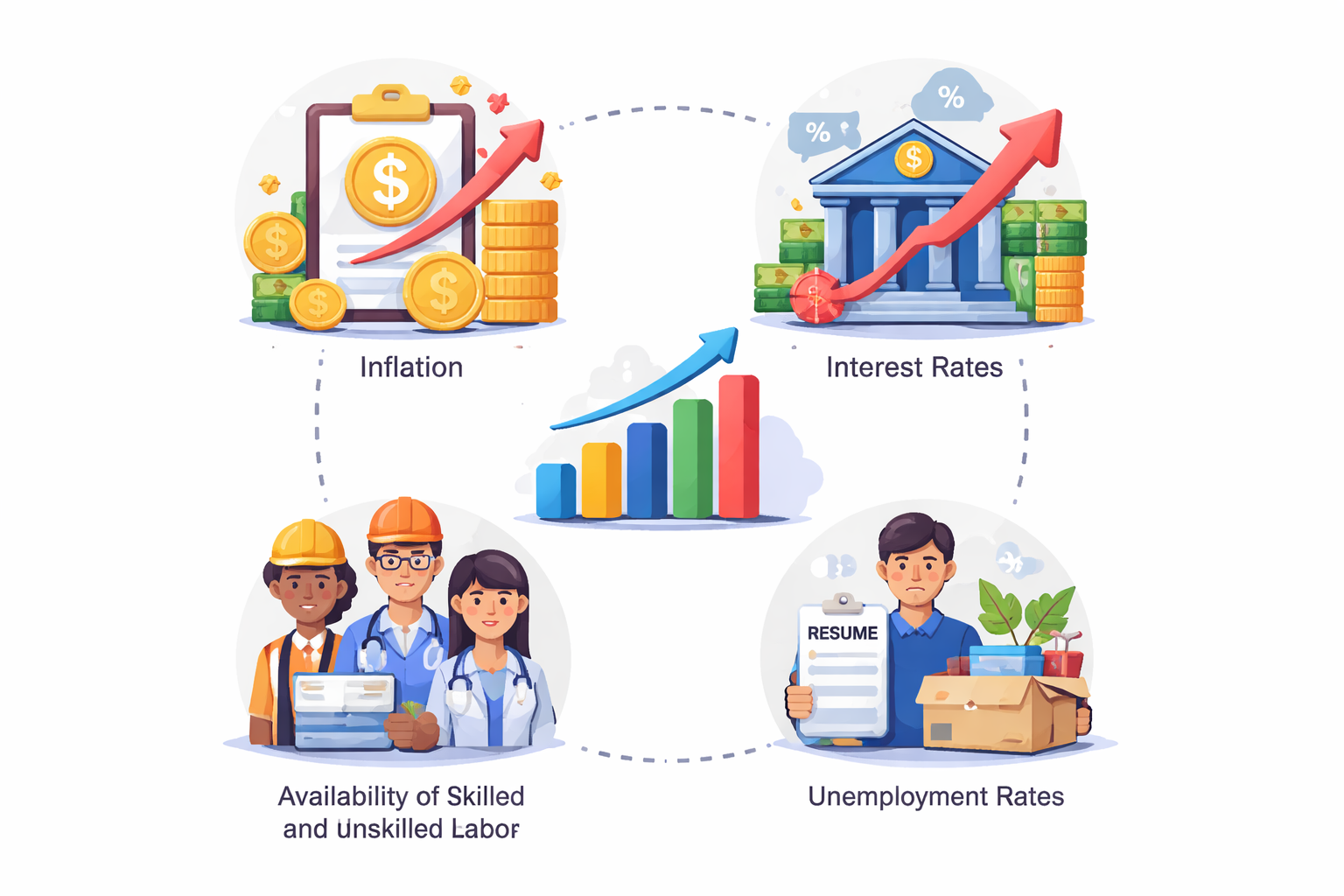
This dotpoint focuses on four economic factors that can strongly impact business performance:
- Inflation
- Interest rates
- Availability of skilled and unskilled labour
- Unemployment rates
A key assessment idea: explain the chain reaction — how the factor changes business costs or consumer behaviour, then how that affects a business function (e.g., marketing, finance, HR, operations).
Inflation
What it means
Inflation is the general rise in prices over time. When inflation rises, the same amount of money buys less.
Two key impacts businesses feel:
- Higher costs (ingredients, rent, electricity, fuel, wages, packaging).
- Lower consumer spending (customers cut back on non-essentials).
“Over the long run, Australia’s inflation has generally averaged around 2–3%, but it has been higher on average since COVID due to the inflation spike in 2021–2023.”

WA examples
✔ A café in Fremantle faces higher coffee bean and milk prices. It may need to raise prices or reduce portion sizes to protect profit.
✔ A Perth tradie pays more for fuel and building materials. Quotes may increase, and customers may delay renovations.
✔ A boutique in Claremont sells fewer “nice-to-have” items because customers prioritise essentials during high inflation.
How inflation impacts business functions
- Operations: renegotiate suppliers, reduce waste, change materials/inputs.
- Marketing: promote value bundles, adjust pricing, focus on “value for money”.
- Finance: tighter cash flow, higher working capital needs, pressure on profit.
- HR: wage pressure increases as staff push for higher pay to match living costs.
Interest rates
What it means
Interest rates are the cost of borrowing money (and the return earned on savings).
When interest rates rise:
- Business loans and overdrafts become more expensive.
- Customers often have less spare money (mortgage repayments rise).

WA examples
✔ A café in East Victoria Park has a loan for fit-out equipment. Higher interest rates increase repayments, reducing cash flow.
✔ A small retailer in Armadale delays expanding to a second store because borrowing costs are too high.
✔ A furniture store in Osborne Park sees lower sales because customers postpone big purchases when mortgage repayments rise.
How interest rates impact business functions
- Finance: higher interest expense and lower borrowing capacity; businesses may keep more cash as a buffer.
- Marketing: may use promotions to stimulate demand when customers are cautious.
- Operations: postpone major purchases (new machinery, renovations, vehicles).
- HR: may slow hiring because the business becomes more risk-averse.
Who Sets the Rate?
In Australia, the Reserve Bank of Australia (RBA) sets a target for the cash rate (the overnight interest rate banks charge each other). The RBA Board reviews inflation and the economy at its policy meetings, then raises or cuts the cash rate target, which flows through to most bank rates (mortgages, business loans, savings).
Availability of skilled and unskilled labour
What it means
Labour availability is how easy it is for businesses to find workers with the right skills.
- Skilled labour: qualified workers (electricians, chefs, nurses, engineers, accountants).
- Unskilled labour: entry-level roles (retail assistants, warehouse work, kitchen hands).
When labour is scarce, businesses can face staff shortages and higher wage costs.

WA examples
✔ A construction company in Perth’s south struggles to find enough qualified tradies. Projects take longer, and overtime costs rise.
✔ A restaurant in Northbridge can’t find experienced chefs, so it reduces its menu and opening hours.
✔ A retail store in Midland finds plenty of casual applicants for weekend shifts, so entry-level roles are easier to fill than skilled roles.
Low labour availability (shortage): what businesses do
- HR: offer higher pay, better rosters, or training to attract staff (because fewer people are available).
- Operations: reduce opening hours, slow service, or delay jobs because there aren’t enough workers to cover shifts.
- Marketing: manage customer expectations (e.g., “longer wait times”), because service quality can drop when short-staffed.
- Finance: labour costs rise (higher wages/overtime), which can reduce profit in the short term.
Simple way to remember it: when staff are hard to find, businesses either pay more or do less (shorter hours / fewer jobs).
Unemployment rates
What it means
Unemployment is the percentage of people who want a job and are actively looking for work, but can’t find one.
When unemployment is high:
- More households have less income and feel uncertain, so they cut back on non-essential spending (e.g. cafés, new clothes, tech).
- Businesses usually get more applicants, so hiring is easier and wage growth can slow.
When unemployment is low:
- More people are employed and feel secure, so spending often rises (demand increases).
- But businesses may struggle to find staff, so they compete for workers, which can cause labour shortages and push wages up (higher costs).
Over the last 20 full years, Australia’s unemployment rate averages about 5%. That means around 5 in every 100 people in the labour force (people working or actively looking) were jobless but actively looking and available to start.
WA examples
✔ If unemployment is high, a gym in Cannington may lose memberships as households cut discretionary spending.
✔ If unemployment is high, a café in Mount Hawthorn may notice fewer add-ons (desserts, extra sides) because customers are more cautious.
✔ If unemployment is low, a café in Subiaco may struggle to staff weekends and may need higher pay rates or incentives to attract workers.
High unemployment: how it impacts business functions
- Marketing: more discounts/value deals to keep customers buying.
- Operations: reduce output or operating hours if demand falls.
- HR: hiring becomes easier (more applicants) and wage growth can slow.
- Finance: revenue often falls, so businesses focus on cost control and cash flow.
Real WA Business Scenarios
Hospitality example
A café in Leederville sees higher ingredient costs (inflation) and slower weekday sales (customers cutting spending).
Impact → raises prices slightly, introduces a value lunch bundle, and reduces quiet-hour staffing.
Functions hit → marketing (pricing/promo) + HR (rostering) + finance (cash flow).
Retail example
A retailer in Innaloo relies on a small business loan for stock. Interest rates rise and repayments increase.
Impact → reduces stock orders, runs clearance sales, and delays a planned store refurb.
Functions hit → finance (debt/cash) + operations (inventory) + marketing (promotions).
Construction / trades example
A building business in Rockingham can’t find enough skilled tradies (labour shortage).
Impact → offers higher wages, invests in apprentices, and extends project timelines.
Functions hit → HR (recruitment/training) + operations (capacity) + finance (costs).

Rapid Fire Summary
- Inflation up → business costs up + customers buy less → profit pressure.
- Interest rates up → loans cost more + customers spend less (mortgages) → demand can drop.
- Labour shortage → higher wages/overtime + staff gaps → slower service/output.
- High unemployment → demand often down but hiring becomes easier.
🎧 Prefer listening?
If you prefer listening to the content in Podcast format:
🎥 Prefer watching?
If you prefer watching the content in video format:
Biz Fact: Café test: Inflation hits venues twice: food inputs (beans, milk, oil) go up and customers cut back on “extras” when budgets tighten.