
U1.23 — Types of Organisational Structures
Overview
Dotpoint 23: types of organisational structures, including: functional, product, divisional, team
An organisational structure is the formal arrangement of roles, responsibilities, authority and communication within a business.
The structure determines how employees are grouped, who they report to, where decisions are made and how different parts of the business work together.
There is no single structure that suits every business. The best structure depends on factors such as the size of the business, what it sells, where it operates and how quickly it needs to respond to change.
The four organisational structures in this dotpoint are:
- Functional structure
- Product structure
- Divisional structure
- Team structure

🏛️ Functional Structure
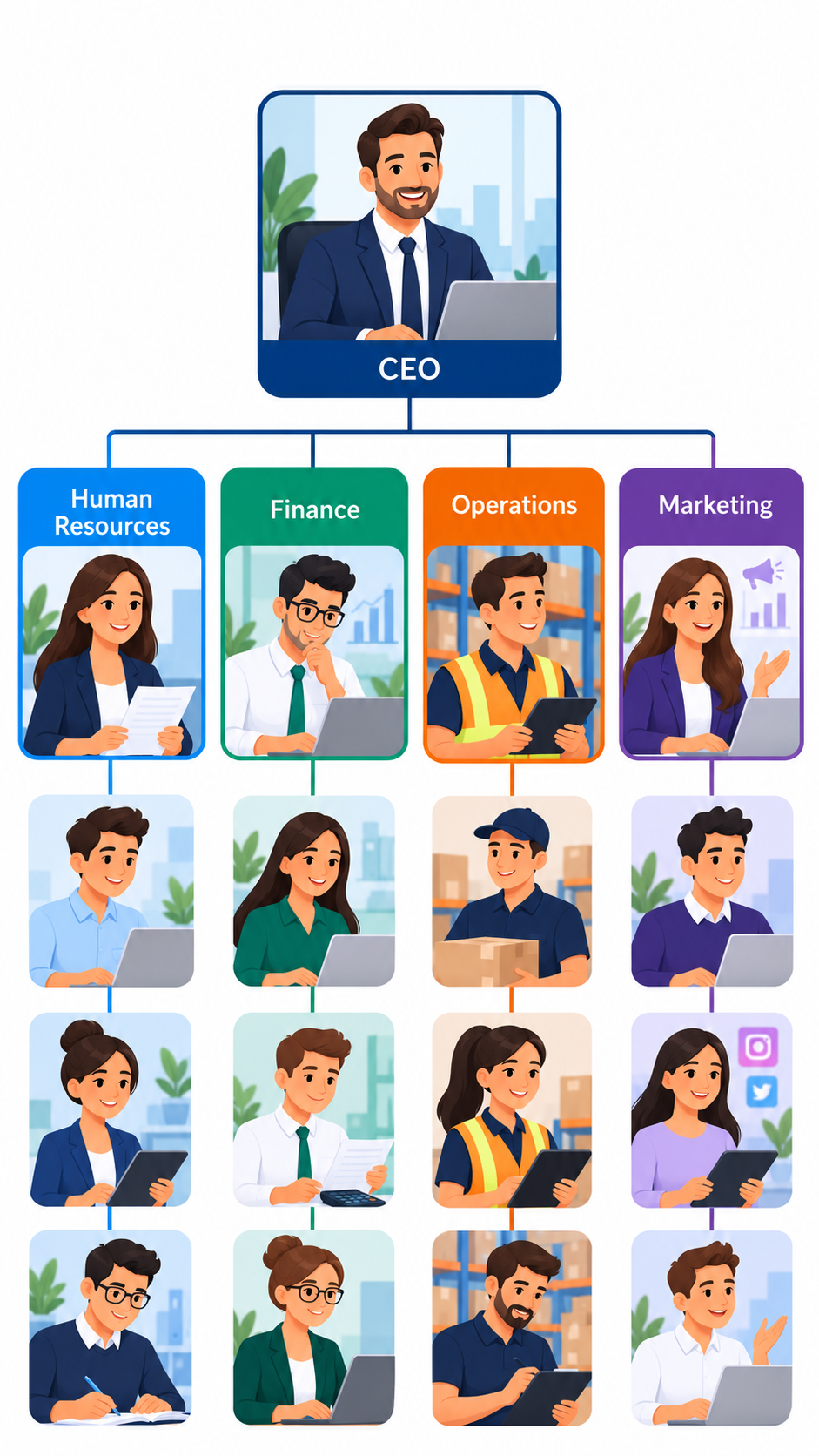
Functional structure groups employees according to specialised business functions such as marketing, finance, human resources and operations.
How a functional structure works
Employees who perform similar types of work are placed together in the same department. Each department usually has a specialist manager responsible for that particular function.
For example, employees involved in advertising, branding and market research may all work within the marketing department, while employees responsible for budgets, payroll and accounts are grouped within finance.
This allows employees to develop strong expertise because they work closely with others who have similar knowledge and skills.
Common business functions
- Marketing: advertising, promotion, branding and market research.
- Finance: budgets, payroll, accounts and financial reporting.
- Human Resources: recruitment, training and performance management.
- Operations: production or delivery of the business's goods and services.
- Sales and Customer Service: generating sales and supporting customers.
- IT / Systems: technology, networks and information systems.
Advantages
- Specialisation: employees develop expertise because they work within one specialised area.
- Efficiency: similar tasks and resources are grouped together, reducing unnecessary duplication.
- Clear responsibility: employees know which department is responsible for each business function.
- Easier training: specialist managers can train and develop employees within their area of expertise.
Limitations
- Departmental silos: employees may focus heavily on their own department rather than the overall business.
- Slower cross-department communication: decisions involving several functions may require approval and discussion across multiple departments.
- Conflicting priorities: departments may have different goals. For example, marketing may want a larger advertising budget while finance wants to reduce spending.
- Reduced flexibility: rigid departmental boundaries can make it harder to respond quickly to new opportunities or problems.
Why specialisation can be both a strength and a weakness
The major strength of a functional structure comes from putting specialists together. Employees can share knowledge, develop expertise and complete similar tasks efficiently.
However, the same grouping can create silos. A marketing department may understand promotion extremely well but have limited knowledge of operational problems or financial constraints. The business therefore needs strong communication between departments so that specialist decisions support the organisation as a whole.
Best suited for
- Small to medium-sized businesses.
- Businesses offering a relatively limited range of products or services.
- Businesses where specialist expertise is important.
- Stable environments where roles and processes are relatively predictable.
Example: A school
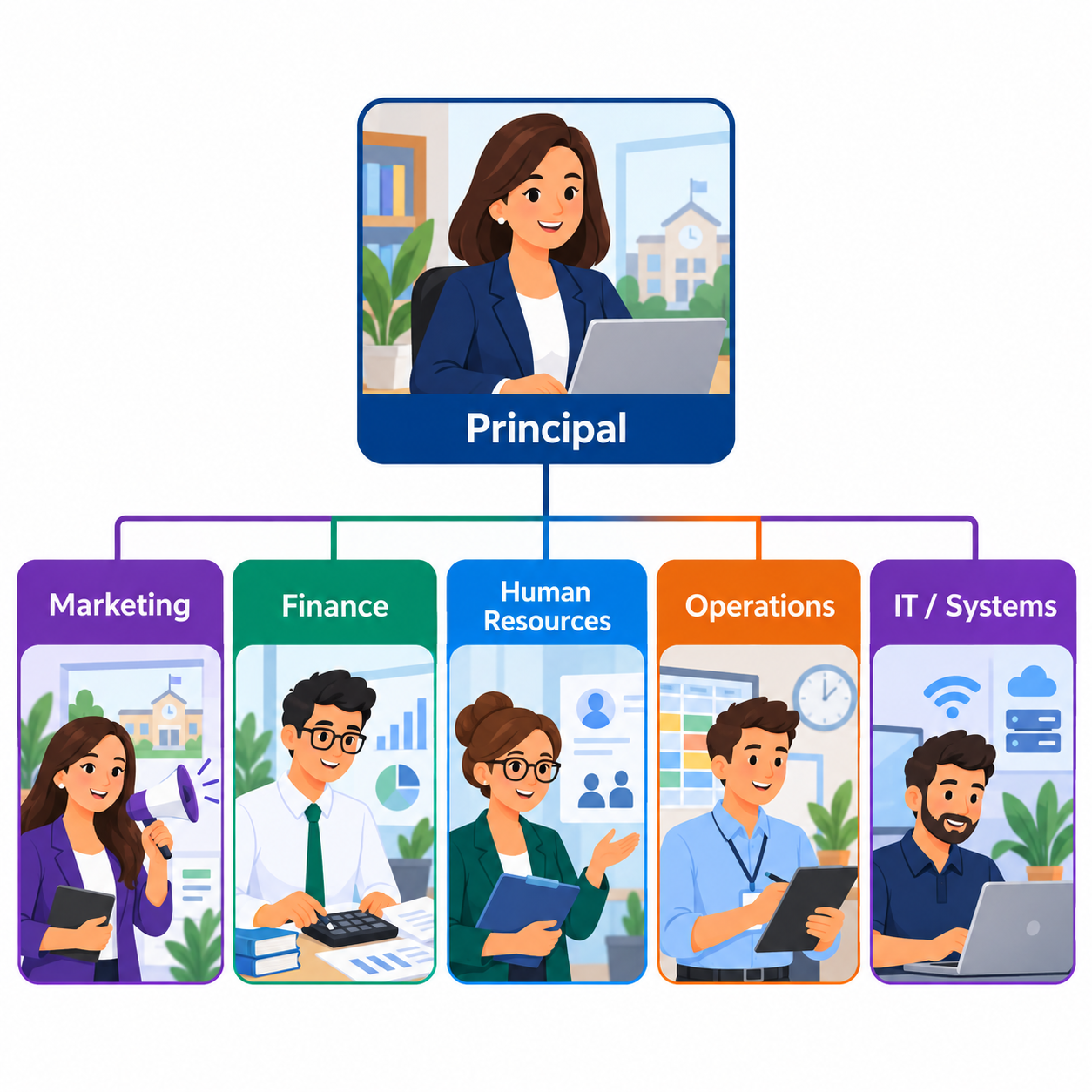
A school can operate using a functional structure because employees are grouped according to the specialist work they perform.
- Marketing: promotes enrolments through advertising, open days and community events.
- Finance: manages budgets, payroll and resource allocation.
- Human Resources: recruits staff and manages professional development and performance.
- Operations: coordinates teaching, timetabling and everyday school activities.
- IT / Systems: manages devices, networks and digital learning platforms.
Each area develops specialist expertise, although the departments still need to communicate when decisions affect more than one part of the school.
Example of how to write this in an exam
A functional structure groups employees according to specialised business functions such as marketing, finance, human resources and operations. For example, a school may have a finance department responsible for budgets and payroll and a marketing department responsible for enrolment promotion. This allows employees to specialise in one area and can improve efficiency because similar tasks and expertise are grouped together. However, departments may become siloed and focus on their own priorities, which can reduce communication and coordination across the organisation.
📦 Product Structure
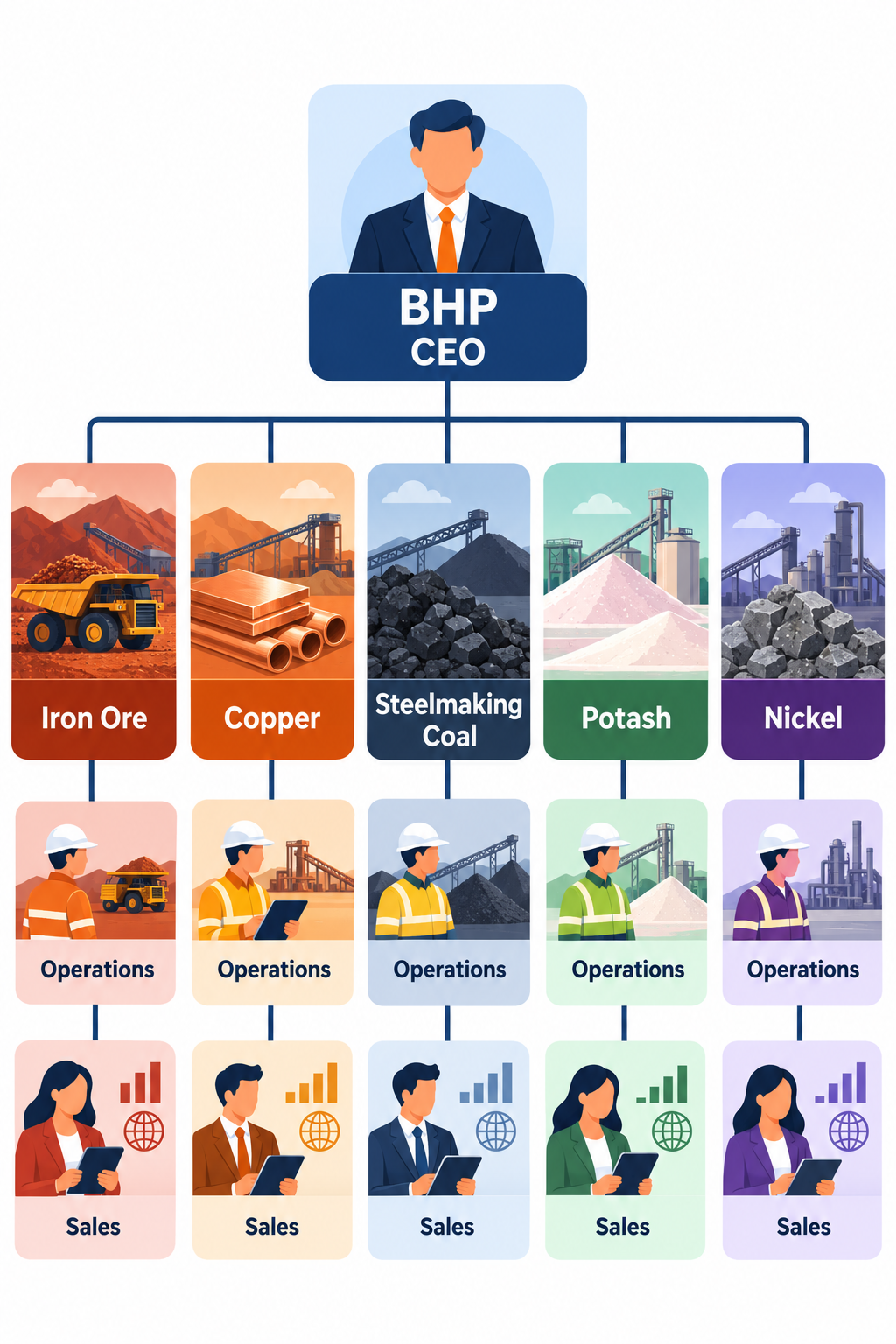
Product structure groups employees around different products or product lines, with each product area operating as a separate unit within the business.
How a product structure works
Instead of grouping all marketing employees together or all finance employees together, the business creates separate units around its major products.
Each product unit can contain the people and resources needed to manage that product, such as marketing, operations, sales and financial support.
This means managers can make decisions based on the specific customers, competitors, costs and opportunities affecting that product rather than treating every product in the same way.
Why businesses use it
Different products may operate in very different markets. They can have different customers, competitors, production methods and marketing strategies.
A product structure gives each product line clearer responsibility for its own performance. Managers can see whether that product is growing, profitable or losing market share and can respond without waiting for every decision to move through the entire organisation.
Advantages
- Product focus: managers can concentrate on the needs and performance of one product line.
- Clear accountability: it is easier to identify which unit is responsible for the success or failure of a product.
- Faster product decisions: decisions can be made closer to the product rather than passing through unrelated departments.
- Encourages innovation: individual product teams can respond to competitors and customer preferences more quickly.
- Easier performance measurement: sales, costs and profitability can be assessed by product.
Limitations
- Duplication: several product units may each require their own marketing, finance or operations employees.
- Higher costs: duplicated staff and resources can make the structure more expensive.
- Internal competition: product units may compete for funding, employees and senior management attention.
- Inconsistent decisions: different product units may develop different approaches unless senior management maintains coordination.
The key trade-off: focus versus duplication
A product structure gives managers a much stronger focus on one product. This can improve decision-making because employees understand that product's customers and competitors.
The trade-off is that resources may be duplicated. If five product units each require their own marketing employees, the business may spend more than it would under a functional structure with one central marketing department.
Best suited for
- Large businesses with several clearly different products.
- Businesses where different products target different customer groups.
- Businesses where products face different competitors or market conditions.
- Businesses that need clear accountability for individual product performance.
Example – LVMH
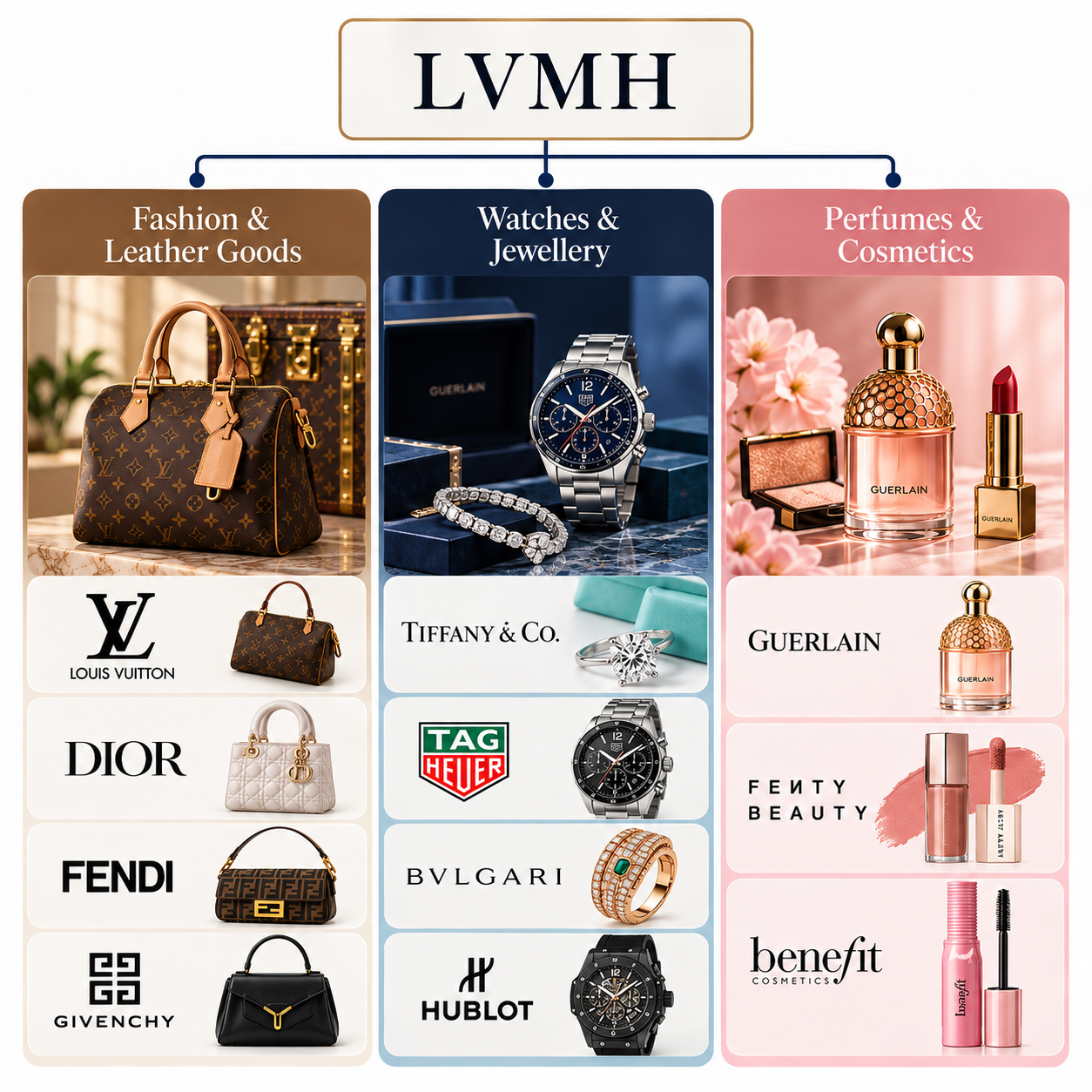
LVMH uses a product-based organisational structure by grouping its many luxury brands into major product divisions.
For example, its Fashion and Leather Goods division includes brands such as Louis Vuitton, Dior, Fendi and Givenchy, while its Watches and Jewellery division includes Tiffany & Co., TAG Heuer, Bulgari and Hublot.
It also has a Perfumes and Cosmetics division containing brands such as Guerlain, Fenty Beauty and Benefit Cosmetics.
Each product division can focus on the different customers, competitors, marketing and operations relevant to that particular market.
Example of how to write this in an exam
A product structure groups employees around separate products or product lines. For example, LVMH groups many of its luxury brands into product divisions such as Fashion and Leather Goods, Watches and Jewellery, and Perfumes and Cosmetics. This allows each division to focus on the particular customers, competitors and marketing needs of that product market. It also creates clearer accountability for product performance. However, the structure may increase costs because functions and resources can be duplicated across separate product divisions.
🧭 Divisional Structure
Divisional structure groups employees according to factors such as geographic location, market or customer group, with each division operating semi-independently.
How a divisional structure works
A large business may operate across different regions or serve customer groups with very different needs. Rather than controlling every decision from one central office, the business can create separate divisions.
Each division usually has its own managers and may control areas such as staffing, operations, marketing and budgets within that part of the organisation.
Head office still sets the overall direction of the business, but divisional managers have more authority to make decisions suited to their own market.
Common ways divisions may be created
- Geographic region: WA division, eastern states division or international division.
- Market: retail market, commercial market or government market.
- Customer group: individual customers, small businesses or large corporate clients.

Advantages
- Local responsiveness: decisions can reflect the needs of a particular region or customer group.
- Faster decisions: divisional managers do not need head office approval for every operational issue.
- Clear accountability: performance can be measured separately for each division.
- Customer focus: managers can adapt products, staffing and promotion to the customers they serve.
Limitations
- Duplication: each division may require its own managers and support functions.
- Higher costs: operating several semi-independent divisions can increase administrative and staffing expenses.
- Inconsistency: customers may receive different service or experiences across divisions.
- Coordination challenges: head office must ensure divisions continue working toward the same overall business goals.
Why decentralised decision-making can help
Divisional managers are closer to the customers and conditions affecting their part of the business. This means they may identify local problems or opportunities faster than managers at a distant head office.
However, giving divisions greater independence can also reduce consistency. The business therefore needs enough decentralisation to respond locally while still maintaining common standards, branding and overall strategy.
Best suited for
- Large organisations operating across several geographic areas.
- Businesses serving customer groups with significantly different needs.
- Businesses where local knowledge and fast local decision-making are important.
Examples
- A national retailer may have a WA division responsible for local staffing, stores and regional promotions.
- A logistics business may operate separate Perth metropolitan and regional WA divisions because transport conditions and customer needs differ.
- A large financial institution may separate personal banking and business banking because the two customer groups require different services and expertise.
- Wesfarmers operates a number of very different businesses that cater for different types of customers, including Bunnings, Kmart, Priceline Pharmacy and Officeworks. Separating these businesses allows each area to focus on the particular customers, competitors and operating conditions relevant to its market.
Example of how to write this in an exam
A divisional structure groups employees according to factors such as geographic region, market or customer group. For example, a national retailer may operate a WA division with managers responsible for local staffing, store operations and regional promotions. This allows decisions to be made closer to WA customers and enables the business to respond more quickly to local conditions. However, separate divisions may duplicate management and support roles, increasing costs and creating the risk of inconsistent decisions across the organisation.
🤝 Team Structure
Team structure groups employees with complementary skills into teams that work together toward a particular objective, project or area of responsibility.
How a team structure works
A team structure places greater emphasis on collaboration than traditional departmental boundaries.
Employees from different specialist areas may work together in one team. For example, a project could include an employee from marketing, finance, design and operations.
This allows information to move directly between the people completing the work rather than repeatedly travelling through separate departments and managers.
Types of teams
- Cross-functional teams: employees from different business functions work together toward one objective.
- Project teams: temporary teams created for a specific project and disbanded when the work is completed.
- Ongoing teams: permanent teams responsible for continuous operations or service delivery.

Advantages
- Faster communication: team members can communicate directly rather than through several departments.
- Greater flexibility: teams can be created or changed as projects and priorities change.
- Better problem-solving: employees with different knowledge and perspectives contribute to decisions.
- Innovation: collaboration across specialist areas can generate new ideas.
- Employee involvement: greater responsibility and participation can improve motivation.
Limitations
- Role ambiguity: employees may be unclear about who has authority or who is responsible for a decision.
- Conflict: team members may disagree over priorities, responsibilities or solutions.
- Coordination difficulty: employees working across several teams may face competing demands.
- Inconsistent performance: some teams may work very effectively while others struggle with communication or leadership.
The key trade-off: flexibility versus clarity
A team structure can respond quickly because employees with different skills work directly together. This can reduce delays and make the organisation more flexible.
However, traditional hierarchies usually provide very clear reporting relationships. Team structures can weaken that clarity, particularly when an employee works on several projects or reports to both a team leader and a functional manager.
Best suited for
- Start-ups.
- Creative and digital businesses.
- Project-based organisations.
- Businesses operating in fast-changing environments.
- Businesses where innovation and collaboration are important.
Examples
- Digital agencies: an advertising specialist, designer, copywriter and account manager may form one client project team.
- Event businesses: temporary teams may be created to organise and deliver major events.
- Construction businesses: employees with different technical and management skills may be assembled for an individual project.
Example of how to write this in an exam
A team structure groups employees with complementary skills so they can work together toward a common objective. For example, a digital agency may create a project team containing a designer, advertising specialist, copywriter and account manager for one client campaign. This allows employees from different specialist areas to communicate directly and can improve flexibility and problem-solving. However, employees may become unclear about authority or responsibilities if leadership and reporting relationships are not clearly established.
🔍 How to Tell the Four Structures Apart
Start with one question
When identifying an organisational structure, ask: what is the business using to group its employees?
The answer usually reveals the structure.
Functional
Grouped by what employees DO.
Marketing employees work together, finance employees work together and operations employees work together.
Think: departments.
Product
Grouped by what the business SELLS.
Employees are organised around different products or product lines.
Think: different product areas.
Divisional
Grouped by WHERE or WHO.
Employees may be organised around geographic regions, markets or customer groups.
Think: WA division, international division or different customer markets.
Team
Grouped by what they are WORKING ON.
Employees with different skills work together toward a particular objective or project.
Think: project or cross-functional team.
🎧 Prefer listening?
If you prefer listening to the content in Podcast format:
🎥 Prefer watching?
If you prefer watching the content in video format:
🃏 Flashcards
Card 1 of 15
🎮 Revision Games
💰 BME Millionaire
Climb the ladder by mastering organisational structures.
🧩 Structure Match
Match each business situation to the correct structure.
⚡ 60 Second Showdown
Rapid-fire questions across all four organisational structures.

Biz Fact: Google uses team-based structures so engineers, designers and marketers work together on one product at a time.