
U1.25 — Phases of the Employment Cycle
Overview
Dotpoint 25: Phases of the Employment Cycle.
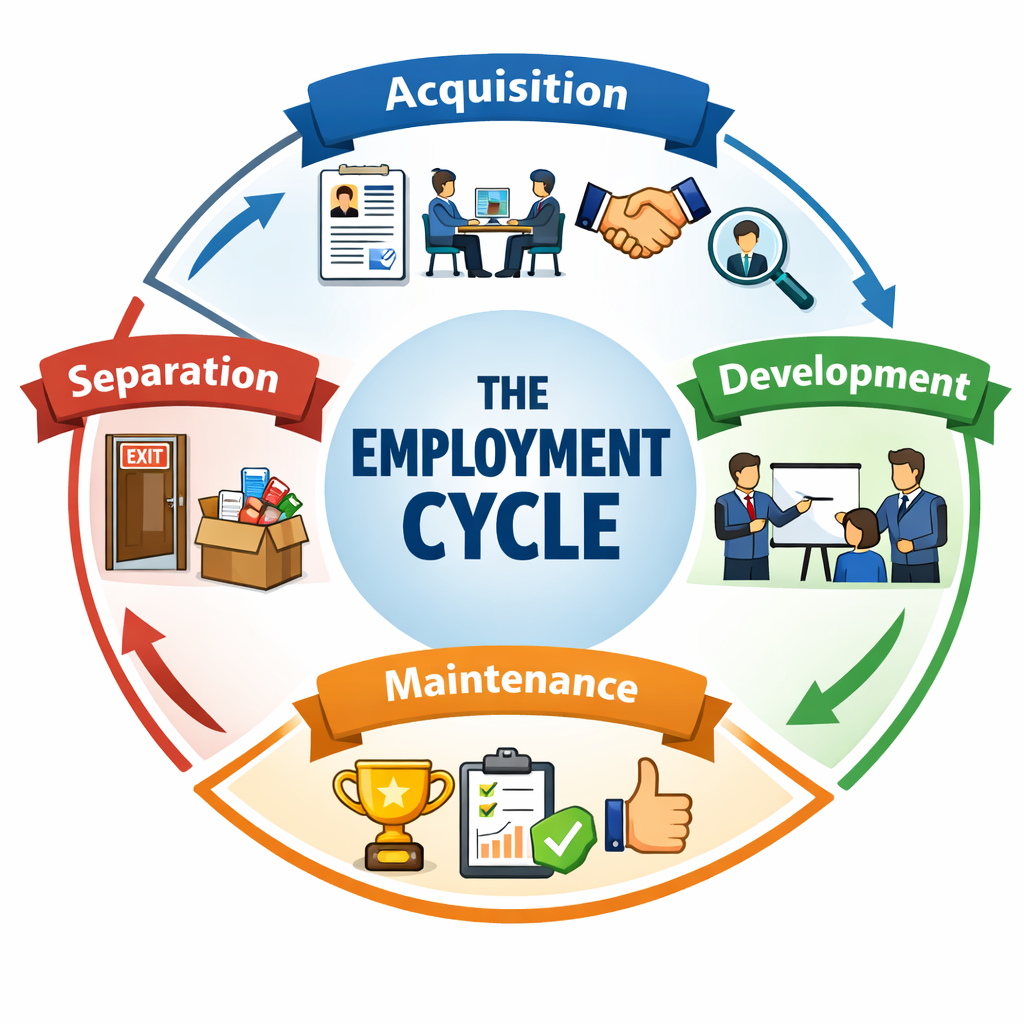
Employment cycle describes the full journey of an employee through a business — from when the business identifies a staffing need, through to when the employee eventually leaves.
The four phases examined in this dotpoint are:
- Acquisition
- Development
- Maintenance
- Separation
🔍 Acquisition (Stage 1 of the Employment Cycle) — Acquire them
Acquisition is the first phase of the employment cycle. It is the process of planning for staff, then attracting and selecting the right people to fill roles.
Why getting acquisition right matters
Decisions made at this stage have long-term consequences for productivity, costs, morale and turnover.
If a business recruits someone whose skills, experience or expectations do not match the role, that employee may struggle to perform effectively. This can create additional supervision and training costs and may eventually result in the employee leaving, forcing the business to recruit again.
Poor acquisition often leads to:
- underperformance
- increased training costs
- workplace conflict later in the cycle
This course divides Acquisition into two parts
1) Staffing needs
Workforce planning
Before advertising a position, a business must clearly identify why it is hiring and what problem the new employee is meant to solve.
If the staffing need is identified correctly, the business can choose an employment type and recruitment strategy that actually suits the work required. If it misjudges the need, it may employ too many people, too few people, or hire someone under the wrong employment arrangement.
Effective workforce planning requires businesses to consider:
- what work is not being completed efficiently or to the required standard
- whether the need is short-term or long-term
- if existing staff could be trained instead of hiring
- what employment type best suits the role (full-time, part-time, casual, contract, apprentice)

Short-term workforce planning
- focuses on immediate needs such as busy periods, staff absences, or short projects
- often addressed through casual employees, overtime, labour hire or short-term contracts
Long-term workforce planning
- linked to growth, expansion, retirements, technology change, or new services
- often addressed through permanent recruitment, apprenticeships and training pipelines
Job analysis, job design and job description
Before recruitment begins, a business must be clear about the role it wants to fill. This usually involves three connected steps: job analysis, job design, and job description.
Job analysis
Job analysis is the process of identifying what a job involves. It looks at the key tasks, duties, responsibilities, skills, qualifications, working conditions, and reporting relationships linked to the role.
This helps the business understand exactly what type of employee is needed, which makes later recruitment and selection more accurate.
Job design
Job design is the process of organising the tasks and responsibilities within a role.
It focuses on how the job is structured to improve efficiency, motivation, job satisfaction, and productivity. For example, a business may decide how much variety, autonomy, teamwork, or responsibility the role should include.
Poor job design can lead to boredom, stress, and staff turnover.
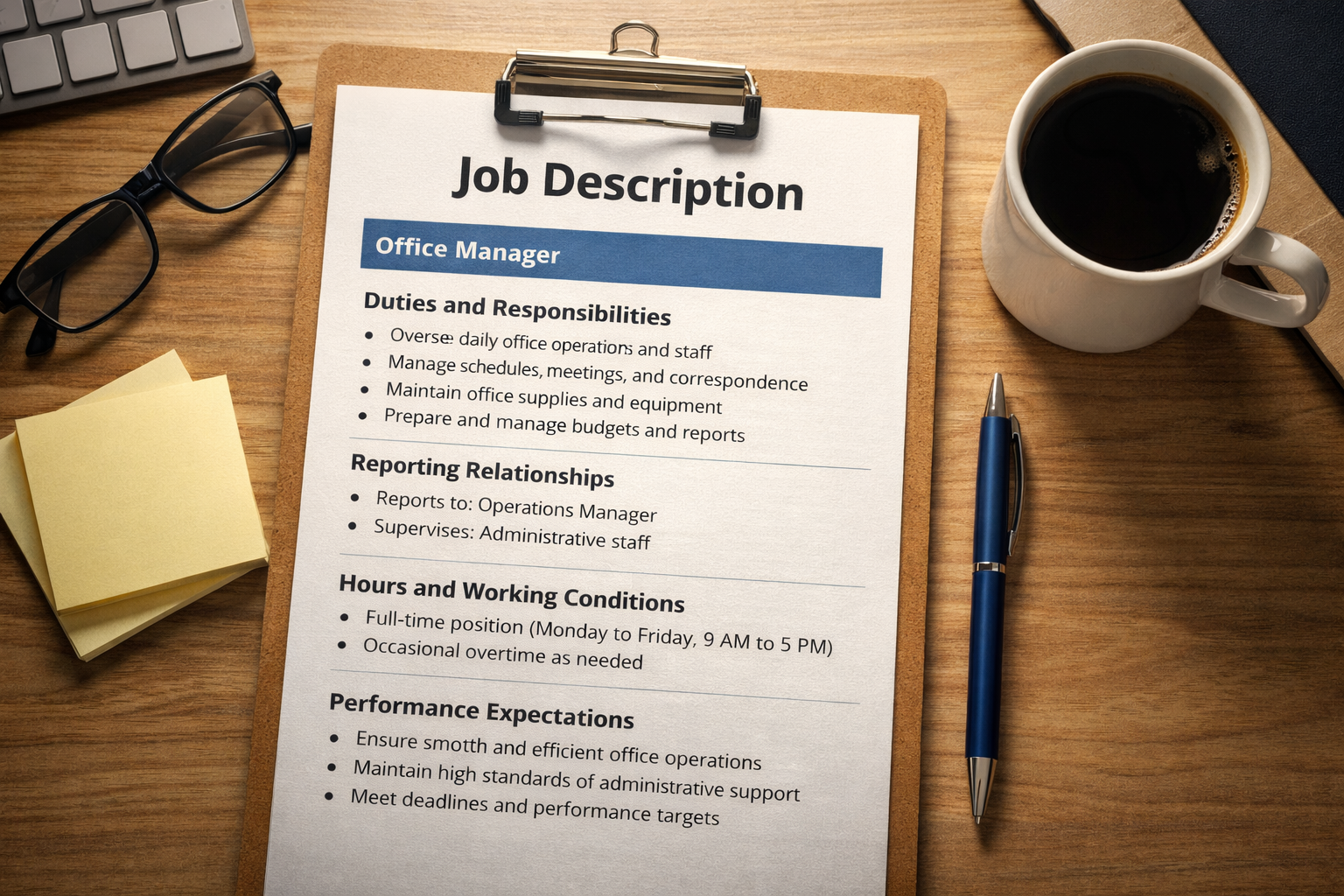
Job description
A job description is the written document that outlines the main features of the job.
It usually includes duties, responsibilities, reporting lines, hours, working conditions, and performance expectations.
It is important because it helps applicants understand the role, allows fair comparison between candidates, reduces misunderstandings, and provides a benchmark for performance management.
Simple difference
- Job analysis = studies the job
- Job design = structures the job
- Job description = writes the job down
2) Recruitment and Selection
Recruitment is the process of attracting a pool of suitable applicants for a vacant position.
Internal recruitment
Internal recruitment involves filling vacancies by promoting or transferring existing employees within the business.
Advantages
- faster and cheaper than external recruitment
- employees already understand the business culture and systems
- improves motivation and employee loyalty
- lower risk due to known performance history
Disadvantages
- limits the pool of candidates
- may create resentment among staff who miss out
- reduces opportunities for new ideas and innovation
- can create skill gaps elsewhere in the organisation
External recruitment
External recruitment involves attracting applicants from outside the business.
Advantages
- larger pool of candidates
- brings new skills, experience and ideas into the business
- useful when specialised skills are required
- can support change and improvement
Disadvantages
- more time-consuming and costly
- higher risk as employee performance is less certain
- longer induction and training period required
- may disrupt existing workplace culture
Common recruitment methods in Perth
- online job platforms (Seek, Indeed, LinkedIn)
- social media and community groups
- TAFE and apprenticeship pathways
- labour hire firms for short-term needs
- employee referrals (common in hospitality and trades)

Selection is the process of systematically assessing applicants to identify the candidate who best matches the job requirements and the organisation's needs.
The purpose of selection is to minimise poor hiring decisions and reduce future training, supervision and turnover costs.
A stronger match between the employee and the role means the employee is more likely to reach the required level of productivity and remain with the business, reducing the need to repeat the recruitment process.
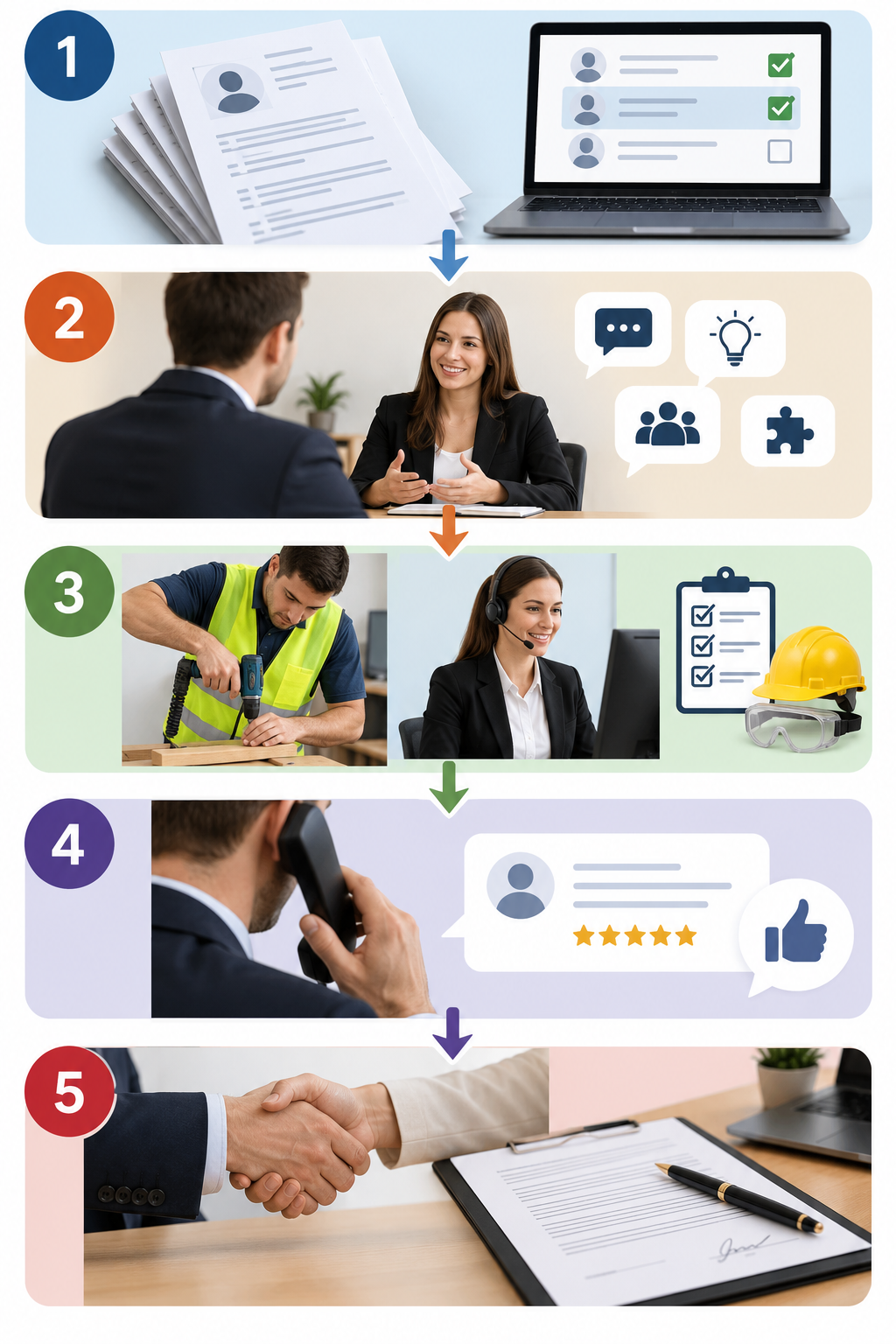
Selection process
Application screening
Applications are reviewed against the job description and person specification. Applicants who meet the required skills, experience and qualifications are shortlisted.
Interviews
Interviews assess communication, problem-solving, reliability, teamwork and cultural fit. Behavioural and scenario-based questions can test how an applicant may respond in workplace situations.
Testing (where appropriate)
This may include practical skills tests, role-plays for customer service roles, or safety and compliance checks in high-risk industries.
Reference checks
Referees are contacted to confirm past performance, reliability, attendance, conduct and teamwork.
Job offer and employment contract
A formal job offer is made and supported by an employment contract outlining pay, hours, responsibilities, reporting lines, probation and notice periods.
Indicators of effective acquisition
Successful acquisition is reflected in:
- lower staff turnover
- fewer performance issues during probation
- faster time to reach expected productivity
- reduced training and supervision costs
- positive feedback from managers, colleagues and customers
Example of how to write this in an exam
Acquisition is the first phase of the employment cycle and involves identifying staffing needs, recruiting applicants and selecting the most suitable employee. For example, a business experiencing long-term growth may conduct a job analysis to identify the duties and skills required for a new permanent position before advertising externally through Seek. External recruitment gives the business access to a larger pool of candidates and may introduce new skills and ideas. The business can then screen applications, conduct interviews and check references to identify the applicant who best matches the job requirements. Effective acquisition can reduce future training and supervision costs because the employee is more likely to perform effectively and remain with the business. However, external recruitment can be more expensive and time-consuming than recruiting an existing employee internally.
📈 Development (Stage 2 of the Employment Cycle) — Build them
Development focuses on building employee skills, knowledge and confidence over time. It includes the induction of new employees into the business and the ongoing training provided as employees develop, take on more responsibility, or adapt to change.
Why getting development right matters
Effective development improves productivity, safety, motivation and retention, while poor development can lead to mistakes, low morale and high staff turnover.
Employees who understand their role and receive the skills needed to perform it are more likely to work accurately and confidently. This reduces mistakes and helps the business achieve more consistent performance.
This course divides Development into two parts
1) Induction
What is induction?
Induction is the process of introducing a new employee to the business, their role, and the workplace environment. It usually occurs in the first days or weeks of employment.
The purpose of induction is to help new employees:
- understand how the business operates
- know what is expected of them
- feel safe, supported and confident in their role
A well-run induction reduces early mistakes, stress and employee turnover.

What happens during induction training?
Induction typically includes:
- introduction to workplace policies and procedures
- explanation of job duties and performance expectations
- workplace health and safety training
- introduction to supervisors, team members and reporting lines
- explanation of hours, pay systems and workplace rules
- familiarisation with equipment, systems or software
Example: A new employee at a Perth construction site would complete safety inductions before starting work, while a retail employee in a shopping centre may receive customer service, POS system and store policy training.
2) Training
Employee Training
Training develops the knowledge and skills employees need to perform their jobs effectively, safely and confidently.
Training may be needed when an employee starts a new role, is promoted, needs to improve their performance, or when new technology, processes or safety requirements are introduced.
Why Businesses Provide Training
| Training aims to... | This can lead to... |
|---|---|
| Improve employees' skills and job knowledge | Higher productivity and fewer mistakes |
| Teach employees correct and safe work practices | Improved safety and reduced workplace problems |
| Prepare employees for new technology or changing processes | Employees adapting more effectively to change |
| Develop employees for greater responsibility | More opportunities for promotion and career development |
| Improve customer service skills | More consistent service and greater customer satisfaction |
Effective training can also improve employee motivation and retention, as employees may feel more capable, supported and valued by the business.
On-the-job training
On-the-job training occurs when employees learn by doing the job itself, usually while being supervised or coached by a manager or experienced colleague.
This type of training takes place in the actual work environment using real equipment and tasks.
Advantages
- training is practical and directly relevant to the job
- employees learn using real equipment and procedures
- lower cost compared to formal external training
Disadvantages
- mistakes can affect customers, safety or productivity
- quality of training depends on the skill of the trainer
- can slow down experienced staff who are supervising

Off-the-job training
Off-the-job training occurs away from the normal workplace and focuses on learning rather than performing the job.
Examples include
- external courses and workshops
- TAFE or university programs
- online training modules
- simulations and role-plays
Advantages
- no risk to customers, safety or production during training
- delivered by specialists or experts
- allows employees to focus fully on learning
Disadvantages
- more expensive than on-the-job training
- skills may not perfectly match the real workplace
- employees are away from productive work time

Why development matters overall
Businesses that invest in effective induction and training are more likely to:
- reduce staff turnover
- improve safety and compliance
- increase productivity and service quality
- develop future leaders internally
In contrast, businesses that neglect development often face higher costs, more errors, and lower employee morale.
Example of how to write this in an exam
Development is the phase of the employment cycle that builds employee skills, knowledge and confidence through induction and ongoing training. For example, a new employee at a Perth construction business may first complete an induction covering workplace rules, safety procedures, reporting lines and job expectations. This reduces the likelihood of early mistakes because the employee understands how to operate safely and what is expected of them. The business may then provide on-the-job training where the employee learns practical tasks using real equipment while being supervised by an experienced worker. This can improve productivity because the training is directly relevant to the employee's role and is relatively inexpensive. However, mistakes made during on-the-job training may affect safety or productivity, so appropriate supervision is important.
🛠️ Maintenance (Stage 3 of the Employment Cycle) — Support them
Maintenance is the stage of the employment cycle where the business works to keep employees in the workplace by providing the conditions, support and systems needed for them to remain employed, motivated and productive.
The importance of effective maintenance
At the maintenance stage, the business is no longer focused on hiring or introducing a new employee. Instead, it must make sure existing employees are supported, rewarded and managed effectively so they continue to perform well and want to remain with the business.
Effective maintenance can reduce staff turnover because employees are more likely to stay when their conditions are fair, expectations are clear, performance is supported and strong work is recognised.
This course divides Maintenance into three parts
1) Agreements
Agreements
Agreements are the broader workplace arrangements that help determine the pay, conditions and entitlements that apply to employees.
They may come from an industry award, enterprise agreement or workplace agreement and can apply to a group of employees rather than just one person.
Agreements May Cover
- minimum pay rates or salary levels
- leave entitlements
- allowances
- working conditions
- flexible work arrangements
- workplace benefits
- other employment entitlements
Why Agreements Matter
Agreements help employees understand the conditions they are entitled to receive.
Fair and competitive agreements can improve employee satisfaction and retention, while poor conditions may contribute to low morale and staff turnover.
Example
A school may have an enterprise agreement that sets salary scales, leave entitlements and working conditions for its teaching staff.
2) Contracts
Contracts
A contract is the specific employment arrangement between the business and an individual employee.
It sets out exactly what applies to that person in their role.
A Contract May Include
- whether employment is full-time, part-time, casual or fixed-term
- salary or wage
- hours of work
- job title and duties
- start date
- notice periods
- additional benefits or conditions
Why Contracts Matter
Contracts provide employees with clarity and certainty about their role and conditions.
They may also be reviewed if an employee is promoted, changes roles or negotiates new conditions, which can help support retention.
Example
A teacher's contract may state that they are employed full-time, their salary level, start date and specific teaching responsibilities.
Agreements vs Contracts
The easiest way to remember the difference is:
For example, a school's enterprise agreement may set salary scales and leave conditions for all teachers, while an individual teacher's contract states their specific role, salary level, hours and start date.
3) Performance Management
Performance management is the process of monitoring, reviewing and improving employee performance so that employees continue to meet business expectations and contribute to business goals.
Performance management helps the business identify how well employees are performing, where improvement may be needed and how strong performance can be recognised.
Two important parts of performance management are appraisals and rewards and recognition.
Appraisals
An appraisal is a formal review of an employee's work performance.
Appraisals can help a business:
- review how well the employee is performing
- identify strengths and weaknesses
- provide feedback
- identify training and development needs
- set goals for improvement
- support decisions about promotion, pay rises or rewards
Why appraisals matter
Appraisals give the employee clear feedback about what they are doing well and what needs improvement. This can help the employee correct weaknesses before they become larger performance problems.
They also give the business an opportunity to identify training needs and recognise strong performance, which can improve productivity, motivation and retention.

Rewards and Recognition
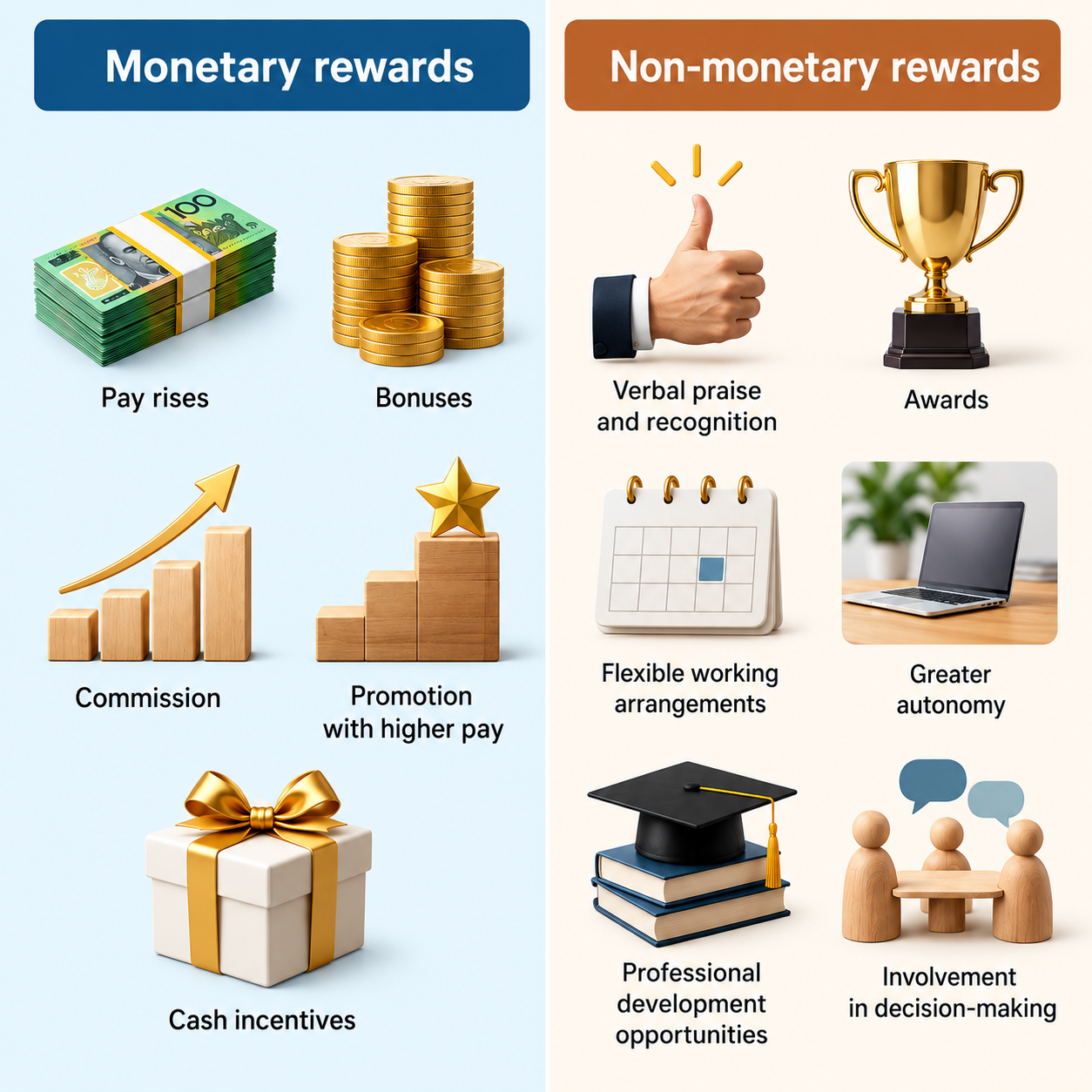
Rewards and recognition are used to acknowledge strong employee performance, encourage desired behaviour and improve commitment to the business.
Monetary rewards
Monetary rewards provide a direct financial benefit to the employee.
- pay rises
- bonuses
- commission
- promotion with higher pay
- cash incentives
Non-monetary rewards
Non-monetary rewards provide recognition or benefits without direct financial payment.
- verbal praise and recognition
- awards
- flexible working arrangements
- greater autonomy
- professional development opportunities
- involvement in decision-making
Why rewards and recognition matter
When employees feel their performance is recognised, they may become more motivated and committed to the business. This can improve job satisfaction and reduce staff turnover.
Businesses often use a combination of monetary and non-monetary rewards because different employees may value different types of recognition.
Why maintenance matters overall
Businesses that manage maintenance well are more likely to:
- retain employees
- reduce staff turnover and absenteeism
- improve motivation and job satisfaction
- create clearer expectations
- improve productivity and performance
In contrast, poor maintenance can lead to conflict, low morale, underperformance and costly employee exits.
Example of how to write this in an exam
Maintenance is the stage of the employment cycle where a business supports and manages employees so they remain productive and want to stay with the organisation. One part of maintenance is performance management, which involves monitoring, reviewing and improving employee performance. For example, a manager may conduct a formal appraisal to review an employee's performance, provide feedback and identify further training needs. This can improve productivity because weaknesses can be identified and addressed before they become larger performance problems. Strong performance may also be recognised through monetary rewards such as a bonus or non-monetary rewards such as praise, flexibility or greater autonomy. When employees feel recognised and supported, job satisfaction and commitment may improve, reducing staff turnover and the cost of replacing experienced employees.
🚪 Separation (Stage 4 of the Employment Cycle) — Send them off
Separation occurs when the employment relationship between an employee and a business ends. Separation can be voluntary or involuntary.
Why separation needs to be managed carefully
How separation is handled can affect staff morale, business reputation, legal risk and the organisation's ability to recruit employees in the future.
A professional separation process can reduce disputes and help remaining employees maintain confidence in management, while poor handling can damage trust and create costly legal or workplace problems.
This course divides Separation into four parts
1) Retirement — Voluntary Separation
Retirement occurs when an employee chooses to permanently leave the workforce, commonly after a long period of employment.
Key features
- usually planned in advance
- provides the business with time to prepare for the employee's departure
- allows important knowledge and responsibilities to be transferred to other employees
- may create a new vacancy that begins another acquisition process
Business impact
Effective succession planning can reduce disruption because another employee can be trained or recruited before the retiring employee leaves.
Example
A senior manager announces they will retire at the end of the year. The business begins training another employee to take over key responsibilities before the manager leaves.

2) Resignation — Voluntary Separation
Resignation occurs when an employee chooses to leave their current position.
Common reasons
- better job opportunities
- dissatisfaction with pay or conditions
- poor management or workplace culture
- relocation
- further study or career change
What happens?
Employees are usually required to provide notice in accordance with their employment contract. This gives the business time to redistribute work and begin recruiting a replacement.
Business impact
High resignation rates can indicate problems with pay, leadership, workload or workplace culture and may increase recruitment and training costs.
Example
An employee resigns after accepting a higher-paying position with another business and provides the required notice before leaving.

3) Retrenchment — Involuntary Separation
Retrenchment, also known as redundancy, occurs when a job role is no longer required by the business — not because of the employee's performance or behaviour.
Key point: ➡️ The role becomes redundant, not the person.
Common causes
- economic downturn or reduced demand
- business restructuring or downsizing
- automation or technology replacing tasks
- business closure or relocation
- a project or contract ending
What the business may need to provide
In genuine redundancy situations, employers may be required to provide:
- redundancy pay
- notice or pay in lieu of notice
- consultation with affected employees
- support during the transition where available
Why it must be handled carefully
Retrenchment must be genuine and properly managed. Poor handling may lead to disputes or unfair dismissal claims and can also reduce the morale of employees who remain with the business.
Example
A construction company completes a major project and has no new contracts available. Several positions are no longer required, resulting in retrenchment.

4) Dismissal — Involuntary Separation
Dismissal occurs when an employer terminates an employee's employment because of misconduct, ongoing underperformance or a breach of workplace rules.
Key point: ➡️ Unlike retrenchment, dismissal relates to the employee's performance or behaviour.
Two main forms
- summary dismissal – immediate termination for serious misconduct such as theft, violence or a serious safety breach
- dismissal after warnings – may occur where poor performance or less serious misconduct continues after the employee has been given opportunities to improve
Dismissal procedure
Identify the issue
The performance or behaviour concern is clearly identified and documented so the employee understands the specific problem.
Communicate expectations
The employee is told what standard is required and how their current performance or behaviour is falling short.
Provide support and time to improve
The business may provide coaching, additional training or a performance improvement plan so the employee has a reasonable opportunity to improve.
Issue formal warnings
If the problem continues, verbal or written warnings may be issued explaining what must improve and what may happen if it does not.
Allow the employee to respond
The employee is given an opportunity to explain their behaviour or performance and respond to the concerns raised.
Make a final decision
If the problem remains unresolved, the business may proceed with dismissal while following relevant contractual and workplace requirements.

Summary dismissal may bypass some of these stages when serious misconduct makes immediate termination appropriate.
Why separation matters overall
Businesses that manage separation well are more likely to:
- reduce legal risk and workplace disputes
- protect the business's reputation
- maintain trust and morale among remaining employees
- manage the transition to replacement employees more effectively
Example of how to write this in an exam
Separation occurs when the employment relationship between an employee and a business ends and can be voluntary or involuntary. For example, retrenchment is an involuntary form of separation that occurs when a position is no longer required by the business rather than because of the employee's performance. A construction company may retrench employees after a major project finishes and no replacement contracts are available. Removing positions can reduce labour costs when there is insufficient work, helping the business adjust its workforce to lower demand. However, retrenchment must be genuine and managed carefully because poor handling may create legal disputes and can reduce the morale of employees who remain with the business. This may lower productivity if remaining employees become concerned about their own job security.
🏉 Case Study — A Fremantle Dockers AFL Player and the Employment Cycle
The employment cycle can also be applied to professional sport. Consider a player progressing through their employment journey with the Fremantle Dockers.
Stage 1: Acquisition
Fremantle identifies a staffing need within its playing list, such as the need for an additional midfielder with particular physical, technical and tactical skills.
- workforce planning identifies current and future gaps in the playing list
- job analysis identifies the skills, responsibilities and physical requirements needed for the playing role
- recruitment involves identifying and attracting potential players through scouting and list-management processes
- selection involves assessing players through match performance, physical testing, interviews and other available information
Getting acquisition right increases the likelihood that the selected player matches Fremantle's needs and can develop into a productive member of the playing group.
Stage 2: Development
After joining Fremantle, the player enters the development phase through induction and ongoing training.
- induction introduces the player to club expectations, facilities, staff, training routines, safety requirements and behavioural standards
- on-the-job training occurs through skills sessions, match simulation, gym programs and coaching while the player performs football-related tasks
- additional specialist training may develop areas such as kicking, strength, recovery, nutrition and game strategy
Effective development builds the player's knowledge, skills and confidence, improving their ability to perform effectively within Fremantle's playing system.
Stage 3: Maintenance
Once the player is established, Fremantle enters the maintenance phase by managing the player's conditions, performance and ongoing motivation.
- broader workplace agreements help determine employment conditions applying to AFL players
- the player's individual contract sets out the specific employment terms applying to that player
- performance management involves monitoring and reviewing training and match performance
- appraisals and regular feedback identify strengths, weaknesses and areas for further development
- rewards and recognition may include recognition for strong performance, greater playing responsibility or improved contract opportunities
Effective maintenance can improve motivation, performance and retention by ensuring the player understands expectations and feels their contribution is recognised.
Stage 4: Separation
Eventually, the employment relationship between Fremantle and the player may end through separation.
- retirement – the player voluntarily chooses to permanently end their AFL playing career
- resignation / voluntary departure – the player chooses to leave their current employment arrangement to pursue another opportunity
- retrenchment or redundancy – in general employment terms, this would occur where a role is no longer required rather than because of employee performance
- dismissal – in general employment terms, this occurs where employment is terminated because of employee behaviour, misconduct or ongoing performance issues
Whatever the reason, managing separation professionally can help protect relationships, reputation and morale while allowing the club to begin another acquisition process if a replacement player is required.

🎧 Prefer listening?
If you prefer listening to the content in Podcast format:
🎥 Prefer watching?
If you prefer watching the content in video format:
🃏 Flashcards
Card 1 of 43
🎮 Revision Games
💰 BME Millionaire
Climb the money ladder by mastering the employment cycle.
🧩 Cycle Match
Match each real workplace situation to the correct phase.
⚡ 60 Second Showdown
Build a streak with rapid-fire employment cycle questions.

Biz Fact: Hiring the wrong employee can cost a business 30–50% of that worker's annual salary in lost productivity, rehiring and training.