
General U1.03 - Concept of Entrepreneurship
Overview
Dotpoint 3: concept of entrepreneurship.
Entrepreneurship is the process of identifying a business opportunity and taking action to develop, organise and operate a venture that creates value, while accepting the risks involved.
An entrepreneur is the person who undertakes this process. Entrepreneurs do more than simply think of ideas. They identify opportunities, make decisions, organise resources and take action to turn an idea into something customers may value.
Entrepreneurship therefore connects an opportunity with action. It involves initiative, resourcefulness and a willingness to accept uncertainty because the outcome of a new venture is never guaranteed.

What entrepreneurship means
From opportunity to action
Entrepreneurship is not just having a good idea. It is the process of acting on an opportunity and trying to turn that opportunity into a venture that creates value.
The entrepreneur makes decisions about what to offer, who the customers are, how the business will operate and what resources will be needed. Because the entrepreneur acts before the outcome is certain, entrepreneurship always involves some level of risk and uncertainty.
What entrepreneurship can involve
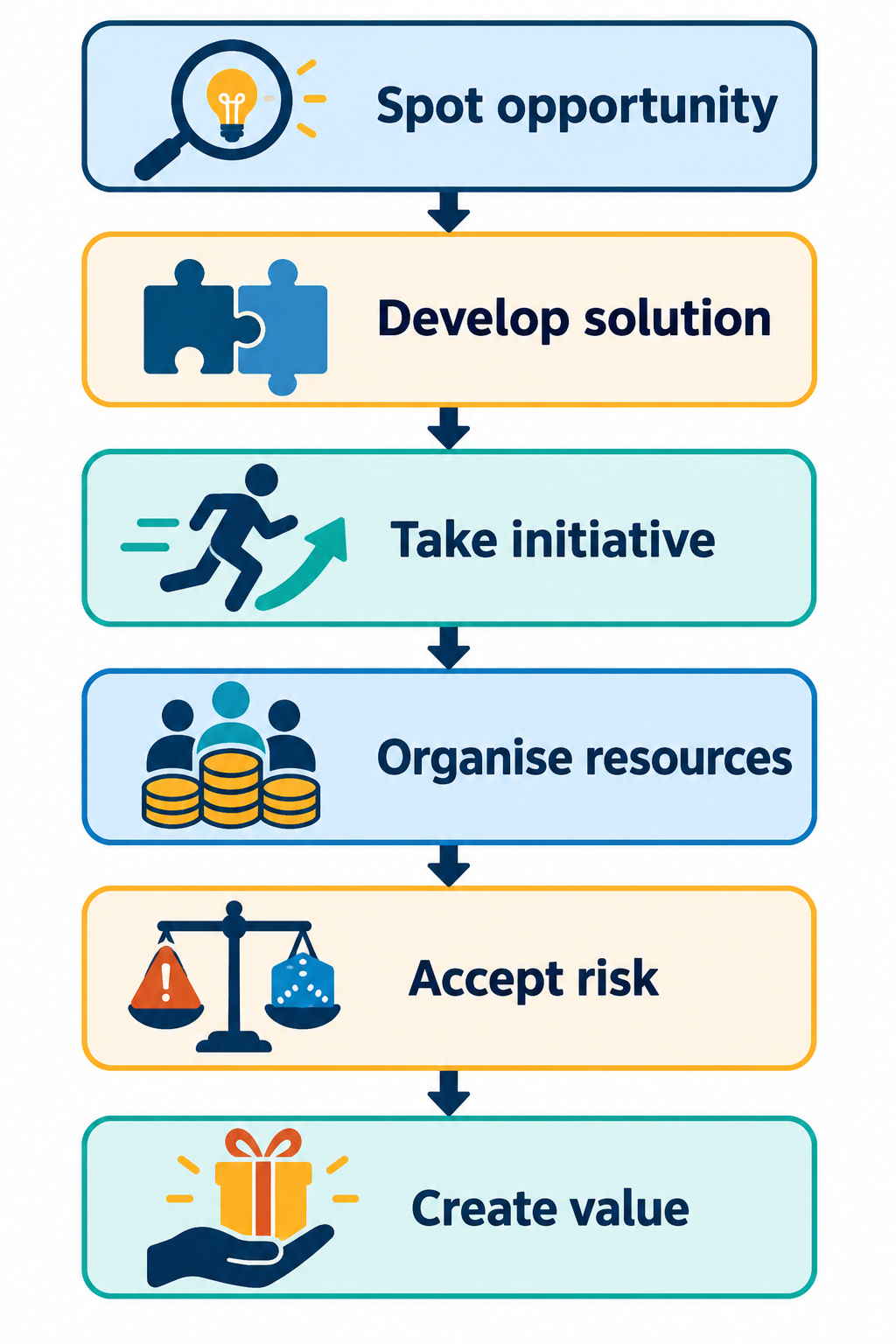
Entrepreneurship is a process
The entrepreneur is the person. Entrepreneurship is the process of recognising an opportunity, organising resources and taking action to create value from it.
Important characteristics of an entrepreneur
Characteristics that support entrepreneurial action
Entrepreneurs do not all have the same personality, but certain characteristics can help them identify opportunities, make decisions, cope with uncertainty and keep developing a venture when problems arise.
These characteristics are not guarantees of success. They are qualities that can make it easier for an entrepreneur to act on opportunities and respond effectively to challenges.

Important idea
An entrepreneur does not need to be naturally strong in every characteristic. Many of these qualities can be developed through experience, feedback, planning and practice.
Risk and reward in entrepreneurship
Why entrepreneurship involves risk
Starting a business involves risk because an entrepreneur cannot be certain that the business will succeed.
Entrepreneurs often invest their own money, time and effort into a business. If the business is successful, they may earn profits, build wealth, create a valuable business asset and enjoy greater independence. These potential rewards help explain why entrepreneurs are willing to accept risk.
However, if the business fails, they could lose money and the time they have invested.
The main risks entrepreneurs face include:
- Financial risk – losing money if the business does not make enough sales to cover its costs.
- Personal risk – working long hours, experiencing stress and having less time for family or friends.
- Business failure – the possibility that customers will not buy the product or competitors will attract customers away.

How entrepreneurs reduce risk
Entrepreneurs cannot remove all risks, but they can make calculated decisions to reduce the chance of failure.
For example, before opening a clothing store, an entrepreneur might:
Why entrepreneurship matters
Creating value beyond the founder
Entrepreneurship can benefit more than the person who starts the venture. New businesses can introduce new products and services, create employment, increase competition and encourage other businesses to improve.
Entrepreneurship can also address social or environmental problems. A venture may be designed to make a profit while also reducing waste, improving accessibility, supporting a community or solving another real-world problem.
The following are five important ways entrepreneurship can contribute beyond the founder:

Entrepreneurship in Western Australia
A WA ecosystem around entrepreneurs
Western Australian entrepreneurs can draw on a network of organisations that provide education, mentoring, workspaces, connections and access to investors. These organisations do not guarantee success, but they can help founders develop ideas, learn business skills, test ventures and connect with people who may support growth.
Perth-based innovation and coworking organisation offering spaces, startup programs and founder support. Its Plus Eight programs support early-stage entrepreneurs and startups.
Explore Spacecubed
WA entrepreneurship organisation with programs for young people, university students and startups. Its programs help participants develop, test and pitch business ideas.
Explore Bloom
A WA network of private investors that connects early-stage founders with investors and also provides mentoring, networks and startup support.
Explore Perth Angels
Provides information and support for WA small businesses, including guidance for people planning, starting and operating a business.
Explore SBDC
Why an ecosystem helps
An entrepreneur may have technical skill or a promising idea but still need help with customer testing, financial planning, pitching, networks or finance. Entrepreneurship ecosystems bring together people and organisations with different types of expertise and resources.
Entrepreneurship in action: Melanie Perkins and Canva
From frustration to global entrepreneurship
Melanie Perkins’ entrepreneurial journey began in Perth while she was studying at university and teaching students how to use design software. She noticed that many users found professional design programs complicated, expensive and difficult to learn.
Rather than treating that frustration as simply a problem, Perkins recognised an opportunity to make design easier and more accessible. She and Cliff Obrecht first developed Fusion Books, an online school-yearbook platform that allowed users to create layouts more simply through a web browser.
That early venture gave them experience in identifying customer needs, developing an online product, attracting users and learning how to operate a technology business. The broader idea eventually developed into Canva, which launched in 2013 with the aim of making visual design easier for everyday users.
The case demonstrates several features of entrepreneurship: identifying a problem, taking initiative, organising resources, persuading investors, accepting uncertainty, learning from an earlier venture and continuing to develop the idea over time.

Key lesson
Entrepreneurship is not defined by having a spectacular idea on day one. It is the repeated process of identifying problems, testing possible solutions, learning from evidence and taking action despite uncertainty.
🎧 Prefer listening?
If you prefer listening to the content in Podcast format:
🎥 Prefer watching?
If you prefer watching the content in video format:
🧑🏫 Class Activities
Hands-on activities
These activities are designed to help you apply the full content to real businesses through research, decision-making and practical classroom tasks.
How this section could be used: teachers could place students into small groups and allocate different activities, ask students to complete one or two activities each week, or use the activities at the end of each syllabus point so groups can take turns completing and presenting one task to the class. Activities can also be used as extension work, revision, or as a starting point for short class discussions.

1. Build the Entrepreneur
Scenario: You have been given $1,000 and four weeks to launch a small business aimed at students in your local area. Your goal is to prove that you can move from an idea to genuine entrepreneurial action.
Your task:
- Choose one realistic customer problem or unmet need faced by students.
- Develop a simple product or service that could solve the problem.
- Identify five characteristics of an entrepreneur that would help you launch the venture and explain how each would be used.
- List the key resources you would need, including money, skills, technology, equipment or people.
- Identify one financial risk, one personal risk and one business failure risk.
- Explain two actions you would take to reduce those risks before spending the full $1,000.
- Identify the potential reward if the venture succeeds.
Finish with: a 60-second pitch explaining why your idea demonstrates entrepreneurship rather than simply being a business idea.
2. From Opportunity to Action
A school has long lunch queues and students regularly miss the start of lunchtime sport.
- Identify the opportunity.
- Propose one entrepreneurial solution.
- List three resources needed to test the idea.
- Identify two risks or uncertainties.
- Describe a small-scale test before committing major money.
3. Entrepreneur Characteristics in Action
A new clothing brand has disappointing early sales, limited cash and customer feedback suggesting the designs need improvement.
- Identify four entrepreneur characteristics that would help the founder respond.
- Explain how each characteristic could be demonstrated.
- Identify one financial risk and one personal risk.
- Recommend one calculated action the founder should take next.
4. WA Entrepreneurship Support
Allocate one of these organisations to each group: Spacecubed, Bloom, Perth Angels or SBDC.
- Identify what the organisation does.
- Identify who it supports.
- Explain what resource or problem it could help an entrepreneur with.
- Present a 60-second explanation to the class.
5. Risk-Reduction Challenge
Your group plans to open a small streetwear store aimed at teenagers and young adults.
- Identify one financial risk, one personal risk and one business-failure risk.
- Identify two potential rewards that may make the entrepreneur willing to accept these risks.
- Design four actions to reduce those risks before opening the shop.
- Include market research, testing demand, supplier comparison and starting small.
- Explain which action would reduce risk the most and why.
✍️ Short Answer Questions
Practice questions
Answer each question before opening the sample answer. Marks are based on the command term and the number of separate points requested.
Show sample answer
Entrepreneurship is the process of identifying a business opportunity and taking action to develop, organise and operate a venture that creates value while accepting risk.
Show sample answer
An entrepreneur is the person who identifies and acts on a business opportunity. Entrepreneurship is the process that person undertakes to organise resources, accept risk and develop the venture.
Show sample answer
One characteristic is initiative, where the entrepreneur takes action rather than waiting for someone else to develop the opportunity. Another is resilience, which allows the entrepreneur to recover from setbacks, learn from mistakes and continue developing the venture.
Show sample answer
An entrepreneur may accept financial risk because starting a business can provide potential rewards such as profit, independence and growth in the value of the business. However, the entrepreneur may invest money before knowing whether sales will cover costs. As a result, the entrepreneur accepts the possibility of financial loss in pursuit of a potentially greater reward.
Show sample answer
Testing demand allows the entrepreneur to see whether customers are actually willing to buy before committing large amounts of money. This helps the entrepreneur identify weak demand or pricing problems early. As a result, the amount of money exposed to possible loss can be reduced.
Show sample answer
Entrepreneurship can create value by developing a product or service that solves a customer problem or meets a need more effectively. This gives customers a useful benefit such as greater convenience, lower cost or improved quality. As a result, customers may be willing to support and pay for the new venture.
Show sample answer
Entrepreneurship can create employment when new ventures employ the founder and additional workers as they grow. It can also increase competition because new businesses may encourage existing firms to improve their price, quality, service or convenience.
Show sample answer
A support organisation can provide knowledge, mentoring, networks or access to investors that the founder may not already have. This can help the entrepreneur improve the idea, test assumptions and make better-informed decisions. As a result, the founder may be better prepared to launch or grow the venture.
Show sample answer
I recommend that the student does not immediately spend the full $10,000. This is because entrepreneurship involves managing uncertainty, and the student should first test whether customers actually value the idea using a lower-cost prototype or trial. As a result, the student can gather evidence and reduce the amount of money at risk before committing to full development.
Show sample answer
Melanie Perkins recognised that many users found existing design software difficult, identifying a problem worth solving. She then helped develop Fusion Books and later Canva, using experience, resources and continued testing to refine the idea. As a result, a customer frustration was turned into a scalable business venture through entrepreneurial action.
🃏 Flashcards
Card 1 of 13
🎮 Revision Games
💰 BME Millionaire
Climb the prize ladder by mastering the concept and process of entrepreneurship.
🚀 Venture Builder
Work through five realistic Australian small-business briefs, balance control, risk, finance and growth, and choose the best structure.
⚡ 60 Second Showdown
A fast 60-second sprint covering business motivations, liability, advantages, limitations and business scenarios.

Biz Fact: Apple started in a garage – Steve Jobs and Steve Wozniak launched Apple in 1976 with limited resources and a big idea.