
General U1.19 - Key Features of a Job Description
Overview
Dotpoint 19: key features of a job description.
A job description is a document that explains what a job involves and what the employer is looking for in a suitable employee.
A clear job description helps a business attract applicants who are more likely to suit the role. It can explain the work to be completed and the qualities the employer needs from the person who will perform it.
This dotpoint focuses on three important features used when describing what a suitable employee needs:
1. Skills – what the person must be able to do.
2. Qualifications – formal certificates, licences or education that may be required.
3. Experience – previous work or practical exposure that helps prepare the person for the role.

🛠 Skills
Skills are abilities that allow a person to perform tasks effectively.
A job description can identify the skills needed to complete the work successfully. Some skills are practical and job-specific, while others help employees communicate, organise work and solve problems.
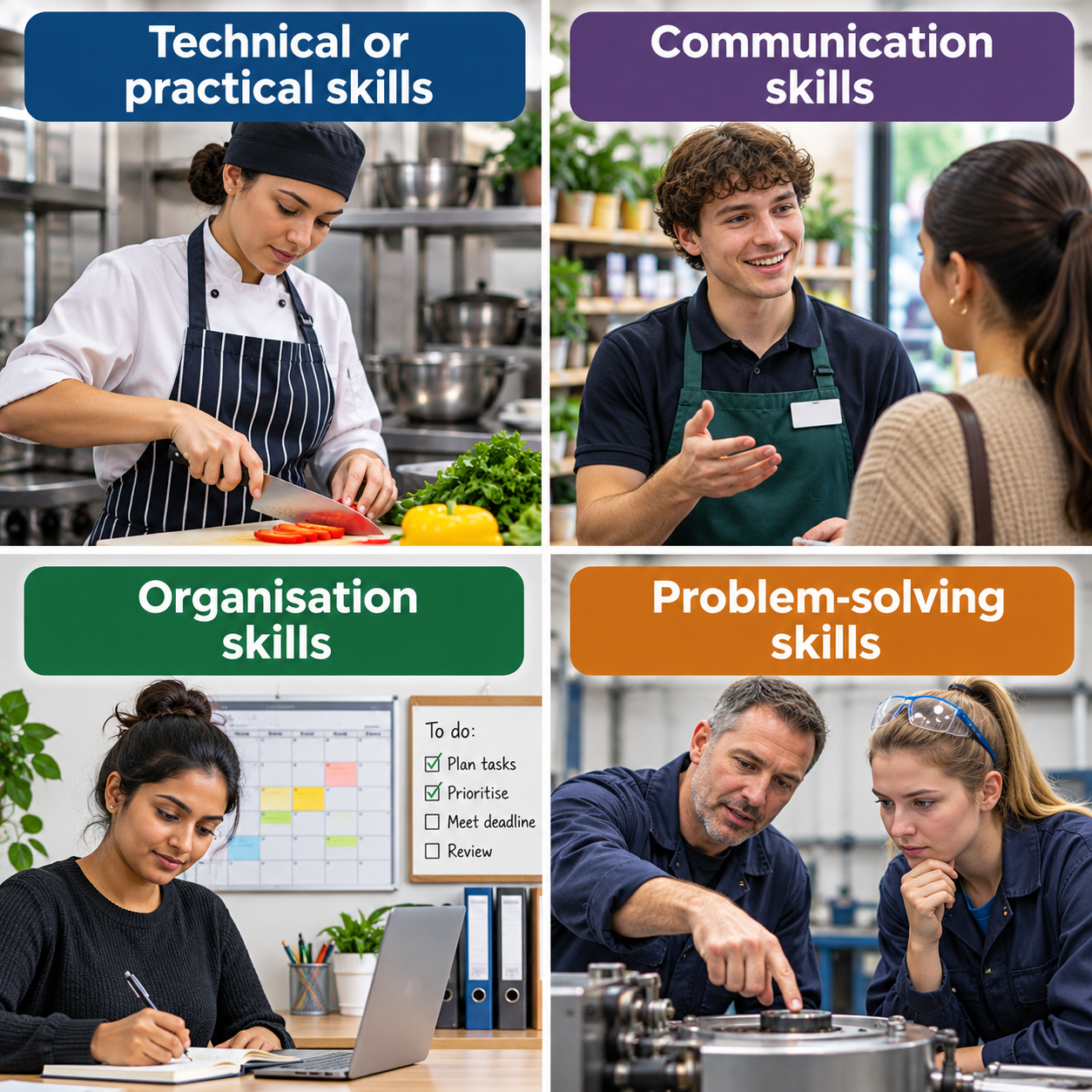
Common types of skills employers may include
Technical or practical skills
Abilities directly connected to the work, such as using accounting software, operating equipment, preparing food or repairing bicycles.
Communication skills
The ability to listen, explain information clearly and interact effectively with customers, co-workers or suppliers.
Organisation skills
The ability to manage time, prioritise tasks and keep work accurate and organised.
Problem-solving skills
The ability to identify problems and choose practical ways to deal with them.
Skills should match the actual job
A small business does not need to list every desirable quality imaginable. The most useful skills are those that clearly connect to the work the employee will actually perform.
Examples of skills that may be advertised for different jobs
- Café assistant: customer communication, basic food preparation, time management and the ability to work efficiently during busy periods.
- Bicycle mechanic: safe use of repair tools, basic mechanical skills, problem-solving and clear communication with customers.
- Retail assistant: customer service, point-of-sale skills, organisation and the ability to work as part of a team.
- Office assistant: computer skills, written communication, organisation and attention to detail.
- Landscaping worker: safe use of equipment, physical coordination, teamwork and the ability to follow instructions.
🎓 Qualifications
Qualifications are formal certificates, licences, education or training that show a person has completed a recognised standard of learning or competency.
A job description may identify qualifications that are needed to perform the role safely, legally or effectively. Some qualifications are essential, while others may simply make an applicant more suitable.
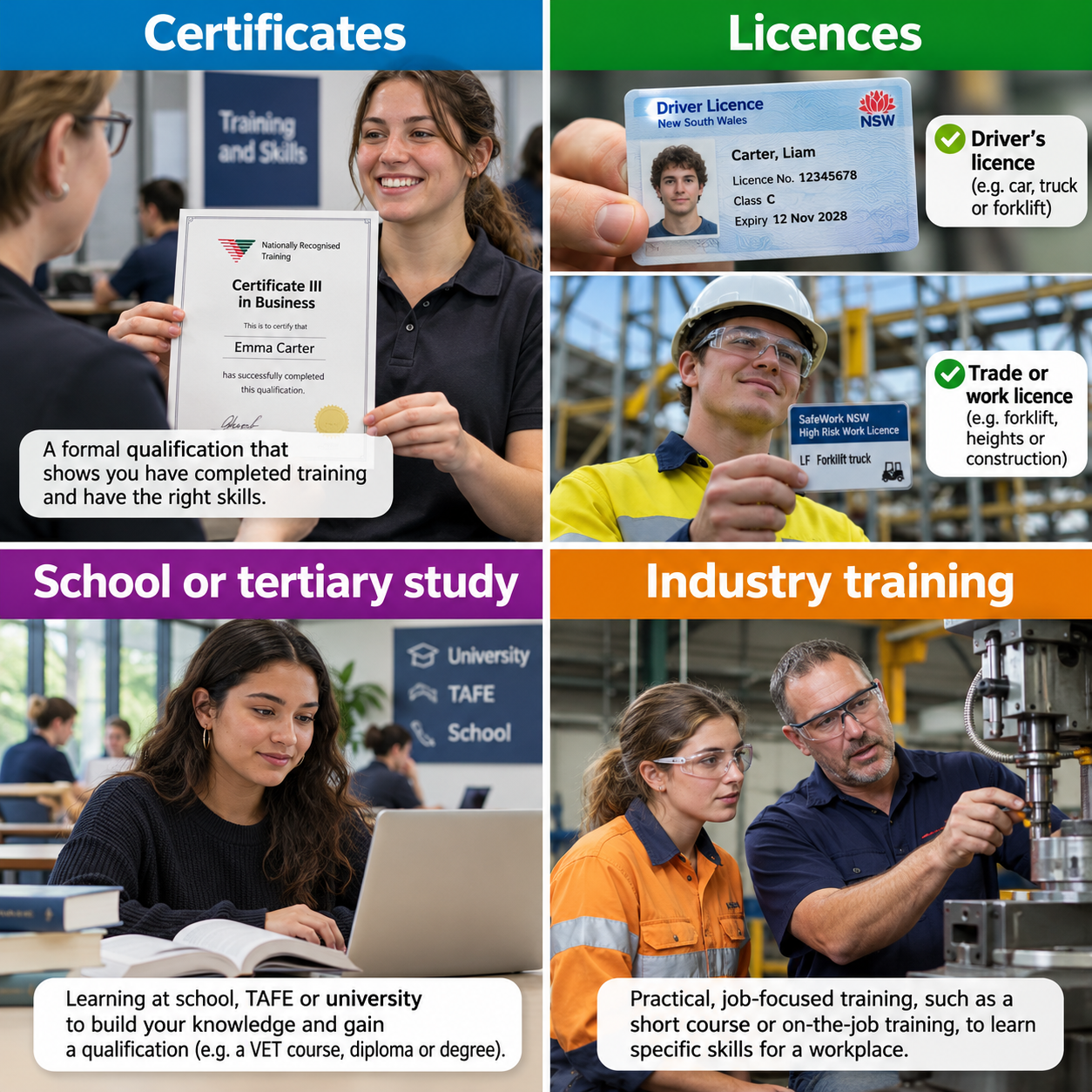
Common types of qualifications employers may include
Certificates
A recognised certificate can show that an applicant has completed training in a particular area.
Licences
Some roles require a current licence or permit, such as a driver’s licence or a trade licence.
School or tertiary study
A role may require or prefer a certain level of education or study in a relevant field.
Industry training
Short courses or recognised training can demonstrate competency needed for particular tasks.
Essential or desirable?
Essential qualifications are needed to perform the role or meet a legal or business requirement.
Desirable qualifications are useful but the applicant may still be considered without them.
Examples of qualifications that may be advertised for different jobs
- Mobile dog groomer: a current driver’s licence may be essential because the employee needs to travel between customers.
- Electrician: appropriate electrical qualifications and licences are required for certain electrical work.
- Commercial cook: a Certificate III in Commercial Cookery may be requested for some roles.
- Bar or hospitality worker: Responsible Service of Alcohol training may be required where alcohol is served.
- Office administration role: a certificate in business or administration may be desirable but not always essential.
🧭 Experience
Experience is the knowledge and practical understanding a person develops through previous work or relevant activities.
A job description may describe the type or amount of experience that would help an applicant perform the role. Relevant experience can reduce training needs, but entry-level positions may still be suitable for applicants with limited experience.
Common types of experience employers may include
Industry experience
Previous work in the same industry can help an employee understand common customers, products and workplace practices.
Role experience
Previous work in a similar position can reduce the amount of training needed when the employee starts.
Customer experience
For customer-facing roles, previous experience dealing with customers can help the employee respond confidently and professionally.
Experience is not always essential
Entry-level jobs may be suitable for applicants with limited experience if the business is prepared to train them.

Relevant experience matters most
More experience is not automatically better. Experience that closely matches the job may be more useful than many years in an unrelated role.
Examples of experience that may be advertised for different jobs
- Café barista: previous café or hospitality experience may be desirable because the applicant may already understand busy service periods and customer interaction.
- Retail assistant: previous retail or customer-service experience may help the employee use store systems and respond to customers confidently.
- Events assistant: experience at functions, school events or hospitality venues may help the applicant adapt to busy and changing situations.
- Workshop assistant: previous hands-on work with tools or machinery may reduce the amount of basic training required.
- Junior office assistant: school, volunteering or casual work that involved filing, data entry or customer contact may provide useful experience even if the applicant has not held a full-time office job.
🎧 Prefer listening?
Listen to the Job Description podcast for another way to revise this dotpoint.
🎥 Prefer watching?
Watch the Job Description video to reinforce the key ideas.
🧑🏫 Class Activities
Hands-on activities
These activities are designed to help you apply the full content to real businesses through research, decision-making and practical classroom tasks.
How this section could be used: teachers could place students into small groups and allocate different activities, ask students to complete one or two activities each week, or use the activities at the end of each syllabus point so groups can take turns completing and presenting one task to the class. Activities can also be used as extension work, revision, or as a starting point for short class discussions.

1. Build the Right Applicant
Westside Bike Repairs needs a junior workshop assistant who will help with simple repairs, speak with customers and keep the workshop organised.
Output: create a three-column table with Skills, Qualifications and Experience. Add at least two suitable items under each heading, then explain which requirement should be essential and which could simply be desirable.
2. Real Job Advertisement Research
Find a current Australian job advertisement for a casual or entry-level role from a major employer such as Woolworths, Coles, Bunnings, Kmart or McDonald’s.
- Identify two skills requested.
- Identify any qualifications requested.
- Identify any experience requested.
- Decide which feature appears most important to the employer.
Output: prepare a one-slide job-ad analysis showing the three features and your conclusion.
3. Essential or Desirable?
Coastal Dog Grooming needs an employee who will drive a company van, wash and groom dogs, and speak with customers.
Output: classify each of the following as Essential, Desirable or Not Needed: driver’s licence, animal-care certificate, five years of office experience, customer-service skills, previous grooming experience, university degree. Give a short reason for each choice and identify whether each item is a skill, qualification or experience.
4. Fix the Bad Job Description
A small café advertises for a junior barista and says the applicant must have a university degree, ten years of management experience, advanced spreadsheet skills and a forklift licence.
Output: rewrite the applicant requirements so they better match a junior café role. Include two skills, one qualification and one type of relevant experience, and label each as essential or desirable.
5. Skills, Qualification or Experience?
Classify each item:
- current driver’s licence
- confident customer communication
- worked in retail for one year
- Certificate III in Commercial Cookery
- ability to use a point-of-sale system
- previous experience supervising a small team
Output: complete a three-column sort and then write one sentence explaining the difference between the three categories.
6. Hire for a Small Business
Riverbend Events is choosing between two applicants for a casual events assistant:
Applicant A: has a hospitality certificate and three years of restaurant experience but gives brief, unclear answers during the interview.
Applicant B: has no formal qualification and six months of school-event volunteering but communicates confidently and solves problems calmly.
Output: recommend one applicant in a short paragraph using skills, qualifications and experience as evidence.
✍️ Short Answer Questions
Practice questions
Answer each question before opening the sample answer. Use the command term carefully and apply the marketing decision to the context provided.
Show sample answer
A job description is a document that explains what a job involves and what the employer is looking for in a suitable employee.
Show sample answer
Skills, qualifications and experience.
Show sample answer
The job description could include customer communication skills so the employee can take orders and respond to customers, and organisation skills so the employee can manage several tasks during busy periods.
Show sample answer
The employee needs to travel between customers’ homes in the business vehicle. Without a valid driver’s licence, the employee may be unable to perform this major part of the job. As a result, the licence can be listed as an essential qualification because it is directly connected to completing the role.
Show sample answer
An applicant with relevant experience may already understand similar tasks, equipment or customer situations, even if they have worked for a shorter period. A person with many years of unrelated experience may still need significant training in the actual role. As a result, relevant experience can help the employee become productive more quickly and reduce the training pressure on a small business.
Show sample answer
Unnecessary qualifications can discourage suitable applicants who could perform the job well but do not hold a certificate or degree that is unrelated to the work. The business may therefore receive fewer appropriate applications. As a result, qualifications should match the actual requirements of the role rather than simply making the job description appear more demanding.
Show sample answer
A clear job description tells applicants which skills, qualifications and experience are relevant to the position. This can encourage suitable people to apply while helping unsuitable applicants recognise that the role may not match them. The owner can then compare applicants against clearer criteria rather than relying only on first impressions. The implication is that the business may make a more suitable hiring decision and reduce the risk of having to replace or retrain the wrong employee.
Show sample answer
One advantage of prioritising experience is that an experienced employee may understand the work already and require less training, which can be valuable for a small business with limited time. However, experience alone does not guarantee that the applicant has the skills or required qualifications for the role. A less experienced applicant may have stronger communication or problem-solving skills and could learn the technical parts of the job quickly. Overall, experience is important when it is relevant, but the employer should consider skills, qualifications and experience together rather than automatically choosing the person with the longest work history.
🃏 Flashcards
Card 1 of 9
🎮 Revision Games
💰 Job Description Millionaire
Climb the ladder by mastering skills, qualifications and experience.
🧩 Skill, Qualification or Experience?
Sort each requirement into the correct category.
⚡ 60 Second Showdown
Race through job-description questions before the clock expires.
Biz Fact: A qualified electrician cannot legally perform certain electrical work in Western Australia without the appropriate licence.