
General U2.06 - Intent and Purpose of WA Workplace Laws
Overview
Dotpoint 6: intent and purpose of Western Australian workplace laws.
Workplace laws establish rules that businesses and workers must follow. Different laws exist because workplaces can involve different types of risk and unfair treatment.
This dotpoint examines why these laws exist and what they are designed to achieve. Some laws focus on fair treatment and equal opportunity, while others focus on protecting people from workplace health and safety risks.
This dotpoint focuses on the intent and purpose of:
1. Equal Opportunity Act 1984 (WA)
2. Work Health and Safety Act 2020 (WA)

⚖️ Why workplace laws exist
Workplaces need rules
Businesses make decisions that affect employees every day. They recruit workers, allocate tasks, provide equipment, manage workplaces and decide how employees are treated.
Without workplace laws, employees could face unfair treatment or unsafe working conditions without clear legal standards protecting them.
Workplace laws therefore establish minimum standards of behaviour and responsibility that businesses and workers are expected to follow.
What do intent and purpose mean?
🎯 Intent
The intent of a law is the overall goal the law is trying to achieve.
For example, a workplace safety law may intend to prevent people being injured at work.
🛠️ Purpose
The purpose explains why the law is needed and the broad way it helps achieve its goal.
For example, a workplace safety law may aim to reduce the chance that hazards lead to injury or illness.
Two laws, two different workplace problems
🤝 Equal Opportunity Act 1984 (WA)
Focuses mainly on fair treatment and equal opportunity.
It aims to reduce unlawful discrimination and harassment connected to protected personal characteristics.
🦺 Work Health and Safety Act 2020 (WA)
Focuses mainly on health and safety at work.
It aims to prevent workplace injury, illness and other harm by encouraging workplace risks to be identified and controlled.
The easiest way to separate the laws
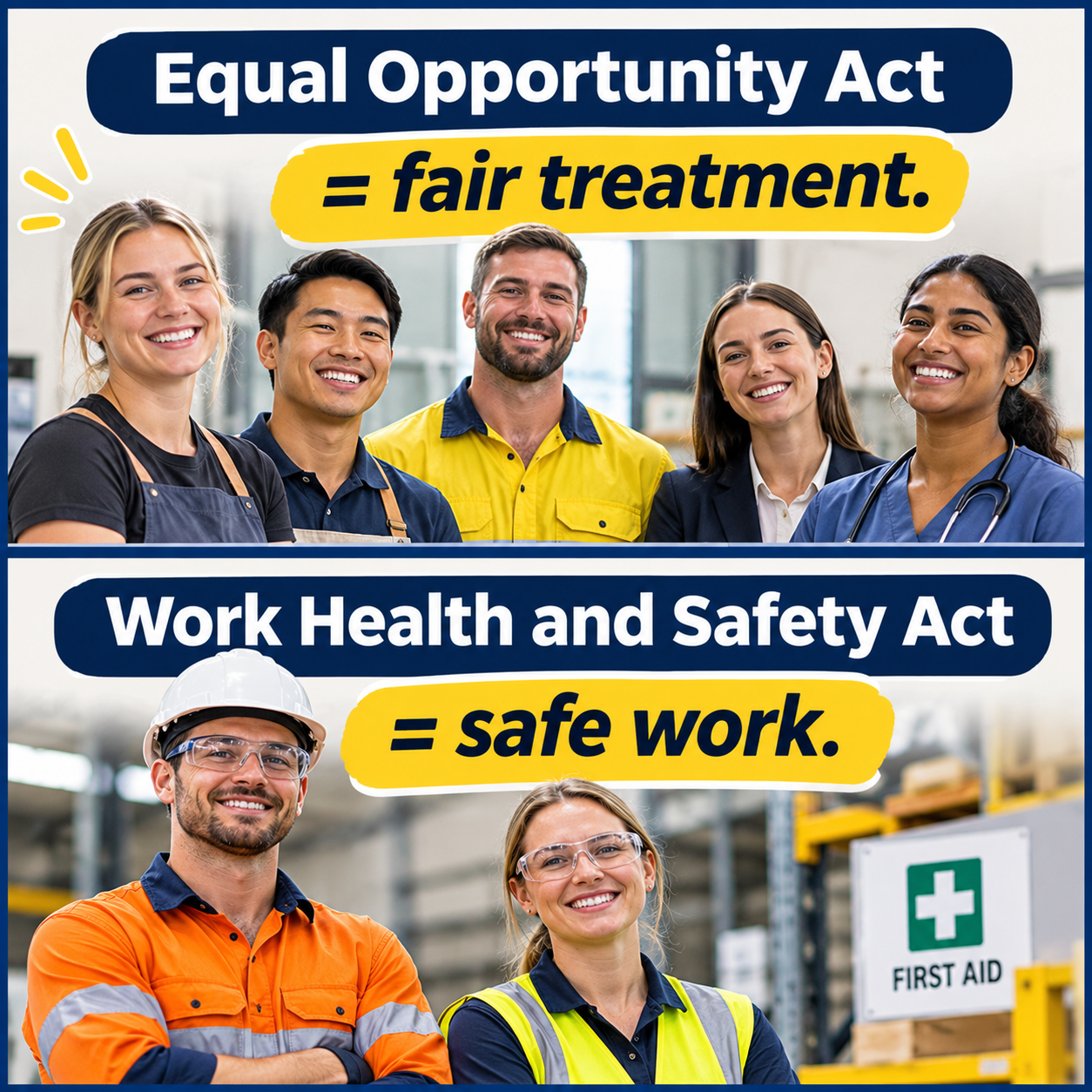
Equal Opportunity Act = fair treatment.
Work Health and Safety Act = safe work.
🤝 Equal Opportunity Act 1984 (WA)
What is the Equal Opportunity Act 1984 (WA)?
The Equal Opportunity Act 1984 (WA) is a Western Australian law designed to promote equality of opportunity and protect people from certain forms of unlawful discrimination and harassment.
In a workplace, this means employment decisions should not be unfairly based on personal characteristics protected by the law.
The intent of the Act
The main intent is to create a fairer society where people have opportunities to participate in areas such as employment without being unfairly disadvantaged because of protected personal characteristics.

The main purposes of the Act
⚖️ Promote equal opportunity
People should have a fair opportunity to apply for jobs, gain promotion and participate in workplaces.
🛡️ Reduce unfair treatment
The law makes certain types of discrimination and harassment unlawful.
👥 Encourage fair decisions
Employment decisions should be based on relevant factors such as skills, qualifications, experience and performance rather than unlawful discriminatory reasons.
What is discrimination?
Discrimination involves unfair treatment
Discrimination can occur when a person is treated unfairly because of a personal characteristic or ground protected by the law.
Protected characteristics include areas such as age, race, sex, pregnancy and impairment, as well as other grounds covered by the Act.
A simple way to think about it is this: if a person is treated unfairly, the key question is whether the unfair treatment happened because of a protected personal characteristic.
❌ Example: unfair recruitment
A qualified applicant is rejected from an office position only because the employer believes the person is “too old for the team”.
The decision is based on the person's age rather than their ability to perform the job.

✅ Example: lawful business decision
An applicant is rejected because they do not hold a licence that is genuinely required to perform the job.
The decision is based on a relevant job requirement rather than a protected personal characteristic.

Not every unfavourable decision is discrimination
A worker missing out on a job, promotion or opportunity does not automatically mean discrimination has occurred.
The key question is why the person missed out.
Businesses can make decisions based on legitimate factors such as qualifications, experience, performance and genuine job requirements.
Why does this matter for a small business?
Fair decisions reduce legal and workplace problems
A small business may make decisions about recruitment, promotion, training, employee behaviour and customers.
Understanding equal opportunity law encourages the owner to make these decisions using fair and relevant business reasons.
This can reduce the risk of complaints while also helping employees feel respected and fairly treated.
🦺 Work Health and Safety Act 2020 (WA)
What is the Work Health and Safety Act 2020 (WA)?
The Work Health and Safety Act 2020 (WA) is Western Australia's main workplace health and safety law.
Its broad aim is to protect workers and other people from risks created by work and workplaces.
The intent of the Act
The main intent is to prevent workplace harm before it occurs.
The Act focuses on preventing harm before it occurs by encouraging workplace hazards and risks to be identified and controlled rather than waiting until somebody is injured or becomes ill.

The main purposes of the Act
⛑️ Protect people
Workers and other people should be protected from workplace risks that may cause injury, illness or other harm.
⚠️ Manage workplace risks
Workplace hazards should be identified and action taken to eliminate or reduce the risks they create.
📉 Reduce workplace harm
The law aims to reduce workplace injuries and illness by encouraging hazards and risks to be addressed before people are harmed.
Hazard and risk are connected
⚠️ Hazard
A hazard is something that could cause harm.
Examples include a wet floor, damaged electrical cable, unsafe machinery or heavy stock stored incorrectly.
📉 Risk
A risk relates to the possibility that the hazard could actually cause harm.
Recognising hazards and reducing the risks they create can help prevent injury or illness.
🧹 Example: a supermarket storeroom
A supermarket employee notices that a box has leaked liquid across the storeroom floor.
The spill is a hazard because somebody could slip and fall.
Cleaning the spill and keeping people away from the area until it is safe reduces the chance that the hazard will cause an injury.

Who oversees workplace safety in WA?
WorkSafe WA regulates and enforces workplace health and safety laws in Western Australia.
Its role includes providing information about workplace safety and taking enforcement action where workplace safety laws are not being followed.

🎧 Prefer listening?
Listen to the WA Workplace Laws podcast to revise the key ideas in this dotpoint.
🎥 Prefer watching?
Watch the WA Workplace Laws video to reinforce the difference between fair treatment and safe work.
🧑🏫 Class Activities
Hands-on activities
These activities are designed to help you apply the full content to real businesses through research, decision-making and practical classroom tasks.
How this section could be used: teachers could place students into small groups and allocate different activities, ask students to complete one or two activities each week, or use the activities at the end of each syllabus point so groups can take turns completing and presenting one task to the class. Activities can also be used as extension work, revision, or as a starting point for short class discussions.

1. Fair or Unsafe?
Classify each situation as mainly involving the Equal Opportunity Act or the Work Health and Safety Act.
- a worker is rejected for promotion because she is pregnant
- a damaged electrical cord is still being used
- a qualified applicant is rejected because of their race
- a worker is given training before using new machinery
- a spill is left across a shop floor
- an applicant is rejected because they lack a required qualification
Output: complete a table headed Scenario, Law and Reason.
2. Fair Recruitment Check
A Perth clothing store is recruiting a new sales assistant.
The owner has written the following criteria:
- must have customer-service skills
- must be under 25
- must be available on Saturdays
- must have retail experience
- must “fit the young look of the team”
Identify which criteria appear relevant to the job and which could create an equal opportunity concern.
Output: rewrite the recruitment criteria so they focus on relevant job requirements.
3. Workplace Hazard Hunt
Imagine you are inspecting a small takeaway business.
Identify five possible workplace hazards, such as:
- hot cooking equipment
- wet floors
- heavy stock
- sharp equipment
- electrical equipment
For each hazard, identify the possible harm and suggest one way the risk could be reduced.
Output: complete a Hazard → Possible Harm → Risk Reduction table.
4. Workplace Laws Presentation
Choose either the Equal Opportunity Act 1984 (WA) or the Work Health and Safety Act 2020 (WA).
Create a short presentation explaining:
- the intent of the law
- its main purpose
- the workplace problem it is designed to reduce
- one realistic small-business example
Output: prepare a three-slide presentation titled Why This Workplace Law Exists.
5. Real Business Example
Choose a real WA business and explain one situation where fair treatment would be important and one situation where workplace safety would be important.
You might choose a supermarket, café, childcare centre, warehouse or construction business.
Output: create a short business profile with two headings: Equal Opportunity and Work Health and Safety.
6. Workplace Problems Action Plan
A new indoor sports centre employs eight workers.
The owner has not created clear recruitment criteria, a worker has complained about repeated comments relating to their age, several electrical cables cross a walkway and new employees have not received safety training.
Identify:
- two issues connected to equal opportunity
- two issues connected to workplace health and safety
- which law is most closely connected to each problem
- one practical way each problem could be reduced
Output: create a four-row Workplace Problems Action Plan.
✍️ Short Answer Questions
Practice questions
Answer each question before opening the sample answer. Marks are based on the command term and the number of separate points requested.
Show sample answer
One purpose of the Equal Opportunity Act 1984 (WA) is to promote equality of opportunity so people have a fair opportunity to participate in areas such as employment. A second purpose is to reduce unlawful discrimination and harassment based on personal characteristics protected by the law.
Show sample answer
One purpose of the Work Health and Safety Act 2020 (WA) is to protect workers and other people from workplace health and safety risks. A second purpose is to reduce workplace injury and illness by encouraging hazards and risks to be identified and controlled.
Show sample answer
The Equal Opportunity Act encourages a small business to base recruitment decisions on relevant job requirements such as an applicant's skills, qualifications and experience rather than unlawfully discriminating because of a protected personal characteristic. As a result, applicants are more likely to receive a fair opportunity to compete for the position and the business reduces the risk of discriminatory recruitment practices.
Show sample answer
One purpose of the Work Health and Safety Act 2020 (WA) is to protect people from risks created by work and workplaces. Identifying and controlling hazards such as unstable stock, blocked walkways or damaged equipment reduces the chance that these hazards will cause injury or illness. As a result, managing workplace hazards supports the Act's aim of preventing workplace harm before it occurs.
Show sample answer
In a workplace context, discrimination means a person is treated unfairly because of a protected personal characteristic rather than on a fair and relevant basis. For example, rejecting someone because of age or race may be discriminatory if that characteristic is the reason for the decision.
Show sample answer
Workplace hazards can cause employee injury or illness if they are not identified and controlled. The WHS Act aims to reduce these risks before an incident occurs. As a result, employees and other people in the workplace are less likely to experience injury or illness, supporting the Act's overall purpose of creating safer workplaces.
Show sample answer
The Equal Opportunity Act does not require a business to employ every applicant because businesses can still make decisions using lawful and relevant job criteria such as qualifications, experience and ability to perform the role. The problem occurs when a decision involves unlawful discrimination based on a protected ground. As a result, a business can select the most suitable applicant while still providing candidates with a fair opportunity.
Show sample answer
Decision: The damaged cable should stop being used and the hazard should be made safe.
Reason: A damaged electrical cable could expose people in the workplace to electric shock or another injury, so leaving it in use would allow a known safety risk to remain.
As a result, controlling the hazard reduces the likelihood of somebody being harmed, directly supporting the WHS Act's purpose of preventing workplace injury and illness.
Show sample answer
One advantage is that workplace laws establish clear standards that protect people from problems such as unlawful discrimination and unsafe working conditions. This can contribute to a workplace where employees feel safer and more fairly treated.
One disadvantage is that complying with workplace laws can require additional time and money. A small business may need to review workplace practices, provide training or spend money reducing safety risks.
Overall, workplace laws are important for small businesses because the protection they provide against unfair treatment and workplace harm is likely to outweigh the additional compliance effort. Safer and fairer workplaces can also reduce the likelihood of complaints, injuries and disruption to normal business operations.
🃏 Flashcards
Card 1 of 10
🎮 Revision Games
💰 BME Millionaire
Climb the money ladder by mastering the purpose of WA's Equal Opportunity and workplace safety laws.
⚖️ Which Law?
Read realistic workplace situations and decide whether the main issue is fair treatment or workplace safety.
⚡ 60 Second Showdown
Race through rapid questions on intent, purpose, discrimination and workplace hazards.

Biz Fact: In WA, refusing to hire someone simply because they are pregnant may be unlawful discrimination.