
U1.04 - National Employment Standards (NES) for Employment Contracts
Overview
Dotpoint 4: National employment standards for employment contracts, including minimum wage, minimum working conditions and unfair dismissal.
The National Employment Standards (NES) are Australia's minimum legal employment rights under the Fair Work Act. They establish a legal baseline for employment contracts, meaning businesses cannot provide employees with conditions below the required minimum standards.
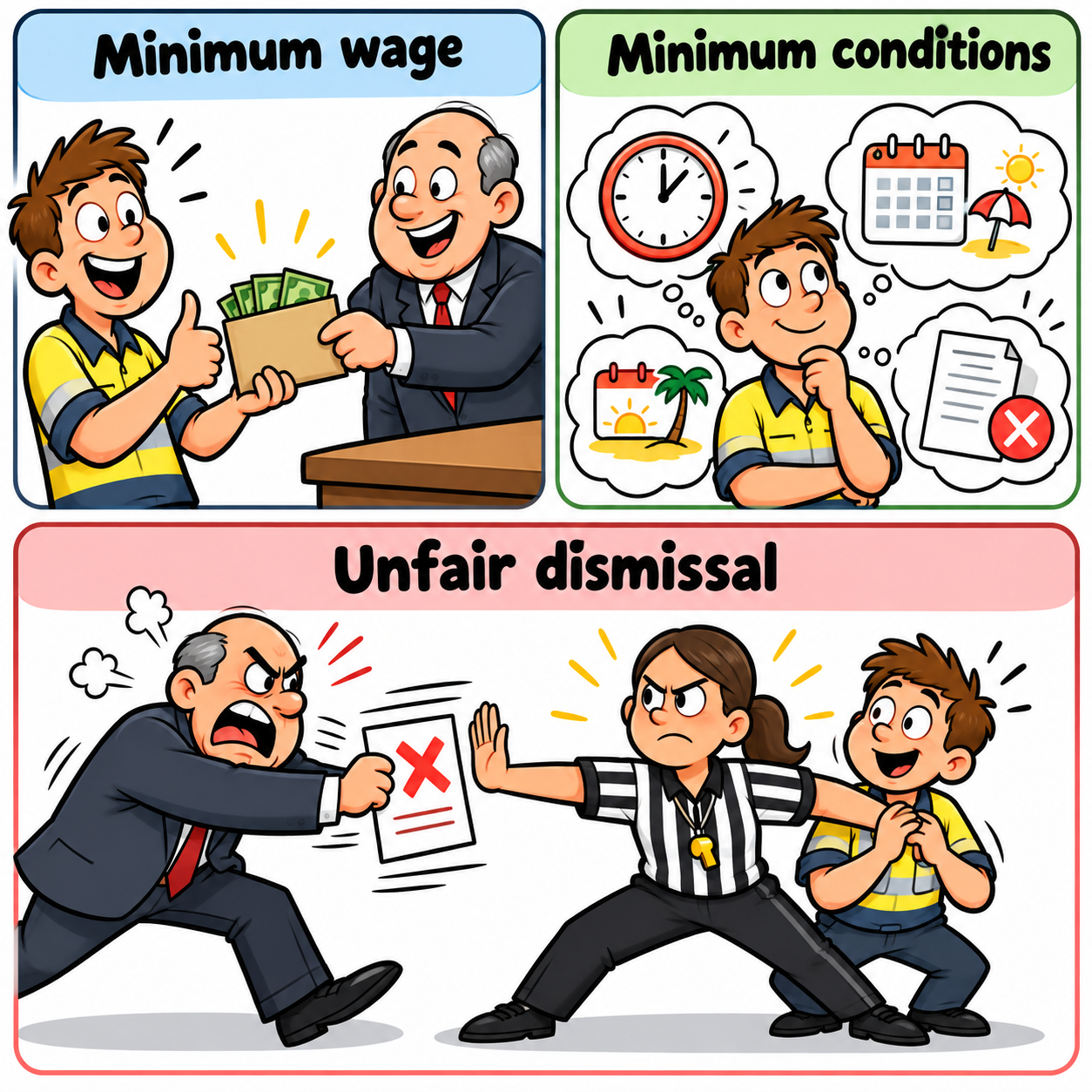
This dotpoint focuses on three important areas of employee protection:
- Minimum wage - employees must receive at least the legal minimum pay that applies to their work.
- Minimum working conditions - employees are protected by minimum rights relating to hours, leave, public holidays and ending employment.
- Unfair dismissal - employees are protected from dismissal that is harsh, unjust or unreasonable.
National Employment Standards (NES)
The National Employment Standards (NES) are the minimum legal employment rights that apply to most employees in Australia. They set the baseline for employment contracts, so a business cannot provide conditions below these minimum standards even if an employee agrees.
National Employment Standards and the Fair Work Act
The Fair Work Act
The NES are created under the Fair Work Act 2009, Australia's main workplace law.
The Act:
- sets minimum pay and conditions
- regulates employment contracts and awards
- protects employees from unfair dismissal
- is enforced by the Fair Work Ombudsman and the Fair Work Commission.
Any contract, workplace policy or verbal agreement that tries to go below the legal minimum is not legally valid.
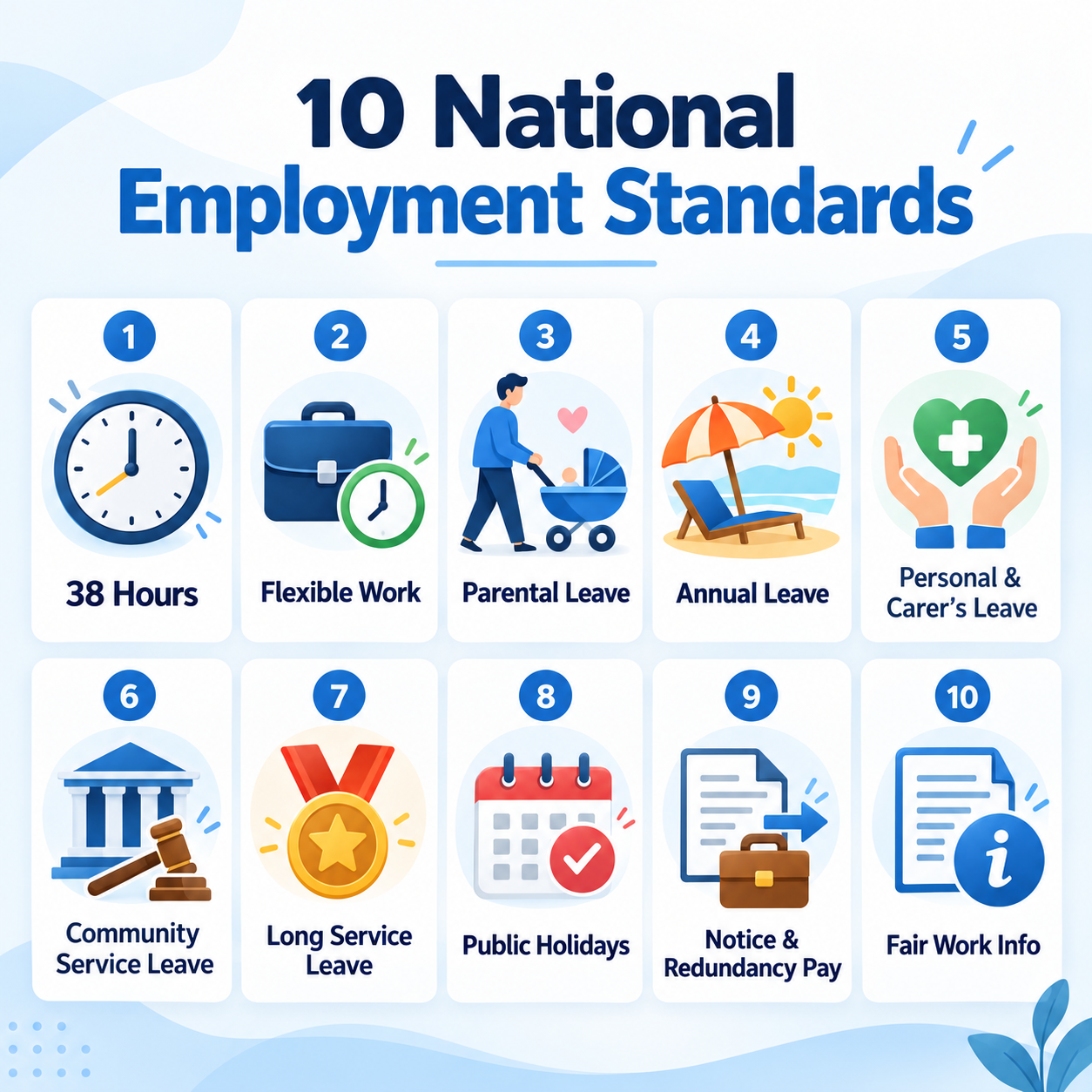
Every eligible employee is entitled to minimum standards covering:
- Maximum weekly hours - 38 ordinary hours plus reasonable overtime
- Requests for flexible working arrangements
- Parental leave and related entitlements
- Annual leave - 4 weeks paid, or 5 weeks for some shift workers
- Personal/carer's leave and compassionate leave
- Community service leave - for example, jury duty
- Long service leave
- Public holidays
- Notice of termination and redundancy pay
- Fair Work Information Statement.
Minimum wage
Minimum wage is the lowest legal rate of pay that can apply to an employee.
From 1 July 2026, the Australian National Minimum Wage is $26.44 per hour or $1,004.90 per week for a full-time employee working 38 hours. However, many employees are covered by a Modern Award or enterprise agreement, which may provide a higher minimum rate of pay.
Minimum wage
Awards and enterprise agreements

The National Minimum Wage is not the wage that applies to every employee. Most Australian employees receive their minimum pay and conditions through either a Modern Award or an enterprise agreement.
Modern Award
A Modern Award is a legal document that sets minimum pay rates and working conditions for employees in a particular industry or occupation.
Awards can cover things such as:
- minimum hourly pay rates
- penalty rates for weekends, public holidays or late-night work
- overtime rates
- allowances
- meal and rest breaks
- hours of work
- rostering arrangements.
For example, employees working in hospitality may be covered by the Hospitality Industry Award, while some office employees may be covered by the Clerks Award. Different employees within the same business can sometimes be covered by different awards depending on the work they perform.
Example: A café worker may have an award rate above the National Minimum Wage and may also receive a higher penalty rate for working on a Sunday. The employer must pay the applicable award rate, not simply the National Minimum Wage.
Enterprise agreement
An enterprise agreement is a legally approved agreement that sets minimum pay and conditions for employees in a particular business or group of businesses.
Unlike an award, which can apply across an entire industry, an enterprise agreement is usually tailored to a particular workplace and is created through bargaining between the employer and employees. It must be approved by the Fair Work Commission.
An enterprise agreement might contain different arrangements for:
- wages
- overtime
- penalty rates
- rostering
- allowances
- working hours
- other workplace conditions.
Where an enterprise agreement applies, the award generally does not directly set the employee's conditions. However, the agreement's base rate of pay cannot be lower than the base rate in the relevant award, and the National Employment Standards still apply.
The key difference
Modern Award → applies broadly to an industry or occupation.
Enterprise agreement → applies to a specific business or group of businesses and is negotiated for that workplace.
How the minimum wage system works
Is an enterprise agreement in place?
→ Use the pay and conditions in the enterprise agreement.
No enterprise agreement? Is the employee covered by an award?
→ Use the relevant award rates and conditions.
No award or enterprise agreement?
→ The employee must generally receive at least the National Minimum Wage and the National Employment Standards.
Bottom line
The National Minimum Wage is the basic safety net for award- and agreement-free employees. For many workers, the actual minimum they must legally receive comes from an award or enterprise agreement, which may provide higher wages and additional entitlements such as penalty rates, overtime and allowances.
Correct minimum pay protects employees from underpayment while also helping businesses operate legally and fairly. Paying the correct rate:
- reduces exploitation of young and vulnerable workers
- ensures employees receive the award, agreement or National Minimum Wage rate that legally applies to them
- creates fairer competition because businesses cannot gain an advantage by illegally underpaying staff
- reduces the risk of back-pay claims, penalties, payroll corrections and reputational damage
- can improve employee trust, motivation and retention because staff are more confident they are being paid correctly.
Important distinction
Minimum wage is not itself one numbered NES entitlement. Minimum pay is supported by the Fair Work Act, annual wage decisions, Modern Awards and enterprise agreements. It is included in this syllabus dotpoint because an employment contract must still comply with the legal minimum pay that applies to the employee.
Example of how to write this in an exam
Minimum wage is the lowest legal rate of pay that can apply to an employee. From 1 July 2026, the National Minimum Wage is $26.44 per hour or $1,004.90 per week for a full-time employee working 38 hours. However, many employees are covered by a Modern Award or enterprise agreement that sets a higher legal minimum. For example, a café employee covered by the Hospitality Industry Award may be entitled to an award rate above the National Minimum Wage as well as Sunday penalty rates. The employer must therefore pay the applicable award rate rather than simply using the National Minimum Wage. Paying the correct minimum reduces underpayment, back-pay claims, penalties and reputational damage while protecting employees from exploitation.
Minimum working conditions
Minimum working conditions are the legal rights that protect employees in their day-to-day employment, particularly in relation to hours of work, leave, public holidays and ending employment properly.
Minimum working conditions
Key minimum conditions
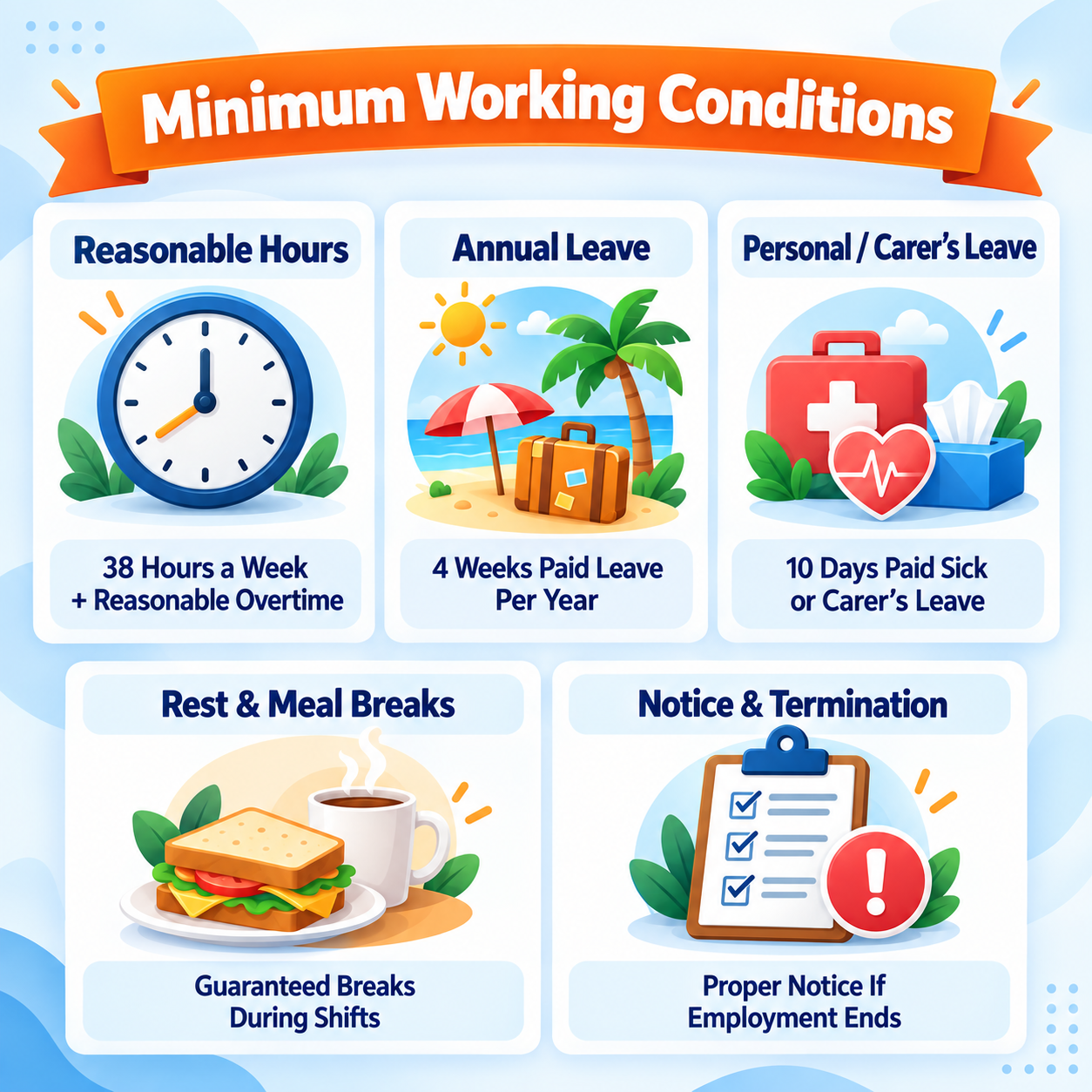
- Reasonable hours of work: full-time employment is generally based on 38 ordinary hours each week, plus reasonable additional hours.
- Breaks: meal and rest breaks are generally set by the relevant award or enterprise agreement.
- Annual leave: generally 4 weeks paid leave each year, or 5 weeks for some shift workers.
- Personal/carer's leave: generally 10 days paid leave each year for full-time employees, pro-rata for part-time employees.
- Compassionate leave: typically 2 days per occasion when required.
- Public holidays: employees have rights relating to absence and correct payment.
- Ending employment: minimum notice periods and redundancy entitlements may apply.
A full-time employee works for a large retail store in Perth. Their contract states that they work 38 ordinary hours per week, but during busy periods they may be asked to work reasonable additional hours. The employee receives four weeks of paid annual leave and 10 days of paid personal/carer's leave each year.
When the store opens on a public holiday, the employee's rights and pay must be handled in accordance with the applicable workplace rules. If the employee later leaves the business, the employer must also follow any required notice of termination provisions.
This case shows how several minimum working conditions can operate together in one employment relationship, including hours of work, annual leave, personal/carer's leave, public holidays and notice of termination.

Common business mistakes
- writing contracts that attempt to remove sick leave during probation
- regularly rostering excessive hours without considering whether additional hours are reasonable
- incorrectly handling public holiday entitlements or pay
- assuming a signed contract can override minimum legal conditions.
Minimum working conditions are not one single NES item. They are created by several minimum standards working together, especially those dealing with hours, leave, public holidays and notice of termination.
Example of how to write this in an exam
Minimum working conditions are the legal rights that protect employees in areas such as hours of work, leave, public holidays and termination. For example, a full-time retail employee may work 38 ordinary hours per week, receive four weeks of paid annual leave and 10 days of paid personal/carer's leave, while also having rights relating to public holidays and notice of termination. An employment contract cannot simply remove these minimum protections. Therefore, businesses must design contracts, rosters and leave arrangements around the relevant legal standards, helping prevent exploitation while reducing the risk of employee disputes, back-pay claims and reputational damage.
Unfair dismissal
Unfair dismissal occurs where an employee is dismissed in a way that is harsh, unjust or unreasonable. A fair dismissal generally requires both a valid reason and a fair process.
Unfair dismissal
When may a dismissal be unfair?
A dismissal may be considered unfair where:
- there was no valid reason for dismissal
- the employee was not told what the problem was
- the employee was not given a reasonable opportunity to respond
- the business did not follow a fair process
- the decision involved discriminatory or otherwise unlawful treatment.
If a dismissal is found to be unfair, the business may face consequences such as compensation, reinstatement orders, legal costs, management time and reputational damage.
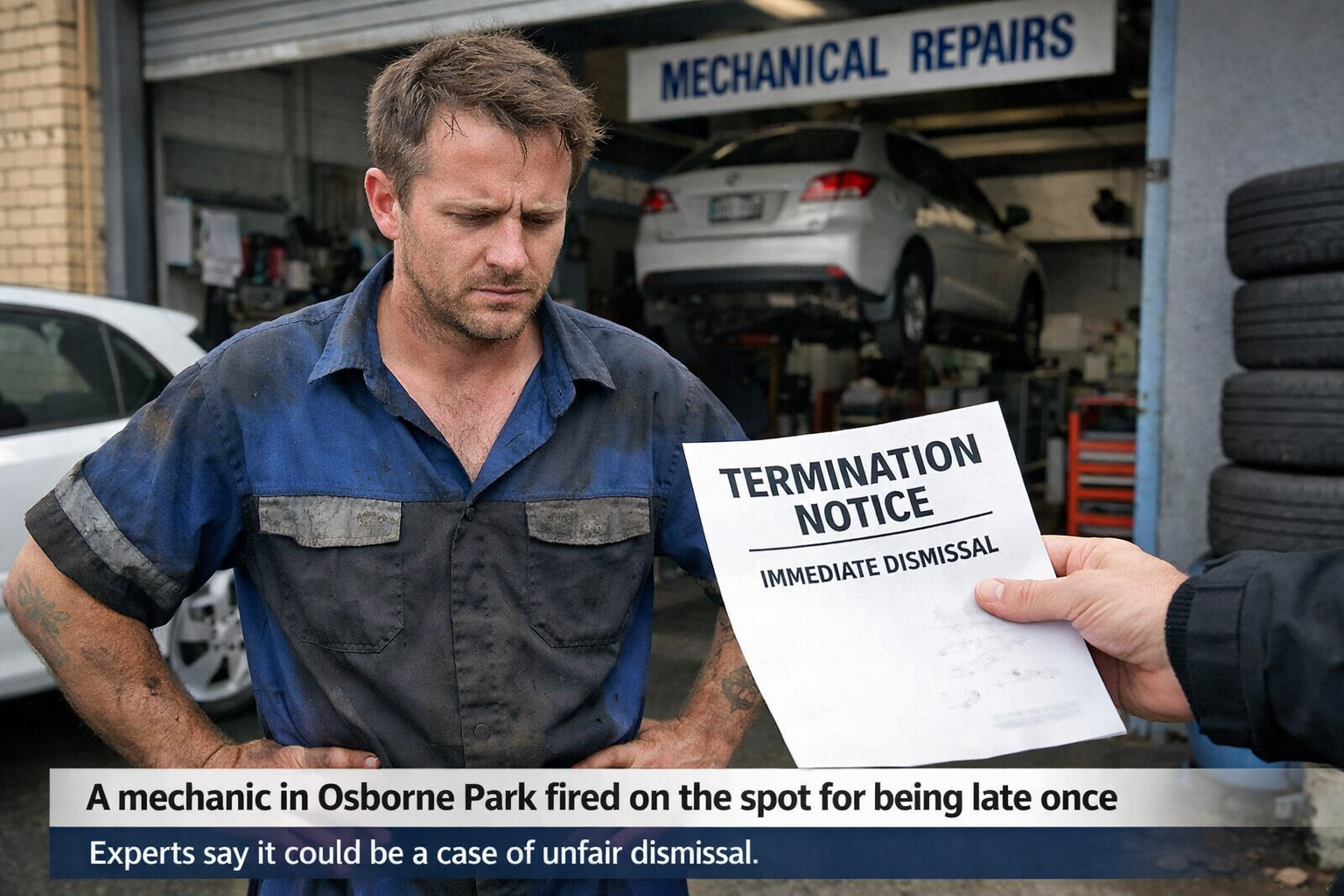
- A mechanic in Osborne Park fired immediately for being late once may raise an unfair dismissal issue if the response is disproportionate and no fair process is followed.
- A hospitality worker in Scarborough dismissed after raising safety concerns may also involve other workplace protections.
- A warehouse employee in Welshpool dismissed with no warning, meeting or chance to respond may be able to challenge the process.
What businesses should do
- keep written records and warnings where appropriate
- clearly explain the performance or conduct concern
- allow the employee to respond
- follow a consistent and fair process
- use clear workplace policies and apply them consistently.

Unfair dismissal is protected under the Fair Work Act rather than being one standalone numbered NES entitlement. The NES still provide important safeguards relating to notice of termination and redundancy.
Example of how to write this in an exam
Unfair dismissal occurs when an employee is dismissed in a harsh, unjust or unreasonable way. A business should have a valid reason for dismissal and follow a fair process, including clearly explaining the concern and giving the employee an opportunity to respond. For example, if a warehouse employee is dismissed immediately with no warning, meeting or chance to explain their conduct, the employee may challenge the dismissal as unfair. If the claim succeeds, the business may face compensation or reinstatement orders as well as legal costs, lost management time and reputational damage. Following a documented and consistent process therefore protects both the employee's rights and the business from unnecessary legal risk.
Real-world workplace links
What these rules look like in real businesses
Underpaying junior staff by ignoring award rates
A common risk in retail and hospitality is paying a flat hourly rate that appears reasonable but is below the correct award rate for the employee's age, classification or work pattern.
- This can particularly affect Year 11 and 12 casual employees.
- Businesses may be required to back-pay employees and correct payroll systems.
- An employee agreeing to a lower rate does not remove the legal minimum.
Calling employees “contractors” to avoid entitlements
Some businesses may label workers as contractors in an attempt to avoid leave and other employee entitlements. The label alone does not determine the real nature of the relationship.
- If the worker is effectively treated as an employee, the business may still owe employee entitlements.
- This can lead to claims for unpaid leave, correct pay rates and other amounts.
- It can also damage employee trust and the business's reputation.
Unfair dismissal after poor process
Dismissal decisions become risky when businesses act quickly without proper investigation, documentation or an opportunity for the employee to respond.
- Examples include firing someone on the spot with no warning or meeting.
- Even where performance is a genuine concern, process still matters.
- Written records and consistent policies can reduce the risk of disputes.

🎧 Prefer listening?
If you prefer listening to the content in Podcast format:
🎥 Prefer watching?
If you prefer watching the content in video format:
🃏 Flashcards
Card 1 of 12
🎮 Revision Games
💰 BME Millionaire
Climb the prize ladder by mastering NES, minimum pay, working conditions and dismissal rules.
📋 Fix the Contract
Inspect seven employment contract clauses and choose the lawful clause or correction.
⚡ 60 Second Showdown
A fast challenge covering NES rights, awards, working conditions and unfair dismissal.
Biz Fact: Even if a worker agrees to worse conditions, the NES still override the contract.