
U1.15 - Key Features of the Market Research Process
Overview
Dotpoint 15: Key Features of the Market Research Process
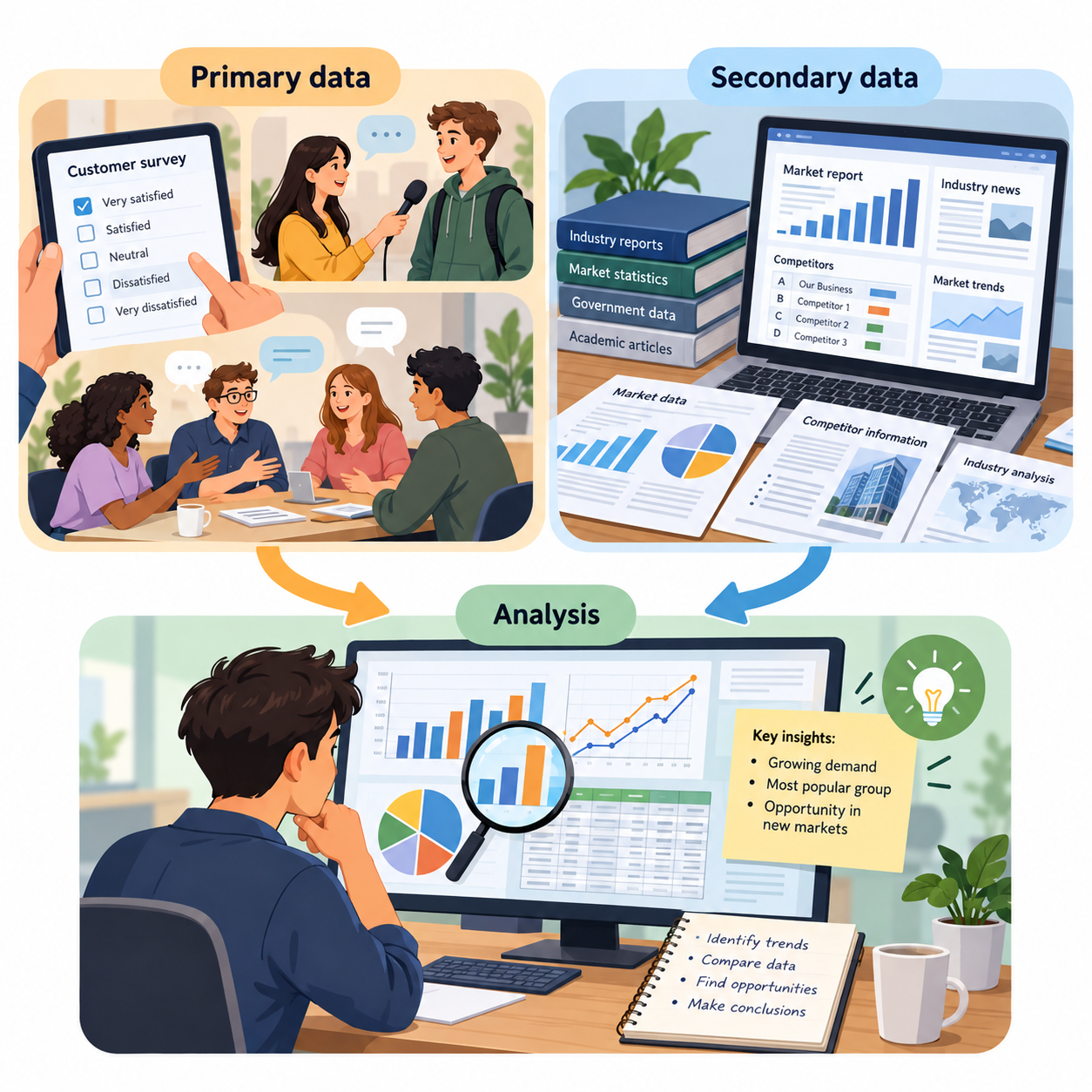
Market research is the process of collecting, recording and analysing data about customers, competitors and the market.
This dotpoint focuses on two major features of the market research process:
- Collection of primary and secondary data
- Data analysis
What is Market Research?
Market research is the process of collecting, recording and analysing data about customers, competitors and the market.
The purpose is to reduce guesswork. Instead of making marketing decisions only on assumptions, a business gathers information and uses it to make more informed decisions about what customers want and how the market is changing.
What businesses use market research for
- Customer preferences: what customers like, dislike and what may encourage them to buy.
- Pricing decisions: what customers see as good value or too expensive.
- Competition: who the main competitors are and why customers may choose them.
- Market trends: changes in demand, customer interests or buying habits.
- Place: where customers are and how they prefer to buy, such as in-store, delivery or online.

Memory tip: Market research = collect → record → analyse → decide.
Collection of Primary and Secondary Data
This is the information-gathering stage. Businesses will often use a combination of primary and secondary data because each type provides different information.
Primary data
Primary research is new data collected by the business for its own specific purpose.
- Examples: surveys, interviews, observation, focus groups and experiments.
- Useful when: the business needs a direct answer to a specific question.
- Example: "Would Scarborough customers pay $16 for this lunch?"
Secondary data
Secondary research uses existing data that has already been collected by others or generated previously by the business.
- Examples: ABS data, government reports, industry reports, Google reviews, competitor websites and internal sales records.
- Useful when: the business wants background information, trends or a quick picture of the market.
Primary research methods
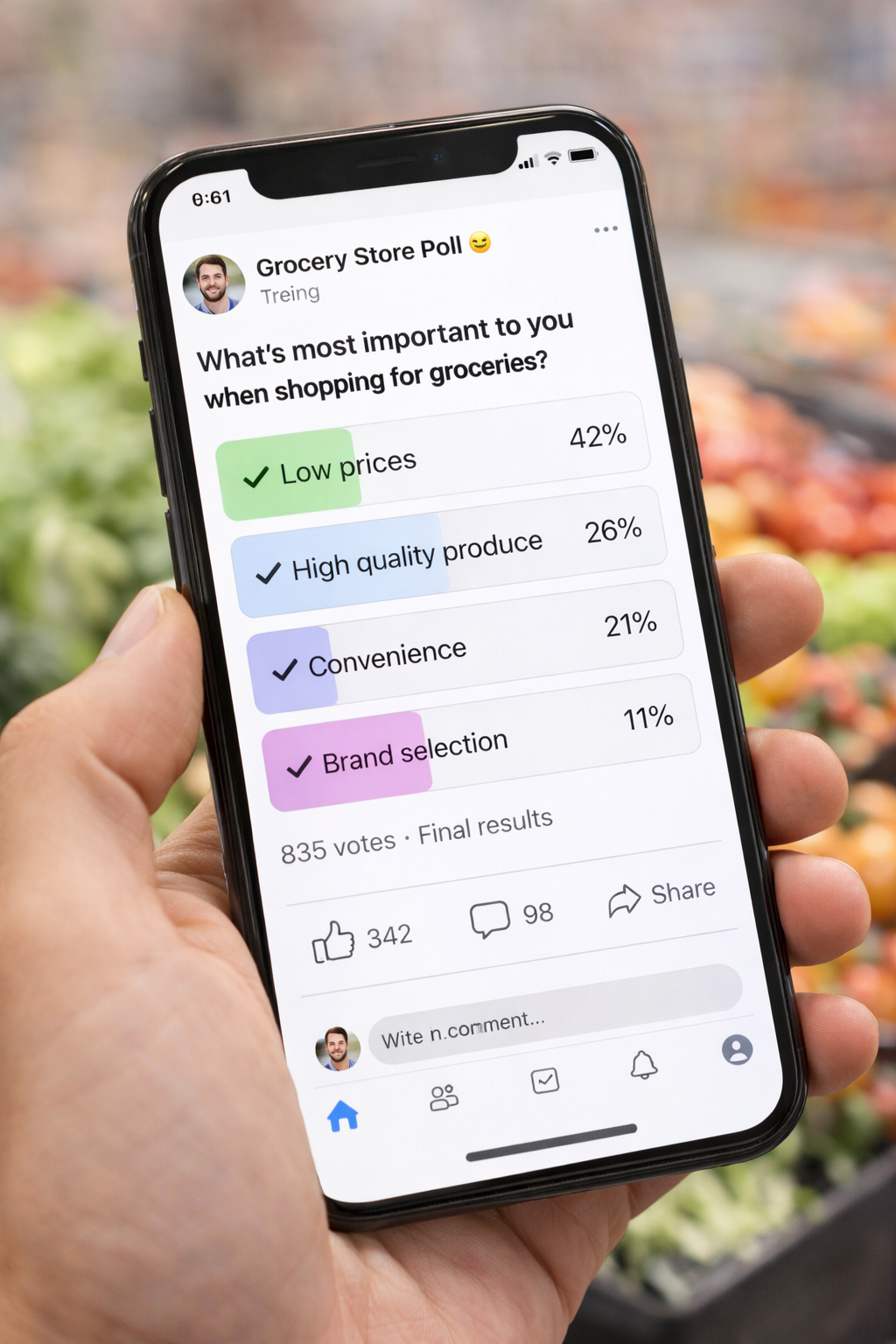
- Surveys: collect responses from many people using tools such as Google Forms, QR codes or online polls.
- Interviews: allow the business to ask follow-up questions and understand why customers think a certain way.
- Observation: records what customers actually do, such as queue length, busiest times or which products they ignore.
- Focus groups: use a small group discussion to explore opinions and ideas in detail.
- Experiments: test alternatives, such as two prices, advertisements or menu designs, and compare the result.
Advantages and disadvantages of primary research
Advantages
- Up to date: collected now in the current market.
- Specific: designed around the business's exact question.
- Control: the business chooses the questions and method.
- Relevant: can focus directly on the local target market.
Disadvantages
- Time and cost: can be expensive and slow to collect.
- Sampling problems: a small or unrepresentative sample may mislead.
- Bias: poor questions or responses may distort results.
- Low response rates: customers may ignore surveys or rush answers.


Common secondary sources
- Government and statistics: ABS, WA Government reports and local council data.
- Industry reports: trade associations, chambers of commerce and industry reports.
- Competitor research: prices, menus, promotions, opening hours, websites, reviews and social media.
- Internal records: sales history, booking data, loyalty sign-ups and busiest times.
- Online signals: Google Trends, search demand and online booking enquiries.
Advantages and disadvantages of secondary research
Advantages
- Lower cost: often free or cheaper than primary research.
- Time efficient: the data already exists.
- Large scale: can cover broad populations.
- Trend analysis: useful for identifying longer-term patterns.
Disadvantages
- Not specific: may not exactly answer the business's question.
- Outdated: conditions may have changed since the data was collected.
- Quality varies: reliability depends on the original source.
- No control: the business cannot change how the original data was gathered.


Example of how to write this in an exam
Primary research is new data collected first-hand by the business for a specific purpose, whereas secondary research uses information that already exists and was previously collected by another source or by the business itself. For example, a café surveying customers about a proposed lunch price is primary research because it is creating new data for its own question. By contrast, using ABS statistics, competitor websites or existing sales records is secondary research because the information already exists. Primary research is generally more specific and current, while secondary research is usually faster and cheaper to obtain.
Data Analysis
Data analysis is the stage where a business examines the information it has collected to identify patterns, trends and meaning.
Collecting data alone is not enough. The business needs to organise and interpret the results so the research can lead to a decision.
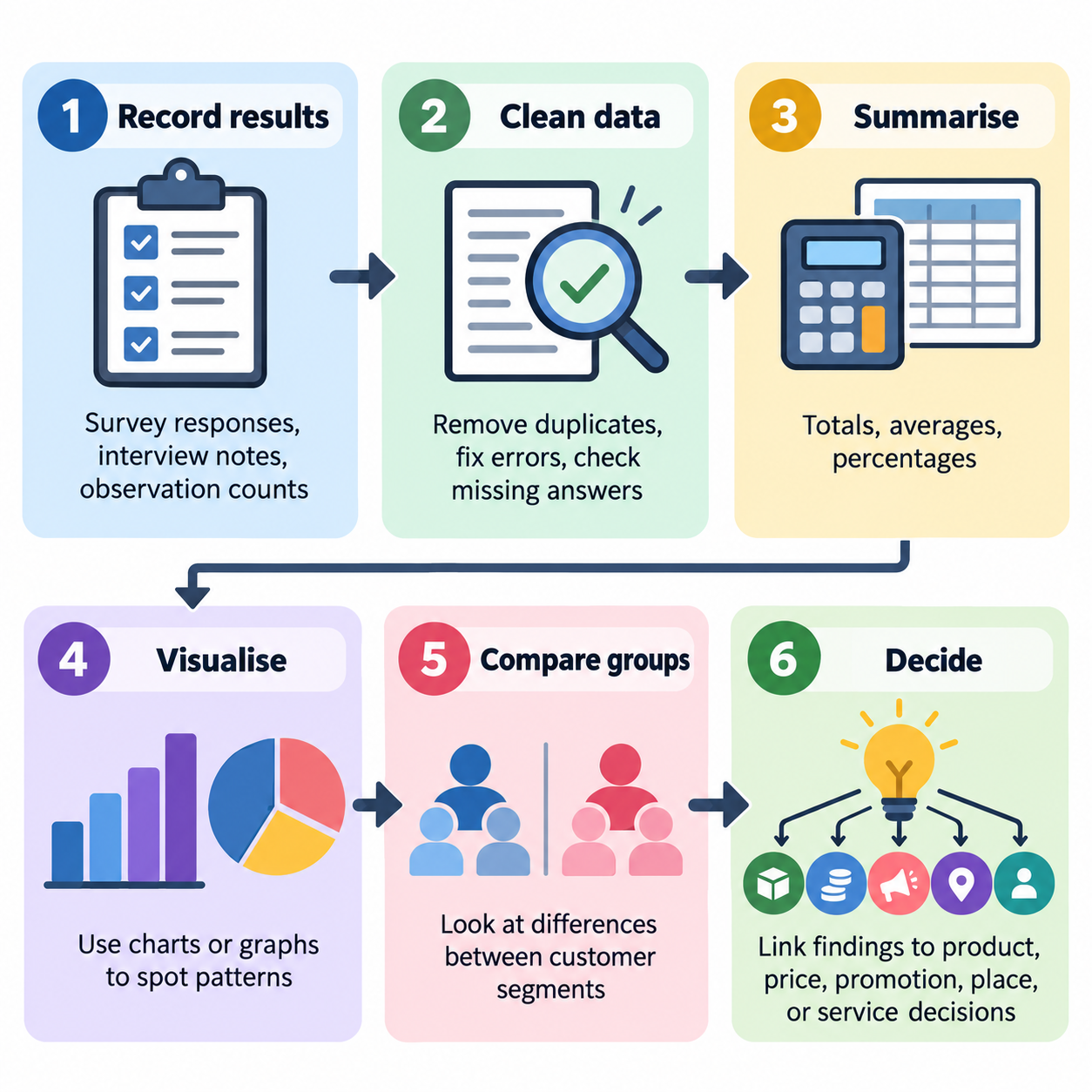
From raw data to a decision
- Record results: enter survey responses, interview notes and observation counts.
- Clean the data: remove duplicates, correct obvious errors and check for missing answers.
- Summarise: calculate totals, averages and percentages.
- Visualise: use charts or graphs so patterns are easier to see.
- Compare groups: examine differences between customer segments.
- Decide: link findings to product, price, promotion, place or service decisions.
Quantitative vs qualitative data
Quantitative data - numbers
Quantitative data is numerical data that can be measured and counted.
- Examples: percentages, totals, averages and frequencies.
- Best for: questions such as "how many?", "how often?" and "which option is most popular?"
- Example: 48% of 120 respondents would pay $12-$15 for lunch.
Qualitative data - reasons
Qualitative data is descriptive data that explains opinions, reasons and attitudes.
- Examples: comments, interview responses and common themes.
- Best for: understanding why customers think or behave in a certain way.
- Example: interviews reveal customers want faster service and clearer menu options.
Example of how to write this in an exam
Data analysis involves examining collected information to identify patterns and meaning. For example, a café may calculate the percentage of customers who prefer a $14 lunch deal and then review interview comments explaining why customers prefer that price. Combining quantitative and qualitative findings helps the business make a more informed pricing decision.
WA Example: Market Research in Action
Perth Example - New Lunch Offer in Leederville
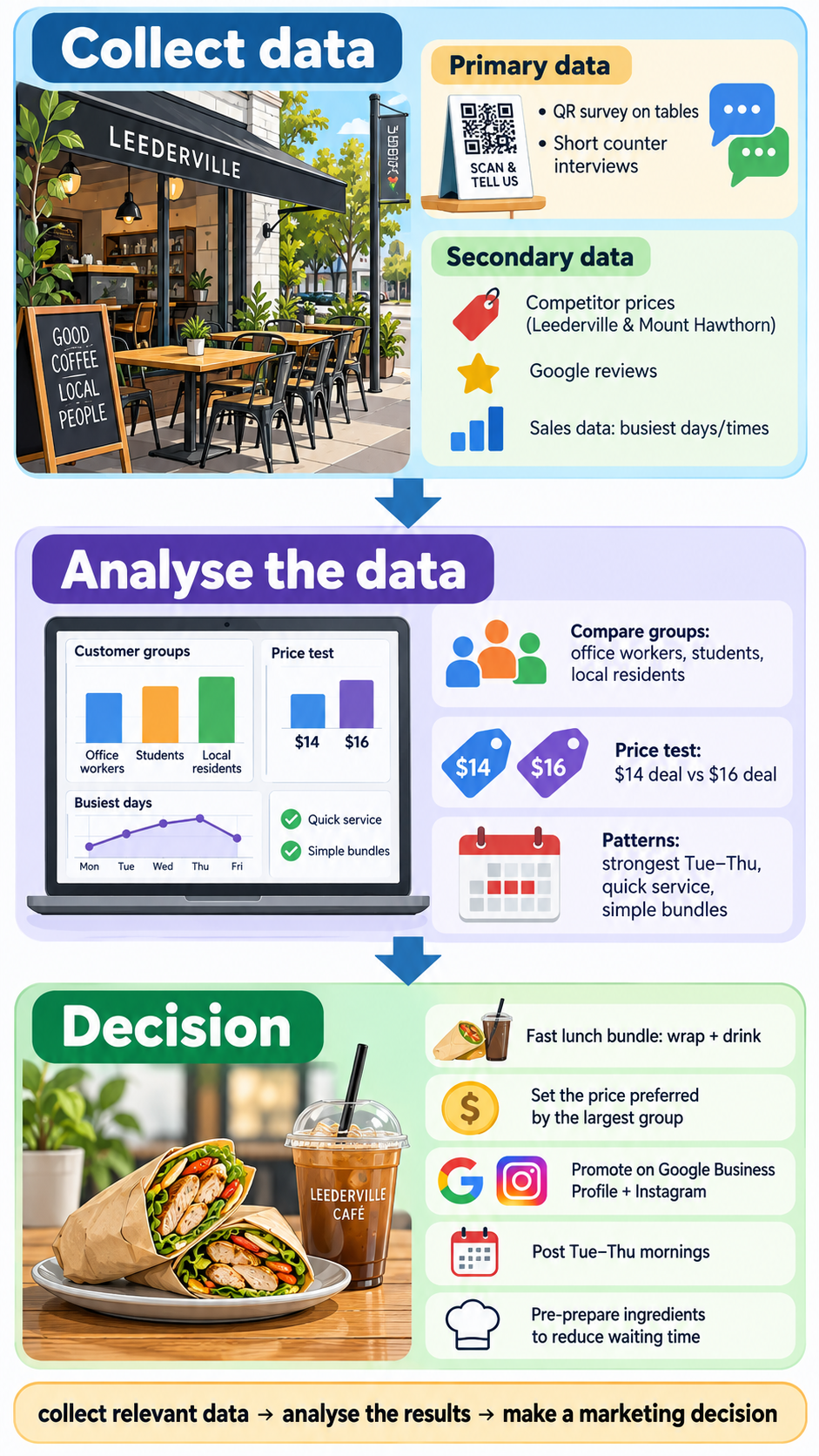
A small café in Leederville wants to launch a weekday lunch special to increase customer numbers between 11:30am and 2pm. Rather than guessing what customers want, it carries out market research before committing to the offer.
1) Collect data
- Primary data: a QR-code survey on tables and short counter interviews asking customers what would make them return for lunch.
- Secondary data: competitor lunch prices in Leederville and Mount Hawthorn, Google reviews and the café's own sales data showing busiest days and times.
2) Analyse the data
- Compare customer groups: office workers, students and local residents.
- Price testing: compare preference for a $14 deal with a $16 deal.
- Identify patterns: demand is strongest Tuesday to Thursday and customers repeatedly mention quick service and simple bundles.
Decision
- Create a fast lunch bundle such as a wrap and drink at the price supported by the largest group.
- Promote the offer on Google Business Profile and Instagram on Tuesday to Thursday mornings.
- Pre-prepare ingredients to reduce waiting time during the lunch rush.
This shows the full process: collect relevant data → analyse the results → make a marketing decision.
🎧 Prefer listening?
If you prefer listening to the content in podcast format:
🎥 Prefer watching?
If you prefer watching the content in video format:
🃏 Flashcards
Card 1 of 13
🎮 Revision Games
💰 BME Millionaire
Climb the ladder by mastering market research.
🕵️ Research Detective
Identify the correct type of research or data in each scenario.
⚡ 60 Second Showdown
Rapid-fire questions on collection and analysis.

Biz Fact: Big retailers use loyalty programs as ongoing market research. With over 10 million active Everyday Rewards members, Woolworths gains constant insights into customer buying behaviour.