
U2.04 — Employee Protections at Work as Provided by the Fair Work Act 2009
Overview
Dotpoint 4: Employee protections at work as provided by the Fair Work Act 2009.
The Fair Work Act 2009 is Australia’s main workplace law. It protects employees by providing minimum legal entitlements and protections against certain forms of unfair treatment at work.
These protections include minimum entitlements under the National Employment Standards (NES), minimum pay and conditions through awards and agreements, and protection from unfair dismissal and adverse action.

📘 Fair Work Act at a glance
What the Fair Work Act does
The Fair Work Act 2009 is Australia’s main workplace law. It helps regulate the relationship between employers and employees and provides a basic safety net of workplace rights.
- it sets minimum legal protections for employees
- it supports fairness at work
- it protects employees from some forms of unlawful treatment
- it operates through organisations including the Fair Work Ombudsman and Fair Work Commission
Fair Work Ombudsman
The Fair Work Ombudsman is an Australian Government agency that helps employees and employers understand workplace laws. People can contact it for advice, make complaints about issues such as underpayment, and report employers who may be breaking workplace laws.
Fair Work Commission
Australia’s workplace relations tribunal. It deals with matters such as unfair dismissal, general protections disputes, awards and enterprise agreements.
🧾 The employee safety net
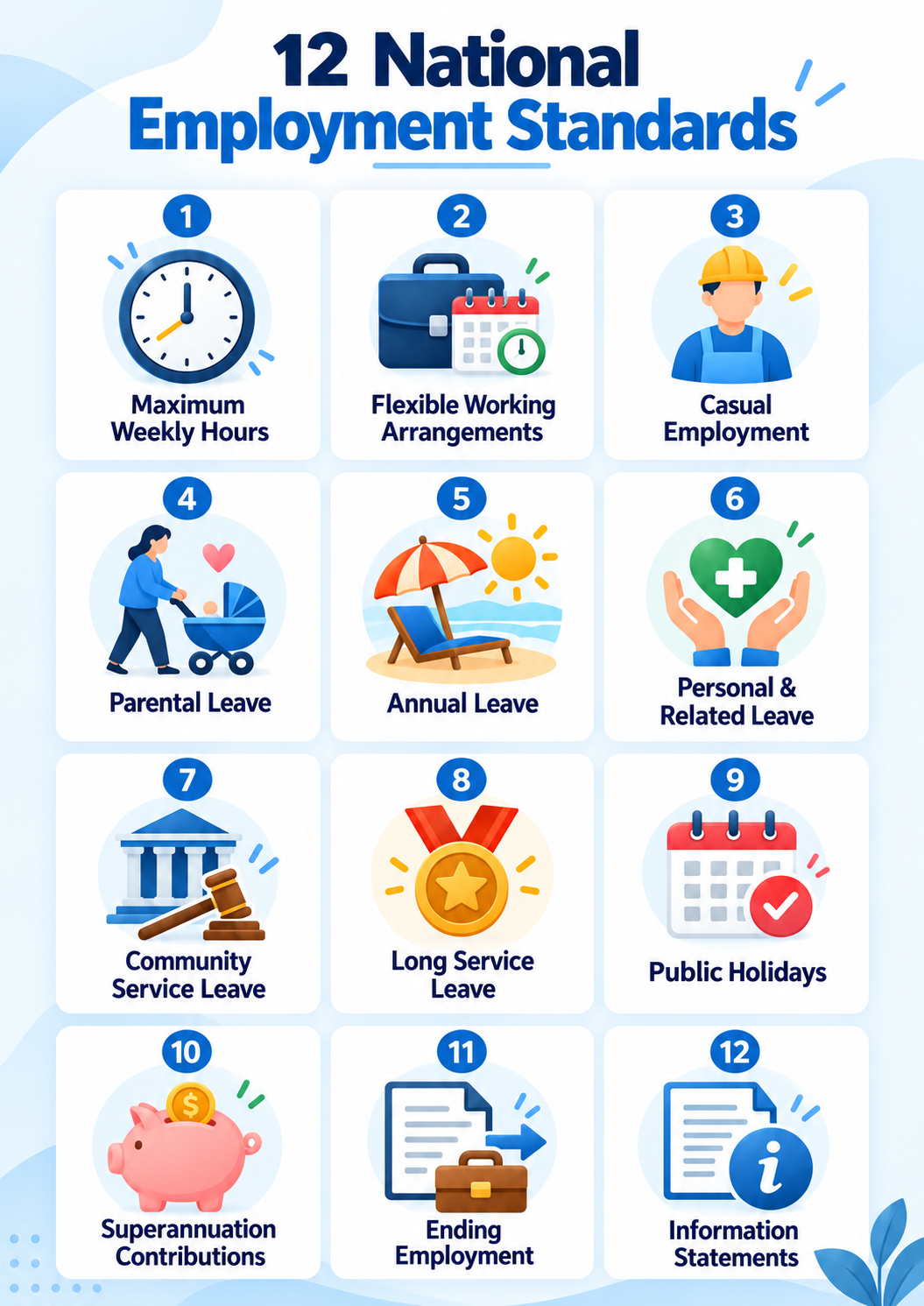
The National Employment Standards (NES) are minimum employment entitlements that have to be provided to employees in the national workplace relations system.
The NES form the basic employment safety net. An award, enterprise agreement or employment contract cannot provide conditions that are less favourable than the NES.
Not every employee receives every NES entitlement in exactly the same way. For example, casual employees do not receive paid annual leave, but they still receive important NES protections and entitlements that apply to casual employment.
The 12 National Employment Standards entitlement areas
Example of how to write this in an exam
One way the Fair Work Act 2009 protects employees is through the National Employment Standards. The NES provide minimum employment entitlements that cannot simply be removed by an employment contract or enterprise agreement. For example, eligible full-time employees are entitled to paid annual leave and maximum weekly working-hour protections. This provides employees with a minimum safety net and prevents businesses from reducing employment conditions below the legal minimum.
💵 Pay and working conditions
1) Minimum pay
Employees must be paid at least the legal minimum that applies to their employment.
For many employees, the correct minimum pay rate comes from a Modern Award or enterprise agreement, rather than simply the National Minimum Wage.
- a business cannot legally pay less than the applicable minimum rate
- an employee cannot simply agree to give up minimum legal pay rights
- underpayment can still be unlawful even if the business is small
There is more detail on awards, agreements and employment conditions in U1.04 .
2) Minimum working conditions
Employee protection is not only about the hourly wage. The Fair Work system also sets minimum conditions around when employees work, when they can take leave and what happens when employment ends.
Hours, breaks and time away from work
Employees have legal protections relating to working hours, leave and time away from work. These protections help prevent employees from being expected to work unlimited hours or give up minimum leave entitlements.
- full-time employees generally work a maximum of 38 ordinary hours each week, plus reasonable additional hours
- eligible employees receive annual leave so they can take paid time away from work
- personal/carer’s leave allows eligible employees to take time away from work because of illness or caring responsibilities
- employees also have rights relating to public holidays and other types of protected leave
Awards and agreements can add further conditions
Modern Awards and enterprise agreements can provide more detailed rules for particular industries and workplaces.
- they may set ordinary working hours and rostering rules
- they may provide meal breaks and rest breaks
- they may set overtime rates, penalty rates and allowances
- they may provide conditions that are better than the NES, but cannot simply remove the minimum NES safety net
Examples of what this means in practice
- a Perth café cannot simply pay a worker less than the applicable award rate because the owner wants to reduce labour costs
- a retail employee may be entitled to particular breaks, penalty rates or overtime payments under the award that applies to their job
- an employer cannot write a contract that removes an eligible full-time employee’s minimum annual leave entitlement
- a manager cannot simply refuse all personal leave because the workplace is short-staffed if the employee is legally entitled to take the leave
- when employment ends, eligible employees may have rights relating to notice, redundancy and final payments

Example of how to write this in an exam
One protection provided to employees under the Fair Work system is minimum pay and working conditions. Employees must receive at least the legal pay rate and conditions that apply to their employment through the NES, Modern Awards or enterprise agreements. For example, a retail employee covered by an award may be entitled to a minimum hourly rate, required breaks and penalty rates for particular hours of work. This means an employer cannot simply lower wages, remove breaks or cancel minimum leave entitlements in order to reduce labour costs. As a result, employees receive greater financial security and protection from being placed on employment conditions below the legal minimum.
⚖️ Protection from unfair treatment
1) Unfair dismissal
Unfair dismissal occurs when an eligible employee is dismissed in a way that is harsh, unjust or unreasonable.
This does not mean every employee who loses their job has been unfairly dismissed. Employers are allowed to dismiss employees for legitimate reasons, such as serious misconduct, poor performance or inability to perform the role. However, the reason and the process used by the employer are important.
When considering whether a dismissal was harsh, unjust or unreasonable, the Fair Work Commission may consider factors such as:
- whether there was a valid reason related to the employee’s conduct or capacity
- whether the employee was told the reason for the possible dismissal
- whether the employee had an opportunity to respond before the final decision was made
- whether the employee had previously been warned about unsatisfactory performance where relevant
- whether the employer followed a fair and reasonable process
For example, if an employee is repeatedly performing poorly, the employer may have a legitimate concern. However, immediately dismissing the employee without clearly explaining the performance problem or giving them an opportunity to respond may increase the risk that the dismissal is considered unfair.
The protection therefore does not prevent businesses from dismissing employees. It encourages employers to have a valid reason and follow a fair process.

2) Other protections at work
Adverse action
An employer cannot take harmful action against an employee for prohibited reasons, such as because the employee has or uses a workplace right.
For example, an employee should not be punished simply because they asked to receive a legal entitlement or questioned whether they were being paid correctly.
Unlawful discrimination
Employees and prospective employees are protected from adverse action taken because of protected personal attributes.
This means employment decisions should be based on legitimate workplace factors rather than unlawful discriminatory reasons.
Coercion
A person cannot unlawfully pressure or threaten another person to use or not use a workplace right in a particular way.
For example, an employer should not threaten an employee in order to make them give up a workplace right.
Undue influence or pressure
Employers cannot place inappropriate pressure on employees to change or give up certain workplace conditions or rights.
This helps protect employees where there may be a large imbalance of power between the worker and employer.
Example of how to write this in an exam
Another employee protection under the Fair Work system is protection from unfair dismissal. An eligible employee may be able to challenge a dismissal that is harsh, unjust or unreasonable. For example, if an employee is dismissed for alleged poor performance but was never clearly told about the problem or given an opportunity to respond, the process may be considered unfair. This protection encourages businesses to establish a valid reason for dismissal and use a fair process before ending employment. As a result, employees have greater protection from arbitrary dismissal, while employers are encouraged to use proper performance-management and termination procedures.
💼 Why this matters
For employees
The Fair Work system gives employees a minimum level of security in the employment relationship. Employees do not have to rely only on what an individual employer is willing to offer.
- income protection — minimum pay rules reduce the risk of employees being paid below their legal entitlement
- minimum working conditions — employees receive rights relating to hours, leave, public holidays and ending employment
- greater job security — eligible employees can challenge dismissals that may be harsh, unjust or unreasonable
- protection when using workplace rights — employees have protections against adverse action, coercion and some forms of discrimination
- access to help — employees can seek information or assistance when workplace rights may have been breached
For businesses
Businesses must build Fair Work requirements into normal employment decisions rather than treating compliance as optional.
- higher labour costs may result from minimum wages, penalty rates, leave, superannuation and other employee entitlements
- administration is required to correctly calculate wages, maintain records and manage leave and employment conditions
- managers need to follow fair processes when dealing with poor performance, disciplinary issues or dismissal
- compliance can reduce disputes because employees have clearer expectations about their rights and conditions
- non-compliance creates risk because underpayment or unfair workplace practices can result in complaints, penalties, repayment of wages and reputational damage
Example of how to write this in an exam
Employee protections under the Fair Work Act 2009 can have both costs and benefits for businesses. One disadvantage is that employers must meet minimum legal requirements for wages, leave, superannuation and other employment conditions, which can increase labour and administration costs. For example, a hospitality business cannot reduce costs by simply paying employees below the relevant award rate or removing legal leave entitlements. However, compliance can also benefit the business because clear employment conditions and fair workplace processes can reduce disputes, improve employee trust and support staff retention. In contrast, failing to comply with workplace laws may result in underpayment claims, repayment of wages, penalties and damage to the business’s public image. Therefore, while employee protections can increase operating costs, they also encourage more stable and lawful employment relationships.
🎧 Prefer listening?
If you prefer listening to the content in Podcast format:
🎥 Prefer watching?
If you prefer watching the content in video format:
🃏 Flashcards
Card 1 of 12
🎮 Revision Game — BME Millionaire
💰 BME Millionaire
Climb the money ladder by mastering the Fair Work Act, NES, minimum conditions and employee protections.

Biz Fact: The Fair Work Act matters to students too — even first jobs in retail, fast food or hospitality are covered by workplace protections.