
U3.12 — Rationale For and Benefits of Global Strategic Alliances
Overview
Dotpoint 12: rationale for and benefits of global strategic alliances.
Global strategic alliance is an arrangement where two or more businesses cooperate to achieve strategic goals in international markets.
Rationale means the reason a business chooses a particular alliance. It answers: Why would the business use this alliance?
Benefits are the positive outcomes the business may gain from the alliance.
The syllabus focuses on five types of global strategic alliances:
- outsourcing
- acquisition
- mergers
- joint ventures
- franchising

📤 Outsourcing
Outsourcing occurs when a business contracts another business to perform a function, task or service that was previously completed internally or could have been completed internally.
Rationale for outsourcing
A business may outsource so it can focus on its core business activities while another specialist business completes support functions more efficiently.
This is common for:
- human resources
- payroll
- IT support
- accounting
- customer service
- logistics
- manufacturing
- digital marketing

Benefits of outsourcing
1. Allows focus on core business
The business can concentrate on its main product or service instead of spending time managing support functions.
2. Access to specialist expertise
The business can use external experts with better skills, systems or technology than it has internally.
3. Reduced costs
Outsourcing may reduce wages, training, equipment, software, recruitment and administration costs.
4. Greater flexibility
The business can scale services up or down more easily as demand changes across markets.
5. Improved efficiency
Specialist providers may complete tasks faster and more accurately because they focus on that service every day.
6. Global coverage
Outsourcing can give a business access to overseas labour, time-zone coverage and local market support.
Limitations of outsourcing
1. Loss of control
The business may have less direct control over quality, timing, customer service and employee standards.
2. Reputation risk
If the outsourcing provider acts unethically, makes mistakes or provides poor service, the main business may still be blamed.
3. Confidentiality risk
Important customer, employee, financial or technology data may need to be shared with an external provider.
4. Provider dependence
The business may become reliant on another organisation, making it vulnerable if the provider fails, increases prices or loses staff.
Real-world examples
Australian example: Telstra and Infosys
Telstra outsources parts of its software engineering and IT transformation to Infosys, an Indian technology company headquartered in Bengaluru. This gives Telstra access to Infosys’s global technology workforce, although the work may be delivered from India, Australia and other locations.

Global example: Nike manufacturing
Nike outsources footwear and clothing manufacturing mainly to contract factories in Asian countries. Most Nike footwear was produced in Vietnam, Indonesia and China, while major apparel production also occurred in Vietnam, China and Cambodia.

Example of how to write this alliance in an exam
Outsourcing may be used as a global strategic alliance because it allows a business to contract a specialist provider to complete non-core functions such as HR, payroll, IT or logistics. This means the business can focus on its main operations while accessing external expertise and potentially reducing costs. As a result, the business may improve efficiency, concentrate on growth and use its resources more effectively in global markets.
🏢 Acquisition
An acquisition occurs when one business purchases another business and gains control over its assets, operations, customers, staff, brand or technology.
Rationale for acquisition
A business may use an acquisition to quickly enter a foreign market, gain an established customer base, acquire technology, remove a competitor, access distribution networks or expand product range.
Rather than building a new operation from the beginning, the acquiring business buys a business that already has resources it wants. This can include recognised brands, loyal customers, patents, digital platforms, skilled employees, suppliers, retail locations, production facilities or licences.
Acquisitions are often used when speed is important, when the target business owns valuable technology or when the acquiring business wants stronger control than it would have in a joint venture or franchising arrangement.

Benefits of acquisition
1. Faster market entry
The acquiring business can enter a market quickly by purchasing a business already operating there.
2. Existing customers
The business gains access to the acquired business’s customers, brand awareness and market share.
3. Access to assets and staff
The business can gain factories, stores, technology, intellectual property, suppliers and experienced employees.
4. Reduced competition
Buying a competitor can increase market share and reduce the number of rivals in the market.
5. Economies of scale
The combined business may spread costs across more output, markets and customers.
6. Strategic control
Unlike some alliances, the acquiring business can gain direct control over decisions and operations.
Limitations of acquisition
1. High cost
Acquisitions can be expensive and may require large amounts of debt, cash or shares.
2. Integration problems
Systems, staff, leadership styles, cultures and processes may be difficult to combine.
3. Overpaying risk
The acquiring business may pay too much if expected growth, synergies or market demand do not occur.
4. Reputation and culture risk
Customers or employees may resist the takeover, especially if the acquired business loses its identity.
Real-world examples
Facebook acquired Instagram — announced 9 April 2012 for approximately US$1 billion in cash and shares. The acquisition helped Facebook expand into mobile photo sharing and gain Instagram’s rapidly growing user base.
Disney acquired Pixar — completed 5 May 2006 in an all-share deal valued at approximately US$7.4 billion. Disney gained Pixar’s animation technology, creative expertise and successful films such as Toy Story, Finding Nemo and The Incredibles.
Disney acquired Marvel Entertainment — completed 31 December 2009 for approximately US$4 billion. Disney gained Marvel’s superheroes, characters and entertainment franchises, including Iron Man, Thor and the Avengers.
Microsoft acquired Activision Blizzard — completed 13 October 2023. The deal was originally announced at US$68.7 billion, while Microsoft later recorded a total purchase price of US$75.4 billion. Microsoft gained franchises including Call of Duty, World of Warcraft and Candy Crush.
Canva acquired Leonardo.Ai — announced 29 July 2024. Canva did not officially disclose the price, although reports valued the deal at approximately US$250 million, or about A$370 million at the time. Canva gained Leonardo.Ai’s generative-image technology and visual-AI expertise.
Example of how to write this alliance in an exam
An acquisition may be used as a global strategic alliance because it allows one business to purchase another business and immediately gain access to its customers, staff, assets, technology and market position. This is useful when a business wants to expand quickly into a foreign market rather than building operations from the beginning. As a result, the business may increase market share, reduce competition and accelerate global growth.
🔗 Mergers
A merger occurs when two or more businesses combine to form one larger business. Unlike an acquisition, a merger is often presented as a more cooperative joining of businesses, although one business may still become more dominant in practice.
Rationale for mergers
A business may merge to become larger, stronger and more competitive in domestic and global markets. By combining with another business, it may gain access to a larger customer base, stronger financial resources, more employees, better technology, established brands, production capacity and new distribution channels.
Mergers may also help businesses reduce duplicated costs, improve efficiency, share risk, gain expertise and increase market power. In global markets, this can help the merged business compete against larger international rivals and expand faster than either business could alone.
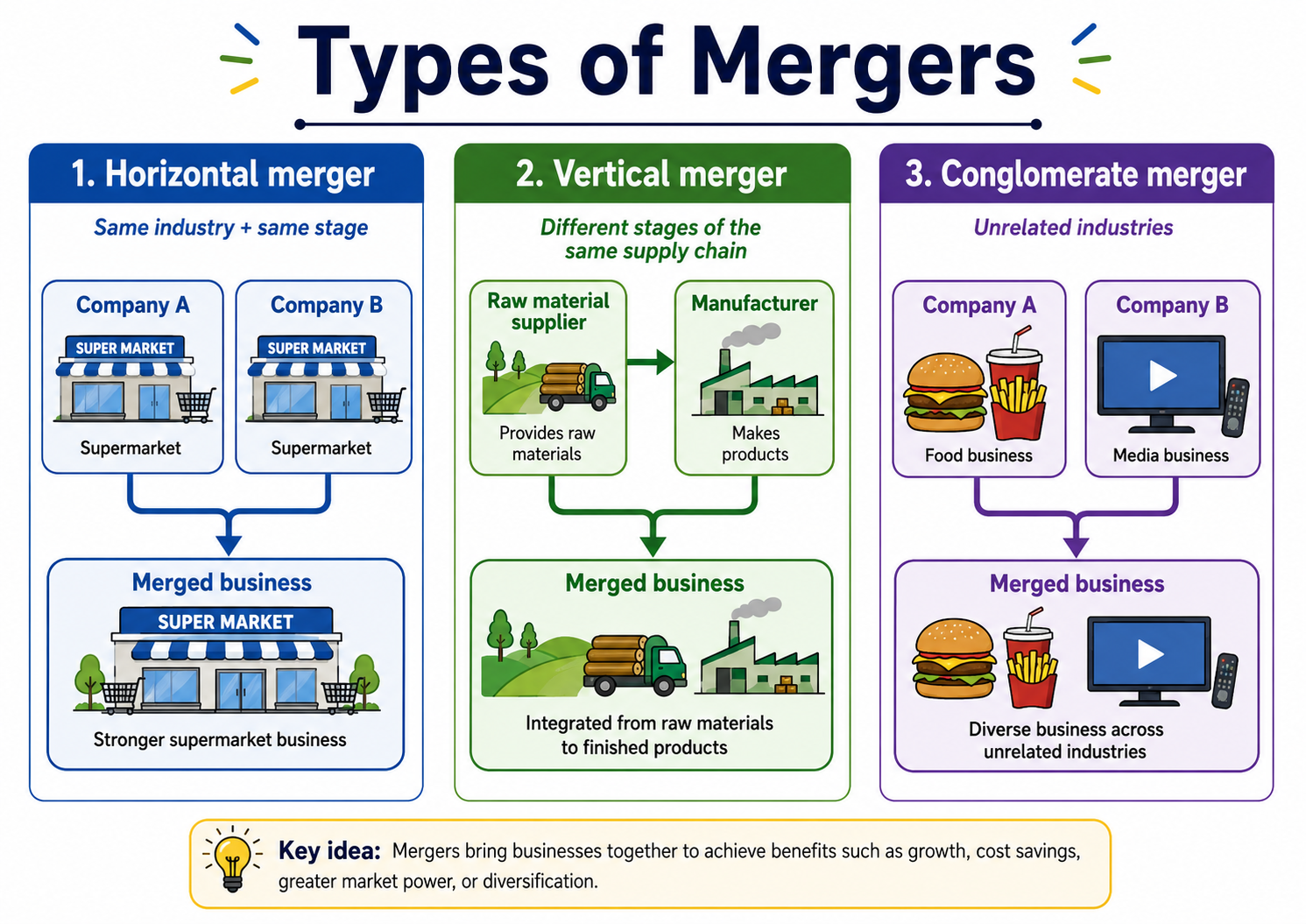
Types of mergers
Horizontal merger
A horizontal merger occurs when two businesses in the same industry and at the same stage of production combine.
Rationale: the businesses may merge to increase market share, reduce competition, grow their customer base and achieve economies of scale.
Examples: two banks, two airlines, two oil and gas companies, two media companies or two skincare businesses merging.
Real-life example: Exxon and Mobil merged in 1999 to create ExxonMobil. Both were major oil and gas companies involved in exploration, refining and fuel sales.
Vertical merger
A vertical merger occurs when businesses at different stages of the same supply chain combine.
Rationale: the businesses may merge to gain more control over supply, distribution, production costs, quality and delivery reliability.
Examples: a manufacturer merging with a supplier, distributor or retailer.
Real-life example: Essilor and Luxottica combined in 2018 to form EssilorLuxottica, connecting prescription lenses, eyewear frames, distribution and retail within the eyewear supply chain.
Conglomerate merger
A conglomerate merger occurs when businesses in unrelated industries combine.
Rationale: the businesses may merge to diversify income, reduce reliance on one industry, access new customers and spread risk across different markets.
Examples: a technology business merging with a grocery retailer, media business, finance business or entertainment business.
Real-life example: Amazon acquired Whole Foods in 2017 for approximately US$13.7 billion, bringing a technology and e-commerce business together with a physical grocery retailer.
Benefits of mergers
1. Larger customer base
The merged business can access a wider group of customers across more regions or countries.
2. Economies of scale
The combined business may lower average costs by spreading expenses across larger output and sales.
3. Shared expertise
The businesses can combine staff skills, technology, systems and industry knowledge.
4. Increased market power
The merged business may have stronger bargaining power with suppliers, distributors and customers.
5. Greater access to finance
A larger business may find it easier to attract investors or borrow funds for expansion.
6. Reduced duplication
The merged business may remove duplicated departments, systems, stores or administration.
Limitations of mergers
1. Culture clash
Employees may resist the merger if leadership styles, values, work routines or expectations are different.
2. Job losses
Removing duplicated roles may reduce costs, but can damage morale and cause resistance to change.
3. Integration costs
Combining systems, brands, contracts, locations and management structures can be costly and complex.
4. Regulatory concerns
Competition regulators may block or restrict mergers if they reduce competition too much.
Real-world example
Australian example: BHP and Billiton
BHP and Billiton completed a merger in 2001, creating BHP Billiton, one of the world’s largest diversified resources businesses. BHP had its origins in Australia, while Billiton had a long history in mining and metals operations across several countries.
The rationale for the merger was to combine major resource assets, strengthen global scale, diversify across commodities and improve competitiveness in international mining markets. The merged business gained a broader portfolio across resources such as iron ore, coal, copper, petroleum and other minerals, reducing reliance on one commodity or one market.
This shows how a merger can create a larger global business with stronger financial capacity, wider operations, greater bargaining power and improved ability to compete internationally.

Example of how to write this alliance in an exam
A merger may be used as a global strategic alliance because it allows two businesses to combine their resources, customers, technology, expertise and finance into one larger business. This can help the merged business expand into new markets, reduce duplicated costs and increase its market power. As a result, the business may achieve economies of scale, improve competitiveness and gain stronger growth opportunities in global markets.
🤝 Joint ventures
A joint venture occurs when two or more businesses agree to work together on a specific project, product, market or business activity while remaining separate businesses.
Rationale for joint ventures
A business may use a joint venture to enter a foreign market with a partner that has local knowledge, distribution networks, technology, finance, legal understanding or production capability. This allows each business to contribute something valuable while sharing the costs, risks and rewards of the project.
A joint venture is useful when a business does not want to enter a market alone, does not have enough knowledge of the local environment, or needs another business’s technology, resources, brand, production capability or customer access.
It can be either:
- Equity joint venture: the businesses create a separate company that they jointly own and control.
- Contractual joint venture: the businesses work together on a specific project under a formal agreement without creating a new company.

Benefits of joint ventures
1. Shared costs and risk
The partners share investment costs, development costs, marketing costs and financial risk.
2. Access to local knowledge
A local partner may understand customer preferences, laws, suppliers, culture and distribution channels.
3. Access to technology
Partners can combine technology, research and development capability to create stronger products.
4. Faster market entry
The business can enter the market faster by using the partner’s existing contacts and infrastructure.
5. Combined expertise
Each partner can bring different strengths, such as product design, production, finance or marketing.
6. Maintains separate identity
The businesses can cooperate without fully merging or giving up ownership of their original business.
Limitations of joint ventures
1. Shared control
Decision-making may be slower because both partners need to agree on strategy, finance and operations.
2. Conflict between partners
Partners may disagree over goals, leadership, profits, quality, ethics or long-term direction.
3. Unequal contribution
One partner may contribute more money, labour, technology or expertise than the other.
4. Confidentiality risk
Businesses may need to share technology, data or knowledge that could later be used by the partner or competitor.
Real-world examples
Toyota and BYD
Toyota and BYD jointly created BYD Toyota EV Technology in 2020. The 50–50 joint venture combines Toyota’s vehicle-design experience with BYD’s battery and electric-vehicle technology.
The rationale was to develop electric cars for China by sharing technology, research and development costs, local market knowledge and engineering capability. This shows how a joint venture can help businesses enter or strengthen their position in a fast-growing global market without relying only on their own resources.

Gippsland Basin Joint Venture
The Gippsland Basin Joint Venture is a major Bass Strait oil and gas operation. Woodside and ExxonMobil each hold a 50% interest in the joint venture, which continues to supply Australia’s domestic energy market.
The rationale is that large oil and gas projects require major capital investment, technical expertise, infrastructure, exploration knowledge and risk sharing. By working together, the businesses can share the costs, expertise and risks of operating a major resource project that is important to Australia’s energy supply.

Example of how to write this alliance in an exam
A joint venture may be used as a global strategic alliance because it allows two businesses to work together on a specific international project while remaining separate businesses. This can reduce risk because costs, expertise and resources are shared between the partners. As a result, the businesses may gain access to new markets, local knowledge, technology and a larger customer base without needing to complete a full merger or acquisition.
🍕 Franchising
Franchising occurs when one business, the franchisor, gives another business or person, the franchisee, the right to use its brand name, products, systems and business model in exchange for fees or royalties.
Rationale for franchising
A business may use franchising to expand quickly into domestic or global markets using the money, effort and local knowledge of franchisees rather than opening every outlet itself.
The franchisor provides the brand, business model, systems, training, products and marketing support. The franchisee usually invests capital, operates the outlet and manages staff under the franchisor’s rules.
This allows the franchisor to grow faster and increase brand exposure without directly owning every store. It is especially useful for businesses with a proven model that can be repeated in different locations, such as fast food, fitness, retail, accommodation and service businesses.

Benefits of franchising
1. Faster expansion
The business can grow into more locations without directly funding and managing every outlet.
2. Lower capital requirement
Franchisees often provide much of the investment needed to set up and operate the outlet.
3. Local market knowledge
Franchisees may understand local customers, staff, suppliers, regulations and shopping habits.
4. Brand growth
More outlets increase brand exposure, customer awareness and market presence.
5. Ongoing royalty income
The franchisor may earn fees and royalties from franchisees, creating ongoing revenue.
6. Consistent systems
The franchisor can provide standardised processes, training, products and marketing support.
Limitations of franchising
1. Quality control risk
Poor franchisee performance can damage the reputation of the entire brand.
2. Less direct control
The franchisor does not directly manage every outlet, so service and operations may vary.
3. Legal and cultural differences
Franchising rules, employment laws, food standards and customer expectations can vary between countries.
4. Conflict with franchisees
Franchisees may disagree with fees, marketing decisions, pricing, supply contracts or brand changes.
Real-world examples
Australian example: Bakers Delight
Bakers Delight is an Australian bakery franchise that has grown by allowing franchisees to operate stores using its brand, recipes, systems, training and store model.
Australian example: Zambrero
Zambrero is an Australian Mexican-inspired food franchise. Franchising allows the brand to expand into more locations while franchisees operate stores using Zambrero’s brand, menu and systems.
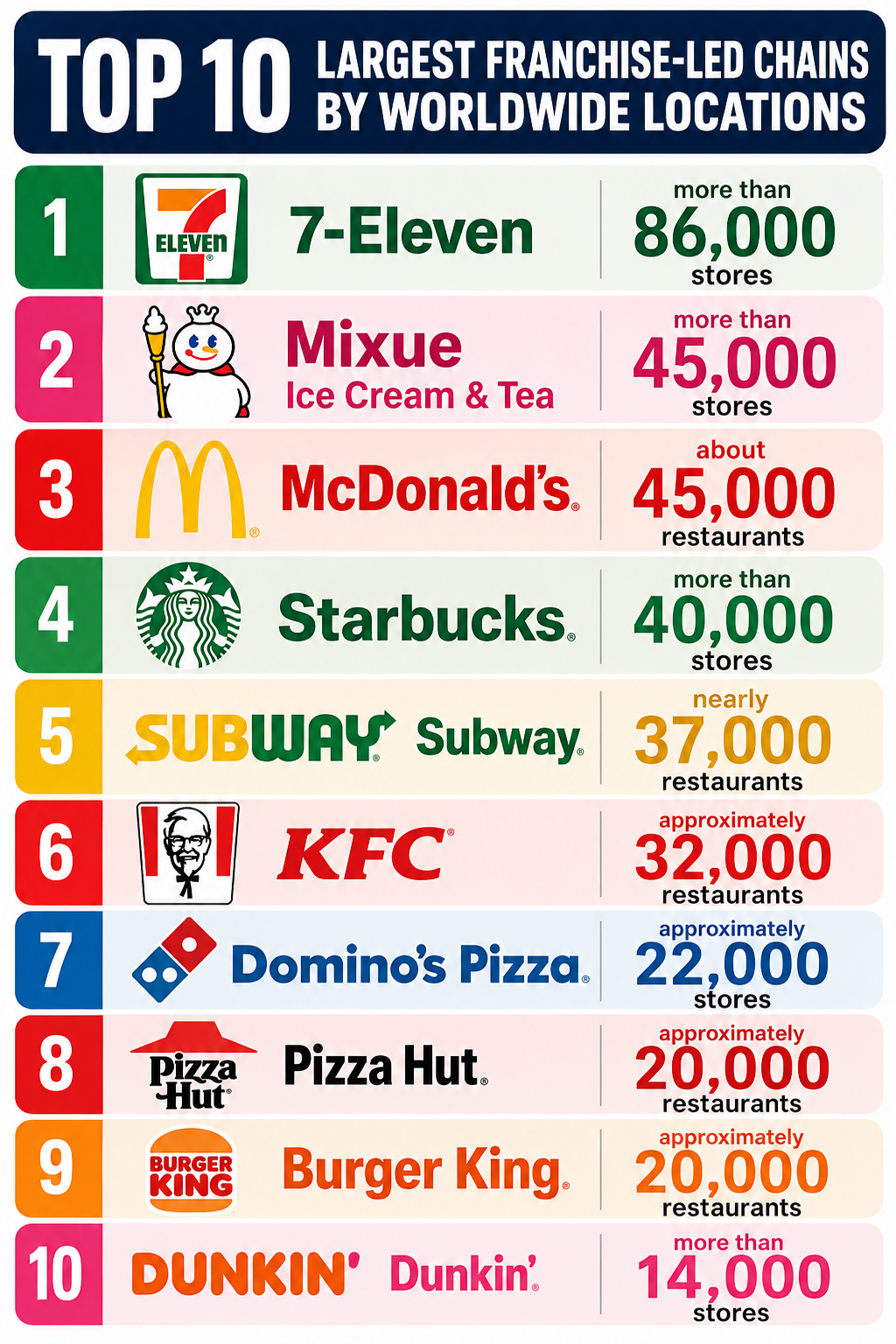
Global example: Subway
Subway has used franchising to expand into many countries by allowing local franchisees to operate stores under the Subway brand and business model.
Global example: 7-Eleven
7-Eleven uses franchising in many markets, allowing store operators to use its brand, systems, supplier arrangements and convenience-store model.
Example of how to write this alliance in an exam
Franchising may be used as a global strategic alliance because it allows a business to expand using franchisees who invest in and operate outlets under the franchisor’s brand and systems. This reduces the amount of capital the franchisor needs to provide while still increasing brand exposure and market presence. As a result, the business may grow faster, earn franchise fees and royalties, and use local operators who understand the target market.
🎧 Prefer listening?
If you prefer listening to the content in podcast format:
🎥 Prefer watching?
If you prefer watching the content in video format:
🃏 Flashcards
Card 1 of 14
🎮 Revision Games
💰 BME Millionaire
Climb the prize ladder. Use your lifelines wisely.
👔 Business Boss
Make 10 alliance decisions. Balance growth, cost, control, expertise and market access.
⚡ 60 Second Showdown
A varied 60-second challenge covering outsourcing, acquisitions, mergers, joint ventures and franchising.
Biz Fact: The 2001 merger between BHP and Billiton created one of the world’s largest diversified resources businesses.
Past Exam Questions
Use these past exam questions to see how this dotpoint has been assessed. Pay close attention to the command term, the number of marks and whether the question is Section 1 or Section 2.
Section 1 Questions
2017 — Section 1 — Question 6(c) — 4 marks
Context
Elk and Frazer are optometrists specialising in eyewear and contact lenses. Given the massive increase in the demand for glasses and contact lenses in all demographics, their business is booming and they are now exporting eyewear to many Asian countries.
6(c): Describe the rationale for and benefit of one type of global strategic alliance for Elk and Frazer if they wanted to develop an operation in Asia. (4 marks)
Command term focus: Describe
Describe: give the main characteristics of the alliance, explain its rationale and describe one benefit for Elk and Frazer.
See the full command term guide here: Command Terms.
6(c) Sample answer
Elk and Frazer could use a joint venture with an Asian eyewear retailer or optical chain. The rationale is that a local partner would already understand Asian customer preferences, retail locations, legal requirements and distribution networks. This would make it easier for Elk and Frazer to develop an operation in Asia rather than entering the market alone.
One benefit is that Elk and Frazer could share costs and risk with the partner while gaining access to local market knowledge. As a result, the business may enter Asia more successfully and increase sales of eyewear and contact lenses.
2018 — Section 1 — Question 2(a) — 3 marks
Context
Uber has collaborated strategically with many international businesses in countries such as Russia, Australia and the United States. Volvo, a Swedish vehicle manufacturer, and Uber recently announced a $300 million joint venture to develop self-driving cars.
2(a): What is the rationale for a joint venture? Describe one benefit of this type of strategic alliance. (3 marks)
Rationale:
Benefit:
Command term focus: Describe
Describe: explain the main reason for using a joint venture and give the main characteristics of one benefit.
See the full command term guide here: Command Terms.
2(a) Sample answer
Rationale: The rationale for a joint venture is that two or more businesses can work together on a specific project while remaining separate businesses. In this case, Uber and Volvo could combine Uber’s transport technology knowledge with Volvo’s vehicle manufacturing expertise to develop self-driving cars.
Benefit: One benefit is shared research and development costs. This means Uber and Volvo can reduce the financial burden and risk of developing expensive technology while still gaining access to the potential profits and expertise created by the project.
2019 — Section 1 — Question 1(b) — 6 marks
Context
In a changing world, businesses must adapt their products, processes and services in a global economy in order to generate wealth. Using your knowledge of global businesses, answer the following questions.
1(b): Outline the rationale for and identify two benefits of each of the following global strategic alliances.
(i) Acquisition (3 marks)
Rationale:
Benefit one:
Benefit two:
(ii) Franchising (3 marks)
Rationale:
Benefit one:
Benefit two:
Command term focus: Outline + Identify
Outline: state the main rationale and briefly clarify it. Identify: name two clear benefits for each alliance.
See the full command term guide here: Command Terms.
1(b) Sample answer
Acquisition rationale: The rationale for an acquisition is to quickly enter a market or gain control of another business’s assets, customers, technology, staff or distribution networks.
Acquisition benefit one: faster access to an established customer base.
Acquisition benefit two: increased market share and greater control over operations.
Franchising rationale: The rationale for franchising is to expand a proven business model into more locations using franchisees who invest in and operate the outlets.
Franchising benefit one: faster expansion with lower capital investment by the franchisor.
Franchising benefit two: access to local operators who understand the local market.
2021 — Section 1 — Question 3(a) and 3(b) — 10 marks
Context
In order for businesses to grow and prosper globally, they need to consider opportunities to expand their operations through global strategic alliances.
3(a): Describe the rationale for the following global strategic alliances. (6 marks)
Acquisitions
Mergers
Joint ventures
3(b)(i): Outline two benefits of franchising. (2 marks)
One:
Two:
3(b)(ii): Outline two benefits of outsourcing. (2 marks)
One:
Two:
Command term focus: Describe + Outline
Describe: give the main characteristics of each rationale. Outline: state each benefit and briefly clarify it.
See the full command term guide here: Command Terms.
3(a) and 3(b) Sample answer
Acquisitions: The rationale for an acquisition is to purchase another business in order to gain control of its assets, staff, customers, technology, distribution networks or market share. This can help a business expand globally faster than building operations from the beginning.
Mergers: The rationale for a merger is to combine two businesses so they can pool resources, reduce duplicated costs, increase market power and access a larger customer base. This may make the new business stronger and more competitive globally.
Joint ventures: The rationale for a joint venture is to allow two or more businesses to cooperate on a specific international project while sharing costs, risks, technology and expertise. This is useful when a business wants local knowledge or specialist skills.
Franchising benefit one: franchising allows faster expansion because franchisees invest in and operate outlets.
Franchising benefit two: franchising gives the business access to local operators who may understand local customers and conditions.
Outsourcing benefit one: outsourcing allows the business to focus on core activities while specialists complete support functions.
Outsourcing benefit two: outsourcing may reduce costs by lowering wages, training, equipment or administration expenses.
2022 — Section 1 — Question 1(a) — 6 marks
Context
Business leaders often see the opportunities that may arise from developing global alliance partnerships. However, there are always costs and benefits to consider.
1(a): Define the following global strategic alliances and identify one benefit for each. (6 marks)
Outsourcing:
Acquisition:
Joint venture:
Command term focus: Define + Identify
Define: give the precise meaning of each alliance. Identify: name one clear benefit for each.
See the full command term guide here: Command Terms.
1(a) Sample answer
Outsourcing: Outsourcing is when a business contracts another business to complete a function, task or service. One benefit is that the business can focus on core activities while the specialist provider completes support work.
Acquisition: An acquisition is when one business purchases and gains control of another business. One benefit is faster market entry because the acquiring business gains access to existing customers, staff, assets or distribution networks.
Joint venture: A joint venture is when two or more businesses cooperate on a specific project or business activity while remaining separate businesses. One benefit is shared risk because the partners can share costs, resources and expertise.
2025 — Section 1 — Question 3(a) and 3(b) — 8 marks
Context
Luxury brands often collaborate to create unique products, such as an automobile brand partnering with an exclusive jewellery or fashion brand. These strategic alliances can offer significant benefits for global businesses.
3(a): Describe the rationale for a joint venture and state two of its benefits. (4 marks)
Rationale:
Benefit one:
Benefit two:
3(b): Describe the rationale for an acquisition and state two of its benefits. (4 marks)
Rationale:
Benefit one:
Benefit two:
Command term focus: Describe + State
Describe: give the main characteristics of each rationale. State: provide two benefits clearly and directly.
See the full command term guide here: Command Terms.
3(a) and 3(b) Sample answer
Joint venture rationale: The rationale for a joint venture is that two global brands can work together on a specific product or project while sharing resources, expertise, brand reputation and financial risk. In luxury collaborations, this can allow each brand to contribute its own specialist knowledge, such as automotive design, jewellery, fashion or technology.
Joint venture benefit one: shared costs and reduced risk.
Joint venture benefit two: access to the partner’s brand reputation, expertise and customer base.
Acquisition rationale: The rationale for an acquisition is that one business can purchase another business to gain control over its brand, products, technology, customers, staff or market position. This can be useful when a global business wants to grow quickly or strengthen its competitive position.
Acquisition benefit one: faster access to new markets or customers.
Acquisition benefit two: increased control over assets, technology, products or brand value.
Section 2 Questions
2016 — Section 2 — Question 8(a) — 5 marks
Case study / context
Bill Brick, Chief Executive Officer (CEO) of a national home renovation company, has proposed to the board of directors that the company outsource the human resource (HR) management function of the business. This part of the company’s strategic plan will allow it to concentrate on the core business of home renovations. After months of researching and interviewing potential outsourcing companies, the company has shortlisted two finalists. However, the board is concerned about the finalists’ financial stability over the longer term.
Summary of 2015 financial ratios for shortlisted HR companies
Financial ratios | Company A | Company B
Current ratio | 1.25:1 | 2.0:1
Profit ratio | 10.0% | 13.3%
Expense ratio | 65% | 67%
Return on equity ratio | 8% | 10%
Debt to equity ratio | 50% | 62%
Prepare a report or essay for the board of directors addressing the following points:
8(a): describe outsourcing and identify three benefits of outsourcing to boards of directors (5 marks)
Command term focus: Describe + Identify
Describe: give the main characteristics of outsourcing. Identify: name three clear benefits for the business.
See the full command term guide here: Command Terms.
8(a) Sample answer
Outsourcing occurs when a business contracts another business to complete a function, task or service that could have been completed internally. In this case, Bill Brick’s national home renovation company would outsource its human resource management function to an external HR specialist rather than managing HR inside the business.
Benefit one: outsourcing would allow the company to concentrate on its core business of home renovations. This means the board and management can spend more time improving renovation projects, customer service, quality control and growth rather than managing HR administration.
Benefit two: outsourcing could provide access to specialist HR expertise. The external provider may have stronger systems and knowledge in recruitment, payroll, training, employment law, workplace policies and performance management. This could improve the quality and efficiency of the HR function.
Benefit three: outsourcing may reduce costs and improve flexibility. The company may avoid employing a full internal HR team or purchasing expensive HR systems. This could free resources for the home renovation business, although the board should still consider the shortlisted providers’ long-term financial stability before choosing a provider.
2020 — Section 2 — Question 8(a) — 6 marks
Case study / context
Joho and Pez are entrepreneurs and partners in a successful broadcast media business, specialising in the production of podcasts. Beginning as a small independent outlet with a handful of programs made in-house, it has now grown to be a business with more than 20 employees.
For copyright reasons this image cannot be reproduced in the online version of this document.
By entering into a global strategic alliance, Joho and Pez will continue to grow their business. It will provide the opportunity to increase profits and gain access to more resources, expertise and funding. There is also potential in a global strategic alliance to have access to a diverse labour force and reduce marketing, research and development costs.
In a global strategic alliance, Joho and Pez and their employees will need to respond to different communication protocols, ethical practices, cultural beliefs and levels of education. It is anticipated that the workplace will be far more diverse in a global strategic alliance.
Joho and Pez are acutely aware of how any change to the structure of their business will have an impact on their employees. They pride themselves on maintaining a positive staff culture and seek to continually improve the work environment. They are aware staff may be resistant to the change at first; therefore, Joho and Pez will need to provide structure, information and guidance to prepare their employees for this change.
Referring to the source information and your own knowledge, prepare a report or essay in which you answer the question parts below.
8(a): Describe the rationale for, and discuss the benefits of, a merger for Joho and Pez. (6 marks)
Command term focus: Describe + Discuss
Describe: give the main characteristics of the rationale. Discuss: cover benefits and relevant limitations, applied to Joho and Pez.
See the full command term guide here: Command Terms.
8(a) Sample answer
The rationale for a merger is that Joho and Pez could combine their podcast business with another media, technology or production business to form one larger organisation. This would help them grow globally because the merged business could combine resources, expertise, funding, staff, technology and audiences.
One benefit is access to more resources and expertise. The case states that a global strategic alliance could provide more resources, expertise and funding. This would help Joho and Pez produce more podcast content, improve production quality and reach international audiences.
A second benefit is reduced marketing, research and development costs. By merging with another business, Joho and Pez could share promotional campaigns, technology platforms and production systems. This may reduce duplicated costs and improve efficiency.
A third benefit is access to a diverse labour force. The case states that the workplace may become more diverse, which could give the business access to new ideas, languages, cultural knowledge and international content opportunities.
However, a merger may also create challenges. Employees may resist the change because the case states that Joho and Pez are aware staff may be resistant at first. Different communication protocols, ethical practices and cultural beliefs may also create conflict. Therefore, while a merger may help Joho and Pez grow globally, they would need strong change management, communication and guidance to protect their positive staff culture.
2023 — Section 2 — Question 8(d) — 12 marks
Case study / context
Jay and Lin operate a men’s skincare business known as Woodyz. They started the business together in 2017 and are based in Fremantle, Western Australia. They have five retail stores around the Perth metropolitan area and set up a pop-up store weekly at the weekend markets around the state. The business sells skincare, such as shower gels, facial cleansers and creams. Woodyz prides itself on using 100% organic and vegan ingredients. Ingredients are sourced both locally and overseas. Primary ingredients include sandalwood oil, macadamia oil, aloe vera and cucumber.
Woodyz has a strong social media presence, with regular product information and tutorials posted on Instagram and TikTok. Customers have been also giving Woodyz rave reviews online and recommending the products on their own social media platforms. The business has a growing customer base and Jay and Lin have noticed in the past two years their website has received an increasing number of orders from South Africa. Their South African customers who live in Perth often visit Woodyz to purchase products to give to their relatives in South Africa when they go back to visit. Jay and Lin are now thinking of entering the South African market to grow their business further.
While selling at a recent ‘Men’s week’ convention in Perth, Jay and Lin met up with another stallholder, Alex, who runs Beards R Us. Alex sells shaving products and he also sources 100% organic ingredients. Alex has been considering venturing overseas and setting up production sites in South Africa as well. All three see the potential to grow their businesses together, both in Australia and overseas, over the next few years. Ethical practice is important to Jay, Lin and Alex and they are keen to ensure that any overseas production facilities adhere to international standards.
Jay, Lin and Alex would like to explore their options further. Both businesses would like to consider the options of either a joint venture or a merger to enter into the South African market. Jay, Lin and Alex are also considering options for funding. With interest rates on the rise, they are now seeking advice from a business consultant.
Refer to the case study and your own knowledge to answer the questions below.
8(d): For each of the strategic alliances mentioned in this statement, outline the rationale and discuss the benefits. (12 marks)
Command term focus: Outline + Discuss
Outline: state and briefly clarify the rationale for each alliance. Discuss: cover benefits and limitations for both options using the case.
See the full command term guide here: Command Terms.
8(d) Sample answer
Joint venture rationale: The rationale for a joint venture is that Woodyz and Beards R Us could work together to enter South Africa while remaining separate businesses. This suits the case because both businesses sell related men’s grooming products, both use 100% organic ingredients, and both are considering overseas expansion and possible production in South Africa.
One benefit of a joint venture is shared risk and cost. Entering South Africa and setting up production sites could be expensive, especially while interest rates are rising. A joint venture would allow Jay, Lin and Alex to share funding, market research, marketing and production costs.
A second benefit is combined expertise and product range. Woodyz sells skincare such as shower gels, cleansers and creams, while Beards R Us sells shaving products. By cooperating, the businesses could offer a broader men’s grooming range to South African customers, increasing customer appeal.
One limitation of a joint venture is shared control. Jay, Lin and Alex may need to agree on decisions about production, marketing, funding and South African operations, which could slow decision-making.
A second limitation is potential conflict between partners. If Woodyz and Beards R Us disagree over ethical standards, overseas production facilities, brand image or how profits are shared, the alliance may become difficult to manage.
Merger rationale: The rationale for a merger is that Woodyz and Beards R Us could combine to form one larger men’s grooming business. This could help them increase scale, pool resources, strengthen finance and compete more effectively when entering South Africa.
One benefit of a merger is economies of scale. A merged business may reduce duplicated costs in marketing, administration, ordering ingredients, social media, online sales and overseas production. This could help manage expansion costs.
A second benefit is stronger market power. A larger business with skincare and shaving products may appear more credible to South African customers, suppliers and potential investors. This could help the business grow faster overseas.
One limitation of a merger is loss of business identity. Woodyz has built a strong social media presence, customer reviews and a clear vegan and organic brand image, so fully combining with Beards R Us may weaken or confuse its existing brand.
A second limitation is integration difficulty. The businesses would need to combine systems, leadership, staff, finances, product ranges and ethical production standards, which may create conflict, costs and resistance during expansion into South Africa.