
U3.18 — Internal and External Factors that Drive Change in a Global Environment
Overview
Dotpoint 18: internal and external factors that drive change in a global environment.
Businesses operating in a global environment must constantly respond to change. Global markets are affected by changing customer expectations, new technology, international competition, economic conditions, government regulations and social trends.
Change can be driven by factors from inside the business or from outside the business. This dotpoint focuses on two main groups of factors:
- internal factors — forces for change that come from within the business
- external factors — forces for change that come from the business environment outside the organisation.
Understanding these factors is important because businesses that fail to adapt may lose customers, become less competitive or miss opportunities in overseas markets.

🏢 Internal factors that drive change
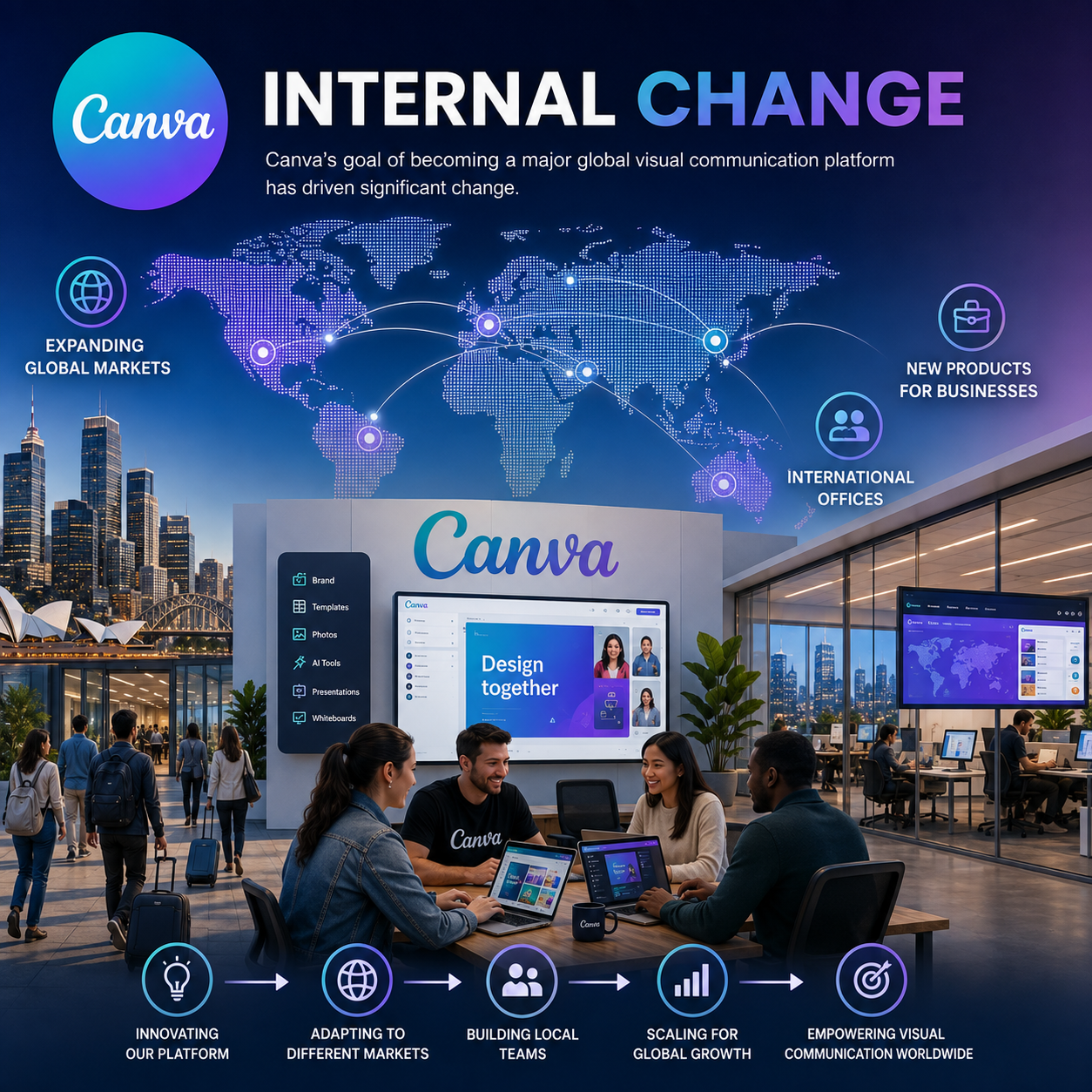
Internal factors are forces for change that come from within the business. These factors are usually linked to the business’s goals, performance, resources, leadership, employees, structure, culture and operations.
Why internal factors drive change
Internal factors drive change because businesses often need to improve how they operate in order to stay competitive in global markets.
A business may decide to change because its strategy has shifted, its costs are too high, its staff need new skills, its structure is inefficient or its current operations are no longer suitable for international growth.
Unlike many external factors, internal factors are usually more controllable because they come from decisions and conditions inside the business.

Key internal factors that drive change
Business goals and strategy
A business may change because its goals or long-term strategy have changed. For example, a business that wants to expand into overseas markets may need to redesign products, change its marketing strategy, open new offices or build international partnerships.
Leadership and management decisions
Managers and owners can drive change by making decisions about structure, staffing, culture, innovation and expansion. Strong leadership can encourage a business to adapt before it falls behind competitors.
Financial performance
Poor sales, falling profits, rising costs or weak cash flow can drive change because the business may need to improve efficiency, reduce expenses or find new revenue sources.
Staff skills and workforce capability
Businesses may need to change when employees require new skills, training or roles. This is especially important in global markets where staff may need to communicate across cultures, manage international customers or work within different business environments.
Organisational culture
Organisational culture refers to the values, attitudes and behaviours shared by people in a business. A business may change its culture if it needs to become more innovative, customer-focused, diverse or internationally minded.
Operational efficiency
Operational efficiency can drive change when the business wants to produce goods or deliver services faster, cheaper or with fewer errors. Global businesses often need efficient systems because they may operate across different countries, time zones and supply chains.
Australian case study — BHP simplifying its corporate structure
BHP provides a strong example of internal change in a global business. In 2022, BHP unified its corporate structure under one Australian parent company, BHP Group Limited.
This was an internal change because it involved the business simplifying its own structure, governance and decision-making arrangements. The change was designed to make the company simpler, more efficient and more flexible when managing its global portfolio.
This shows how internal factors such as organisational structure, strategic direction and leadership decisions can drive change in a global environment.

Example of how to write this factor in an exam
An internal factor that can drive change is leadership and management decision-making. This occurs when managers decide that the business must change its strategy, structure or operations to improve performance. For example, BHP unified its corporate structure under one Australian parent company to make the business simpler and more flexible. As a result, internal leadership can drive change by reshaping the business so it is better suited to competing and operating in a global environment.
🌏 External factors that drive change
External factors are forces for change that come from outside the business. These factors are often less controllable and may include political, economic, social, technological, legal and environmental changes.
Why external factors drive change
External factors drive change because global businesses operate in changing markets, economies, societies and legal systems.
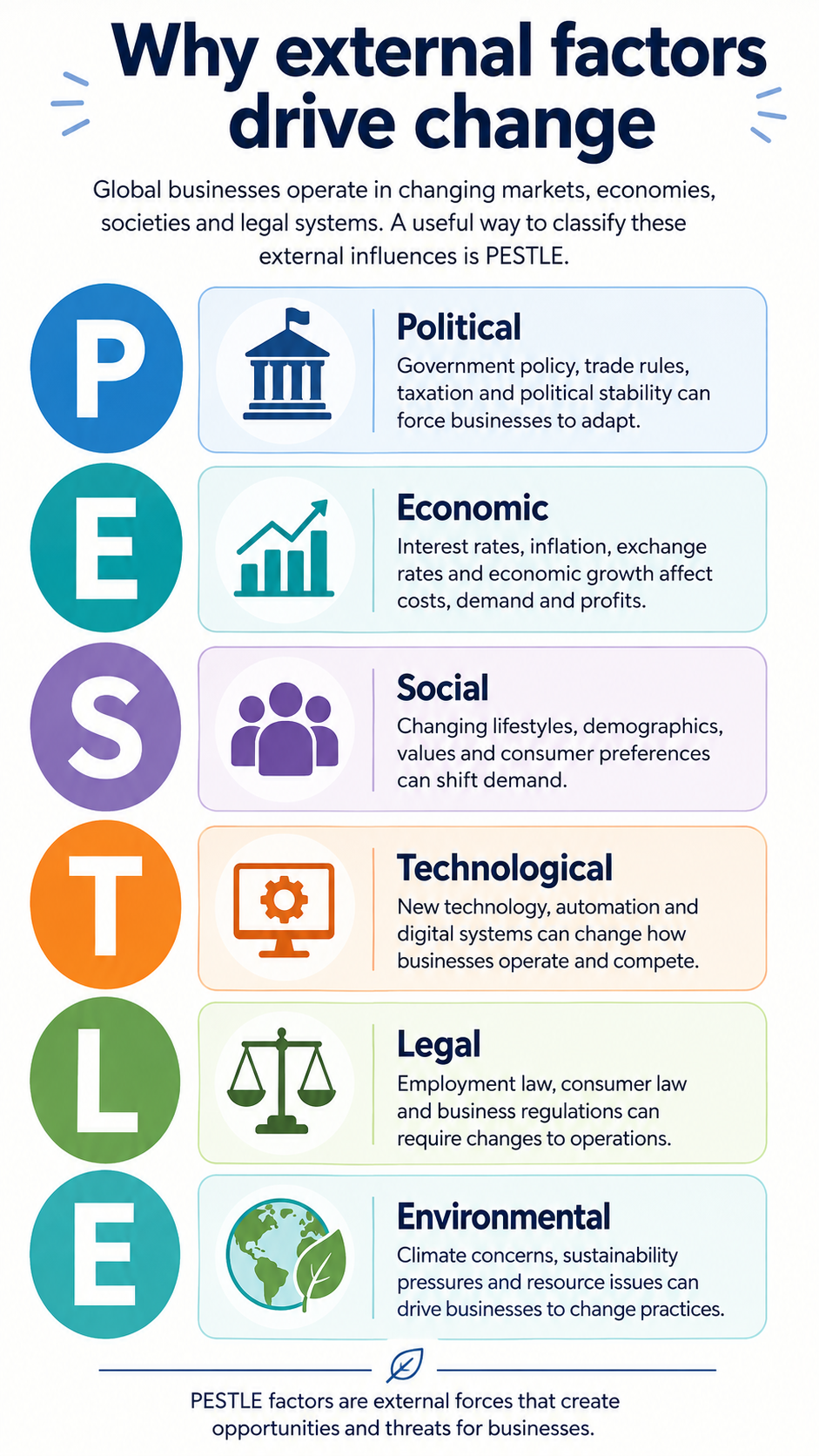
A useful way to classify many external factors is PESTLE. PESTLE factors are the Political, Economic, Social, Technological, Legal and Environmental forces outside the business that can create opportunities or threats.
A business may need to change its products, operations, staffing, marketing or international strategy in response to government policy, exchange rates, customer trends, digital technology, legal requirements or environmental expectations.
Businesses that monitor external factors are more likely to identify threats early and take advantage of opportunities in global markets.

Key external factors that drive change
Political factors
Political factors include government stability, trade agreements, international relations, tariffs, sanctions and government policy. These can drive change by affecting how easily a business can trade or operate across borders.
Economic factors
Economic factors include interest rates, exchange rates, inflation, unemployment, economic growth and consumer confidence. These can drive change by affecting customer spending, business costs and demand in different countries.
Social factors
Social factors include changes in customer preferences, demographics, lifestyles, values and cultural expectations. These can drive change by forcing businesses to adapt products, services and marketing to suit different groups of customers.
Technological factors
Technological factors include digital platforms, automation, artificial intelligence, online payment systems, e-commerce and communication technologies. These can drive change because businesses may need to modernise to meet customer expectations and compete globally.
Legal factors
Legal factors include laws and regulations relating to employment, taxation, product safety, consumer protection, privacy, contracts and international trade. These can drive change because businesses must comply with the rules in each country where they operate.
Environmental factors
Environmental factors include climate change, sustainability expectations, waste reduction, energy use and environmental regulations. These can drive change because customers and governments may expect businesses to operate more responsibly.
Competitive pressure
Competitive pressure occurs when rival businesses force a business to improve its products, prices, customer service or marketing. In global markets, competition can come from both local and international businesses.
Australian case study — Qantas responding to global travel change
Qantas provides a strong example of external factors driving change in a global business. International travel demand, border rules, fuel prices, customer confidence and global competition can all affect how the airline operates.
When external conditions change, Qantas may need to adjust flight routes, staffing, pricing, customer service, aircraft use and international partnerships. These changes are driven mainly by forces outside the business, rather than by conditions fully controlled by Qantas.
This shows how external PESTLE factors can force a global Australian business to adapt its operations and strategy.

Example of how to write this factor in an exam
An external factor that can drive change is economic change. Economic factors such as exchange rates, inflation and consumer confidence can force businesses to adjust their operations so they remain profitable in global markets. For example, CSL earns revenue from overseas markets, so movements in exchange rates can affect the value of its international revenue when reported in Australia. If the Australian dollar rises, overseas revenue may be worth less when converted back into Australian dollars. As a result, external economic conditions can drive change by forcing a business to review pricing, costs and financial planning across different countries.
🎧 Prefer listening?
If you prefer listening to the content in podcast format:
🎥 Prefer watching?
If you prefer watching the content in video format:
🃏 Flashcards
Card 1 of 12
🎮 Revision Games
💰 BME Millionaire
Climb the prize ladder by mastering internal and external drivers of change.
👔 Business Boss
Make 10 change-management decisions. Balance internal capability, external pressure, competitiveness, adaptability and global readiness.
⚡ 60 Second Showdown
A varied 60-second challenge covering internal factors, PESTLE and competitive pressure.

Biz Fact: Flight Centre has had to continually change its business model as online booking technology and changing travel habits reshape the global tourism industry.
Past Exam Questions
Use these past exam questions to see how this dotpoint has been assessed. Pay close attention to the command term, the number of marks and whether the question is Section 1 or Section 2.
Section 1 Questions
2020 — Section 1 — Question 5(a) — 4 marks
Context
Successful management of any workforce requires the ability to continuously change and adapt. To operate in a global environment, organisations must also prepare their people adequately for change.
5(a): Describe one internal and one external factor that drive change in a global environment. (4 marks)
Internal:
External:
Command term focus: Describe
Describe: give the main characteristics of one internal and one external factor and show how each can drive change.
See the full command term guide here: Command Terms.
5(a) Sample answer
Internal: One internal factor that can drive change is business strategy. If a business decides to expand into a global market, it may need to change its products, staffing, management structure and marketing to suit international customers.
External: One external factor that can drive change is technology. New digital platforms, e-commerce systems and communication tools can force a business to update the way it sells products, serves customers and competes in global markets.
2024 — Section 1 — Question 1(a) — 2 marks
Context
To operate successfully in a global environment, businesses must ensure that their staff are prepared adequately for change.
1(a): Identify two internal factors that can drive change in a global environment. (2 marks)
One:
Two:
Command term focus: Identify
Identify: name two correct internal factors only.
See the full command term guide here: Command Terms.
1(a) Sample answer
One: Business goals and strategy.
Two: Staff skills and workforce capability.
Section 2 Questions
2017 — Section 2 — Question 8(a) — 4 marks
Case study / context
During his high school years, Bob worked in his dad’s specialty camera store, developing film and selling cameras and equipment after school. Bob took a couple of gap years and travelled the world, noticing the variety of photographic equipment people used. He also noticed the range of accessories people had purchased, such as camera covers, bags and selfie sticks.
Now back home, Bob’s ambition is to work with his dad to modernise and manage the camera shop once he graduates from the local university. Bob is trying to encourage his dad to embrace new digital technology by changing his current practices to modern digital camera practices and embracing the digital age.
Bob thinks an e-commerce platform would help move the ‘old’ cameras to collectors worldwide. Operationally, this would provide more space to stock digital products for customer sales in the shop. As well, the online presence would provide opportunities to develop electronic sales. However, his dad is resisting any change to the digital age and, as a result, sales are down and the shelves are full of outdated cameras and equipment.
Prepare a short report or essay for Bob and his dad addressing the following points:
8(a): Outline why it is vital that businesses be aware of the internal and external factors that drive change. (4 marks)
Command term focus: Outline
Outline: state why awareness of internal and external factors matters and briefly clarify the effect on the business.
See the full command term guide here: Command Terms.
8(a) Sample answer
It is vital that businesses are aware of internal factors that drive change because these factors can reveal problems inside the business that need to be fixed. In Bob’s dad’s camera shop, sales are down and the shelves are full of outdated cameras and equipment. This shows the business needs to review its stock, sales performance and operational efficiency.
It is also vital that businesses are aware of external factors because the market outside the business may change quickly. The shift from film cameras to digital technology and online selling has changed what customers want and how they purchase products. If the camera shop ignores these external changes, it may continue losing sales to more modern competitors. As a result, awareness of internal and external factors helps a business adapt before it becomes less competitive.
2023 — Section 2 — Question 9(a) — 3 marks
Case study / context
Wendy is the CEO of an Australian-owned hotel chain, Wunderers’ Hotels Pty Ltd, that has been operating for 25 years. Wendy has hotels in Australia and the Asia-Pacific area. The hotels have a strong loyalty rewards program, with over 50,000 members. Their goal in the next five years is to double their membership base and increase sales now that international regulations and legislation have decreased between countries. Wendy has seen an increase in room bookings in the last six months and believes people now have the confidence to travel once again internationally. Another accrediting factor to increased sales is due to popular events being rescheduled, such as the Australian Open and the Formula 1 Grand Prix.
Wunderers’ Hotels’ head office is in Melbourne. However, Wendy would like to move the office to the Asia Pacific region. This would allow her to focus on increasing memberships and customer service within that region and enable the hotel to be recognised as an international hotel chain. Wendy has chosen to establish the new head office in Singapore.
Currently, Wendy has 40 employees working in the Melbourne office in a range of roles in accounting, strategic business development, marketing, sales and human resource management. To train new employees in the Singapore office, she has requested a team member from each department to apply for a new role: Training and Development Coordinator. This will involve travel to Singapore four times a year. The role is an opportunity for leadership within the company and comes with an increase in salary and an annual bonus. Everyone within each team can apply if interested, no matter how long they have worked for the organisation or their experience. One of her main reasons for this is to create a team of leaders with diversity. Wendy strongly believes diversity within teams is a driving force for change and growth.
Some more experienced employees within the company have expressed disappointment and frustration that junior members of staff can apply for this promotional position. This has created arguments within the teams. Some staff members are also unhappy with the change of head office to Singapore. Implementing change within a business can be difficult and it is often met with resistance, so Wendy is keen to use Kotter’s 8 Steps to implement her changes successfully.
Refer to the case study and your own knowledge to answer the questions below.
9(a): Explain one external factor that could drive change in this global business. (3 marks)
Command term focus: Explain
Explain: show cause and effect from one external factor to the resulting change in Wunderers’ Hotels.
See the full command term guide here: Command Terms.
9(a) Sample answer
One external factor that could drive change for Wunderers’ Hotels is economic conditions. The case states that Wendy has seen an increase in room bookings and believes people have the confidence to travel internationally again.
If customer confidence and travel demand increase, Wunderers’ Hotels may need to change its operations to manage growth in the Asia-Pacific region. This could include moving its head office to Singapore, improving customer service and expanding its loyalty rewards program. As a result, stronger economic conditions and increased travel demand can drive change by encouraging the business to expand and operate more internationally.