
U3.20 — Preparing People for Change
Overview
Dotpoint 20: preparing people for change, including Lewin’s Forcefield Analysis model and Kotter’s 8 Steps change management model.
Businesses operating in a global environment must often introduce major change. This may involve expanding into overseas markets, adopting new technology, restructuring departments, merging with another business or changing products and processes to suit new customer expectations.
However, change is more likely to succeed when people are prepared properly. Employees and managers need to understand why the change is necessary, how it will affect them and what support will be provided.
This dotpoint focuses on two change management models:
- Lewin’s Forcefield Analysis model
- Kotter’s 8 Steps change management model
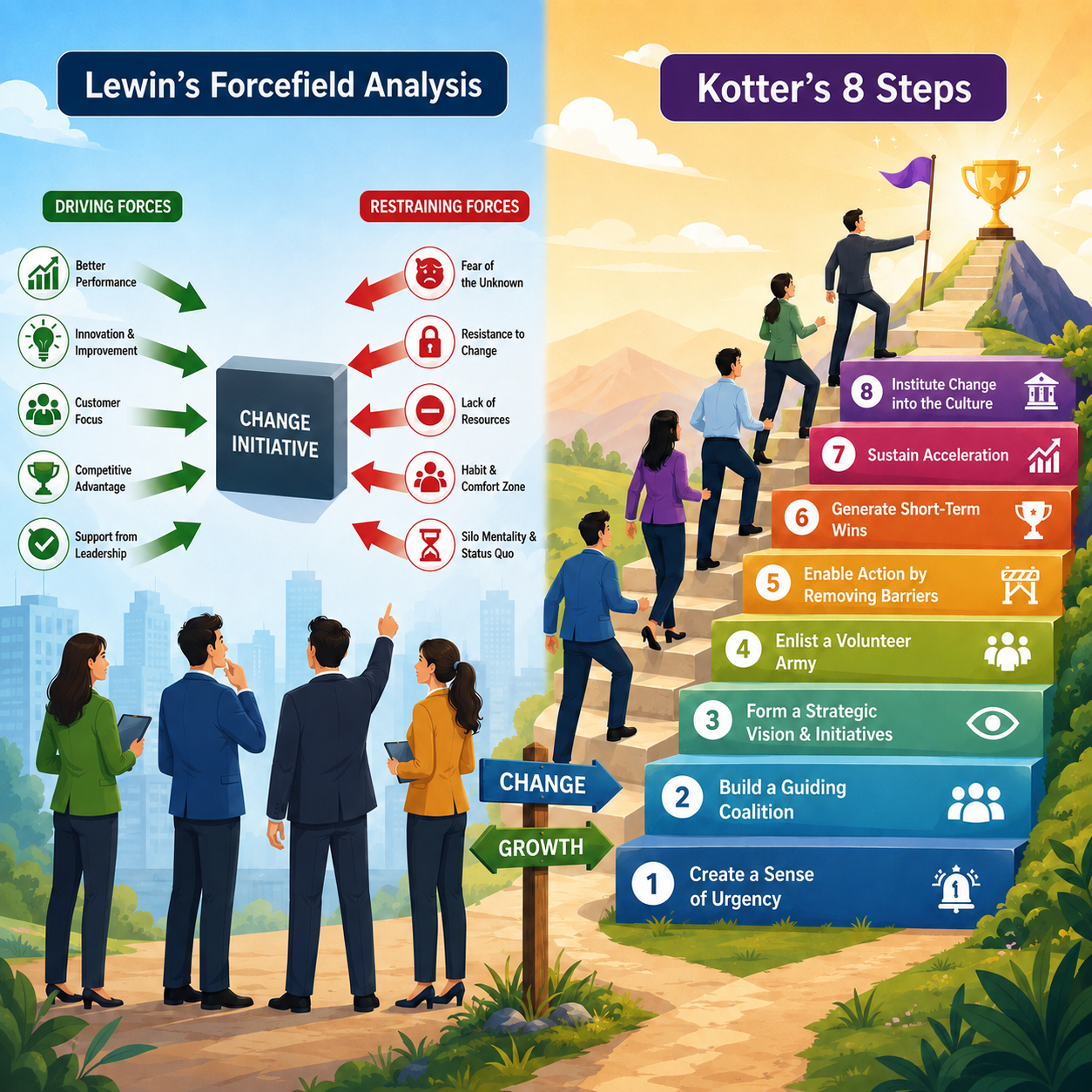
⚖️ Lewin’s Forcefield Analysis model
Lewin’s Forcefield Analysis model is a change management tool used to identify and compare the driving forces supporting change and the restraining forces resisting change.
The model helps managers decide whether change is likely to succeed and what action is needed to prepare people for change.
Summary of the model
Lewin’s Forcefield Analysis was developed by social psychologist Kurt Lewin in the 1940s. It is based on the idea that business change does not happen in isolation; it is shaped by competing pressures that either push the business towards change or hold it back.
Driving forces are the forces that support change, such as falling sales, new technology, global competition, customer demand or growth opportunities.
Restraining forces are the forces that resist change, such as financial costs, staff fear, managerial inertia, cultural incompatibility, lack of training or uncertainty.
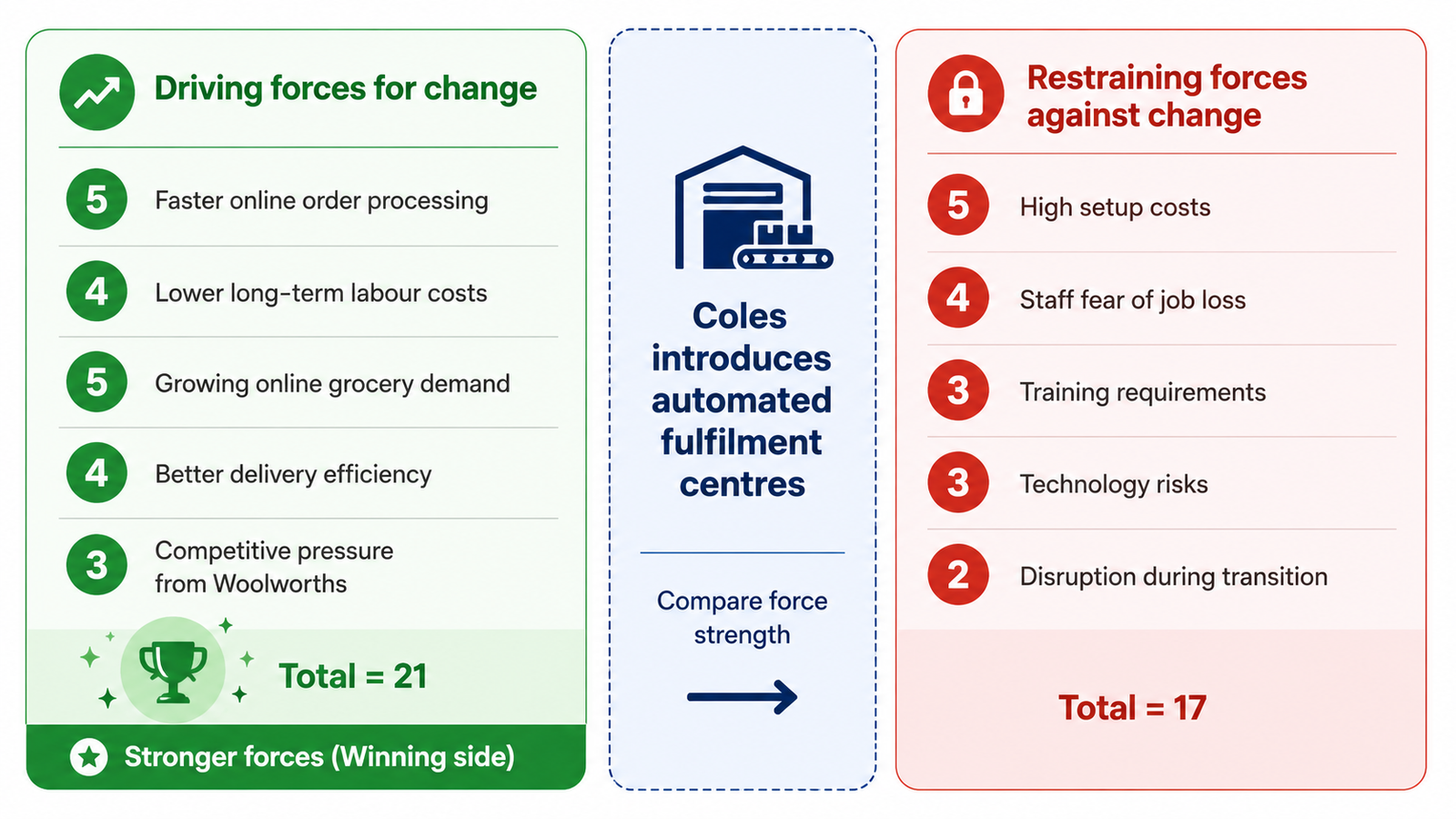
The decision stage involves comparing both sides. If the driving forces are stronger, the change is more likely to succeed. If restraining forces are stronger, the business should reduce resistance before introducing the change.
This model prepares people for change because it encourages managers to identify employee concerns early and create strategies to reduce fear, confusion and resistance.
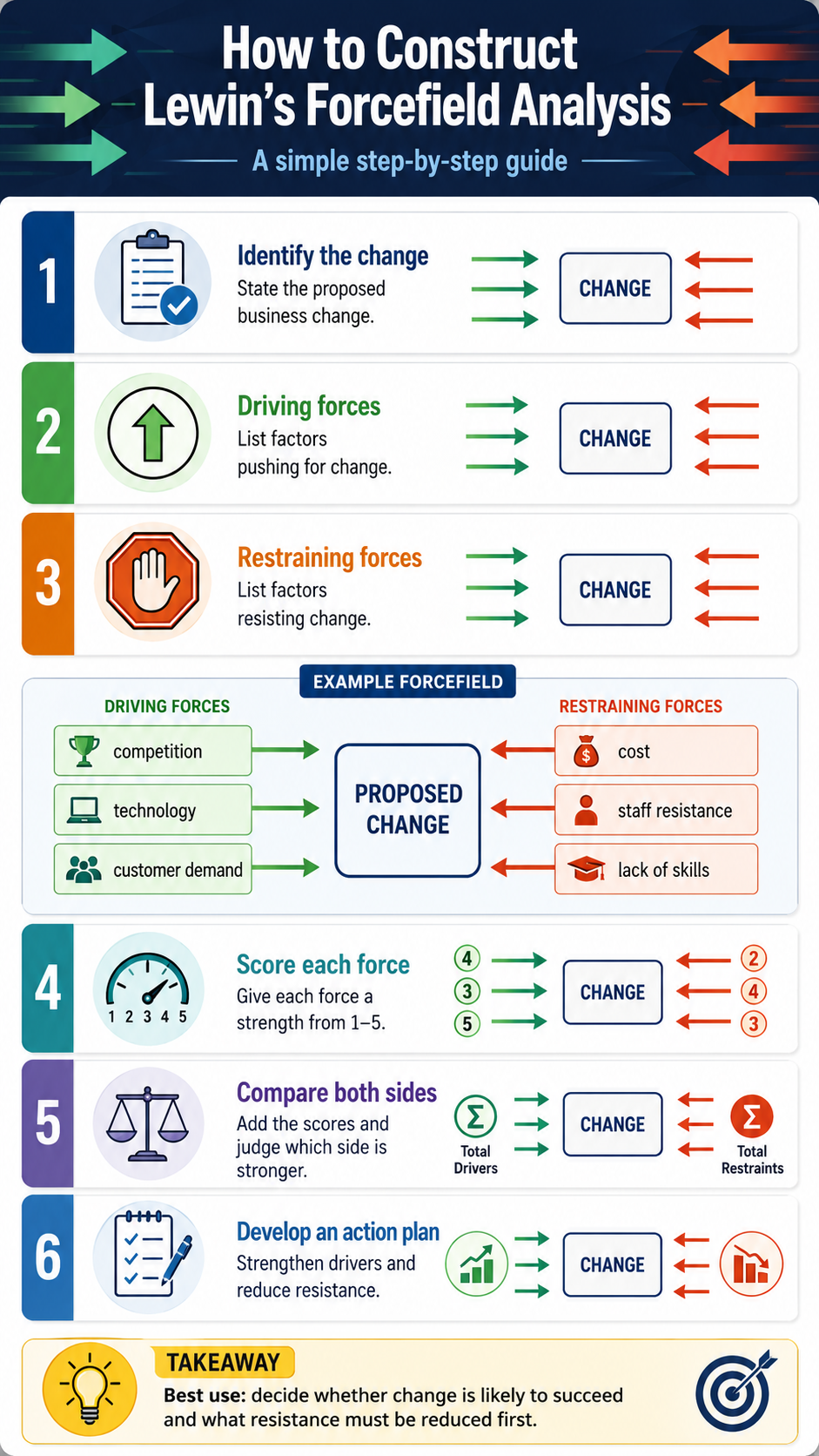
How to construct Lewin’s Forcefield Analysis
Step 1 — Identify the proposed change
Clearly state the change the business is considering. For example, “introduce an e-commerce platform”, “move the head office overseas” or “merge with an international business”.
Step 2 — Identify the driving forces
List the factors pushing the business towards change. These may include falling sales, changing customer expectations, new technology, global market opportunities or stronger competition.
Step 3 — Identify the restraining forces
List the factors resisting change. These may include financial costs, staff attitude, managerial inertia, cultural incompatibility, lack of skills, fear of job losses or uncertainty.
Step 4 — Give each force a strength
Each driving and restraining force can be given a strength score, often from 1 to 5. A higher score means the force has a stronger effect on the proposed change.
Step 5 — Compare both sides
Add the driving force scores and restraining force scores. If driving forces are stronger, change is more likely to succeed. If restraining forces are stronger, the business should reduce resistance first.
Step 6 — Develop an action plan
The business should strengthen the driving forces and reduce the restraining forces. For example, it could communicate the need for change, provide training, offer support, reduce costs or involve employees in decision-making.
Lewin’s Forcefield Analysis diagram — sample layout
Limitations of Lewin’s Forcefield Analysis
Key limitations
- Can oversimplify change: real business change is often more complex than two opposing sides.
- Scoring can be subjective: managers may disagree about the strength of each force.
- Does not fully implement change: it identifies issues but does not provide a detailed change process.
- Forces can change quickly: in global markets, customer demand, competition and employee attitudes can shift rapidly.
Australian case study — JB Hi-Fi strengthening online retail
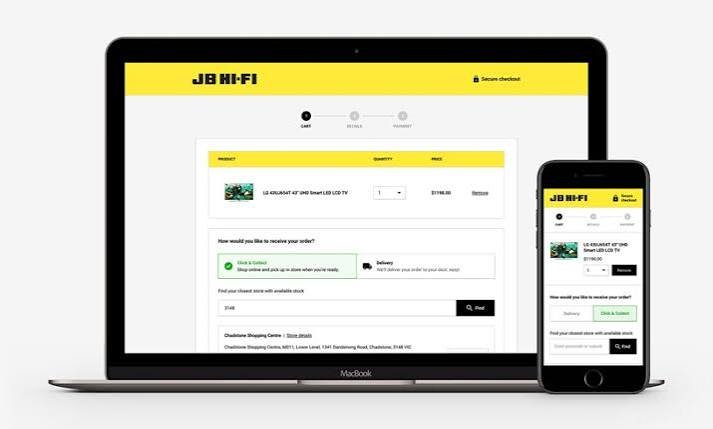
JB Hi-Fi could apply Lewin’s Forcefield Analysis when preparing staff for changes linked to online retail, click-and-collect, delivery systems and digital customer service.
Driving forces may include stronger online competition, customer demand for convenience, the growth of e-commerce and the opportunity to increase sales beyond physical stores.
Restraining forces may include staff concerns about new systems, training requirements, pressure on store teams, delivery costs and fear that online channels could reduce the importance of physical stores.
By using Lewin’s model, JB Hi-Fi could identify the strongest sources of resistance, provide training, explain the benefits of online retail and support staff before the change is fully introduced.
Example of how to write this model in an exam
Lewin’s Forcefield Analysis can prepare people for change by helping managers identify the forces supporting and resisting the proposed change. For example, if JB Hi-Fi wanted to strengthen its online retail systems, driving forces could include customer demand for convenience and stronger online competition, while restraining forces could include staff training costs and employee uncertainty. By identifying these forces before implementing the change, managers can reduce resistance through communication, training and support. As a result, employees are more likely to understand the change and feel prepared to adopt it.
🚀 Kotter’s 8 Steps change management model
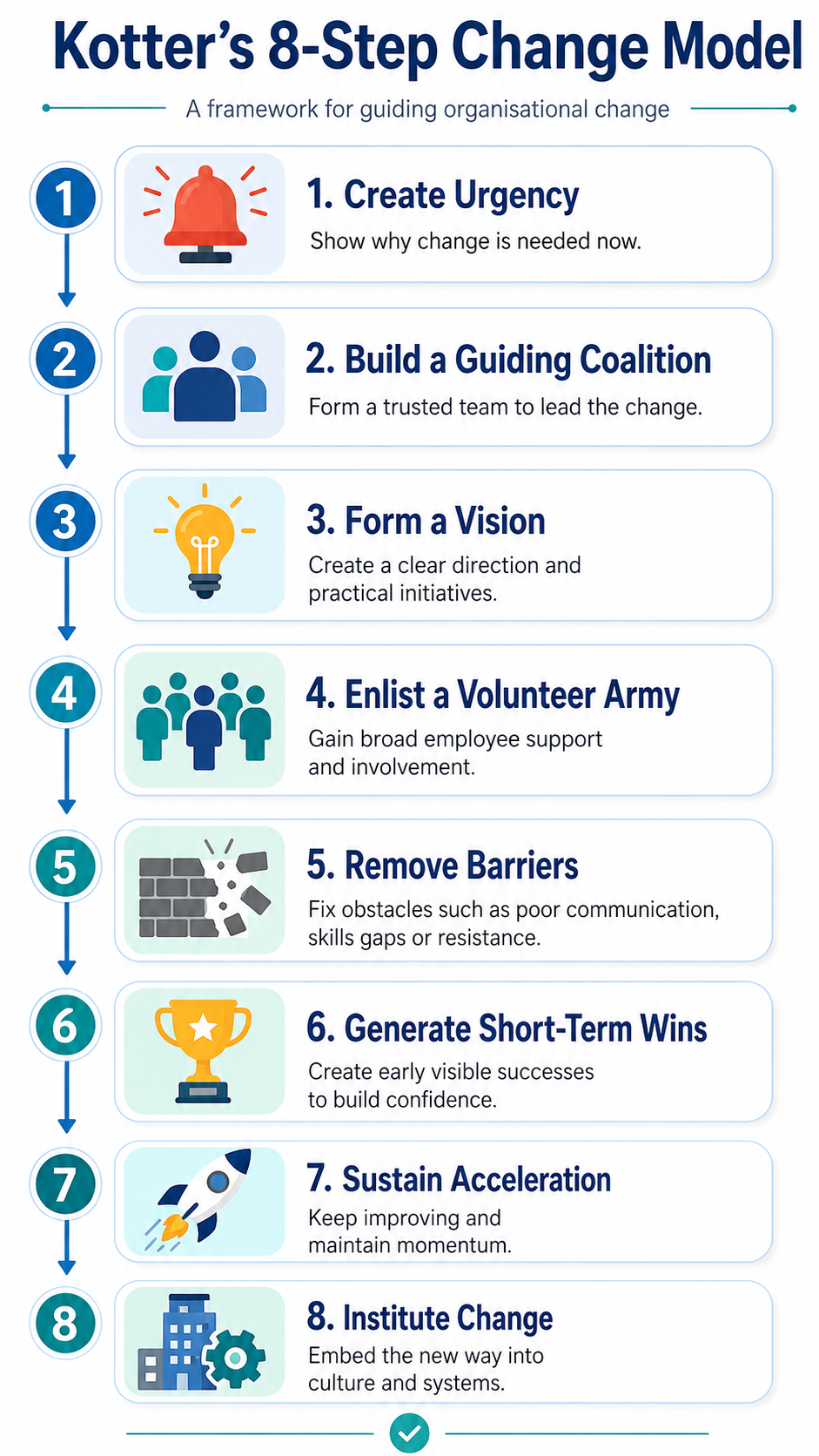
Kotter’s 8 Steps change management model is a structured process that helps managers lead employees through change by creating urgency, building support, communicating a vision and embedding the change into the organisation’s culture.
Summary of the model
Kotter’s 8 Steps model was developed by leadership scholar John Kotter and became widely known through his work on organisational change in the 1990s. The model focuses strongly on the people side of change, rather than treating change as only a technical or operational issue.
The model begins by helping employees understand why change is urgent, then builds leadership support, creates a vision and encourages wider employee involvement. This matters because staff are more likely to support change when they understand its purpose and feel included in the process.
The later steps focus on removing barriers, creating short-term wins, building momentum and making the new behaviour part of normal business culture. This makes the model useful for larger changes where resistance is likely and where managers need to guide people over time.
Kotter’s 8 Steps explained
1Create a sense of urgency
Managers must show employees why change is necessary now. This may involve explaining threats, opportunities, poor performance, customer trends or competitive pressure.
Urgency reduces complacency by helping employees understand that staying the same may be riskier than changing.
2Build a guiding coalition
The business forms a group of influential people who can lead and support the change. This group may include senior managers, department leaders, respected employees and change champions.
The coalition helps build trust and gives the change credibility across the organisation.
3Form a strategic vision and initiatives
The business creates a clear vision of what the change is trying to achieve. The vision should be simple enough for employees to understand and specific enough to guide decisions.
Initiatives are the practical actions used to achieve the vision.
4Enlist a volunteer army
The business encourages a large group of employees to support and participate in the change. This means moving beyond a small leadership group and gaining wider employee involvement.
Employees are more likely to support change when they feel included rather than forced.
5Enable action by removing barriers
Managers identify and remove obstacles that stop employees from supporting the change. Barriers may include poor communication, lack of training, outdated systems, unclear roles or resistant managers.
This step helps employees act on the change rather than simply hearing about it.
6Generate short-term wins
The business creates visible early successes to show employees that the change is working. These wins should be clear, realistic and linked to the overall change goal.
Short-term wins build confidence and reduce resistance.
7Sustain acceleration
The business uses early success to keep improving rather than stopping too soon. Managers continue removing barriers, supporting employees and introducing further improvements.
This step prevents the business from declaring victory before the change is complete.
8Institute change
The business embeds the change into its culture, systems, policies, training and leadership expectations. The new way of operating becomes normal.
This step helps ensure the change continues after the initial excitement has faded.
Limitations of Kotter’s 8 Steps
Key limitations
- Can be time-consuming: eight steps may be slow when the business needs urgent action.
- Can feel top-down: employees may resist if leaders appear to impose the change.
- Steps may overlap: real change is not always neat or sequential.
- Depends on leadership quality: poor communication or weak follow-through can undermine the model.
Australian case study — Woolworths and supply-chain automation
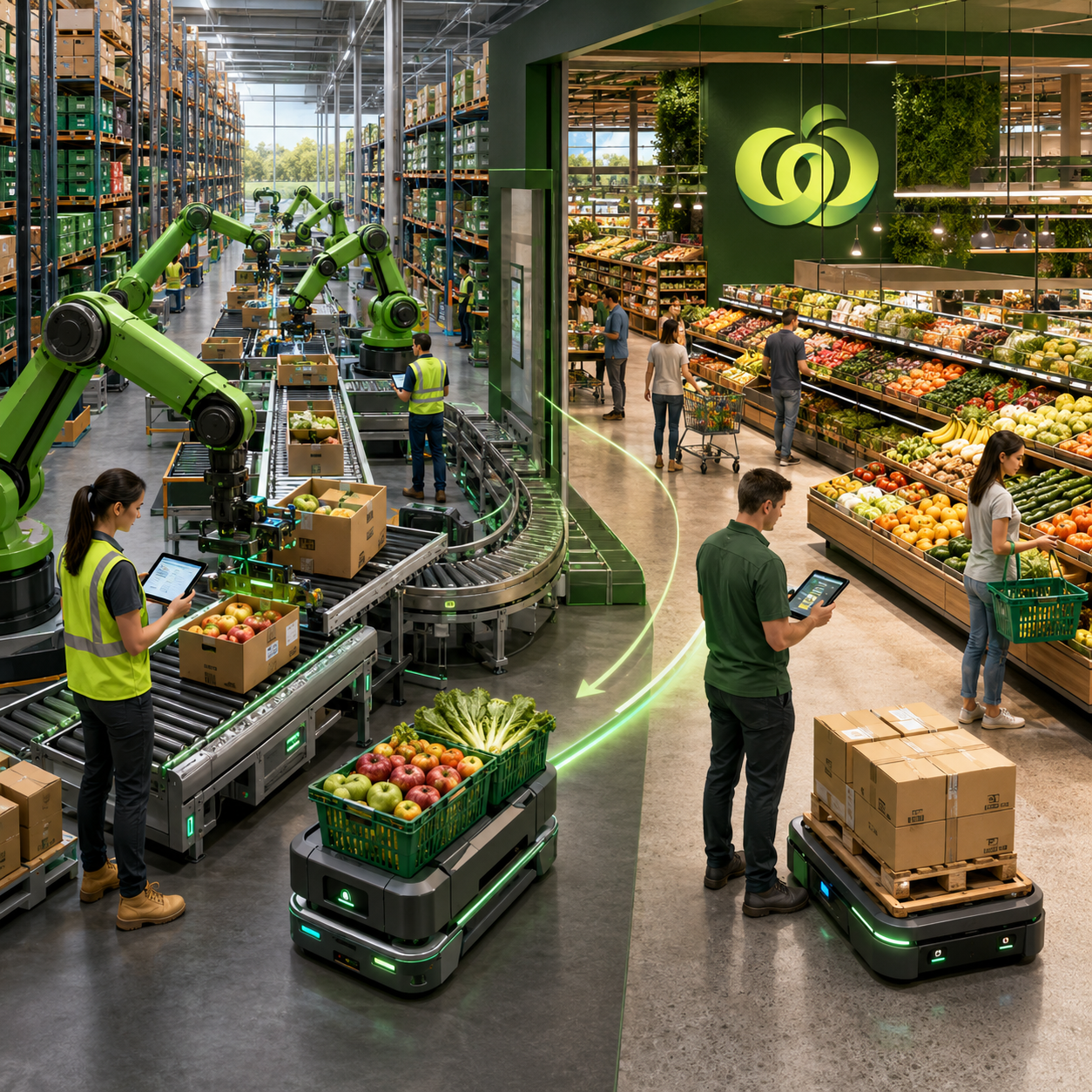
Woolworths could use Kotter’s model when introducing automated distribution centres and new supply-chain systems. This type of change can affect warehouse teams, store teams, delivery processes and customer service.
Step 1: Woolworths could create urgency by explaining that automation is needed to improve stock availability, speed up deliveries and compete in a changing grocery market.
Step 2: It could build a guiding coalition of senior leaders, distribution managers, store managers, training staff and respected team members.
Step 3: It could form a clear vision around faster, safer and more reliable supply chains that improve customer service and support employees with better systems.
Step 4: Woolworths could enlist staff by inviting teams to test processes, provide feedback and become change champions.
Step 5: It could remove barriers by providing training, safety support, clear communication and time for employees to learn new systems.
Step 6: Short-term wins could include faster restocking, improved delivery accuracy or reduced manual handling in selected sites.
Step 7: Woolworths could sustain acceleration by using early success to improve more sites and refine processes.
Step 8: The change could be embedded through training programs, new procedures, leadership expectations and ongoing investment in supply-chain capability.
Example of how to write this model in an exam
Kotter’s 8 Steps can prepare people for change by giving managers a structured process to reduce resistance and build support. For example, Woolworths could use the model when introducing automated distribution systems. It could create urgency by explaining the need for faster and more reliable stock movement, then build a guiding coalition of managers and experienced employees to lead the change. By communicating a clear vision, removing barriers through training and celebrating short-term wins, employees are more likely to understand the purpose of the change and feel supported. As a result, Kotter’s model can make change more successful because it prepares people gradually rather than forcing them to adapt without guidance.
🎧 Prefer listening?
If you prefer listening to the content in podcast format:
🎥 Prefer watching?
If you prefer watching the content in video format:
🃏 Flashcards
Card 1 of 13
🎮 Revision Games
💰 BME Millionaire
Climb the prize ladder by mastering Lewin’s Forcefield Analysis and Kotter’s 8 Steps.
👔 Business Boss
Make 10 change-management decisions. Balance urgency, support, barriers, employee confidence and implementation.
⚡ 60 Second Showdown
A varied 60-second challenge covering Lewin’s model and Kotter’s 8 Steps.

Biz Fact: NetApp used Kotter’s approach to drive cloud change, with 65% of field staff volunteering to drive the change and revenue later growing 44%.
Past Exam Questions
Use these past exam questions to see how this dotpoint has been assessed. Pay close attention to the command term, the number of marks and whether the question is Section 1 or Section 2.
Section 1 Questions
2019 — Section 1 — Question 5(b) and 5(c) — 7 marks
Context
Sersee Designs is an interior design business operating in a global market. It is undergoing organisational change, including a recent leadership restructure, and is experiencing some resistance to change from its employees.
5(b): Explain how Kotter’s 8 Steps change management model could be used to prepare the employees for change at Sersee Designs. (3 marks)
5(c): Describe Steps 2 and 3 of Kotter’s 8 Steps change management model to the Sersee Designs’ leadership team. (4 marks)
Step 2:
Step 3:
Command term focus: Explain and Describe
Explain: show cause and effect. Describe: give the main characteristics of Steps 2 and 3.
See the full command term guide here: Command Terms.
5(b) & 5(c) Sample answer
5(b): Kotter’s 8 Steps could prepare Sersee Designs’ employees for change by giving managers a structured process to reduce uncertainty and build support. For example, the leadership team could create urgency by explaining why the restructure is needed in a global market, then communicate a clear vision and remove barriers through training and support. As a result, employees are more likely to understand the change and feel prepared rather than confused or excluded.
5(c) Step 2: Build a guiding coalition means forming a group of influential people who can lead and support the change. At Sersee Designs, this could include senior leaders, respected designers and team managers who can explain the restructure and encourage staff support.
5(c) Step 3: Form a strategic vision and initiatives means creating a clear picture of what the change is trying to achieve and the actions needed to achieve it. At Sersee Designs, the vision could explain how the leadership restructure will help the business operate more effectively in a global market.
2020 — Section 1 — Question 5(b) — 5 marks
Context
Successful management of any workforce requires the ability to continuously change and adapt. To operate in a global environment, organisations must also prepare their people adequately for change.
5(b): Analyse how a business can apply Lewin’s Forcefield Analysis model when preparing its people for change. (5 marks)
Command term focus: Analyse
Analyse: develop linked relationships between driving/restraining forces, employee preparation and the likely success of change, then explain the implication.
See the full command term guide here: Command Terms.
5(b) Sample answer
A business can apply Lewin’s Forcefield Analysis by identifying how the forces for and against change will affect employee preparation. If managers identify driving forces, such as access to new customers, stronger revenue and global growth opportunities, they can explain to employees why the change is necessary and how it may benefit the business. This can make staff more likely to understand the purpose of the change rather than seeing it as unnecessary disruption.
The business can also identify restraining forces, such as staff uncertainty, training costs and fear of new work practices. Once these barriers are known, managers can prepare employees through communication, training and support before the change is introduced. Over time, this matters because reducing resistance can make employees more confident and willing to adopt the change, improving the chance that the change is implemented successfully.
2022 — Section 1 — Question 2(a), 2(b) and 2(c) — 10 marks
Context
Change management models prepare, support and equip business owners to drive change for business success.
2(a): Label the change management model below. (4 marks)
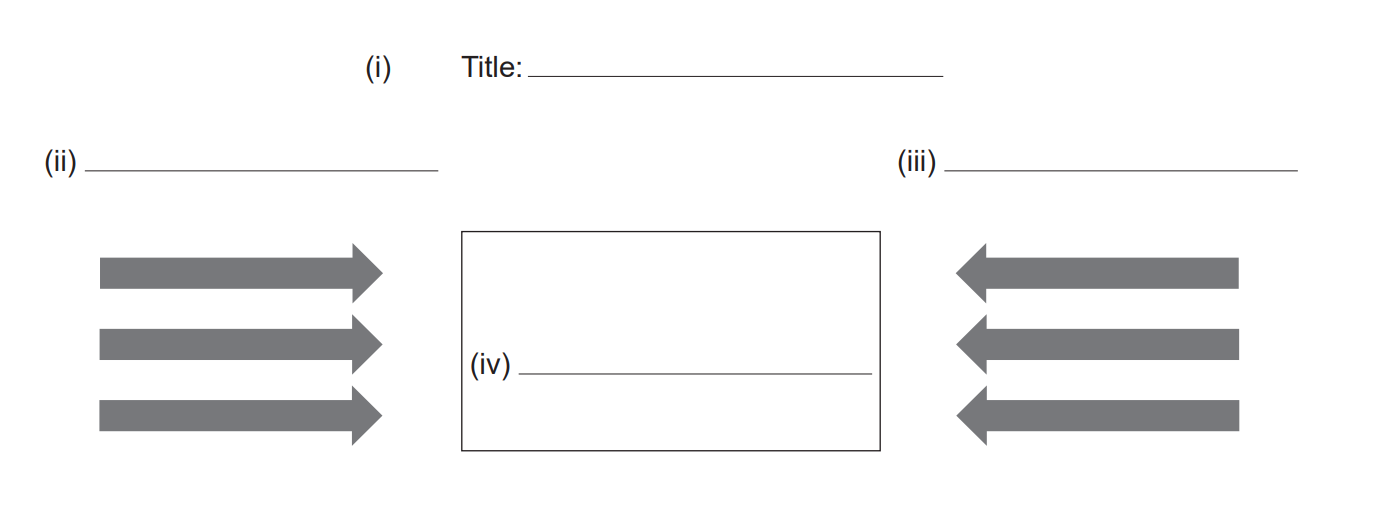
(i) Title:
(ii)
(iv)
(iii)
2(b): Explain the method for using the above change management model. (3 marks)
2(c): Explain how the model on page 5 can prepare people for change within a business. (3 marks)
Command term focus: Label and Explain
Label: name the correct parts of the diagram. Explain: show cause and effect for how the model is used and how it prepares people.
See the full command term guide here: Command Terms.
2(a), 2(b) & 2(c) Sample answer
2(a): The title is Lewin’s Forcefield Analysis. The diagram should be labelled with driving forces, restraining forces and the proposed change.
2(b): The method involves identifying the change the business wants to introduce, then listing the driving forces supporting the change and the restraining forces resisting it. Each force can be given a strength score so the business can compare whether support for the change is stronger than resistance. This helps managers decide whether to proceed with the change or reduce restraining forces first, because strong resistance may cause confusion, poor cooperation or failure during implementation.
2(c): The model prepares people for change because it helps managers identify the concerns employees may have before the change is introduced. For example, if staff are worried about training, workload or job security, managers can respond with communication and support. As a result, employees are more likely to understand the change and feel prepared to accept it.
2024 — Section 1 — Question 1(b) — 3 marks
Context
To operate successfully in a global environment, businesses must ensure that their staff are prepared adequately for change.
1(b): Explain how Lewin’s Forcefield Analysis model can be used to prepare people for change. (3 marks)
Command term focus: Explain
Explain: show cause and effect from identifying and reducing restraining forces to employees being better prepared for change.
See the full command term guide here: Command Terms.
1(b) Sample answer
Lewin’s Forcefield Analysis can prepare people for change by identifying the forces that support the change and the forces that resist it. For example, managers may identify staff fear, lack of training or financial costs as restraining forces. Once these barriers are known, the business can provide communication, training and support before introducing the change. As a result, employees are more likely to understand the change and feel prepared to accept it.
Section 2 Questions
2017 — Section 2 — Question 8(c), 8(d) and 8(e) — 17 marks
Case study / context
During his high school years, Bob worked in his dad’s specialty camera store, developing film and selling cameras and equipment after school. Bob took a couple of gap years and travelled the world, noticing the variety of photographic equipment people used. He also noticed the range of accessories people had purchased, such as camera covers, bags and selfie sticks.
Now back home, Bob’s ambition is to work with his dad to modernise and manage the camera shop once he graduates from the local university. Bob is trying to encourage his dad to embrace new digital technology by changing his current practices to modern digital camera practices and embracing the digital age.
Bob thinks an e-commerce platform would help move the ‘old’ cameras to collectors worldwide. Operationally, this would provide more space to stock digital products for customer sales in the shop. As well, the online presence would provide opportunities to develop electronic sales. However, his dad is resisting any change to the digital age and, as a result, sales are down and the shelves are full of outdated cameras and equipment.
Prepare a short report or essay for Bob and his dad addressing the following points:
8(c): Explain why Kotter’s 8 Steps change management model facilitates change. (3 marks)
8(d): Apply the first three steps of Kotter’s 8 Steps model to guide the camera shop into the digital age. (6 marks)
8(e): Draw and apply Lewin’s Forcefield Analysis to the camera shop and recommend whether or not to adopt change by embracing the digital age. (8 marks)
Command term focus: Explain, Apply and Recommend
Explain: show cause and effect. Apply: use the models directly with the camera shop. Recommend: make a clear decision supported by reasons.
See the full command term guide here: Command Terms.
8(c), 8(d) & 8(e) Sample answer
8(c): Kotter’s 8 Steps facilitates change because it gives managers a structured process for preparing people and reducing resistance. It begins by creating urgency, building a guiding coalition and forming a clear vision, so employees understand why the change is needed and where the business is heading. As a result, change is more likely to be accepted because employees are guided through the process rather than being forced to change suddenly.
8(d): Step 1 — Create urgency means showing stakeholders why change is necessary now. Bob should show his dad that sales are down and the shelves are full of outdated cameras and equipment. This would help his dad understand that staying with old film-based practices is a risk.
Step 2 — Build a guiding coalition means forming a group of people who can lead and support the change. Bob could involve his dad, trusted employees, loyal customers and someone with e-commerce experience to support the shift into digital camera practices and online selling.
Step 3 — Form a strategic vision and initiatives means creating a clear direction for the change and practical actions to achieve it. Bob could create a simple vision: modernise the camera shop by using e-commerce to sell older cameras to collectors worldwide and create more space for digital products in-store.
8(e): In Lewin’s Forcefield Analysis, the driving forces for the camera shop are strong. Falling sales could be scored 5/5 because the business is already performing poorly. Outdated stock could be scored 4/5 because the shelves are full of old cameras and equipment. Customer movement towards digital technology could be scored 5/5 because the market has clearly changed. The opportunity to sell old cameras to collectors worldwide through e-commerce could be scored 4/5. This gives the driving forces a total of 18/20.
The restraining forces include Bob’s dad’s resistance, which could be scored 5/5 because he is strongly resisting the digital age. Financial costs could be scored 3/5 because an e-commerce platform, website support and training would cost money. Lack of digital skills could be scored 3/5, while uncertainty about online selling could be scored 2/5. This gives the restraining forces a total of 13/20.
The camera shop should adopt the change because the driving forces are stronger than the restraining forces. However, Bob should reduce resistance first by starting with a simple e-commerce platform, providing training and explaining how online sales could help move old stock. Therefore, the shop should embrace the digital age gradually, because this would reduce resistance, improve sales opportunities and give the business a better chance of staying competitive in the changing camera market.
2021 — Section 2 — Question 6(d) — 9 marks
Case study / context
Laffitaya is an Australian business that produces high-end hiking and camping clothing. The clothing offers protection from all weather elements that hikers may encounter. It offers insulation, breathable technology, waterproof performance and is lightweight for all hiking and camping conditions. The manufacturing process of the clothing is labour intensive to ensure the garments meet the quality controls of Laffitaya’s management.
The Chief Executive Officer (CEO) of Laffitaya, Quinn, is looking to expand into the Asian market by merging with a Singaporean outdoor supplies business, ExDex Outdoors. The news of the merger has caused many employees in both businesses to be nervous, as they have heard rumours about potential job losses, leadership restructuring and changes to policy in relation to leave entitlements and daily procedures. There has also been talk of increased financial costs associated with the merger, which is creating concern among employees.
Harrison, the operations manager at Laffitaya, is travelling to Singapore to meet with the team at ExDex Outdoors to implement the processes that are used in Australia to ensure the highest standards are maintained in the production of the clothing. Harrison is very efficient and always meets quality control targets. He is also known for his direct nature and tends to talk down to staff, making decisions alone rather than having open communication with his team.
Laffitaya’s CEO, Quinn, is concerned that Harrison may not be aware of cultural considerations required to conduct successful business negotiations in Singapore. Quinn has therefore organised a meeting with Harrison to discuss potential communication strategies to ensure that the best outcome for Laffitaya is achieved.
Referring to the case study and your own knowledge, prepare a report or essay in which you answer the questions below.
6(d): Quinn requires guidance to implement the changes within the business:
● describe Step 4 and Step 5 of Kotter’s 8 Steps change management model
● apply these steps to Laffitaya
and advise Quinn on how Laffitaya could build on these changes. (9 marks)
Command term focus: Describe, Apply and Advise
Describe: give the main features of Steps 4 and 5. Apply: link each directly to Laffitaya. Advise: give a supported suggestion and explain the likely effect.
See the full command term guide here: Command Terms.
6(d) Sample answer
Step 4 — Enlist a volunteer army: This step involves encouraging a large group of employees to support and participate in the change. It moves support beyond senior leaders by involving staff who can influence others and build wider commitment.
At Laffitaya, Quinn could involve employees from both Laffitaya and ExDex Outdoors in merger planning, communication meetings and cultural awareness discussions. This would help reduce nervousness about job losses, leadership restructuring and changes to leave entitlements or daily procedures. Employees are more likely to support the merger if they feel included rather than ignored.
Step 5 — Enable action by removing barriers: This step involves identifying and removing obstacles that prevent employees from supporting the change. Barriers may include poor communication, lack of training, cultural misunderstandings or resistant managers.
At Laffitaya, Quinn should address Harrison’s direct management style and lack of cultural awareness before he meets with ExDex Outdoors. Quinn could provide cultural training, communication strategies and clear expectations for respectful negotiation. This would remove a major barrier to cooperation and improve the chance of a successful merger.
Advice: Quinn should build on these changes by continuing to communicate openly with employees, addressing rumours quickly and creating early signs of progress. For example, Laffitaya could run joint training sessions with ExDex Outdoors and celebrate successful collaboration between the Australian and Singaporean teams. This would help build trust and prepare employees for the next stages of the merger.
2023 — Section 2 — Question 9(d) — 13 marks
Case study / context
Wendy is the CEO of an Australian-owned hotel chain, Wunderers’ Hotels Pty Ltd, that has been operating for 25 years. Wendy has hotels in Australia and the Asia-Pacific area. The hotels have a strong loyalty rewards program, with over 50,000 members. Their goal in the next five years is to double their membership base and increase sales now that international regulations and legislation have decreased between countries. Wendy has seen an increase in room bookings in the last six months and believes people now have the confidence to travel once again internationally. Another accrediting factor to increased sales is due to popular events being rescheduled, such as the Australian Open and the Formula 1 Grand Prix.
Wunderers’ Hotels’ head office is in Melbourne. However, Wendy would like to move the office to the Asia Pacific region. This would allow her to focus on increasing memberships and customer service within that region and enable the hotel to be recognised as an international hotel chain. Wendy has chosen to establish the new head office in Singapore.
Currently, Wendy has 40 employees working in the Melbourne office in a range of roles in accounting, strategic business development, marketing, sales and human resource management. To train new employees in the Singapore office, she has requested a team member from each department to apply for a new role: Training and Development Coordinator. This will involve travel to Singapore four times a year. The role is an opportunity for leadership within the company and comes with an increase in salary and an annual bonus. Everyone within each team can apply if interested, no matter how long they have worked for the organisation or their experience. One of her main reasons for this is to create a team of leaders with diversity. Wendy strongly believes diversity within teams is a driving force for change and growth.
Some more experienced employees within the company have expressed disappointment and frustration that junior members of staff can apply for this promotional position. This has created arguments within the teams. Some staff members are also unhappy with the change of head office to Singapore. Implementing change within a business can be difficult and it is often met with resistance, so Wendy is keen to use Kotter’s 8 Steps to implement her changes successfully.
Refer to the case study and your own knowledge to answer the questions below.
9(d): Apply Steps 6, 7 and 8 of Kotter’s 8 Steps change management model to Wendy’s new Training and Development Coordinator role. Advise how she can use this model to prepare staff for the upcoming changes. (13 marks)
Command term focus: Apply and Advise
Apply: use Steps 6, 7 and 8 directly with Wendy’s case. Advise: recommend how she should use the model and explain why it would help prepare staff.
See the full command term guide here: Command Terms.
9(d) Sample answer
Step 6 — Generate short-term wins: Wendy should create early, visible successes linked to the Training and Development Coordinator role. For example, she could appoint a small group of coordinators from different departments and celebrate their first successful training visit to Singapore. This would show staff that the role is valuable and that the change can create leadership opportunities. As a result, short-term wins could reduce frustration among employees who are unsure about the new role.
Step 7 — Sustain acceleration: Wendy should use these early wins to build momentum and continue improving the change. For example, after the first training visits, she could gather feedback from coordinators, Melbourne staff and Singapore staff to improve the role. She could also expand training responsibilities or create mentoring opportunities for employees who want to apply in the future. This would prevent the business from stopping after the first success and would show employees that the change is continuing in a structured way.
Step 8 — Institute change: Wendy should embed the Training and Development Coordinator role into the culture and systems of Wunderers’ Hotels. This could involve making international training part of leadership development, including diversity and Asia-Pacific customer service in staff training, and recognising coordinators in performance reviews. If the role becomes part of normal career progression, staff are more likely to accept it as a legitimate opportunity rather than a one-off change.
Advice: Wendy should use Steps 6, 7 and 8 to make the change feel fair, visible and permanent. She should communicate early successes, use feedback to improve the role and clearly explain how employees can develop the skills needed to apply. This would prepare staff by reducing uncertainty and showing that the change is linked to growth, diversity and international expansion rather than favouritism or disruption.
2025 — Section 2 — Question 9(b) — 6 marks
Case study / context
Fizzology, an Australian soft drink company, specialises in a variety of flavoured drinks and is seeking to adapt and change its product range to meet new market trends. The current consumer market is looking for healthier options and seeking businesses that are seen to be environmentally-conscious and sustainable in their manufacturing and packaging.
Fizzology wants to conduct research and development to innovate their current products and invent new product ranges. It is looking into creating a kombucha range, fizzy flavoured tea drinks and reduced sugar in their popular Fizzology flavoured soft drinks. They are hoping that by investing in innovation of their products, it will create an opportunity to revitalise their sales in Australia and also provide an opportunity for the business to expand their new product lines globally.
Some members of senior management are not entirely convinced the time and investment into innovation is a wise move. They have seen other drink companies already launch kombucha and sugar-free drinks and they believe there are already strong competitors in the market. Some middle managers are also resistant to the change, concerned about job losses, changes to work routines and pressure to learn new skills and information about the new products. To manage this resistance to change, Fizzology is turning to Kotter’s 8 Step change management model. The business wants to highlight to team members the importance of adapting to consumer tastes and trends and to demonstrate the long-term benefits of being an environmentally-conscious business.
Hoping to convince the Fizzology management team of this change in the business, some team members are working towards having a plan in place to complete the research, investment and innovation to launch their new products internationally in the summer of 2027. Fizzology is aware that even though there are big brand names worldwide in the soft drink market, there is massive revenue potential and the number of potential customers is huge.
9(b): Using Steps 1 and 4 of Kotter’s 8 Step change management model, explain how Fizzology can address resistance to change with its goal of global expansion. (6 marks)
Command term focus: Explain
Explain: show cause and effect for how Steps 1 and 4 could reduce Fizzology’s resistance to change and support global expansion.
See the full command term guide here: Command Terms.
9(b) Sample answer
Step 1 — Create a sense of urgency: Fizzology can address resistance by showing employees and managers why innovation is necessary now. The business can highlight that customers are seeking healthier options and environmentally-conscious businesses, while competitors have already launched kombucha and sugar-free drinks. This would help senior managers and middle managers understand that staying with the current product range may weaken sales and reduce global growth opportunities. As a result, urgency can reduce resistance by showing that change is needed for Fizzology to remain competitive.
Step 4 — Enlist a volunteer army: Fizzology can also address resistance by involving a wider group of employees in the change process. Instead of leaving the innovation plan to only senior managers, the business could involve middle managers, production staff, marketing employees and sustainability-focused team members in product development and launch planning. If employees help test new products, suggest packaging improvements or communicate the benefits of the change, they are more likely to support the goal of global expansion. As a result, Step 4 can reduce resistance by making staff feel included rather than forced to change.