
U4.07 — Political Factors Which Impact on Business Operations in Global Markets
Overview
Dotpoint 7: political factors which impact on business operation in global markets.
Political factors are government-related conditions, decisions and relationships that can influence how a business operates in a global market.
Political factors matter because a global business is affected by the laws, policies, leadership, international relationships and government decisions of the countries where it sells, produces, sources or operates.
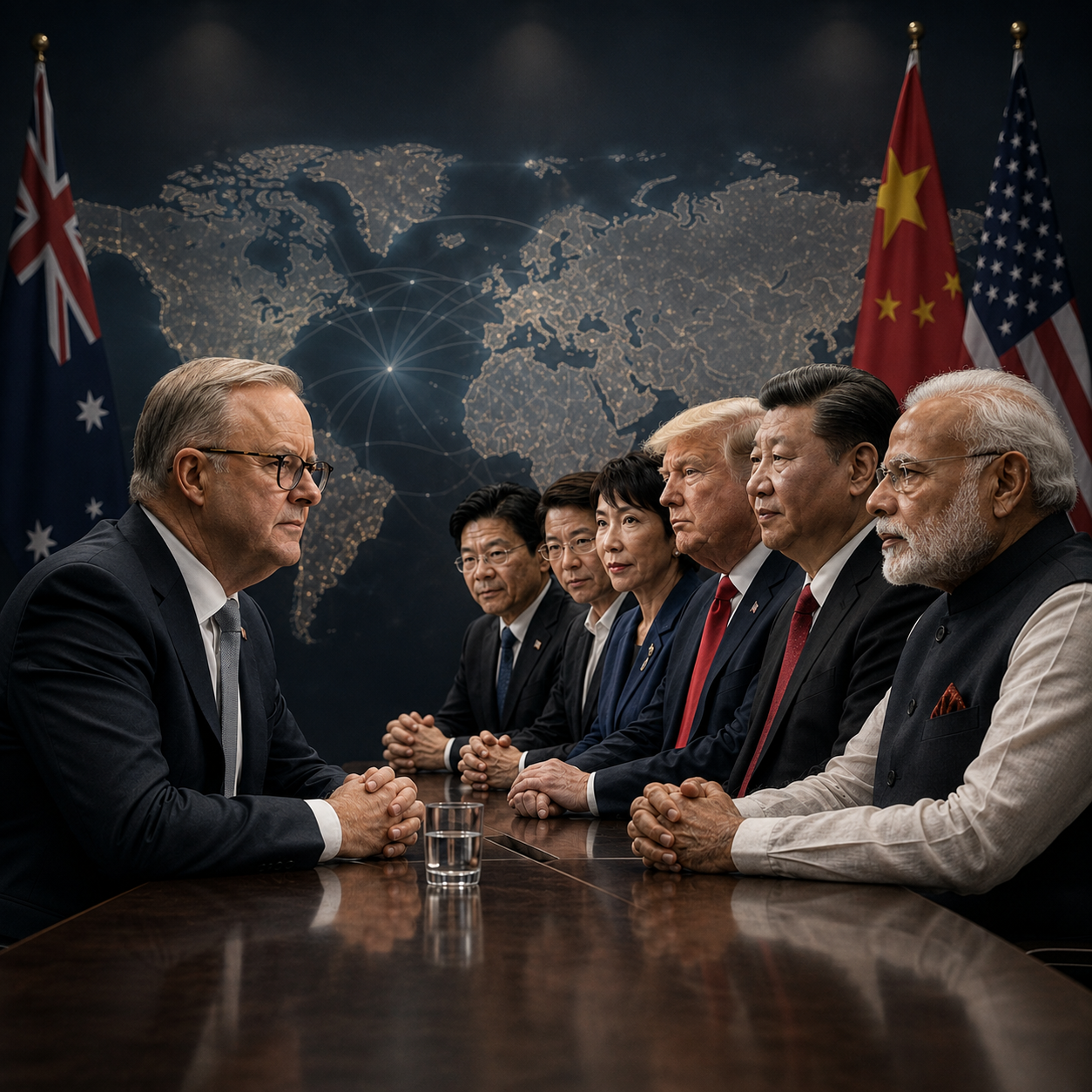
This dotpoint will focus on two political factors:
- stability of foreign governments
- relationship of foreign governments with the Australian Government
🏛️ Stability of foreign governments
What is stability of foreign governments?
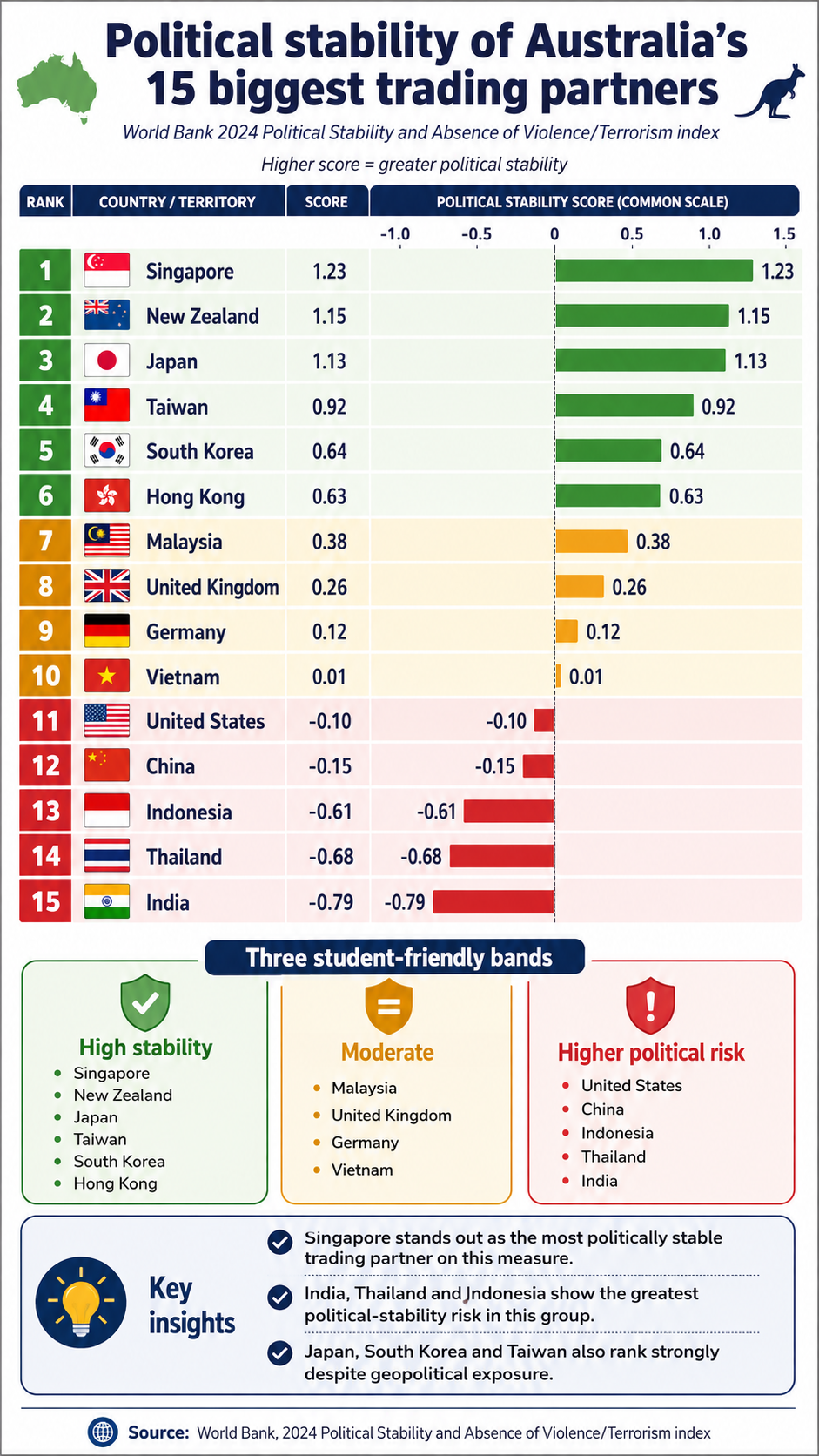
Stability of foreign governments refers to how predictable, secure and reliable the political system is in another country.
A stable foreign government usually has consistent laws, clear regulations, reliable institutions, peaceful leadership transitions, low corruption and a lower risk of civil unrest or sudden policy change.
An unstable foreign government may experience sudden leadership changes, corruption, weak legal systems, protests, conflict, terrorism, policy uncertainty or poor enforcement of laws. This can make it harder and riskier for an Australian business to operate overseas.
Common sources of instability
- Leadership change: a new government may change laws, taxes, industry rules or attitudes towards foreign businesses.
- Conflict or unrest: war, protests, terrorism or civil unrest can disrupt transport, staff safety, tourism demand and production.
- Corruption: bribery, unfair treatment or slow approvals can increase costs and damage business reputation.
- Weak legal systems: poor contract enforcement can make it harder to protect assets, payments and partnerships.
- Sudden policy change: governments may quickly alter tariffs, foreign ownership rules, labour laws or environmental regulations.
- Security risks: safety concerns can reduce customer confidence, increase insurance costs and make staff movement harder.
Impact on global business operations
Government stability can affect business operations because it influences how predictable the operating environment is. If a country is politically stable, a business can plan staffing, pricing, contracts, supply chains, investment and marketing with greater certainty.
For example, an Australian tourism business such as Intrepid Travel may feel more confident offering tours in a stable market like Japan because tourism regulations, transport systems and safety conditions are more predictable.
However, if a foreign government is unstable, the business may face sudden changes to tax, licensing, safety rules, import controls, employment laws or operating permissions. This can increase costs, delay expansion and reduce confidence.
How government stability affects business operations
| Business operation | Impact of stable government | Impact of unstable government |
|---|---|---|
| Planning and investment | The business can make long-term decisions with greater confidence. | The business may delay or cancel expansion due to uncertainty. |
| Costs | Stable laws and taxes help the business estimate costs more accurately. | Sudden tax, wage, licensing or compliance changes can increase costs. |
| Supply chain | Stable transport, ports and regulations support reliable movement of goods. | Unrest, conflict or poor administration can delay imports and exports. |
| Staffing | Clear employment laws make hiring and training easier to manage. | Political unrest or weak legal systems can create safety and labour risks. |
| Revenue | Consumers and tourists may feel confident spending in a safe market. | Demand may fall if customers view the country as unsafe or risky. |
Example of how to write this in an exam
Stability of foreign governments may affect business operations because it determines how predictable the overseas market is. For example, CSL may be more confident expanding biotechnology distribution or manufacturing operations into Singapore because a stable foreign government can provide consistent health regulations, business laws and investment rules. This would allow CSL to plan production, staffing, compliance and supply chains with greater certainty. As a result, government stability can reduce risk and make global expansion more attractive.
🤝 Relationship of foreign governments with the Australian Government
What does this political factor mean?
Relationship of foreign governments with the Australian Government refers to the quality of the political, diplomatic, trade and strategic relationship between Australia and another country.
If Australia has a strong relationship with a foreign government, businesses may benefit from trade agreements, tourism cooperation, investment links, smoother export rules, diplomatic support and a more positive image of Australian products and services.
If the relationship is poor or tense, Australian businesses may face tariffs, sanctions, blocked exports, extra regulation, negative publicity, disrupted travel, reduced consumer trust or difficulty accessing the market.
Impact on global business operations
Good relationships between foreign governments and the Australian Government can make global business easier by encouraging trade, tourism, investment and cooperation. Businesses may face fewer barriers and may be more confident entering that market.
For example, a business such as Flight Centre may benefit from Australia’s strong relationship with Japan because travel links, safety perceptions and tourism cooperation can support demand for Australian travellers visiting Japan.
A tense relationship can create major business risk. For example, Treasury Wine Estates, the owner of Penfolds, was affected when China placed heavy duties on Australian wine during a period of strained relations. When relations improved and China removed the duties in 2024, Australian wine exporters regained access to a major market.

Examples of Australia’s relationships with foreign governments
| Top trading partner | Relationship with Australia | Possible business impact |
|---|---|---|
| 🇨🇳 China | Australia’s largest trading partner, but politically sensitive. Relations have improved after earlier trade tensions. | Large export opportunities, but businesses can face risk if diplomatic tension leads to tariffs, restrictions or disrupted market access. |
| 🇯🇵 Japan | Strong relationship. Australia and Japan have deep trade, tourism, investment and strategic links. | Can support tourism, food exports, education, resources, technology and defence-related opportunities. |
| 🇺🇸 United States | Strong relationship through trade, investment, defence and strategic cooperation. | Can support technology, defence, services, investment and global expansion opportunities for Australian businesses. |
| 🇰🇷 South Korea | Strong trade and strategic relationship with Australia. | Can support exports in resources, food, education, services and technology-related industries. |
| 🇸🇬 Singapore | Strong regional relationship and important business hub in Southeast Asia. | Can help Australian businesses access finance, logistics, regional headquarters and Southeast Asian markets. |
| 🇳🇿 New Zealand | Very close relationship with shared trade, tourism, labour and investment links. | Can make expansion easier due to similar business conditions, close travel links and strong consumer familiarity. |
| 🇮🇳 India | Growing relationship supported by trade, education, migration and strategic cooperation. | Can create opportunities in education, resources, food, technology, professional services and clean energy. |
| 🇬🇧 United Kingdom | Strong historical, trade and investment relationship. | Can support professional services, education, investment, tourism and Australian brands entering the UK market. |
| 🇩🇪 Germany | Strong relationship with links in trade, advanced manufacturing, clean energy and investment. | Can support opportunities for Australian businesses in renewable energy, resources, technology and specialist manufacturing. |
| 🇲🇾 Malaysia | Strong regional trade and education relationship. | Can support Australian businesses in food, education, tourism, professional services and Southeast Asian supply chains. |
| 🇮🇩 Indonesia | Important neighbour and growing partner, with cooperation in trade, education, tourism and regional security. | Can support tourism, agriculture, education, services and regional expansion, although businesses must manage regulatory complexity. |
How this affects business operations
Possible impacts on operations
- Market access: strong relationships may reduce barriers and make it easier to sell products, operate tours, enter contracts or gain approvals.
- Costs: poor relationships may increase costs through tariffs, compliance rules, sanctions, insurance or customs delays.
- Risk: businesses may face higher political risk if government relationships are tense, unpredictable or affected by disputes.
- Reputation: consumers may react positively or negatively to Australian businesses depending on the relationship between governments.
- Tourism demand: strong relationships can support travel confidence, aviation links, safety perceptions and destination promotion.
- Supply chain: good relationships can make importing and exporting smoother, while poor relationships can lead to delays or sudden restrictions.
Example of how to write this in an exam
The relationship of foreign governments with the Australian Government can affect business operations because it influences trade barriers, tourism confidence and market access. For example, Treasury Wine Estates was affected when China placed heavy duties on Australian wine during a period of strained relations, reducing access to a major export market. When Australia–China relations improved and the tariffs were removed in 2024, the business had greater opportunity to rebuild sales in China. This shows that government relationships can directly influence revenue, market access and expansion decisions.
🎧 Prefer listening?
If you prefer listening to the content in podcast format:
🎥 Prefer watching?
If you prefer watching the content in video format:
🃏 Flashcards
Card 1 of 8
🎮 Revision Games
💰 BME Millionaire
Climb the prize ladder. Use your lifelines wisely.
👔 Business Boss
Make 10 global political-risk decisions. Balance certainty, access, cost and confidence.
⚡ 60 Second Showdown
A varied 60-second challenge covering government stability, relationships and business impact.

Biz Fact: When Australia–China relations improved, China removed its tariffs on Australian wine in 2024, reopening a major export market.
Past Exam Questions
Use these past exam questions to see how this dotpoint has been assessed. Pay close attention to the command term, the number of marks and whether the question is Section 1 or Section 2.
Section 1 Questions
2020 — Section 1 — Question 2(b) — 3 marks
Context
There are many potential risks facing businesses that operate in a global market. Careful planning and research are required to ensure a business’ best chance of success.
2(b): Explain one political factor that can have an impact on business operations in a global market. (3 marks)
Command term focus: Explain
Explain: show cause and effect by explaining how the political factor affects operations and the result.
See the full command term guide here: Command Terms.
2(b) Sample answer
One political factor is the stability of foreign governments. If an Australian business expands into a country with a stable government, it is more likely to face consistent laws, taxes and regulations. This means the business can plan staffing, pricing, investment and supply chains with greater certainty, which may reduce the risk of operating in the global market.
2023 — Section 1 — Question 4(d) — 4 marks
Context
Strategic management is a key element to consider when operating in global markets.
4(d): Explain, using an example, how one political factor may affect Australian business operations in a global market. (4 marks)
Command term focus: Explain
Explain: show cause and effect and support the explanation with a relevant example.
See the full command term guide here: Command Terms.
4(d) Sample answer
One political factor is the relationship between a foreign government and the Australian Government. For example, when Australia–China relations became strained, Australian wine exporters such as Treasury Wine Estates faced heavy duties on bottled wine, making it harder to sell into China. This reduced market access and created revenue risk. As a result, a poor political relationship can directly disrupt Australian business operations in a global market.
2024 — Section 1 — Question 6(b) — 3 marks
Context
A company that specialises in the manufacture of technology products is planning to expand its operations globally. As part of its strategic planning, the company is considering various sources of external funding and means of navigating the potential political landscape.
6(b): Explain how the stability of foreign governments may affect business operations in a global market for a company planning global expansion. (3 marks)
Command term focus: Explain
Explain: show cause and effect by linking government stability to business operations and the result.
See the full command term guide here: Command Terms.
6(b) Sample answer
The stability of foreign governments may affect business operations because stable governments usually provide more predictable laws, regulations and taxation policies. For a technology company expanding globally, this would make it easier to plan production, hire staff, protect intellectual property and invest in facilities. As a result, the company may be more willing to expand into a stable market because the risk of sudden disruption is lower.
Section 2 Questions
2018 — Section 2 — Question 7(b) — 4 marks
Case study / context
Daisy has been operating a surf and yoga camp in the small beach town of Yallingup in Western Australia. She is very happy with the success of the business, which attracts both local and international tourists. She is thinking of expanding to Bali, Indonesia. This appears to be an ideal location, due to its popularity as a holiday destination, the availability of affordable flights, diverse culture, good surf and the fact that there are already established surf and yoga camps successfully operating in Bali. Daisy has also learned the Indonesian language during her past visits to Bali. She decides she needs to assess the strategic direction of her business and will need to consider whether it is worth expanding overseas.
Through market research, Daisy has discovered Bali has a multi-religious population, with a rich dance and music culture. She has also found that it is important to build relationships before starting business negotiations. Australia and Indonesia are strategic partners and cooperate in a range of areas, including politics, economics, tourism and education.
7(b): Describe two political factors that might affect her business operations in Bali. (4 marks)
Command term focus: Describe
Describe: give the main characteristics or features and apply both political factors to Daisy’s Bali business.
See the full command term guide here: Command Terms.
7(b) Sample answer
One political factor is the stability of the Indonesian Government. If Indonesia provides stable tourism regulations, safety rules, licensing requirements and local business laws, Daisy will be able to plan her Bali surf and yoga camp with greater certainty. This would make it easier to organise accommodation, staff, transport and customer bookings.
A second political factor is the relationship between the Indonesian Government and the Australian Government. The case states that Australia and Indonesia are strategic partners and cooperate in politics, economics, tourism and education. This positive relationship may support tourism links and customer confidence, making it easier for Daisy to attract Australian tourists to her Bali camp.
2019 — Section 2 — Question 8(d) — 6 marks
Case study / context
Utterly Uggalicious is an Australian business that sells sheepskin boots. Currently the wool for the boots is sourced from Australia and New Zealand to ensure the highest-quality materials are used. The boots are manufactured in Australia and sold locally.
Utterly Uggalicious has been operating for five years and has experienced a huge increase in the demand for its products. It believes this is due to their high quality and ethical production policies.
As the business has become more and more popular, Utterly Uggalicious has had to significantly increase production, employ more staff and look for a bigger manufacturing location. While the business is keen to continue to use Australian and New Zealand materials, it is considering the advantages of moving its production offshore. Hence, the business has started to research the benefits of moving its wool processing and manufacturing to Asia.
In making this strategic decision, the business must also consider the negative human and environmental factors that may impact Utterly Uggalicious. Currently, the business has a corporate social responsibility strategy in place; however, a move to Asia could hinder the business’ ability to follow this strategy.
8(d): Consider how two political factors could impact on the business’ operations in Asia. (6 marks)
Command term focus: Consider
Consider: give an advantage, a disadvantage and a judgement for each political factor.
See the full command term guide here: Command Terms.
8(d) Sample answer
One political factor is the stability of foreign governments. If Utterly Uggalicious moves wool processing and manufacturing to an Asian country with a stable government, it is more likely to experience consistent employment laws, tax rules, environmental regulations and factory requirements. This could help the business plan production and control costs with greater certainty. However, if the foreign government is unstable, sudden changes to labour laws, safety rules or import and export procedures could disrupt production and increase costs. Overall, government stability would be a significant factor because the business’ offshore production would depend on reliable laws and predictable operating conditions.
A second political factor is the relationship between the foreign government and the Australian Government. If Australia has a positive relationship with the Asian country, Utterly Uggalicious may face fewer trade barriers, smoother customs processes and stronger support for Australian business activity. However, if the relationship becomes strained, the business could face restrictions, tariffs, negative publicity or delays in moving materials and finished boots between countries. Overall, this relationship would be important because any breakdown in trade or diplomatic ties could reduce the benefits of cheaper offshore production.
2025 — Section 2 — Question 7(d) — 8 marks
Case study / context
SNO Tours is a Western Australian-based travel and tourism proprietary limited company. It has built a presence in the Australian market by providing unique small-group holiday experiences, focusing primarily on adventures with friends. Its target market is people aged between 18 to 25 who want to explore and are open to trying new things. The business model operates on the needs and wants of clients, including their budgets and preferred adventure activities. With a thriving client base and strong social media following, SNO Tours is considering expanding its tour offerings to include countries in Asia, specifically Japan.
SNO Tours feels Japan is a suitable starting point for small-group adventures as there are favourable economic conditions for both the business and its clients. With the Japanese yen (JPY) being weak compared with the Australian dollar (AUD), Australians visiting Japan can spend more on experiences while away. Compared to travel experiences in Australia, SNO Tours’ clients will be able to do more during their Japanese holiday, including affordable skiing holidays, visits to many cities and experiences of local culture. The relationship between the Australian and Japanese governments is positive and it is a safe and stable country for travel.
While the SNO Tours’ team is excited for this expansion, they are also aware that they will need more money to finance it. They have recorded a profit for the year, resulting in some retained profits, but will need to consider external sources of funding to make their dream a reality.
SNO Tours is well aware of the ethical implications of its industry. It has always held itself to high standards and all clients agree to a responsible travel agreement. It prides itself on its respect for local culture and will continue to do so. With expansion into international travel, it will be further considering its corporate social responsibility and how it can best operate in the travel and tourism industry.
7(d): Analyse how the stability of foreign governments and the relationship of foreign governments with the Australian government could impact SNO Tours. (8 marks)
Command term focus: Analyse
Analyse: identify the variables, explain linked relationships and draw out the implication. Section 2 requires application.
See the full command term guide here: Command Terms.
7(d) Sample answer
The first political factor is the stability of foreign governments. Japan’s stable government can reduce uncertainty for SNO Tours because tourism regulations, safety requirements and business laws are less likely to change unexpectedly. This would allow SNO Tours to plan its tour packages, accommodation partnerships and transport arrangements with greater confidence. In turn, greater political stability may also increase traveller confidence in Japan as a safe and reliable destination, which could encourage more of SNO Tours’ target market of 18 to 25-year-olds to book its tours. The implication is that SNO Tours may be more willing to invest in its Japanese expansion because the risk of political disruption affecting its operations and demand is relatively low.
The second political factor is the relationship of foreign governments with the Australian Government. Australia and Japan have a strong political relationship, which can create a more supportive environment for Australian businesses such as SNO Tours entering the Japanese market. Strong diplomatic, trade and tourism links may make it easier for SNO Tours to develop relationships with Japanese accommodation, transport and activity providers. These stronger local partnerships could improve the reliability and quality of its tour packages, helping SNO Tours build trust with Australian travellers. The implication is that the positive Australia–Japan relationship may reduce the risks associated with entering Japan and improve the likelihood that SNO Tours’ international expansion is successful.