
U2.12 — Stages of the Product Lifecycle
Overview
Dotpoint 12: stages of the product lifecycle.
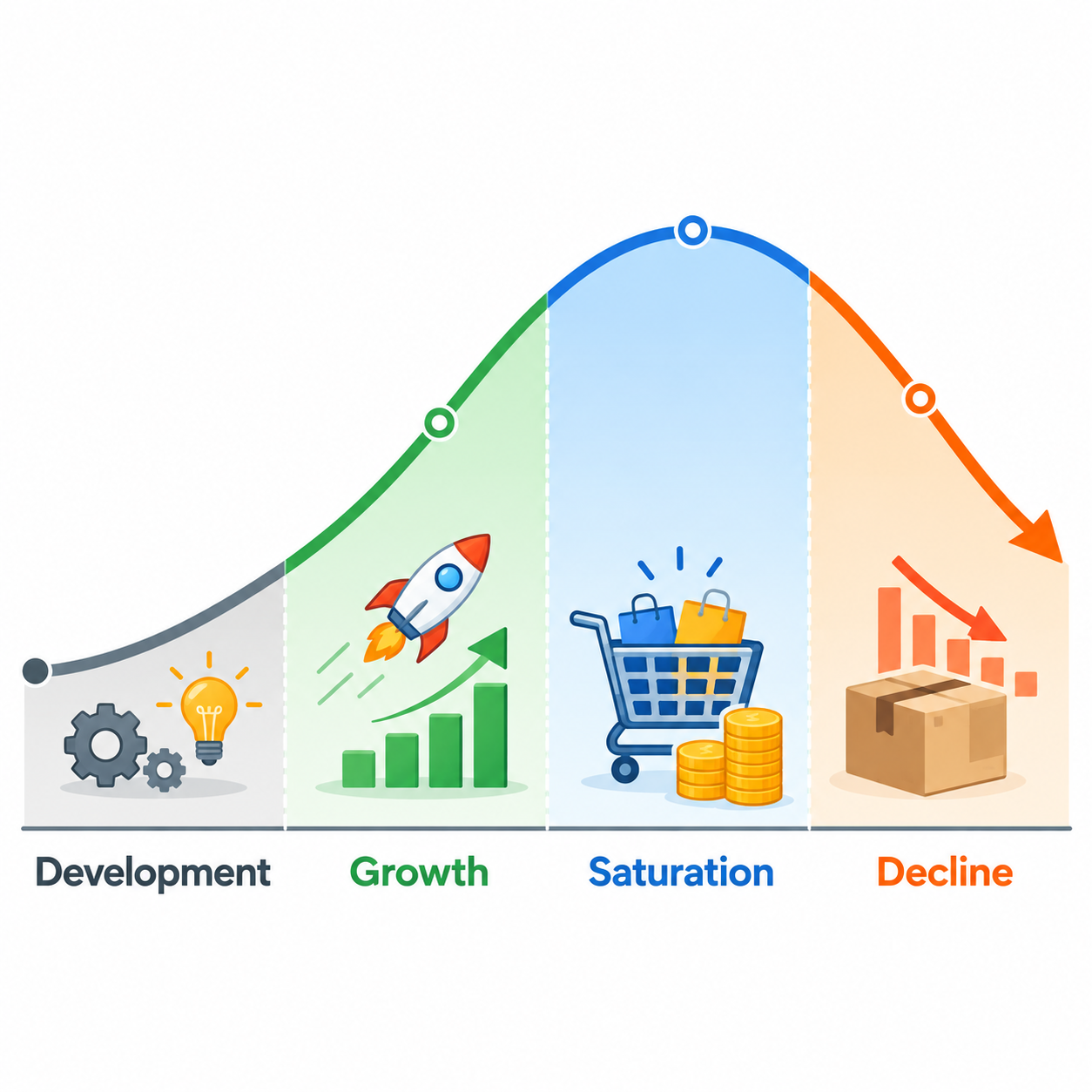
The product lifecycle describes the stages a product may move through over time, from its early development through to a possible decline in demand.
This dotpoint focuses on the four main stages:
1. Development
2. Growth
3. Saturation
4. Decline
📈 What is the product lifecycle?
The product lifecycle is the pattern a product may follow from the time it is first developed until it eventually loses demand.
How the pattern changes over time
Not every product moves in exactly the same way, but many products follow a similar pattern over time. A common pattern is:
1. During development, the product is new to the market, so awareness is limited and sales are usually low or uncertain.
2. As the product enters growth, more customers become aware of it and demand increases, causing sales to rise.
3. At saturation, the market becomes more crowded and sales growth begins to slow or level off.
4. During decline, customer interest falls or newer alternatives appear, causing demand and sales to decrease.
The iPod

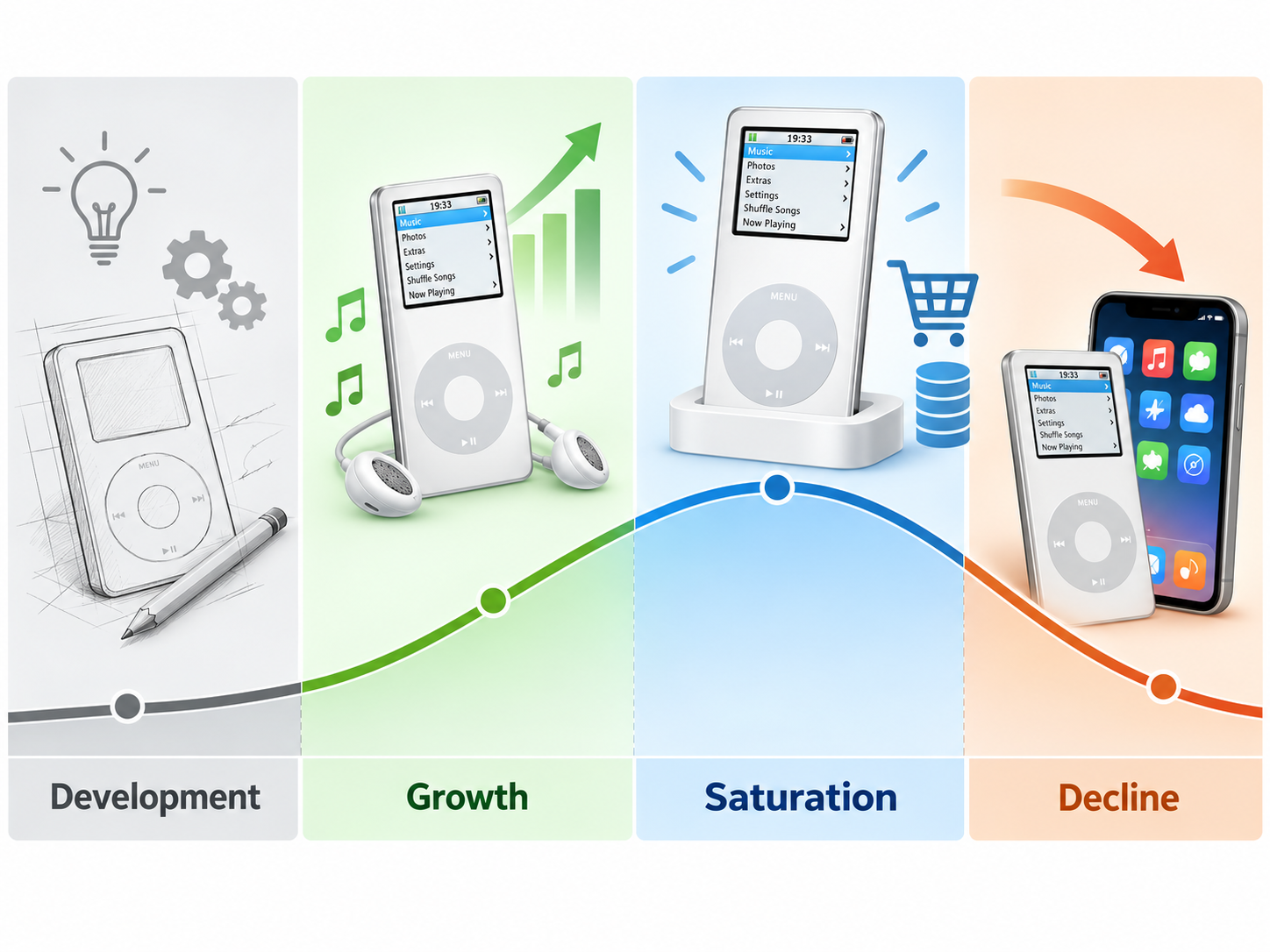
The iPod started in development in the early 2000s, entered growth from around 2001, reached saturation in the late 2000s, and moved into decline in the 2010s as smartphones replaced the need for a separate music player.
🧩 Stages of the product lifecycle
The four stages of the product lifecycle
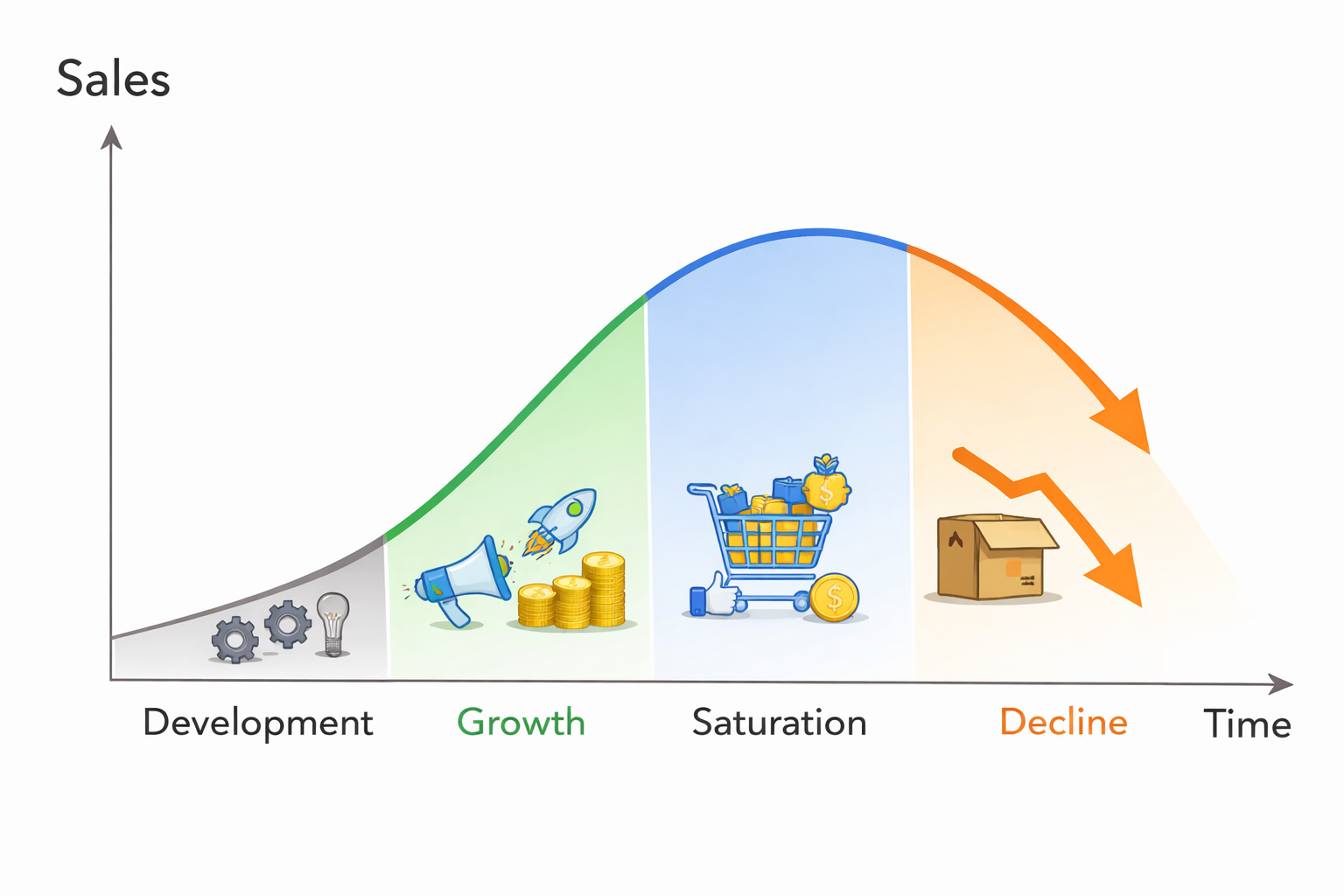
As a product moves through its lifecycle, its sales, customer demand, profitability and level of competition can change.
Although not every product follows exactly the same path, the product lifecycle is commonly divided into four stages:
1. Development
2. Growth
3. Saturation
4. Decline
1. Development
This is the early stage where the product is being created, tested or prepared for launch. The business is investing in the product, but market demand is not yet proven.
- the product is being created, tested or refined before wider release
- sales are not yet established or remain extremely low
- business costs can be high because of research, design, production preparation and promotion
- customer awareness is usually limited because the product is new or not yet widely available
- profitability may be low or negative because costs are being incurred before strong sales develop
- there is a high level of risk because the business does not yet know how strongly customers will respond
2. Growth
This is the stage where customer awareness increases and the product begins to gain stronger acceptance in the market, causing demand and sales to rise.
- sales increase more quickly as more customers begin buying the product
- customer awareness and interest improve as the product becomes better known
- profits may begin to rise as increasing sales help cover earlier development and launch costs
- the product gains stronger recognition and market presence
- more competitors may enter because they can see that the market is becoming attractive
- the business may expand production, supply or distribution to keep up with growing demand
3. Saturation
This is the stage where the market becomes more developed and crowded. Sales may still be high, but the rate of sales growth slows or levels off.
- sales may stabilise rather than continue rising strongly
- market growth slows because many potential customers already know about or own the product
- competition is usually strong as businesses fight for similar customers
- many customers who want the product may already have bought it, reducing the number of new buyers
- businesses may need stronger promotion, differentiation or product improvements to protect market share
- price pressure can increase as rivals compete more aggressively for customers
4. Decline
This is the stage where customer interest weakens and demand falls, causing sales to decrease over time.
- sales decrease as fewer customers continue buying the product
- customer interest weakens because tastes, trends or technology may have changed
- newer products or better alternatives may replace the existing product
- profits may fall as revenue decreases and the product becomes less commercially attractive
- the business may reduce promotion, update the product, use an extension strategy or remove it from the market
- some competitors may leave the market as overall demand becomes weaker
How to write this in an exam
The product lifecycle describes how a product may move through development, growth, saturation and decline over time. During development, the product is being created, tested or prepared for launch, so sales are very low while costs and risk can be high. As the product enters growth, customer awareness and demand increase, causing sales and potentially profits to rise, while successful products may also attract new competitors. At saturation, the market becomes more crowded and sales growth slows or levels off, meaning the business may need to work harder to protect market share. During decline, customer interest and demand fall, often because tastes change or newer alternatives appear, causing sales and profitability to decrease. This means the marketing approach used by a business may need to change as the product moves through its lifecycle.
➕ Extension stage of the PLC
Extending the life of a product
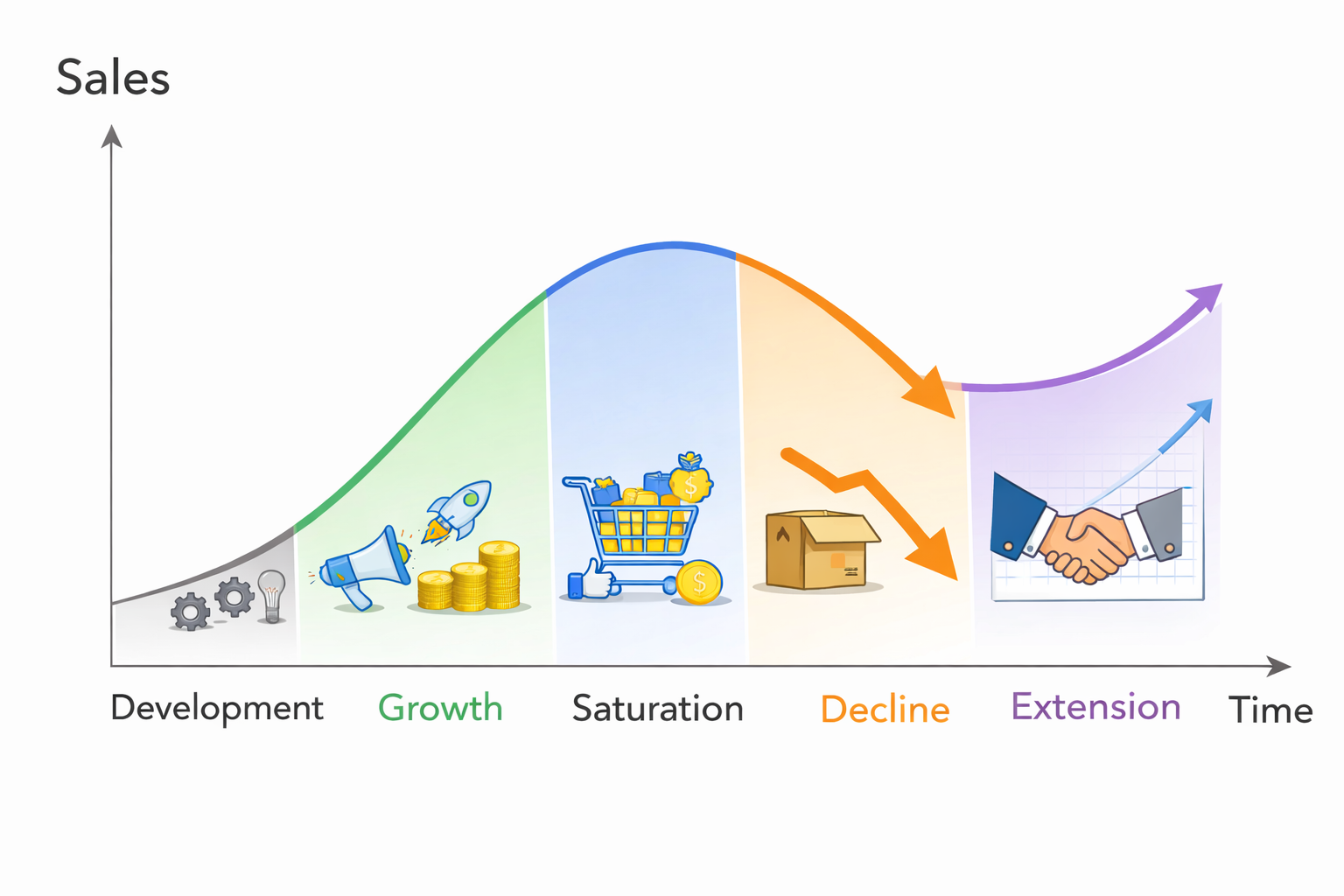
The extension stage is when a business tries to keep a product selling for longer instead of letting it move fully into decline. This is usually done by refreshing the product or changing the way it is marketed so that customer interest continues.
Businesses may try to extend the life of a product by:
- updating the branding
- refreshing the packaging
- adding new features or improvements
- changing the design or style
- running new promotions
- targeting a new market segment
- repositioning the product
- adjusting the price
- releasing limited editions or variations
- linking the product to new trends or technology
- expanding to a new country
Examples
Apple iPhone: Apple regularly releases updated iPhone models with new features, design changes and stronger cameras, helping extend sales and keep the product relevant for longer.
Coca-Cola: Coca-Cola has extended the life of many products through new packaging, limited editions, flavour variations and fresh promotions aimed at keeping customer interest high.
HBF in WA: HBF has kept its brand relevant in Western Australia by refreshing its marketing, maintaining strong visibility and adapting its offers and messaging to suit changing customers over time.
How to write this in an exam
A business can use an extension strategy to keep a product selling for longer and delay its movement into decline. For example, it may update the product’s features, refresh its packaging, run new promotions or target a new market segment. This can renew customer interest and attract additional buyers, helping the business maintain sales and extend the useful life of the product.
⚠️ Limitations of the PLC
The product lifecycle is a useful model for understanding how products may change over time, but it does not perfectly predict what will happen to every product. The PLC can help businesses think about sales, demand and competition, but it should not be used on its own to make marketing decisions.
Main limitations
- Not every product follows the same pattern: some products grow quickly, some decline slowly, and some skip stages completely.
- It can be hard to identify the exact stage: a business may not know whether a product is in growth, saturation or decline until after sales data becomes clearer.
- External factors can suddenly change the cycle: technology, competitors, trends, economic conditions or new laws can cause a product to rise or fall faster than expected.
- Some products stay popular for a very long time: products such as Coca-Cola, Vegemite or iPhones may not decline in a simple way because businesses keep refreshing them.
- Extension strategies can change the pattern: advertising, new packaging, new flavours, updated features or entering new markets can extend a product’s life.
- It is better for looking backwards than predicting the future: the PLC can explain what has happened, but it cannot guarantee what will happen next.
Key takeaway
The PLC is helpful for thinking about marketing strategies, but businesses should also use sales data, customer feedback, competitor research and market trends before making decisions.
How to write this in an exam
One limitation of the product lifecycle is that not every product follows the same pattern. A product may move through stages at different speeds, skip a stage or remain popular for a long period, making it difficult for a business to identify exactly where the product sits in the cycle. As a result, relying only on the PLC could lead to poor marketing decisions, so the business should also consider sales data, customer feedback, competitor activity and market trends.
🎧 Prefer listening?
If you prefer listening to the content in Podcast format:
🎥 Prefer watching?
If you prefer watching the content in video format:
🃏 Flashcards
Card 1 of 9
🎮 Revision Games
💰 BME Millionaire
Climb the ladder by mastering the PLC stages, extension strategies and limitations.
📈 Stage Match
Identify the lifecycle stage or concept that best matches each market situation.
⚡ 60 Second Showdown
Race the clock across stages, patterns, extensions and PLC limitations.

Biz Fact: The Nintendo Wii grew fast because of its motion controls and family appeal, but later declined as the novelty wore off and newer consoles entered the market.