
U3.17 — Factors that Impact on the Success of Innovation
Overview
Dotpoint 17: factors that impact on the success of innovation, including timing, cost, marketing strategy and technology.
Innovation does not automatically succeed just because a business has a new idea. A new product, process or service can fail if it is launched at the wrong time, costs too much, is poorly marketed or is not supported by suitable technology.
Many different factors can influence whether an innovation succeeds or fails. This dotpoint focuses on four key factors:
- timing
- cost
- marketing strategy
- technology

⏱️ Timing
Timing refers to when a business introduces an innovation to the market. Timing can affect whether customers are ready for the innovation, whether it matches current trends and whether the business can launch before competitors gain an advantage.
Why timing matters for innovation success
A strong innovation can still fail if it enters the market at the wrong time. Timing influences whether customers are ready for the innovation, whether it matches current trends and whether the business can launch before competitors gain an advantage.
Launching too early can be risky because customers may not understand the innovation, see a need for it or be willing to pay for it. Launching too late can also reduce success because competitors may already control the market and have stronger brand recognition and customer loyalty.
Businesses must therefore consider several timing factors before introducing an innovation. These include customer readiness, market trends, opportunities for first-mover advantage, economic conditions, and seasonal or regulatory changes.
Key factors affecting innovation timing
Customer readiness
An innovation is more likely to succeed when customers understand the problem it solves, recognise its value and are willing to change their behaviour or adopt a new product or service.
Real-life example — Netflix: Netflix streaming grew as faster internet, smart televisions and connected devices made the service easier for customers to use.
Alignment with market trends
Innovation is more likely to succeed when it reflects changing consumer preferences and trends such as health, sustainability, convenience, online shopping, automation or personalisation.
Real-life example — Beyond Meat: Beyond Meat grew with health and sustainability trends, but weaker plant-based meat demand shows trends can change quickly.
Opportunity for first-mover advantage
First-mover advantage occurs when a business is one of the first to introduce an innovation and gains benefits before competitors enter the market.
Launching early can help the business build brand recognition, attract loyal customers, gain market knowledge and establish a strong competitive position. However, the first business also carries the risk of introducing an innovation before customers or supporting technology are ready.
Real-life example — Tesla: Tesla entered the modern electric vehicle market early, helping it build brand recognition, battery expertise and a charging network before many rivals caught up.

Economic conditions
Innovation may be more successful when consumer and business confidence is high and people are willing to spend money on new or unfamiliar products and services.
During weaker economic conditions, customers may reduce discretionary spending, delay purchases or choose cheaper alternatives. This can make it more difficult for a business to successfully launch a premium innovation.
Real-life example — Afterpay: Afterpay grew with online shopping and digital payments, but high inflation and debt concerns can reduce demand or increase regulation.
Seasonal and regulatory conditions
Businesses must consider whether seasonal demand or new government regulations create an appropriate launch window. Launching at the right time can increase demand or ensure that the innovation meets new legal requirements.
Real-life example — Apple: Apple usually releases new iPhones in September, helping build awareness before the major end-of-year shopping period.
Regulatory changes can also create opportunities for innovation, such as recyclable packaging or cleaner production technology.

Example of how to write this factor in an exam
Timing can impact the success of innovation because a business must launch when customers are ready and market conditions support the new idea. For example, Tesla benefited from entering the modern electric vehicle market early, before many established car manufacturers had large electric vehicle ranges. Early entry helped Tesla build brand recognition, improve battery technology and develop its charging network before many rivals caught up. As a result, good timing can help a business gain customer loyalty and a stronger competitive position.
💸 Cost
Cost refers to the money required to research, develop, produce, launch, market and support an innovation. Costs can include research and development, equipment, technology, staff training, production changes, marketing campaigns and ongoing maintenance.
Why cost matters for innovation success
A promising innovation can still fail if the business cannot afford to develop, launch and support it properly. Innovation often requires substantial spending before the business earns any revenue, including expenditure on research, prototypes, equipment, specialist employees, staff training and marketing.
Spending too little can result in poor testing, low product quality or an ineffective launch. However, spending too much can place pressure on cash flow, increase debt and make it difficult for the business to recover its investment.
Businesses must therefore ensure that innovation is financially realistic. The expected long-term benefits—such as higher sales, lower operating costs or stronger profits—must be sufficient to justify the total cost and financial risk involved.
Key cost factors affecting innovation
Research and development costs
Research and development, or R&D, involves investigating, designing, developing and testing new or improved products, processes and services.
These activities can be expensive because the business may need to pay for specialist employees, prototypes, ingredients, software, testing equipment and professional advice before the innovation earns any revenue. There is also no guarantee that every research project will produce a commercially successful innovation.
Real-life example — CSL: CSL invests heavily in scientific research, clinical trials and new therapies, often years before a product generates revenue.
Launch and training costs
Introducing an innovation often creates additional costs beyond its initial development. The business may need to purchase equipment, upgrade systems, train employees, redesign facilities and promote the innovation to customers.
Underfunding the launch may reduce success because employees may not know how to use or deliver the innovation effectively, while customers may not understand its value.
Real-life example — Qantas: New aircraft require Qantas to spend on pilot training, cabin-crew preparation, engineering support and flight simulators.
Economies of scale
Economies of scale occur when the average cost of producing each unit falls as the scale of production increases.
Once an innovation becomes widely adopted, the business may be able to spread its research, technology and equipment costs across a greater number of units. It may also negotiate lower prices from suppliers, improve production efficiency and make greater use of specialised machinery.
However, economies of scale may not be achieved if customer demand remains low and the business cannot sell enough units.
Real-life example — Tesla: Tesla can spread factory, equipment and development costs across more vehicles as production increases.
Access to suitable funding
Businesses need an appropriate source of finance to fund innovation without creating excessive financial pressure.
Possible funding sources include retained profits, loans, investors, government grants and business partnerships. Internal finance may avoid interest expenses and a loss of control, while external finance can provide access to larger amounts of money.
However, borrowing increases debt and interest costs, while bringing in investors may reduce the original owners’ control over the business.
Real-life example — Canva: Canva used external investor funding to expand its workforce, improve its platform and support international growth.
Opportunity cost
Opportunity cost is the value of the next-best alternative that is given up when a decision is made.
Money, employees and management time committed to one innovation cannot be used for another project. The business must therefore compare its available options and decide whether the proposed innovation represents the best use of its limited resources.
An innovation may generate benefits but still be a poor decision if another investment could have produced a greater return or supported a more important business objective.
Real-life example — Woolworths: Money spent on automated distribution centres cannot also be used immediately for new stores, lower prices or other customer-facing technology.
Expected return on investment
Return on investment, or ROI, compares the financial benefits generated by an investment with the amount spent on it.
An innovation is more likely to be financially successful when the additional revenue, cost savings and profits it generates are greater than its research, development and launch costs.
However, ROI can be difficult to predict because customer demand, competitor actions and development costs may differ from expectations. Some innovations may also take several years to recover their initial cost.
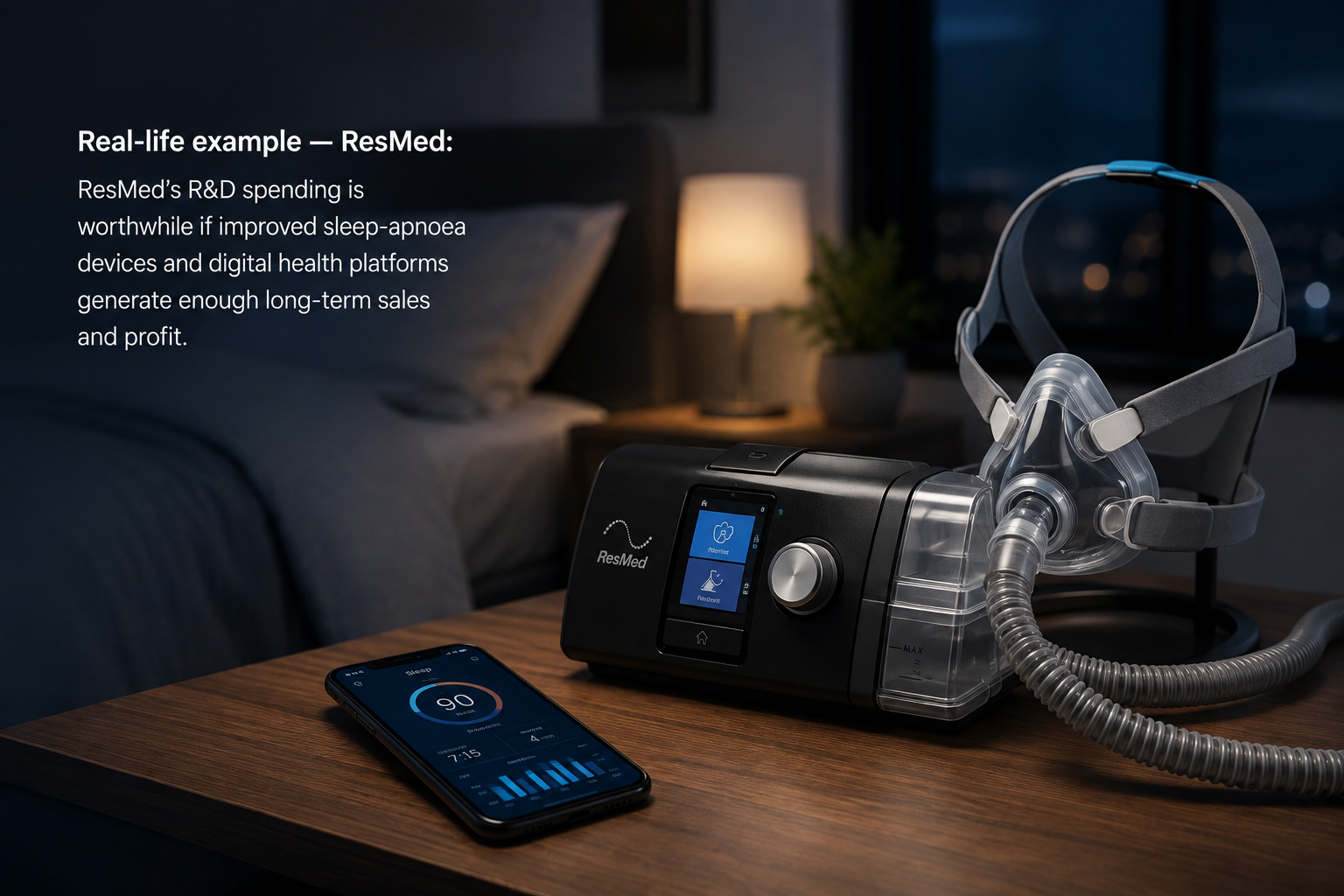
Real-life example — ResMed: ResMed’s R&D spending is worthwhile if improved sleep-apnoea devices and digital health platforms generate enough long-term sales and profit.
Example of how to write this factor in an exam
Cost can impact the success of innovation because the business must be able to afford the development, launch and ongoing support of the new idea. For example, CSL invests heavily in research and development, clinical trials and new medical therapies before products generate revenue. These costs are necessary because medical innovation requires extensive testing, approval and specialist knowledge before it can be sold. As a result, cost can determine whether innovation creates financial gain or becomes a financial risk.
📣 Marketing strategy
Marketing strategy refers to the way a business promotes, positions, prices, distributes and communicates an innovation to its target market. A strong marketing strategy helps customers understand the innovation and see why it is valuable.
Why marketing strategy matters for innovation success
A strong innovation can still fail if customers do not notice it, understand it or believe that it offers greater value than existing alternatives. Marketing strategy helps connect the innovation to customer demand by identifying who the innovation is designed for and explaining why customers should adopt it.
Poor marketing may result in low awareness, weak sales or customer confusion, even when the innovation itself is valuable. In contrast, effective marketing can build trust, create interest and encourage customers to change from an established product or service.
Businesses must therefore develop a marketing strategy that supports the innovation from research through to launch. This includes understanding customers, building a recognisable brand, establishing a clear market position, selecting effective promotional methods and making the innovation easily accessible.
Key marketing factors affecting innovation
Market research
Market research is the collection and analysis of information about customers, competitors and market conditions.
Research can help a business identify customer needs, preferred features, acceptable prices and potential demand before investing heavily in an innovation. It can also reveal weaknesses in competing products and reduce the risk of developing something customers do not want.
However, market research does not guarantee success because customer preferences may change, participants may provide inaccurate responses or the business may interpret the findings incorrectly.
Real-life example — Canva: Canva uses customer feedback and user research to identify useful features and improve its design platform.
Branding
Branding involves creating a recognisable identity for a business or product through elements such as its name, logo, packaging, design and overall reputation.
Strong branding can help customers recognise, trust and remember an innovation. This is particularly important when the innovation is unfamiliar because customers may be more willing to try it when it is connected to a trusted brand.
However, poor branding or an inconsistent message may confuse customers and make it difficult for the innovation to stand out.
Real-life example — Vegemite: Vegemite’s familiar brand and packaging can help customers notice and trust new product variations.

Market positioning
Market positioning refers to how a business wants customers to view its product compared with competing alternatives.
An innovation may be positioned as premium, affordable, sustainable, convenient, healthy or technologically advanced. Clear positioning helps customers understand its main value and why it is different from competing products.
If the positioning is unclear or does not match the product’s price and quality, customers may not understand why they should purchase it.
Real-life example — Aesop: Aesop positions its products as premium through minimalist packaging, distinctive stores and a controlled retail experience.
Promotion
Promotion involves communicating with customers to create awareness, explain benefits and persuade them to purchase or adopt an innovation.
Businesses may use advertising, social media, influencers, demonstrations, public relations, free trials or in-store displays. The promotional method should match the target market and allow customers to see how the innovation works.
Promotion can be expensive, and an ineffective campaign may attract attention without generating enough sales.
Real-life example — GoPro: GoPro uses customer and athlete videos to show its cameras working in real situations.
Distribution channels
Distribution channels are the methods and locations used to make a product or service available to customers.
An innovation must be accessible where customers expect to purchase or use it. Distribution may occur through physical retailers, websites, mobile apps, online marketplaces, delivery services or direct sales.
Even a well-promoted innovation may fail if customers cannot access it easily, while wider distribution can increase convenience and sales.
Real-life example — Domino’s: Domino’s website, mobile app and delivery network make its ordering and tracking innovations easy for customers to access.
Target market fit
A target market is the specific group of customers a business aims to serve with its products and marketing.
The innovation and its marketing strategy must match the needs, preferences, income and purchasing behaviour of this group. A clear target market allows the business to design suitable features, pricing, promotion and distribution.
An innovation may fail if it is promoted to customers who do not value its benefits or cannot afford it.
Real-life example — Afterpay: Afterpay targeted customers comfortable with online shopping, digital payments and paying in instalments.

Example of how to write this factor in an exam
Marketing strategy can impact the success of innovation because customers must notice the innovation, understand its value and believe it is better than existing alternatives. For example, GoPro promotes its cameras through customer and athlete videos that show the product being used in real situations. This allows customers to see the innovation working, rather than only being told about its features. As a result, an effective marketing strategy can increase awareness, build trust and encourage customers to adopt the innovation.
💻 Technology
Technology refers to the tools, systems, software, equipment and digital infrastructure that allow innovation to be developed, delivered and supported. Technology can affect whether an innovation is practical, reliable and scalable.
Why technology matters for innovation success
Technology can make innovation possible by helping a business create new products, automate processes, analyse information and deliver more convenient services to customers.
However, using advanced technology does not automatically make an innovation successful. New systems may be unreliable, expensive, difficult to operate or incompatible with the business’s existing processes. Customers may also reject an innovation if the technology is confusing or does not provide a clear improvement.
Businesses must therefore select technology that is reliable, secure, user-friendly and suited to the needs of employees and customers. The technology must support the innovation without creating excessive costs, operational problems or customer frustration.
Key technology factors affecting innovation
Ability to enable new ideas
Technology can make products, processes and services possible that could not previously be developed or delivered effectively.
Examples include artificial intelligence, mobile applications, automation, robotics, online platforms, tracking systems and digital payment services. These technologies can help a business solve customer problems, improve efficiency or create an entirely new way of delivering value.
However, the business must ensure that the technology provides a genuine benefit rather than introducing it simply because it is new.
Real-life example — Atlassian: Atlassian has added AI features to tools such as Jira and Confluence to help users summarise work and turn ideas into tasks.
Reliability
Reliability refers to the ability of technology to operate consistently and accurately without frequent faults, breakdowns or interruptions.
Reliable technology can improve product quality, reduce mistakes and build customer confidence. This is particularly important when an innovation affects customer safety, health, money or access to essential services.
If the technology regularly fails, customers may lose trust in both the innovation and the business.
Real-life example — Cochlear: Cochlear’s hearing implant technology must operate reliably because device failure could significantly affect users’ quality of life.
Integration with existing systems
Technology integration occurs when new technology connects and works effectively with the business’s existing equipment, software, information and work processes.
Successful integration can allow information to move smoothly between different parts of the business. It can also reduce duplication, improve communication and allow employees to continue working without major disruption.
Poor integration may create errors, delays and additional costs because employees may need to operate several disconnected systems or enter the same information more than once.
Real-life example — Rio Tinto: Rio Tinto’s autonomous trucks, trains and monitoring systems are more effective when integrated into a connected mining system.
User-friendliness
User-friendliness refers to how easy a technology is for employees or customers to understand and operate.
A user-friendly innovation should have clear instructions, simple navigation and features that make tasks faster or more convenient. This can encourage adoption and reduce the amount of training and customer support required.
If the technology is confusing or requires too many steps, customers may continue using familiar alternatives, while employees may make mistakes or resist the change.
Real-life example — Commonwealth Bank: The CommBank app’s success depends on customers being able to easily find and use digital banking features.
Implementation and security risk
Implementation risk is the possibility that introducing new technology will cause unexpected problems, costs or disruptions.
Technology may fail because it has not been tested properly, is installed incorrectly, becomes outdated or contains cybersecurity weaknesses. Employees may also require significant training, while customers may lose access to products or services during a system failure.
Businesses must therefore test technology carefully, protect customer information, train employees and prepare backup systems before fully introducing an innovation.
Real-life example — CrowdStrike: CrowdStrike’s faulty software update showed how technology failures can create widespread disruption if updates are not properly tested.

Example of how to write this factor in an exam
Technology can impact the success of innovation because it may determine whether a new product, process or service is reliable, practical and easy to use. For example, Domino’s uses online ordering, Pizza Tracker and GPS delivery tracking to make the ordering and delivery process more transparent for customers. If the technology works well and supports customers, it can reduce confusion, improve convenience and make the innovation easier to use. As a result, suitable technology can improve customer confidence and increase the overall success of the innovation.
🎧 Prefer listening?
If you prefer listening to the content in podcast format:
🎥 Prefer watching?
If you prefer watching the content in video format:
🃏 Flashcards
Card 1 of 12
🎮 Revision Games
💰 BME Millionaire
Climb the prize ladder by mastering the factors that affect innovation success.
👔 Business Boss
Make 10 innovation decisions. Balance timing, cost, marketing, technology and customer adoption.
⚡ 60 Second Showdown
A varied 60-second challenge covering timing, cost, marketing strategy and technology.

Biz Fact: Kodak invented the first portable digital camera in 1975, but did not commercialise it at the time — a classic example of missing the timing of a major technological shift.
Past Exam Questions
Use these past exam questions to see how this dotpoint has been assessed. Pay close attention to the command term, the number of marks and whether the question is Section 1 or Section 2.
Section 1 Questions
2016 — Section 1 — Question 2(b) — 4 marks
Context
Question 2 (10 marks)
2(b): Outline two factors that impact the success of innovation. (4 marks)
One:
Two:
Command term focus: Outline
Outline: state two factors and briefly clarify how each can affect innovation success.
See the full command term guide here: Command Terms.
2(b) Sample answer
One: One factor is timing. Innovation is more likely to succeed if it is launched when customers are ready, when market trends support the new idea and before competitors gain a strong position. Poor timing can mean customers are not ready or the market is already crowded.
Two: A second factor is cost. Innovation can require spending on research and development, prototypes, equipment, staff training, promotion and technology. If these costs are too high, the innovation may place pressure on cash flow and fail to provide a strong return on investment.
2020 — Section 1 — Question 1(c) — 3 marks
Context
When should a business go global? Australian businesses are competing in a complex world economy and it’s important that companies respond to the legal, cultural and economic environments of the countries in which they operate. These environmental factors can foster or hinder innovation, business operations, marketing and enterprise.
1(c): Explain how a marketing strategy can have an impact on the success of innovation. (3 marks)
Command term focus: Explain
Explain: show cause and effect from marketing strategy to customer awareness, understanding or adoption of the innovation.
See the full command term guide here: Command Terms.
1(c) Sample answer
A marketing strategy can impact the success of innovation because it determines how clearly the business communicates the innovation to customers. The business must identify the target market, explain the benefits of the innovation, position it against competitors and choose appropriate promotional and distribution channels.
If customers understand the value of the innovation and can access it easily, they are more likely to trust it and adopt it. As a result, an effective marketing strategy can increase awareness, customer interest and sales, making the innovation more successful.
2023 — Section 1 — Question 3(c) — 3 marks
Context
Innovation is often important to the continued success of any business. It can refer to a new process, idea or product.
3(c): Explain how technology can have an impact on the success of innovation. (3 marks)
Command term focus: Explain
Explain: show cause and effect from technology to the success or failure of the innovation.
See the full command term guide here: Command Terms.
3(c) Sample answer
Technology can impact the success of innovation because it may determine whether a new product, process or service is reliable, practical and easy to use. For example, a business may rely on software, mobile applications, automation, online ordering systems or tracking technology to deliver the innovation effectively.
If the technology works well and supports employees and customers, it can reduce errors, improve efficiency and make the innovation easier to use. As a result, suitable technology can improve customer experience and increase the overall success of the innovation.
Section 2 Questions
2017 — Section 2 — Question 7(d) — 6 marks
Case study / context
For copyright reasons this text cannot be reproduced in the online version of this document, but may be viewed at http://www.dominos.com.au/insidedominos/technology
Prepare a short report or essay for the CEO addressing the following points:
7(d): Explain how the factors of cost and technology have impacted the success of innovation for Domino’s Pizza. (6 marks)
Command term focus: Explain
Explain: show cause and effect for both cost and technology and link each factor to Domino’s.
See the full command term guide here: Command Terms.
7(d) Sample answer
Cost: Cost has impacted the success of innovation for Domino’s because technologies such as online ordering, Pizza Tracker and GPS Driver Tracker require investment in software, data systems, staff training and ongoing technical support. Domino’s must develop and maintain these digital systems before it receives the full benefit of the innovation. As a result, the innovation will only be successful if the extra sales, improved efficiency and stronger customer experience are greater than the cost of developing and maintaining the technology.
Technology: Technology has also impacted the success of Domino’s innovation because the business relies on digital systems to make ordering, tracking and delivery more convenient for customers. If customers can order online, receive updates and monitor their order through tools such as Pizza Tracker and GPS Driver Tracker, the service becomes easier and more transparent. As a result, suitable technology can improve customer satisfaction, provide delivery data and make Domino’s innovation more successful in a competitive fast-food market.
2019 — Section 2 — Question 7(b) — 6 marks
Case study / context
Health and fitness is a multimillion dollar industry. More and more people are aware of the importance of healthy eating and daily exercise. People of all ages spend money on gym memberships, personal training and group fitness classes, books, clothing, sporting equipment and much more.
Jettaya is a triathlete with a degree in sports and rehabilitation science and wants to profit from this expanding industry. She has recently created an online fitness program, healthy eating diet plan and clothing line so she can tap into the industry.
Jettaya understands the importance of being innovative to differentiate her product and service in this heavily saturated market. She realises that technology is a powerful tool for creating a profile for herself and to market her products and services in Australia and overseas. Jettaya has also conducted market research and has decided to manufacture her clothing line in China due to the cheaper labour costs and materials and the fact that the free trade agreement between China and Australia brings many benefits.
Jettaya realises that she needs to create a strategic vision and be innovative and creative for her business to become a success. She has come to you to ask for some advice and tips about how to create a successful global business.
7(b): For innovation to be a success there are a number of factors to consider. Examine two of these factors in relation to Jettaya’s chosen industry. (6 marks)
Command term focus: Examine
Examine: explain two factors in detail, including how each could support or limit innovation in Jettaya’s business.
See the full command term guide here: Command Terms.
7(b) Sample answer
Technology: Technology is a major factor for Jettaya because her innovation is based on an online fitness program, healthy eating diet plan and the use of technology to create a profile and market products in Australia and overseas. If Jettaya uses reliable technology, such as a professional website, online workout platform, social media tools and payment systems, customers can access her products more easily. This would support success because customers in a saturated fitness market are likely to choose services that are convenient, user-friendly and professional. However, if the technology is difficult to use, unreliable or too expensive, customers may become frustrated and choose competing fitness services.
Marketing strategy: Marketing strategy is also important because the health and fitness industry is heavily saturated. Jettaya needs to clearly position her products by showing how her triathlon background, sports and rehabilitation science degree, online fitness program and clothing line are different from competitors. If customers understand why her service is more valuable than other fitness programs, they may be more likely to trust and purchase from her. However, if her branding, promotion or target market fit is unclear, her innovation may be lost among many other fitness brands. Therefore, marketing strategy can determine whether customers notice and trust her innovation.
2021 — Section 2 — Question 8(b) — 6 marks
Case study / context
In some parts of the world, people have been spending more time at home, which has led to increased spending on interior design. Market trends in Australia and Europe have seen a rise in expenditure on home accessories and decor such as new furniture, artwork and plants.
Matilda has operated a successful homewares store in Perth selling rugs, cushions, wall hangings and furniture. She also operates an online store selling her products around Australia. She has seen a surge in online sales over 2020 and early 2021, leading her to consider expanding her business.
After reading a European ecommerce report in 2020 stating that ‘European shoppers are spending more time shopping online’, Matilda has decided to provide the European market access to her online store. The article also mentioned that ‘online marketplaces in Europe have attracted significant traffic and seen high visitor engagement that has translated into sales’.
She understands that her products, processes and services need to be innovative. She wants to ensure that her products are unique, luxurious and of the highest quality. Her processes in terms of her website, ordering and delivery need to be seamless and her customer service will need to be excellent in order to stand out from competitors. Matilda has decided that she also needs to investigate technology that is available to assist her to successfully sell her products to the European market. She is willing to invest money into her business operations in order to ensure that she has the best opportunity to be profitable in her expansion.
Matilda also needs to evaluate her competitive position in the international market to see whether she will be able to compete successfully. She has come to you (as a business advisor) to ask for advice.
Referring to the case study and your own knowledge, prepare a report or essay in which you answer the questions below.
8(b): Explain to Matilda how timing and cost may have an impact on the success of innovation in her business. (6 marks)
Command term focus: Explain
Explain: show cause and effect for timing and cost and apply both factors to Matilda’s innovation.
See the full command term guide here: Command Terms.
8(b) Sample answer
Timing: Timing may impact the success of innovation in Matilda’s business because she is considering European expansion when people are spending more time at home and European shoppers are spending more time shopping online. This creates an opportunity for Matilda to launch her online European store while demand for ecommerce and homewares is strong. As a result, if Matilda launches while online homewares demand is high, her innovation in website, ordering, delivery and customer service is more likely to attract European customers and support a successful expansion.
Cost: Cost may also impact the success of innovation because Matilda will need to invest money into technology, website systems, ordering processes, delivery systems and customer service to compete in Europe. These costs are important because seamless ecommerce, delivery and customer service may require significant upfront spending before she receives enough overseas revenue. As a result, the innovation will be successful only if the increased sales and profitability from the European market are greater than the costs of improving her products, processes and services.
2022 — Section 2 — Question 7(b) — 6 marks
Case study / context
Natasha has completed an online horticulture course and is keen to start up her own business helping people build and manage their own vegetable gardens. Natasha believes her business will be successful due to the recent growth in the number of people wanting fresh produce that they can grow at home. Friends have told her about Freelancer, the world’s largest freelancing, outsourcing and crowdsourcing marketplace. It connects freelancers and those who want to hire them.
During her research about the use of online platforms, Natasha has found information about the ‘gig economy’. The gig economy is the use of online platforms like Uber and Freelancer to instantaneously connect consumers with service providers to deliver goods and services. In 2019, 7.1% of Australians had worked, or tried to find work, in the gig economy, with Airtasker, Uber, Freelancer, Uber Eats and Deliveroo being the top five platforms with registered workers. The benefits for entrepreneurs in a gig economy include low barriers to entry, no requirement for qualifications or experience, flexible working hours and a low-risk opportunity to run a business. However, the online platforms hold all the power, often taking a high commission. The income is uncertain and the long-term sustainability of work is questionable.
Natasha previously worked in marketing, so she has a good understanding of how to promote her business. However, she has never managed her own business and is not confident with the financial and legal aspects of business operations. To differentiate her business from competitors, Natasha is planning to be innovative in the way she provides her service by having a weekly podcast and a YouTube channel. She is planning to provide her clients with information about the most up-to-date self-watering technology, the best plant covers to protect gardens from pests and the most effective composting technology. She eventually wants to offer a membership to her website that will include online tutorials for people to learn about organic food gardening. Natasha believes starting up her business on Freelancer is a great way to test the business idea without having to over-invest. In the process, she hopes to use social media content to develop her business idea and grow a customer base.
Referring to the case study and your own knowledge, answer the questions below.
7(b): Explain two factors that may impact the success of Natasha’s innovation. (6 marks)
Command term focus: Explain
Explain: choose two relevant factors, show cause and effect, and link each to Natasha’s innovation.
See the full command term guide here: Command Terms.
7(b) Sample answer
Marketing strategy: Marketing strategy may impact the success of Natasha’s innovation because she plans to use a weekly podcast, YouTube channel and social media content to grow a customer base. If her content clearly communicates the value of her organic food gardening advice, self-watering technology, pest protection and composting knowledge, customers may see her service as useful and different from competitors. As a result, an effective marketing strategy could help Natasha attract customers who want fresh produce they can grow at home.
Cost: Cost may also impact the success of Natasha’s innovation because she is starting the business through Freelancer to test the idea without over-investing. Using an online platform can reduce financial risk while she builds demand. However, if she later develops a membership website, online tutorials, podcast content and YouTube content, these may require money, time and technical support. As a result, the innovation will be more successful if the extra revenue from customers is greater than the cost of creating and maintaining the service.
2025 — Section 2 — Question 9(c) — 8 marks
Case study / context
Fizzology, an Australian soft drink company, specialises in a variety of flavoured drinks and is seeking to adapt and change its product range to meet new market trends. The current consumer market is looking for healthier options and seeking businesses that are seen to be environmentally-conscious and sustainable in their manufacturing and packaging.
Fizzology wants to conduct research and development to innovate their current products and invent new product ranges. It is looking into creating a kombucha range, fizzy flavoured tea drinks and reduced sugar in their popular Fizzology flavoured soft drinks. They are hoping that by investing in innovation of their products, it will create an opportunity to revitalise their sales in Australia and also provide an opportunity for the business to expand their new product lines globally.
Some members of senior management are not entirely convinced the time and investment into innovation is a wise move. They have seen other drink companies already launch kombucha and sugar-free drinks and they believe there are already strong competitors in the market. Some middle managers are also resistant to the change, concerned about job losses, changes to work routines and pressure to learn new skills and information about the new products. To manage this resistance to change, Fizzology is turning to Kotter’s 8 Step change management model. The business wants to highlight to team members the importance of adapting to consumer tastes and trends and to demonstrate the long-term benefits of being an environmentally-conscious business.
Hoping to convince the Fizzology management team of this change in the business, some team members are working towards having a plan in place to complete the research, investment and innovation to launch their new products internationally in the summer of 2027. Fizzology is aware that even though there are big brand names worldwide in the soft drink market, there is massive revenue potential and the number of potential customers is huge.
9(c): Analyse how timing and costs might impact the success of Fizzology’s investment in research and development for new products. (8 marks)
Command term focus: Analyse
Analyse: develop linked relationships between timing, cost and innovation success, then explain the implications for Fizzology.
See the full command term guide here: Command Terms.
9(c) Sample answer
Timing may have a major impact on the success of Fizzology’s investment in research and development. The case states that customers are currently looking for healthier options and businesses that are environmentally-conscious and sustainable in their manufacturing and packaging. This creates a relationship between market timing and product innovation. If Fizzology completes its research and development and launches kombucha, fizzy flavoured tea drinks and reduced-sugar soft drinks while these consumer trends are still strong, the new products are more likely to attract demand. As a result, timing could help Fizzology revitalise sales in Australia and support its plan to expand new product lines globally.
However, timing could also reduce the success of the innovation. The case states that some managers believe other drink companies have already launched kombucha and sugar-free drinks and that there are already strong competitors in the market. This suggests Fizzology may be entering after competitors have already established brand awareness and customer loyalty. Launching too late can make it harder for a business to gain market share, even if the product itself matches consumer trends. Therefore, timing will affect whether Fizzology benefits from current health and sustainability trends or enters too late to gain a strong competitive position.
Costs may also impact the success of Fizzology’s research and development investment. Developing new drink ranges will require spending on research, testing, ingredients, packaging, manufacturing changes, staff training and marketing. This creates a relationship between the cost of innovation and the financial return from the new products. If Fizzology’s new products generate strong sales in Australia and overseas, the investment may be justified because the revenue gained from the innovation could be greater than the cost of developing and launching it. As a result, the innovation could support financial gain and help convince senior management that the investment was worthwhile.
However, costs could also make the innovation less successful if the investment is too high or sales are lower than expected. The case states that some senior managers are not convinced the time and investment into innovation is a wise move. Research and development, new packaging, production changes and marketing may be expensive before revenue is earned. If Fizzology spends heavily but fails to compete with established kombucha and sugar-free drink brands, the business may experience lower profit, cash flow pressure and wasted resources. Therefore, the success of Fizzology’s innovation depends on whether the timing of the launch and the financial return from new products are strong enough to justify the research and development costs.