
U4.08 — Impact of Legal Systems on Business Operations in Global Markets
Overview
Dotpoint 8: impact of legal systems on business operation in global markets.
Legal systems are the laws, courts, regulators and enforcement processes that control how businesses must operate in a country.
Legal systems matter because the rules are not the same in every global market. An Australian business may be protected under Australian law, but this does not mean it automatically receives the same protection overseas.
In this dotpoint, differences regarding competition regulation are explored through two key legal areas that affect business operations in global markets:
- patent registrations — protecting inventions and stopping competitors from copying innovation
- product liability — legal responsibility for unsafe, defective or harmful products
🔬 Patent registrations
What is a patent?
A patent is a legal right given to the owner of a new invention. It gives the owner the right to stop other businesses from making, using, selling or importing the invention without permission.
Patents usually protect technical inventions such as machines, medical devices, biotechnology, engineering processes, manufacturing methods, agricultural technology, software-related inventions or new ways of solving a practical problem.
The invention must usually be new, useful and not an obvious variation of something that already exists. A business cannot usually patent a basic idea by itself; it needs to protect a specific invention or technical solution.
Impact on global business operations
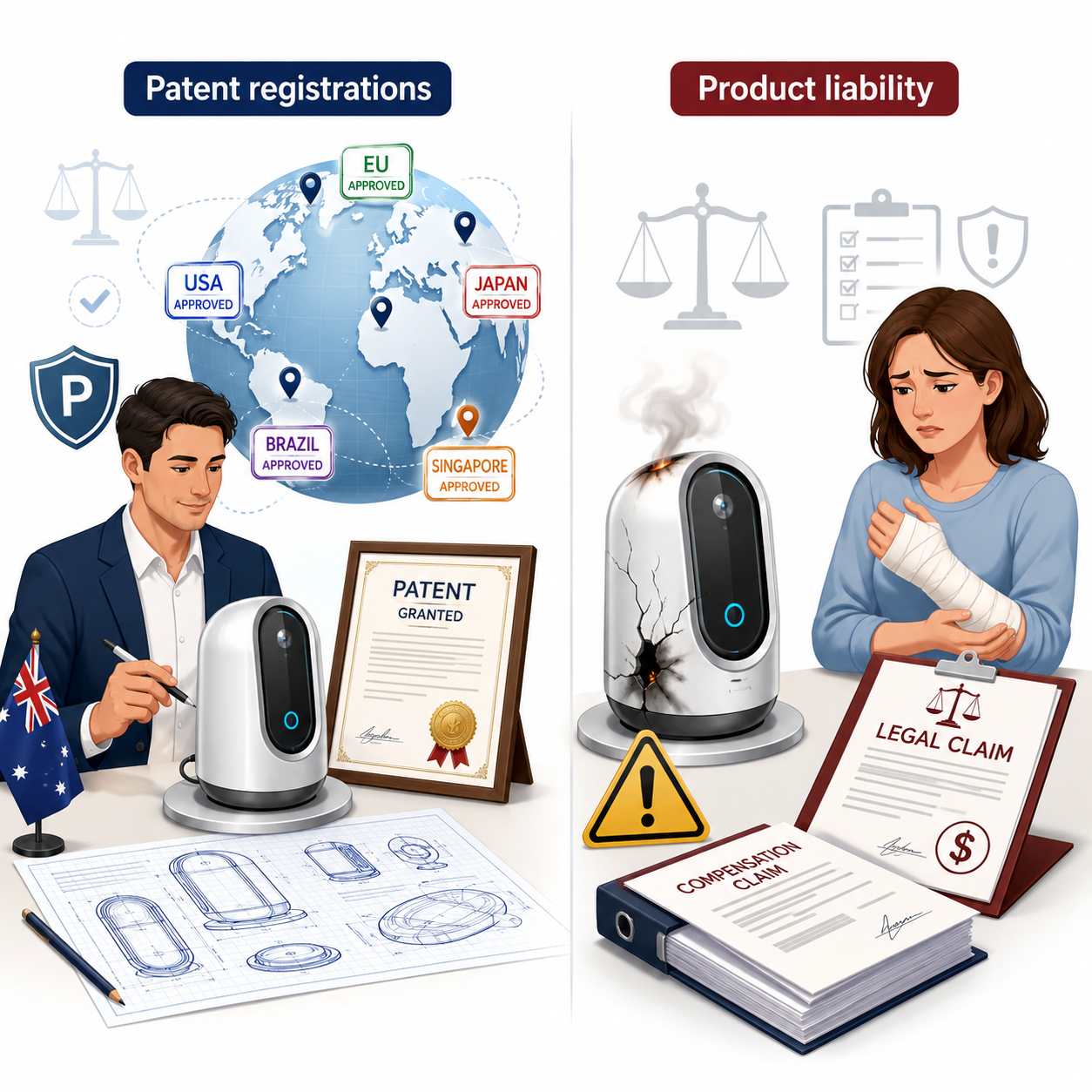
Patent registrations can impact global business operations because patent protection is territorial. This means a patent registered in Australia only protects the invention in Australia. It does not automatically protect the invention in China, Japan, Europe, the United States or other global markets.
This affects operations because a business must decide where to register, when to register, how much to spend on protection, and which overseas markets are most important. This can increase legal costs, planning time and administration.
However, patent registration can also protect a business’ competitive advantage. It can stop overseas competitors from copying the invention, support premium pricing, attract investors, strengthen licensing opportunities and make global expansion less risky.

How patent registration works
Getting a patent in Australia
In Australia, patent applications are handled by IP Australia. A business first needs to identify exactly what part of its product, technology, process or method is new and worth protecting.
The business should keep the invention confidential before applying, because public disclosure may make it harder to prove the invention is new. It should then search existing patents to check whether similar inventions already exist.
A business may lodge a provisional application to secure an early filing date while it develops the invention further. It may then proceed to a standard patent application, where the invention is assessed against legal requirements such as novelty, usefulness and inventiveness.
After applying, the business may need to request examination, respond to issues raised by IP Australia and use a patent attorney to help with technical legal wording. If the patent is granted, the business must pay renewal fees, monitor competitors and take legal action if its invention is copied.

Seeking patent protection globally
There is no single worldwide patent. This is the key global point. A patent registered in Australia does not automatically protect the invention overseas.
An Australian business can apply directly in individual countries, such as the United States, China, Japan or Singapore. It may also use regional systems, such as the European Patent Office, to seek protection across European markets.
Another pathway is the Patent Cooperation Treaty, or PCT. The PCT is administered by WIPO, the World Intellectual Property Organization. It allows the business to file one international application pathway, receive an international search, and buy more time before choosing the countries where it wants protection.
The PCT does not give the business one global patent. The business still needs to enter the national phase in selected countries or regions. This may involve local patent attorneys, translations, filing fees, local examination and renewal fees in each market.
How patent registrations affect business operations
Benefits to business operations
- Protects innovation: competitors may be prevented from copying the invention in protected markets.
- Supports competitive advantage: the business may charge premium prices or differentiate itself from competitors.
- Improves investor confidence: investors may be more willing to support a business with protected technology.
- Creates licensing opportunities: the business may earn revenue by allowing overseas firms to use its invention.
- Supports market entry: protection can make the business more confident entering high-value overseas markets.
Limitations to business operations
- Higher costs: patent attorneys, filing fees, translation, examination and renewal fees can be expensive.
- Longer planning time: businesses may delay launch while applications are prepared and filed.
- Country-by-country protection: a business must choose where protection matters most because it cannot rely on Australian registration overseas.
- Enforcement costs: the business may need to monitor competitors and pay legal costs if its invention is copied.
- Disclosure risk: patent applications make technical information public, which may help competitors design around the invention.
Real-life case study
CSIRO Wi-Fi patent licensing
CSIRO is one of Australia’s best-known patent examples. In the 1990s, CSIRO scientists developed technology that helped make high-speed wireless internet more reliable by solving problems with signal reflection indoors.
CSIRO protected this invention through patents and later argued that major technology companies had used the patented technology in Wi-Fi products without permission. After years of legal disputes and licensing negotiations, CSIRO received significant licensing revenue from global technology companies.
This shows that patent registrations are not just legal paperwork. They can become a business asset that protects innovation, supports licensing income and gives an organisation stronger bargaining power in global markets.
However, it also shows that protection can require long-term legal action and enforcement. A patent is only valuable if the owner can defend it when other organisations use the invention without permission.
Example of how to write this in an exam
Patent registrations can impact business operations because patent protection is territorial. This means a patent registered in Australia does not automatically protect an invention in overseas markets. For example, Cochlear may use the PCT pathway and then enter the national phase in markets such as the United States, Europe and Japan to protect its hearing implant technology from being copied. This may increase legal costs, filing fees and planning time, but it can also protect Cochlear’s innovation and competitive advantage in global medical-device markets.
🛡️ Product liability
What is product liability?
Product liability refers to the legal responsibility a business may have if a product it supplies is unsafe, defective, incorrectly labelled or causes harm to consumers.
A product may create liability if it has a design fault, manufacturing fault, unsafe ingredient, missing warning, poor instructions, misleading safety claim, incorrect label or does not meet required safety standards.
Product liability matters in global markets because each country has different consumer protection laws, safety standards, testing requirements, labelling rules, compensation systems and recall procedures.
Impact on global business operations
Product liability can increase the cost and complexity of global expansion because an Australian business must make sure its product complies with the legal system of each overseas market.
A product that is legal to sell in Australia may still need different testing, certification, ingredient approval, safety warnings, packaging, instructions or translations before it can be sold overseas.
If the product is defective or causes harm, the business may face recalls, compensation claims, fines, lawsuits, lost sales and damage to its reputation. This can be especially serious for skincare, food, medicines, children’s products, electronics, batteries, vehicles, machinery and agricultural equipment.

Product liability in Australia and global markets
Product liability in Australia
In Australia, product liability is mainly linked to the Australian Consumer Law, often called the ACL. Businesses must not supply unsafe products and may be responsible if goods are defective, unsafe, incorrectly labelled or cause injury or loss.
The ACCC is Australia’s national consumer product safety regulator. Product Safety Australia provides information about mandatory safety standards, product bans, recalls and supplier responsibilities.
Australian businesses may need to meet mandatory standards, avoid banned products, give accurate safety information, monitor complaints and issue recalls where necessary. If a product is unsafe, the business may need to stop selling it, notify regulators, contact customers and provide a remedy such as repair, replacement or refund.
This affects operations because businesses must build safety checks into product design, manufacturing, labelling, marketing, quality control and after-sales service.
Product liability on the global scale
On the global stage, product liability becomes more complex because the Australian rules are not enough. A business must research and comply with the laws of each country where the product is sold.
For example, the United States can involve major product liability lawsuits and high compensation claims. The European Union has detailed product safety rules and strong expectations around technical documentation, traceability and consumer protection. Markets such as China and Japan may require local language labels, local standards, testing, approved product claims and high quality expectations.
To protect itself, an Australian business should use local legal advice, test and certify products, adapt labels and warnings, strengthen quality control, purchase product liability insurance, prepare a recall plan and monitor customer complaints in each market.
This means global product liability can increase costs and slow market entry, but it also reduces the risk of recalls, lawsuits, fines and reputational damage.
How product liability affects business operations
Operational impacts
- Product design: the business may need to change ingredients, components, packaging or safety features for each country.
- Costs: testing, certification, insurance, legal advice, translations and quality control can increase expansion costs.
- Speed to market: approvals and compliance checks may delay product launches.
- Marketing: safety claims, health claims and product descriptions must match local laws and not mislead consumers.
- Supply chain: the business must ensure overseas manufacturers and distributors meet required safety standards.
- Reputation: one recall or injury can damage trust across multiple global markets.
Real-life case study
Takata airbags
Takata, a Japanese manufacturer, produced defective airbags that created serious safety risks for drivers and passengers. The issue led to massive recalls around the world, including the largest compulsory product recall in Australian history.
This case shows how product liability can affect business operations on a global scale. A defective component can lead to recalls, repair costs, legal action, regulator involvement, customer fear and severe reputation damage across many countries.
For students, the key lesson is that product liability is not just about paying compensation after something goes wrong. It affects product design, supplier selection, testing, quality control, insurance, recall planning and customer communication before and after the product is sold.

Example of how to write this in an exam
Product liability can impact business operations because a business may be legally responsible if its product is unsafe, defective, incorrectly labelled or causes harm in an overseas market. For example, an Australian skincare business exporting to China may need to check ingredient rules, translated labels, safety warnings and online retail requirements before selling its products. This may increase testing, packaging, insurance and legal compliance costs, but it reduces the risk of recalls, compensation claims, fines and reputational damage.
🎧 Prefer listening?
If you prefer listening to the content in podcast format:
🎥 Prefer watching?
If you prefer watching the content in video format:
🃏 Flashcards
Card 1 of 13
🎮 Revision Games
💰 BME Millionaire
Climb the prize ladder. Use your lifelines wisely.
👔 Business Boss
Make 10 legal-risk decisions. Balance protection, compliance, cost and reputation.
⚡ 60 Second Showdown
A varied 60-second challenge covering patents, product liability and global legal risk.

Biz Fact: Samsung recalled the Galaxy Note 7 globally after battery faults caused some phones to overheat and catch fire.
Past Exam Questions
Use these past exam questions to see how this dotpoint has been assessed. Pay close attention to the command term, the number of marks and whether the question is Section 1 or Section 2.
Section 1 Questions
2017 — Section 1 — Question 4(a) — 4 marks
Context
Business operation in global markets requires knowledge of different business practices and legal systems.
4(a): Describe a difference that could impact business operations in global markets in each of the areas of patent registrations and product liability. (4 marks)
Patent registrations:
Product liability:
Command term focus: Describe
Describe: give the main characteristics or features and show how each legal difference affects business operations.
See the full command term guide here: Command Terms.
4(a) Sample answer
Patent registrations: A key difference is that patent protection is territorial. This means a patent registered in Australia does not automatically protect the invention in overseas markets. This could impact business operations because a business may need to use the PCT pathway or register in individual countries, increasing legal costs and planning time.
Product liability: A key difference is that countries can have different product safety, labelling, testing and compensation laws. This could impact business operations because a business may need to alter product design, packaging, warnings or testing before selling overseas to reduce the risk of recalls, fines or compensation claims.
2018 — Section 1 — Question 3(c) — 3 marks
Context
The export of skin care products, for men and women, to China has shown vigorous growth. This is due to the increase in disposable income in China. As a result, an Australian skin care business is investigating the possibility of developing an online retail store to export its skin care products to China.
3(c): Explain a legal consideration that the Australian skin care business would need to consider before exporting products to China. (3 marks)
Command term focus: Explain
Explain: show cause and effect by explaining the legal consideration and the result for the business.
See the full command term guide here: Command Terms.
3(c) Sample answer
One legal consideration is product liability. Before exporting skincare products to China, the Australian business would need to ensure its ingredients, labels, safety warnings and online sales practices comply with Chinese consumer and product safety laws. This is important because if the product causes harm or does not meet legal standards, the business could face recalls, compensation claims, fines and damage to its reputation.
2019 — Section 1 — Question 2(c) — 3 marks
Context
When planning international expansion, businesses must research a variety of complex factors that may affect their success.
Expanding into a global market requires a business to understand the impact of legal systems on business operations in each new market.
2(c): Explain what a business might need to consider in relation to patent registrations when expanding into a global market. (3 marks)
Command term focus: Explain
Explain: show cause and effect by explaining how territorial patent protection affects global operations.
See the full command term guide here: Command Terms.
2(c) Sample answer
A business must consider that patent registrations are territorial, so a patent registered in Australia will not automatically protect the invention in overseas markets. This means the business may need to register its patent in each country where it plans to sell, manufacture or license the product, or use the PCT pathway before choosing target countries. As a result, global expansion may involve extra legal costs, longer planning time and the risk that competitors copy the invention if protection is not secured.
2020 — Section 1 — Question 2(c) — 4 marks
Context
There are many potential risks facing businesses that operate in a global market. Careful planning and research are required to ensure a business’ best chance of success.
2(c): Discuss the impact of legal systems on businesses operating in a global market in relation to product liability. (4 marks)
Command term focus: Discuss
Discuss: develop relevant advantages and disadvantages of product liability requirements, then weigh them up.
See the full command term guide here: Command Terms.
2(c) Sample answer
Product liability can increase the cost and complexity of operating globally because each country may have different product safety, testing, labelling and compensation laws. A business may need to test products, change packaging, include translated warnings, purchase insurance and prepare recall procedures before selling overseas. This can increase costs and delay market entry.
However, complying with product liability laws can also protect the business. If products are safe and meet local legal standards, the business is less likely to face recalls, fines, lawsuits, compensation claims or reputation damage. Overall, product liability can be a major challenge, but strong compliance can reduce risk and build customer trust in global markets.
2022 — Section 1 — Question 6(a) — 3 marks
Context
Lisa owns several clothing boutiques in Australia and is thinking of opening up a branch overseas.
6(a): Advise Lisa why she needs to consider the impact of legal systems on her business operation in global markets, particularly in relation to patent registrations. (3 marks)
Command term focus: Advise
Advise: recommend what Lisa should do, briefly explain why and state the likely effect.
See the full command term guide here: Command Terms.
6(a) Sample answer
Lisa should research patent and intellectual property rules before opening overseas because legal protection differs between countries. If Lisa has developed a unique product feature, production method or technology used in her boutiques, Australian protection may not automatically apply in the overseas market. She should consider using the PCT pathway or registering protection in the specific country where she plans to operate. The outcome is that Lisa would reduce the risk of competitors copying her ideas, helping protect her competitive advantage and the value of her business as it expands globally.
Section 2 Questions
2021 — Section 2 — Question 7(a) — 3 marks
Case study / context
Smoothex is a Perth company specialising in producing organic skin care and make-up for men and women. It currently has two stores in Perth. Founded in 2010 by Chief Executive Officer (CEO) Rani, Smoothex began by producing 100% natural make-up and has expanded its range to now include daily essentials such as facial cleansers, creams and serums. The business’ main ingredients are locally sourced coconut oil, rose water, sandalwood and lemon myrtle. From 2018, the business has ensured that its products are vegan to cater for this fast-growing market sector. Smoothex prides itself on being environmentally sustainable and a supporter of various local charities.
Smoothex has tailored its products to suit a wide range of skin types and conditions, and has been advertising through its social media pages of Facebook and Instagram. The products have grown in popularity due to the business’ online skin care and make-up tutorials, which it posts on these platforms. Rani has noticed increased engagement from consumers in South-East Asia, in particular a growing customer base in Indonesia and Malaysia. Due to the success of Smoothex, Rani is thinking of opening stores in both Indonesia and Malaysia.
Smoothex believes that entering these South-East Asian markets will be a sound business decision, in particular due to the growing number of females who are becoming a part of the workforce in these countries. This means there is likely to be a high demand for Rani’s skin care and make-up products. With low inflation and all-time low interest rates in Australia, Smoothex would be able to access funding to invest in these overseas markets. Fluctuations in the exchange rates between the three nations have also been low, and both Indonesia and Malaysia are members of the Association of South East Asian Nations (ASEAN). Rani is also aware that Australia has free trade agreements (FTAs) with both Indonesia and Malaysia and is keen to take advantage of these benefits.
Referring to the case study and your own knowledge, prepare a report or essay in which you answer the questions below.
7(a): Countries have different legal systems that regulate competition. Explain how patent registrations could impact the business operations of Smoothex in Indonesia and Malaysia. (3 marks)
Command term focus: Explain
Explain: show cause and effect by linking patent registration to Smoothex’s operations. Section 2 requires application.
See the full command term guide here: Command Terms.
7(a) Sample answer
Patent registrations could impact Smoothex because Indonesia and Malaysia have different legal systems for protecting inventions and business innovations. If Smoothex has developed a unique skincare formula, production method or packaging technology, Australian protection would not automatically apply in those countries. Smoothex could use the PCT pathway to begin an international patent application process before choosing Indonesia and Malaysia as target markets in the national phase. This could increase legal costs and planning time, but it would reduce the risk of competitors copying its products in South-East Asia.
2024 — Section 2 — Question 8(d) — 6 marks
Case study / context
Smart Agriculture Solutions (SAS) has made a name for itself in the Australian agriculture industry for quality products and services. North America and countries in Europe are showing increasing interest in SAS, indicating untapped market potential abroad.
This surge in international interest brings opportunities and challenges for SAS. Currency changes can directly impact profits, making it essential for SAS to have a clear understanding and plan in place. Another pressing concern is payment defaults, a potential threat that could strain the business’s finances. As such, SAS needs to consider ways to minimise financial risks when exporting its products.
SAS is keen to infuse innovation into its offerings, aiming to make its products and services appealing and relevant to international clients. SAS believes that by doing this, they can boost sales and expand their global reach.
As SAS contemplates its global expansion, the team behind it is aware of the various legal challenges they are likely to encounter in different countries. Each country has its own set of rules and regulations, from competition norms to patent rights and product safety standards. SAS is committed to understanding and adhering to these legal frameworks, ensuring compliance and protecting its reputation.
With a blend of financial expertise, innovative ideas and strategic planning, SAS is gearing up to make its mark on the global stage, but will need to navigate challenges and seize opportunities along the way to ensure its success.
8(d): Examine the impact of patent registrations and product liability on SAS’s operations in global markets. (6 marks)
Command term focus: Examine
Examine: explain the effects of both legal issues in detail and apply them to SAS’s global operations.
See the full command term guide here: Command Terms.
8(d) Sample answer
Patent registrations could impact SAS because its innovative agricultural products, systems or software may need legal protection in each global market. A patent registered in Australia would not automatically protect SAS in North America or Europe, so SAS may need to use the PCT pathway and then enter the national phase in selected markets. This would increase legal costs, filing fees and planning time, but it could prevent competitors from copying SAS’s technology and help protect its competitive advantage.
Product liability could also impact SAS because different countries have different safety, labelling, testing and product standards. If SAS sells agricultural equipment or technology overseas, it may need to test products, provide clear warnings, translate instructions and ensure products meet local legal requirements. If a product is defective or causes harm, SAS could face recalls, compensation claims, fines and reputation damage. Therefore, legal systems can increase compliance costs for SAS, but also help protect customers and support long-term trust in global markets.