
U4.13 — Purpose of Production Management Systems
Overview
Dotpoint 13: purpose of production management systems.
A production management system is the organised way a business plans, controls and improves how inputs are transformed into finished goods or services.
Production management systems help businesses organise production so that goods or services are produced efficiently, consistently and to the required standard.
The main focus of this dotpoint is understanding:
- what a production management system is
- the purpose of a production management system

🏭 What is a production management system?
Production management system
A production management system is the way a business organises and controls its production process.
It manages how the business uses inputs, carries out the transformation process, produces outputs, and uses feedback to improve future production.
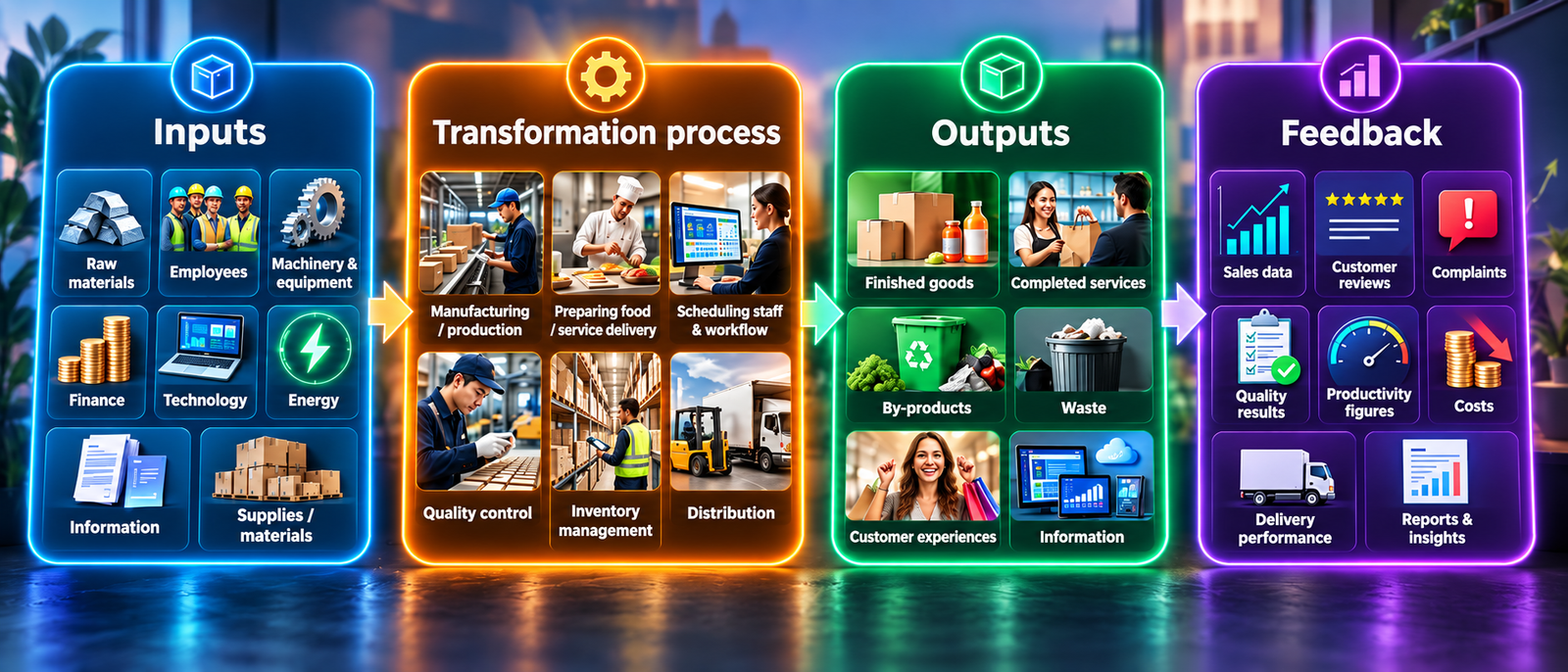
The process can be viewed as four connected stages:
Inputs
The resources used in production, such as raw materials, employees, machinery, equipment, finance, technology, energy and information.
Transformation process
The activities used to turn inputs into a good or service, such as manufacturing, preparing food, scheduling staff, quality control, inventory management and distribution.
Outputs
The results of production, including finished goods, completed services, by-products, waste, customer experiences and information.
Feedback
Information used to assess and improve production, such as sales data, customer reviews, complaints, quality results, productivity figures, costs and delivery performance.
Real-life case study — Remedy Drinks
Remedy Drinks is an Australian beverage company known for products such as kombucha and other fermented drinks. Its production management system can be shown through the four stages:
- Inputs — tea, sugar, flavouring ingredients, cultures, water, bottles or cans, employees, machinery, energy and production information.
- Transformation process — ingredients are mixed and fermented, flavours are added, the drink is tested for quality, packaged, labelled and prepared for distribution.
- Outputs — finished Remedy drinks ready for sale, along with packaging waste and production by-products.
- Feedback — sales figures, customer reviews, retailer feedback, quality-testing results and production-cost data are used to identify problems and improve future production.

Example of how to write this in an exam
A production management system is the way a business organises and controls how inputs are transformed into outputs. For example, Remedy Drinks would use inputs such as tea, sugar, cultures, bottles, machinery, employees and production information, then transform these through mixing, fermentation, quality testing, packaging and distribution. The final outputs are finished drinks ready for sale, while feedback from sales data, customer reviews, retailer feedback and quality results can be used to improve future production. This helps Remedy Drinks produce beverages efficiently, consistently and to the required standard.
🎯 Purpose of production management systems
Purpose
The purpose of a production management system is to help a business produce goods or services efficiently, consistently and at the required standard.
It helps the business coordinate resources, control costs, manage suppliers, maintain quality, reduce waste and meet customer demand.
For a global business, this becomes even more important because production may involve overseas suppliers, longer delivery times, different quality standards, larger customer markets and more complex logistics.
Main purposes
Efficiency
A production management system helps a business use resources efficiently, reducing wasted time, materials, labour and money.
Quality
It helps the business produce goods or services to a consistent standard, reducing errors, defects and customer complaints.
Timing
It helps production occur at the right time so the business can meet customer demand and avoid delays or stock shortages.
Cost control
It helps managers monitor production costs and identify where expenses, waste or inefficiencies need to be reduced.
Supplier coordination
It helps the business organise inputs from suppliers, making sure materials or stock are available when needed.
Customer satisfaction
It helps the business deliver reliable goods or services, which can improve customer satisfaction and protect reputation.
Why this matters for different businesses
Manufacturing business
A business such as Cochlear must carefully manage production because its products require precision, quality control and reliability. A strong production management system helps ensure each product meets expected standards.

Service business
A business such as Qantas also needs production-style systems to manage service delivery, including staffing, scheduling, maintenance, customer service and timing. The output is a service, but it still needs careful planning and control.

How to write this in an exam
The purpose of a production management system is to help a business organise and control how inputs are transformed into finished goods or services. For example, Cochlear needs to manage specialist employees, technology, materials, machinery, quality control and production information because its hearing products require precision, reliability and strict standards. This means the production management system helps Cochlear coordinate each stage of production, reduce errors, control costs and maintain consistent quality. As a result, Cochlear is more likely to produce safe and reliable products that meet customer expectations and protect the reputation of the business.
🎧 Prefer listening?
If you prefer listening to the content in podcast format:
🎥 Prefer watching?
If you prefer watching the content in video format:
🃏 Flashcards
Card 1 of 8
🎮 Revision Games
💰 BME Millionaire
Climb the prize ladder. Use your lifelines wisely.

Biz Fact: A production management system is not just for factories. Cafés, airlines, mines, hospitals, retailers and online businesses all need systems to manage resources, timing, quality and customer demand.
Past Exam Questions
Use these past exam questions to see how this dotpoint has been assessed. Pay close attention to the command term, the number of marks and whether the question is Section 1 or Section 2.
Section 1 Questions
2017 — Section 1 — Question 2(a) — 2 marks
Context
In recent months, Veggie Fresh Café has begun experiencing cash flow problems and one of its major suppliers of fresh produce has gone out of business. The owner, Aaron Green, is looking for a replacement supplier and a way to manage the café’s cash flow.
2(a): Outline for Aaron the purpose of a production management system for his café. (2 marks)
Command term focus: Outline
Outline: state the main point and briefly clarify the key idea.
See the full command term guide here: Command Terms.
2(a) Sample answer
2(a) The purpose of a production management system for Veggie Fresh Café is to help Aaron organise and control how inputs, such as fresh produce, staff, equipment and supplier deliveries, are transformed into meals and drinks. This would help the café produce food efficiently, consistently and to the required standard while reducing waste and improving control over costs.
2019 — Section 1 — Question 3(a) — 3 marks
Context
The process of creating a product is just as important as the final product itself.
3(a): Explain the purpose of production management systems. (3 marks)
Command term focus: Explain
Explain: show cause and effect by explaining why or how something happens and the result.
See the full command term guide here: Command Terms.
3(a) Sample answer
3(a) The purpose of production management systems is to coordinate how inputs are transformed into finished goods or services. This is important because the business needs to organise resources, manage the transformation process, check outputs and use feedback to improve future production. As a result, the business can reduce waste, improve efficiency and produce goods or services consistently to the required standard.
2021 — Section 1 — Question 2(a) — 2 marks
Context
Designing and manufacturing a product of quality requires businesses to be committed to careful planning and management.
2(a): Outline the purpose of production management systems. (2 marks)
Command term focus: Outline
Outline: state the main point and briefly clarify the key idea.
See the full command term guide here: Command Terms.
2(a) Sample answer
2(a) The purpose of production management systems is to help a business organise and control the production process. This helps ensure inputs are transformed into outputs efficiently, consistently and to the required quality standard.