
General U2.03 - The Concept of Ethical Business Practice
Overview
Dotpoint 3: the concept of ethical business practice.
Ethical business practice means operating a business and making decisions in a way that is considered honest, fair, responsible and respectful towards other people.
Businesses make decisions every day that affect employees, customers, clients, suppliers and other people connected to the business.
Ethical business practice considers how those people are treated, not simply whether the business can make money from a decision.
This dotpoint focuses on three important areas of ethical business practice:
1. Codes of ethics for employers and employees
2. Employer and employee behaviour
3. The relationship between a business and its clients

📜 1. Codes of ethics for employers and employees
What makes a business decision ethical?
An ethical business decision is one that considers whether the behaviour is honest, fair, responsible and respectful towards the people affected by it, including employees, customers, suppliers and the wider community.
Ethical decision-making is not simply about making a profit or following the law. It involves considering whether a decision is morally right and whether people are being treated appropriately, even when doing so may cost the business more money or reduce its profits.
What is a code of ethics?
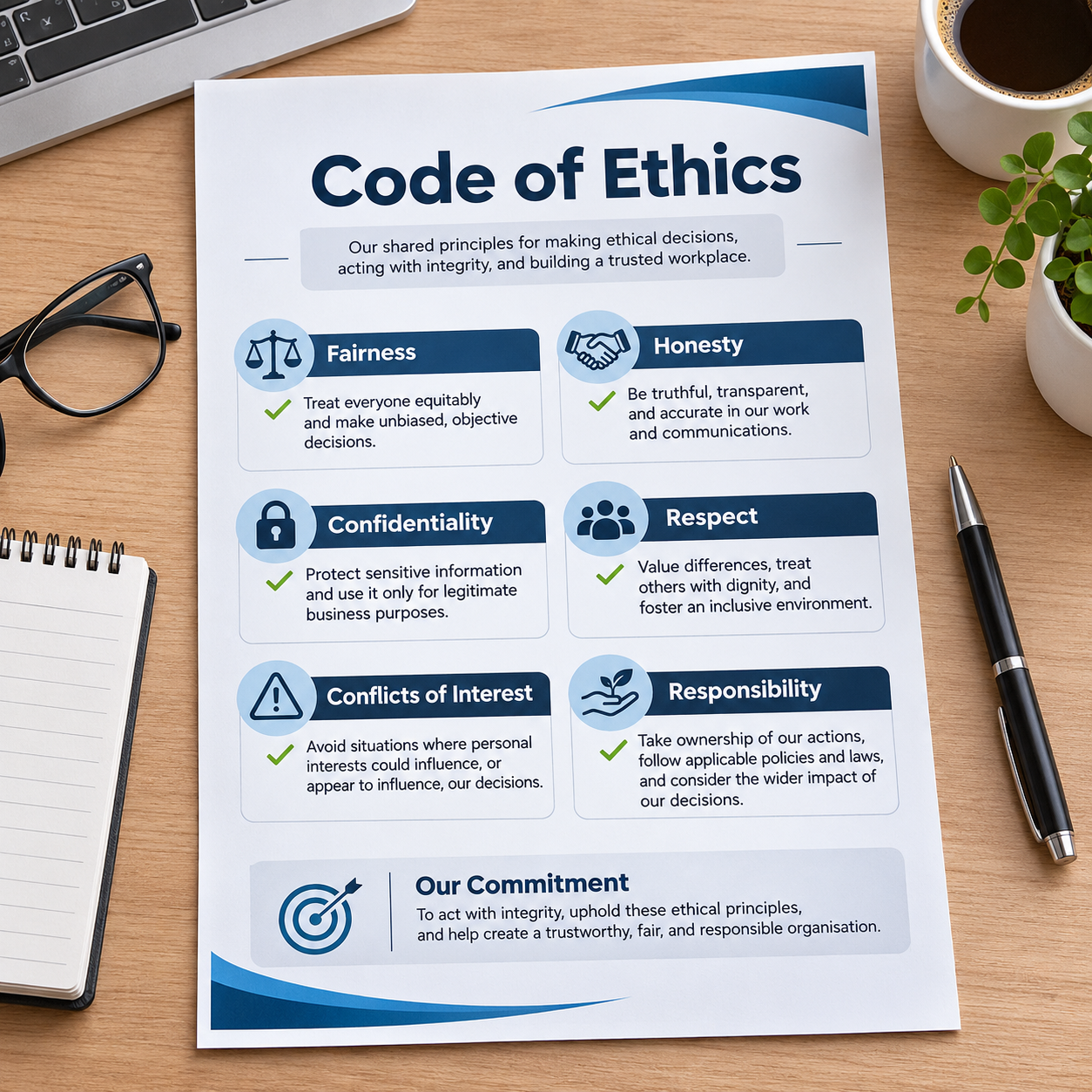
A code of ethics is a written set of principles and standards that outlines the ethical behaviour expected of employers and employees within a business.
It provides a common guide for making decisions and behaving appropriately in the workplace, helping everyone understand what is considered honest, fair, responsible and respectful behaviour.
A code of ethics may cover areas such as treating employees and customers fairly, acting honestly, respecting confidential information, avoiding conflicts of interest and taking responsibility for mistakes.
By establishing clear expectations, a code of ethics helps a business promote consistent ethical behaviour, build trust and maintain a positive workplace culture.
👔 2. Employer and employee behaviour
Ethics depends on everyday behaviour
Ethical business practice is not only about what is written in a code of ethics. It must also be reflected in the way employers and employees behave during normal business activities.
Employers and employees both influence the ethical culture of a workplace through the choices they make and the way they treat other people.
👔 Employer behaviour
- treat employees fairly and respectfully
- communicate honestly
- apply workplace expectations consistently
- listen to legitimate concerns or complaints
- avoid unfair favouritism
- take responsibility when the business makes a mistake
👤 Employee behaviour
- act honestly when completing work
- treat colleagues and clients respectfully
- follow agreed workplace standards
- protect confidential information
- use business property responsibly
- take responsibility for mistakes
🏠 Example: a small building company
A supervisor discovers that an employee has accidentally entered the wrong number of hours on a job sheet, causing a client to be charged too much.
The employee immediately tells the supervisor rather than hiding the mistake.
The supervisor checks the invoice, corrects the amount and explains the error to the client instead of keeping the additional money.
As a result, both the employee and employer demonstrate honesty and responsibility when dealing with a workplace mistake.

🌅 Ethical leadership matters
Employees often observe how owners and managers behave when deciding what behaviour is genuinely accepted inside a business.
If an employer expects honesty, fairness and respect from employees, the employer should demonstrate those same behaviours when dealing with staff, clients and business problems.
If managers regularly ignore unethical behaviour, employees may begin to believe that the written ethical standards are not taken seriously.
In simple terms, the behaviour of business leaders helps set the ethical tone of the workplace.

🤝 3. The relationship between a business and its clients
Trust is central to the relationship
A client often relies on a business to provide accurate information, complete the promised work and behave professionally.
Ethical behaviour is particularly important when the business has more knowledge or expertise than the client and could potentially take advantage of that difference.
Four important features of an ethical business/client relationship
Honest communication
Businesses should provide truthful information about products, services, prices and likely outcomes.
Confidentiality
Private client information should be protected and only used for appropriate business purposes.
Fair treatment
Clients should be treated respectfully and should not be deliberately disadvantaged through dishonest or unfair behaviour.
Responding to problems
If the business makes a mistake, it should acknowledge the issue and take reasonable steps to correct it.
🚗 Example: an independent mechanic
A mechanic inspects a customer's car and discovers that only a small repair is currently required.
The mechanic could recommend several expensive repairs that are not yet necessary, knowing the customer has limited mechanical knowledge.
Instead, the mechanic clearly explains what needs to be repaired now, what may need attention in the future and the approximate cost of each option.
As a result, the client can make a more informed decision and may develop greater trust in the business.

🤝 Ethical behaviour and long-term relationships
Ethical behaviour does not guarantee that every client will remain with a business.
However, consistent honesty, fair treatment and professional communication can help create the trust needed for stronger long-term business relationships.
For example, a personal training business that gives realistic advice, clearly explains fees and recommends services based on what the client actually needs may develop greater trust with clients over time.
As a result, clients may be more willing to return to the business and recommend it to other people.

🎧 Prefer listening?
Listen to the Ethical Business Practice podcast for another way to revise this dotpoint.
🎥 Prefer watching?
Watch the Ethical Business Practice video to reinforce the key ideas.
🧑🏫 Class Activities
Hands-on activities
These activities are designed to help you apply the full content to real businesses through research, decision-making and practical classroom tasks.
How this section could be used: teachers could place students into small groups and allocate different activities, ask students to complete one or two activities each week, or use the activities at the end of each syllabus point so groups can take turns completing and presenting one task to the class. Activities can also be used as extension work, revision, or as a starting point for short class discussions.

1. Real Business Research: Wesfarmers
Wesfarmers is a major Western Australian business group headquartered in Perth. Research its current Code of Conduct.
- Identify five ethical expectations contained in the code.
- Identify which expectations relate to employers, employees or both.
- Choose the expectation you believe is most important.
- Explain why this expectation could matter to a large business such as Wesfarmers.
Output: prepare a one-slide class presentation titled Ethical Behaviour at Wesfarmers. Include five ethical expectations and your choice of the most important one.
2. Fremantle Boutique Billing Error
A small clothing boutique in Fremantle discovers that a customer has accidentally been charged twice for the same purchase.
- Identify the ethical issue.
- State what the business should do.
- Explain why the response demonstrates ethical business practice.
- Identify how the decision could affect the client relationship.
Output: complete a four-part response using the headings Issue, Ethical Action, Reason and Effect on the Client Relationship.
3. Ethical Leadership Slideshow
A small café in Subiaco employs twelve people. The owner expects staff to be honest and respectful, but one supervisor regularly ignores mistakes made by favourite employees while criticising others for similar behaviour.
- Identify what is unethical about the supervisor's behaviour.
- Explain why leadership behaviour matters.
- Suggest two changes the owner could make.
- Explain how these changes could influence employees.
Output: prepare a three-slide presentation: The Problem, Better Leadership and Likely Effect on Employees.
4. Joondalup Building Company
A small building company in Joondalup discovers that an incorrect employee timesheet has caused a client to be overcharged by $650.
- Identify the ethical responsibility of the employee.
- Identify the ethical responsibility of the employer.
- Explain how honesty applies to the situation.
- Explain how responsibility applies to the situation.
Output: complete a two-column table headed Employee Behaviour and Employer Behaviour, followed by a short explanation of the ethical principles involved.
5. Midland Mechanic: Profit or Trust?
A mechanic in Midland discovers that a customer's car needs a $250 repair. The mechanic knows the customer has limited mechanical knowledge and could probably convince them to approve an unnecessary $1,200 repair instead.
- Identify the ethical option.
- Identify the unethical option.
- Explain how each option could affect trust.
- Decide which option the mechanic should choose.
Output: create a comparison table showing the ethical and unethical choices, followed by a two-sentence recommendation.
6. Personal Training Ethics Challenge
A Perth personal training studio can earn more money by selling every new client its most expensive package, even when some clients would be better suited to a cheaper option.
- Explain why the situation creates an ethical issue.
- Compare the most profitable option with the most ethical option.
- Explain how honest advice could affect the client relationship.
- Decide what the business should do.
Output: prepare a one-minute class presentation explaining the dilemma and your recommended decision.
✍️ Short Answer Questions
Practice questions
Answer each question before opening the sample answer. Marks are based on the command term and the number of separate points requested.
Show sample answer
Ethical business practice means operating a business and making decisions in a way that is considered honest, fair, responsible and respectful. It involves considering how business behaviour affects people such as employees, clients and other stakeholders.
Show sample answer
A code of ethics is a written set of principles and standards that outlines the ethical behaviour expected of employers and employees within a business. It provides a common guide for making decisions and behaving appropriately in the workplace.
Show sample answer
One example is treating employees fairly and consistently rather than showing unfair favouritism. Another example is communicating honestly with employees about workplace decisions and problems.
Show sample answer
The employee should honestly report an incorrect timesheet rather than hiding the mistake. The employee should also protect confidential client information rather than sharing it with people who do not require access.
Show sample answer
Employees observe how the café owner and supervisors respond to workplace problems and mistakes. If managers consistently act honestly and apply the same standards to all employees, staff can see that ethical behaviour is genuinely expected. As a result, employees may be more likely to follow those ethical standards themselves.
Show sample answer
The mechanic could clearly explain which repairs are genuinely required and provide accurate information about their likely cost. This allows the client to make a decision using truthful information rather than being pressured into unnecessary work. As a result, the client may develop greater trust in the mechanic and be more willing to return to the business.
Show sample answer
One advantage is that a code of ethics clearly communicates the ethical standards expected from employers and employees. A second advantage is that it can guide people when they face difficult decisions involving honesty, fairness or responsibility.
One disadvantage is that developing and explaining the code can require time and effort from a small-business owner. A second disadvantage is that the code may have little effect if employers and employees do not actually follow the standards contained within it.
Show sample answer
Decision: The gym should contact the client, explain the mistake and refund the duplicate charge.
Reason: Keeping money the business knows was charged incorrectly would conflict with honesty, fairness and responsibility.
As a result, the gym can help maintain the client's trust in the business.
Show sample answer
One advantage of choosing the ethical option is that the business can act consistently with principles such as honesty, fairness and responsibility, which may help maintain trust with employees and clients.
One disadvantage is that the ethical option may increase costs or reduce short-term profits, which could place pressure on a small business with limited financial resources.
Overall, the business should choose the ethical option when the alternative would require dishonest or unfair behaviour, provided the business can remain financially viable.
🃏 Flashcards
Card 1 of 12
🎮 Revision Games
💰 Ethics Millionaire
Climb the ladder by mastering ethical decisions, workplace behaviour and client relationships.
⚖️ Ethical or Unethical?
Judge realistic business situations and decide whether the behaviour is ethical or unethical.
⚡ 60 Second Showdown
Race through ethical business decisions before the clock expires.
Biz Fact: Qantas suffered significant reputational damage following allegations and legal action concerning the sale of tickets for flights that had already been cancelled.