
U4.17 — Use of Technology in Global Markets
Overview
Dotpoint 17: use of technology in global markets.
Technology in global markets refers to the digital systems, software, devices and online platforms businesses use to coordinate operations, reach customers and manage transactions across national borders.
This dotpoint focuses on how specific technologies can be used in three areas:
- distribution of products — tracking, inventory, logistics and supply-chain technologies
- e-commerce — technologies that make international online selling easier, faster and more localised
- social media campaigns — technologies used to target, engage and measure global audiences
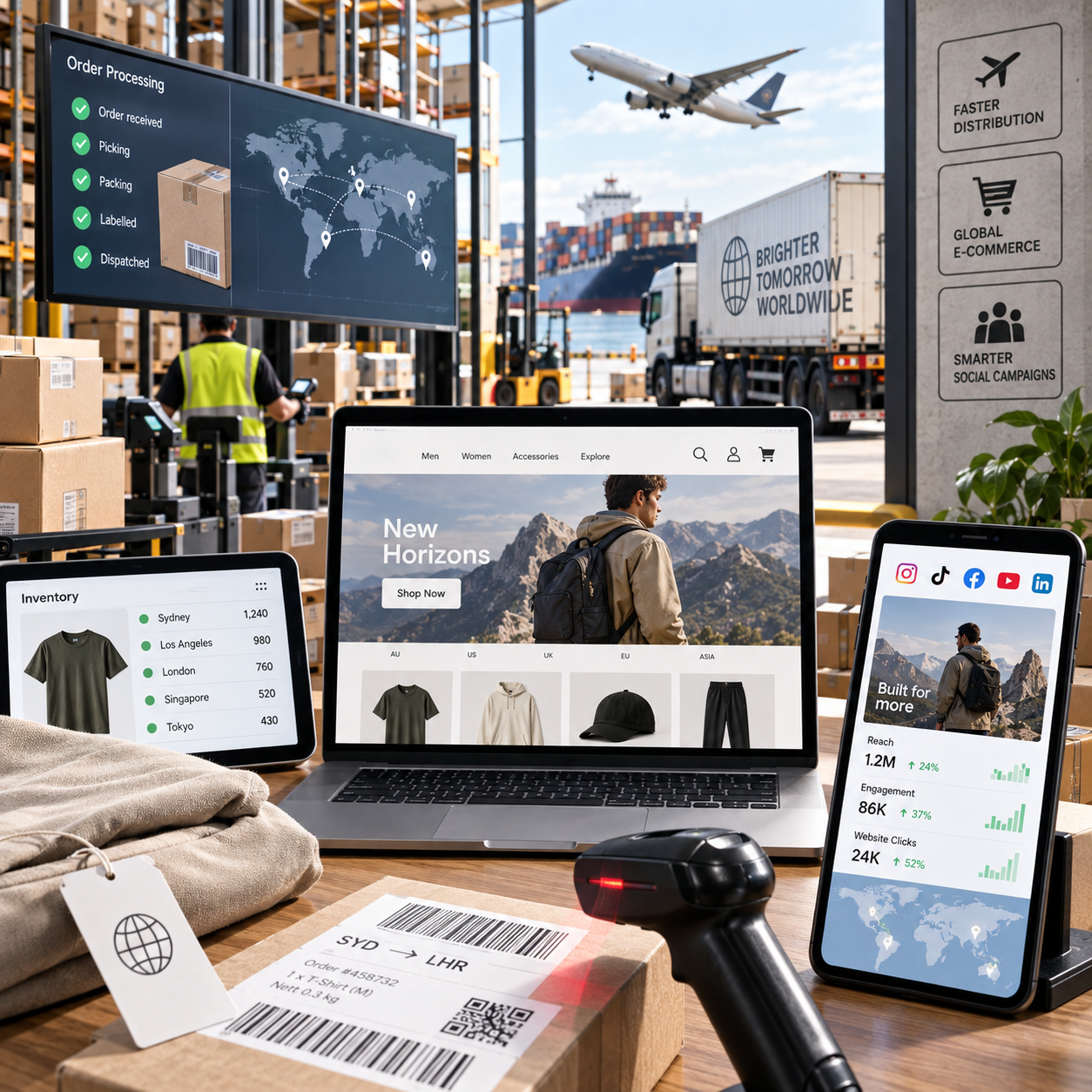
🚚 Distribution of products
How technology assists global distribution
Distribution is the process of moving products from the business to customers through warehouses, transport providers and delivery networks.
Technology assists global distribution by giving businesses greater visibility and control over inventory, transport and deliveries across international supply chains.
Digital systems can identify products, track their location and condition, coordinate warehouses and transport providers, predict demand and provide customers with real-time delivery information.
This can improve speed, traceability, inventory accuracy, reliability and communication, although businesses must invest in compatible systems, reliable data and cybersecurity.
Technologies used in global distribution
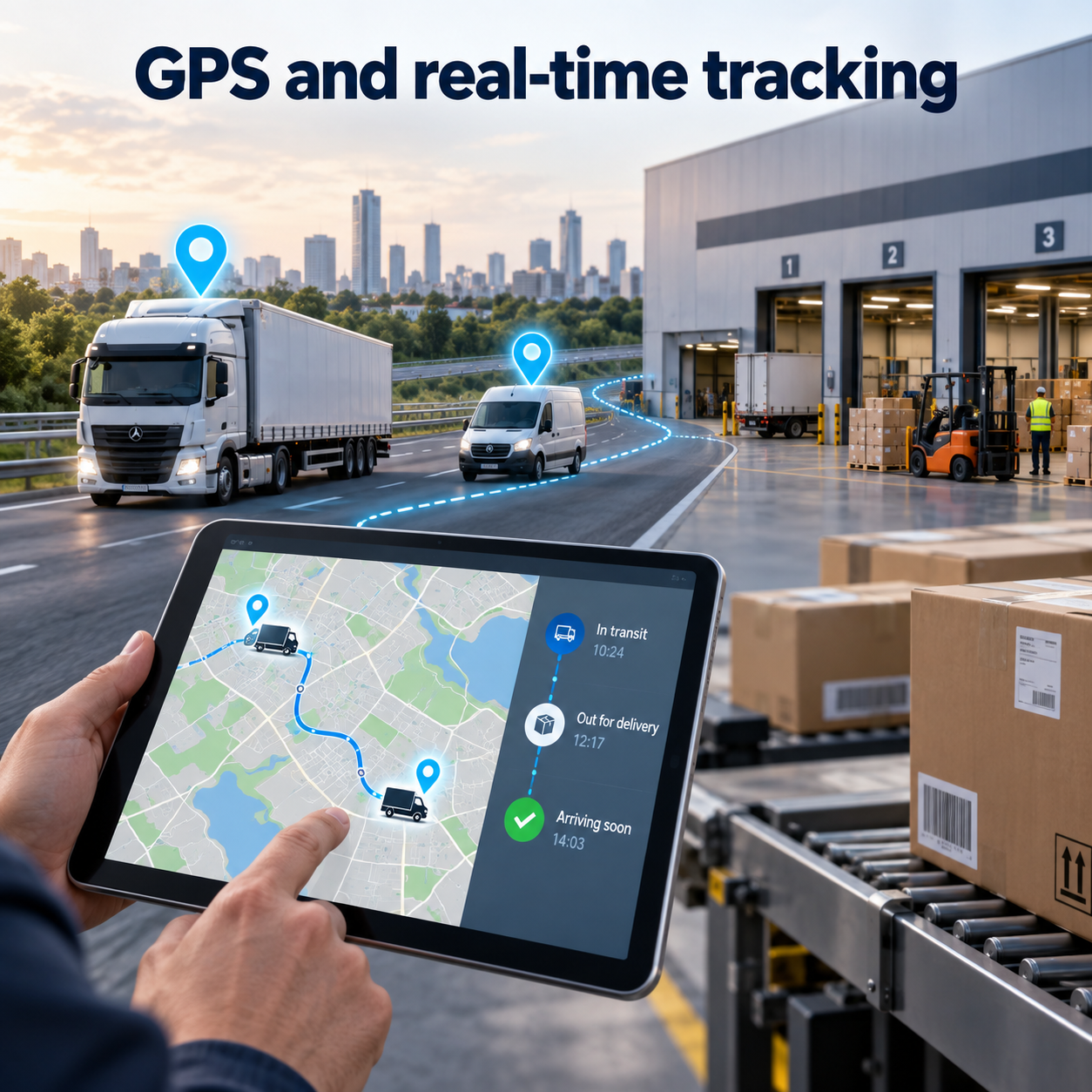
GPS and real-time tracking
GPS, telematics and connected tracking devices allow businesses and logistics providers to monitor the location of vehicles, containers and shipments while they are in transit.
Business effect: delays can be identified earlier, customers can receive delivery updates and businesses can respond more quickly when a shipment is disrupted.
RFID technology
Radio Frequency Identification (RFID) uses electronic tags and radio waves to identify and track products, pallets or containers without requiring direct line-of-sight scanning.
Business effect: businesses can improve supply-chain visibility, inventory accuracy and traceability as products move between factories, warehouses and stores.
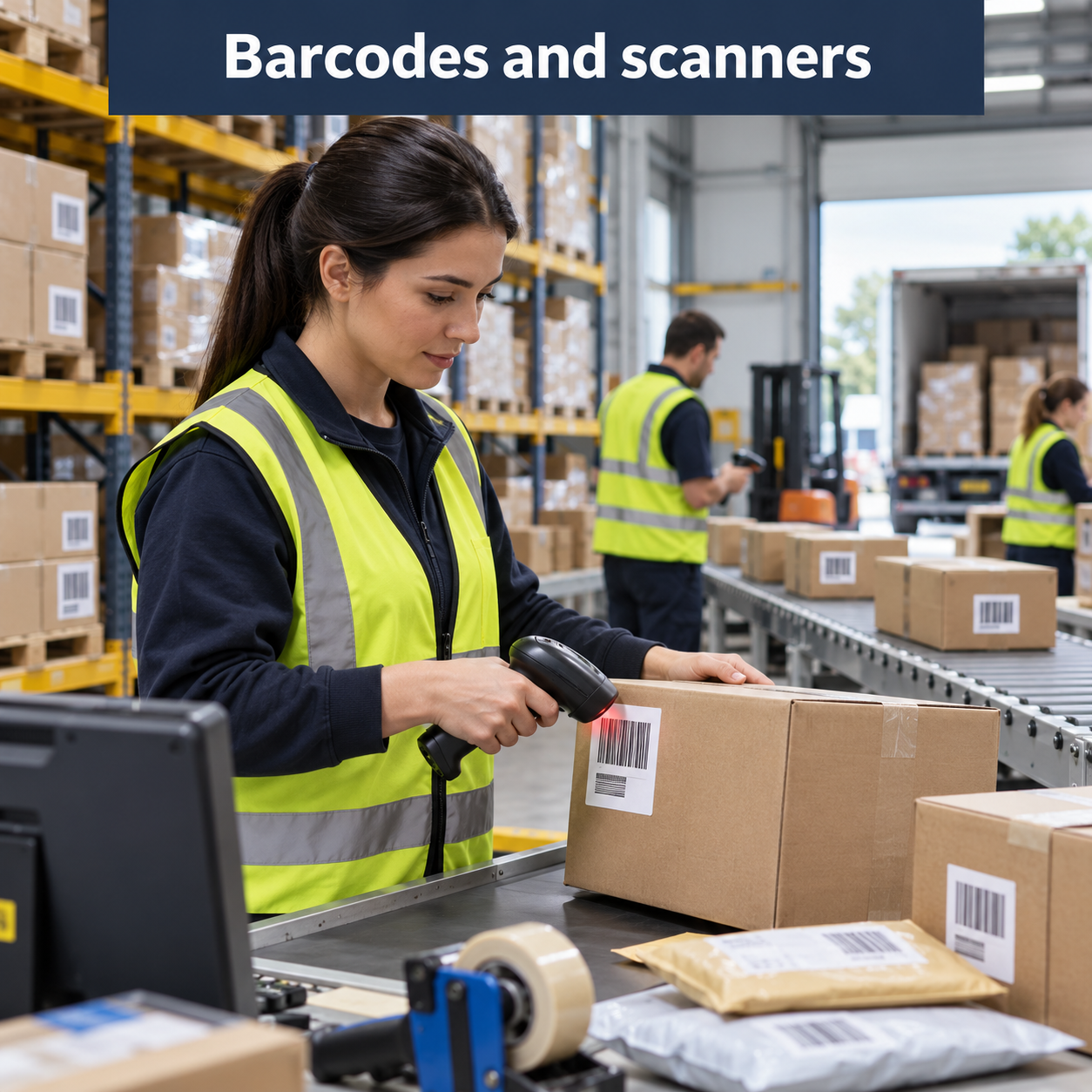
Barcodes and scanners
Barcodes give products or logistics units a machine-readable identity that can be scanned when goods are received, stored, picked, packed or dispatched.
Business effect: inventory records can be updated more accurately and quickly, reducing manual entry errors and helping businesses locate stock.
Warehouse Management Systems (WMS)
A WMS uses software to manage receiving, storage locations, stock levels, picking, packing and dispatch within warehouses or distribution centres.
Business effect: the business can improve inventory accuracy, warehouse efficiency and order fulfilment across multiple locations.
Transport Management Systems and control towers
Transport Management Systems (TMS) and digital control towers coordinate carriers, routes, schedules and shipment data from one central platform.
Business effect: managers gain end-to-end visibility and can change routes, carriers or delivery plans when disruptions occur.
AI and predictive analytics
AI systems can analyse sales, inventory, transport and demand data to forecast stock requirements, identify likely delays and support route or network planning.
Business effect: better forecasting can reduce stock shortages, excess inventory and inefficient transport decisions.
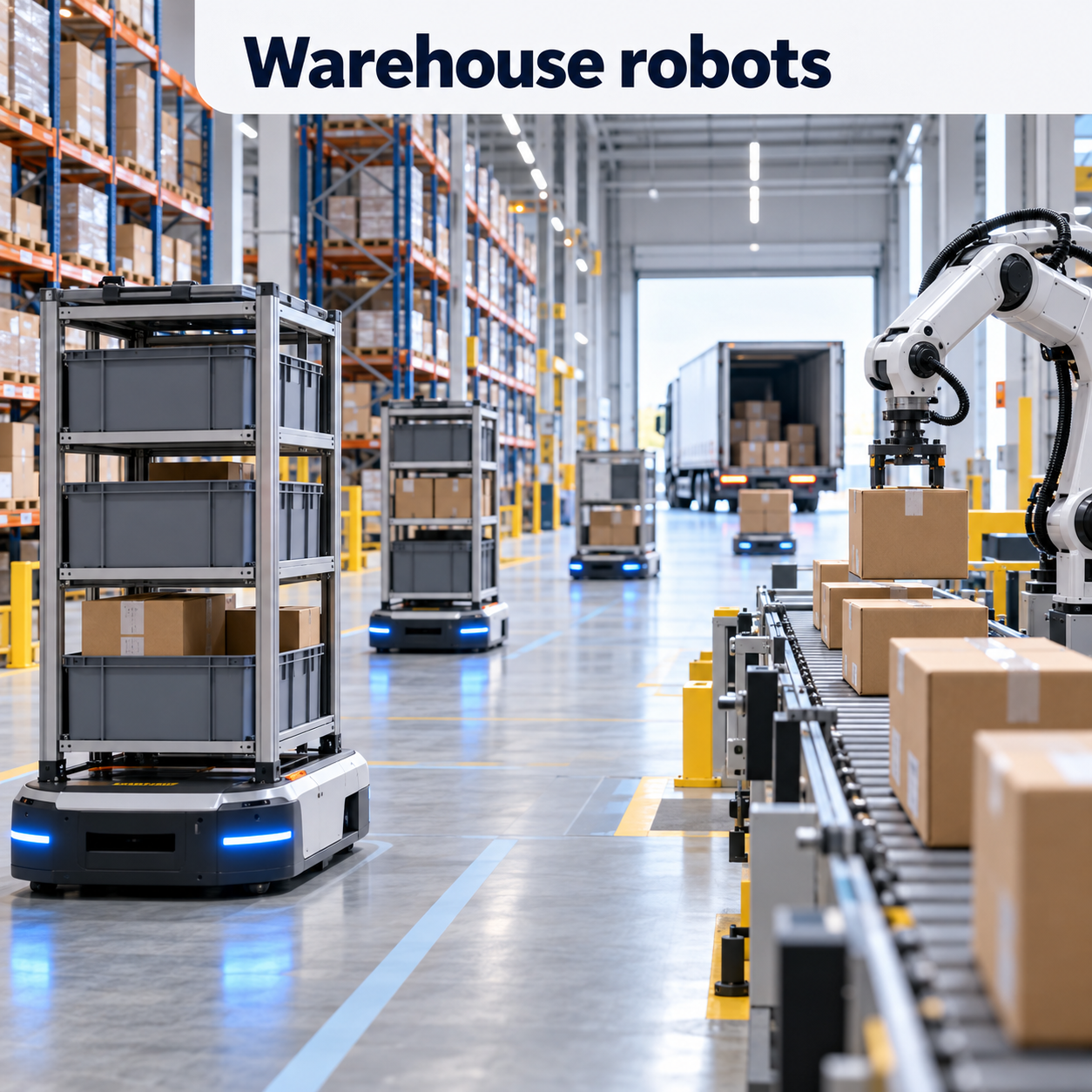
Warehouse robots
Warehouse robots are automated machines used to move, sort and prepare products for distribution, improving speed, accuracy and efficiency.
Business effect: businesses can process large volumes of orders more quickly, reduce repetitive manual handling and improve fulfilment efficiency in global distribution centres.
Benefits and limitations
Benefits
- Improves shipment visibility and traceability across international supply chains.
- Provides more accurate inventory and delivery information.
- Allows faster responses to delays, stock shortages or transport problems.
- Can reduce manual errors and improve warehouse and logistics efficiency.
- Improves customer service through real-time tracking and delivery updates.
Limitations
- Software, scanners, sensors and system integration can require significant investment.
- Global suppliers and logistics partners may use incompatible systems or data standards.
- Incorrect or incomplete data can lead to poor inventory or delivery decisions.
- System outages or cyberattacks can disrupt highly digital supply chains.
- Employees and supply-chain partners may require training to use new technologies effectively.
Case study — Pfizer vaccine distribution
During the global rollout of its COVID-19 vaccine, Pfizer used connected tracking technology to monitor vaccine shipments moving through a highly sensitive international cold chain.
Tracking devices inside specialised shipping containers monitored GPS location, temperature and possible tampering while the vaccines were in transit. This was especially important because the Pfizer-BioNTech vaccine needed to be kept at very low temperatures during distribution.
The information was transmitted to 24/7 control towers, giving Pfizer and its logistics partners real-time visibility of each shipment. If an alert showed a delay or temperature problem, logistics teams could investigate and take corrective action before the vaccines reached their destination.
This shows how distribution technology can provide more than location tracking. It can deliver real-time condition data, early warnings of risk and coordinated decision-making across a global supply chain.

How to write this in an exam
Technology can assist the distribution of products in global markets through technologies such as GPS tracking, RFID, barcodes, warehouse-management systems and warehouse robots. These technologies allow a business to monitor the location and movement of products across international supply chains. This is important because delays, stock shortages or transport problems can be identified earlier. As a result, the business can improve delivery reliability, inventory control and customer communication.
🛒 E-commerce technology
How technology strengthens e-commerce in global markets
E-commerce is the buying and selling of goods and services through online platforms such as websites, apps and digital marketplaces.
The broader role of e-commerce in global business is covered in Dotpoint U3.08. This dotpoint instead focuses on the specific technologies that make international e-commerce work effectively.
Global e-commerce platforms can use localisation tools, multi-currency systems, payment gateways, automated tax and shipping tools, analytics and integrated order-management systems to make an overseas customer’s buying experience feel more local and easier to complete.
These technologies can reduce barriers created by language, currency, payment preferences, distance and different market expectations.
Technologies used in global e-commerce
Website localisation and translation
Technology can automatically or manually display translated product information, market-specific images, local sizing, region-specific content and country-specific domains.
Business effect: overseas customers can understand the website more easily and may be more confident completing a purchase.
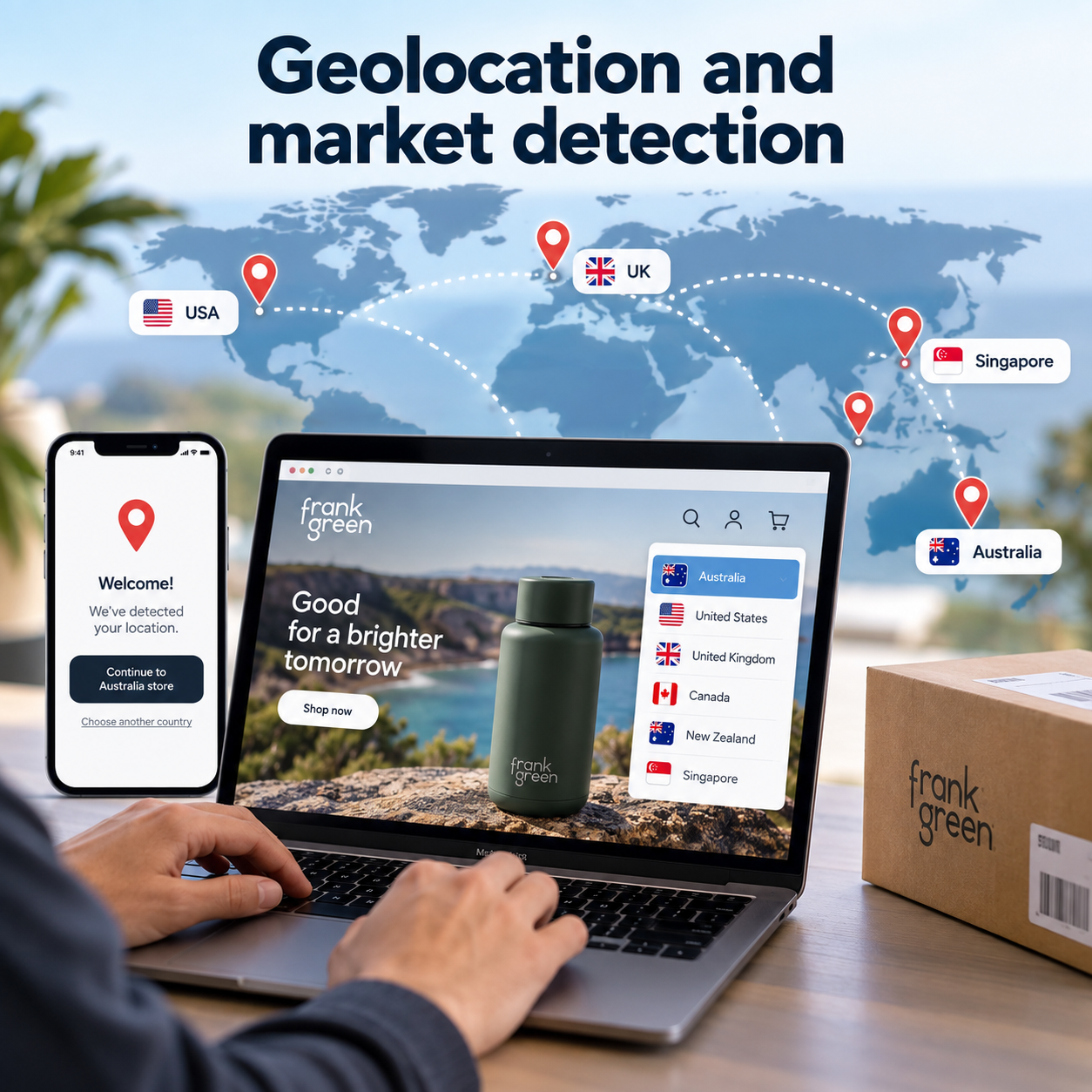
Geolocation and market detection
Websites can detect or ask for a customer’s country and show the appropriate store version, products, shipping options, taxes and regional information.
Business effect: customers see information relevant to their market rather than a generic Australian store experience.
Multi-currency pricing
E-commerce platforms can display prices and process payments in a customer’s local currency using automatic or manually set exchange rates.
Business effect: customers understand the actual purchase price more easily, reducing uncertainty at checkout.
Payment gateways and local payment methods
Payment technologies such as Stripe, PayPal, digital wallets and local payment methods allow customers in different countries to pay electronically using familiar systems.
Business effect: the checkout process becomes faster and more convenient for international customers.
Integrated order and inventory systems
E-commerce software can connect online orders with inventory, warehouse and shipping systems so stock levels and customer orders update automatically.
Business effect: the business can reduce overselling, improve fulfilment and manage international orders more efficiently.
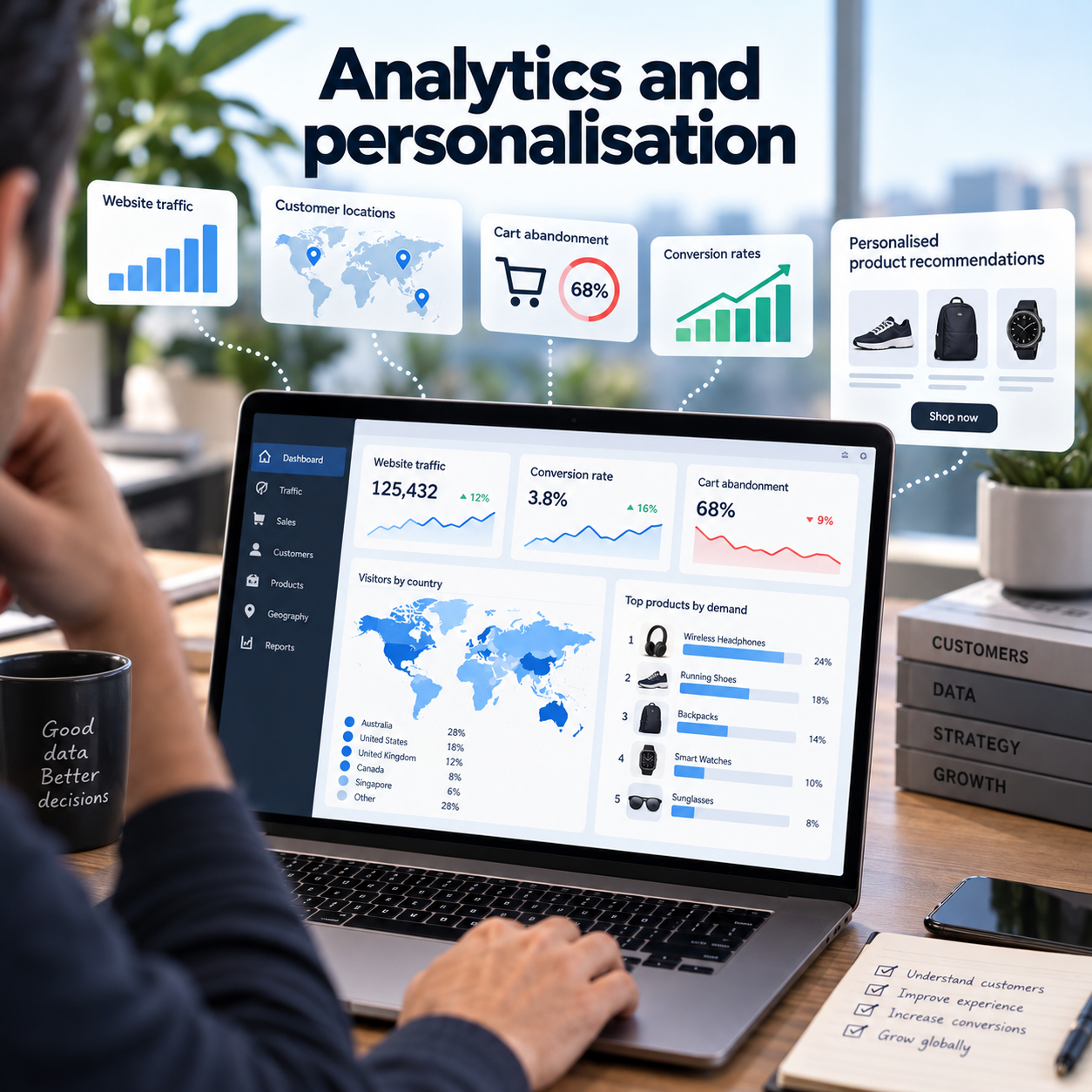
Analytics and personalisation
Businesses can analyse website traffic, cart abandonment, conversion rates, customer locations and product demand in different markets.
Business effect: the business can improve product ranges, website design, promotions and market-specific offers using customer data.
Benefits and limitations
Benefits
- Creates a more localised shopping experience for overseas customers.
- Reduces language and currency barriers.
- Makes international checkout and payment more convenient.
- Connects online orders with inventory and fulfilment systems.
- Provides data about customer behaviour in different global markets.
Limitations
- Localisation and international payment systems can add software and transaction costs.
- Incorrect translations, currency settings or tax information can confuse customers.
- Some payment methods, products or shipping options may not be available in every country.
- Technology still cannot remove all customs, freight and international returns difficulties.
- Customer and payment data must be protected from security and privacy risks.
Case study — Petal & Pup
Petal & Pup is an Australian fashion retailer that expanded its online operations into international markets using Shopify technology. The business used localisation tools to make its online store more suitable for customers in different countries.
Technology can allow a retailer such as Petal & Pup to display local currencies, translated or region-specific content, local payment options and market-specific product information. These systems reduce the friction an overseas customer experiences when browsing and paying through a foreign website.
Shopify reports that Petal & Pup grew into an international brand shipping to more than 80 countries, with international sales becoming a significant share of revenue. The example shows how e-commerce technology can support international growth by making one online platform function differently for customers in different markets.

How to write this in an exam
A local business can use specific e-commerce technologies to gain international customers by localising its online store. For example, the website can automatically display translated product information, local currency and familiar payment methods for customers in another country. This is important because overseas customers can understand prices and product information more easily and experience less friction at checkout. As a result, the business may increase international website conversions and sales without opening a physical store in every market.
📱 Social media campaigns
How technology is used in global social media campaigns
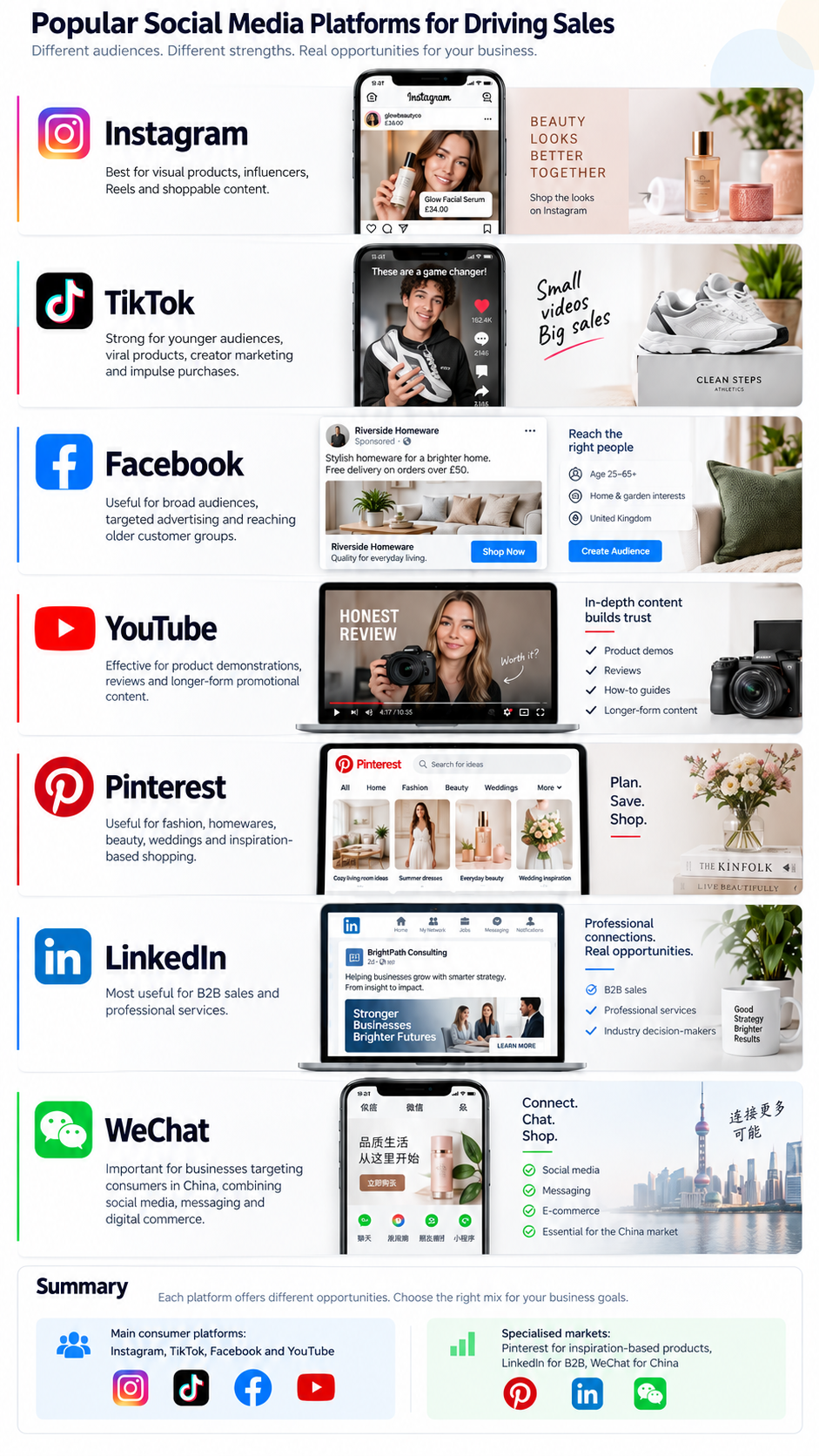
A social media campaign is a coordinated set of marketing activities delivered through social platforms to achieve a specific objective such as brand awareness, website traffic, engagement or sales.
Technology allows a global campaign to do more than simply post content. Businesses can target selected audiences, work with creators, schedule content across time zones, retarget interested customers, measure campaign results and optimise advertising using real-time data.
Successful global campaigns also need to adapt content to different languages, cultures, platform preferences and customer behaviours.
Technologies used in social media campaigns
Targeted advertising
Advertising platforms can target users by factors such as location, language, age, interests, behaviours and device type.
Business effect: a business can show different campaigns to customers in different international markets instead of using one broad message everywhere.
Custom and lookalike audiences
Businesses can retarget people who have visited a website, interacted with previous content or are already customers, and can create lookalike audiences with similar characteristics.
Business effect: advertising can focus on users more likely to be interested in the product.
Creator and influencer technology
Platforms and creator tools help businesses identify influencers, manage collaborations and amplify creator content through paid advertising.
Business effect: businesses can access established audiences and create content that appears more authentic or locally relevant.
Algorithms and recommendation systems
Social platforms use recommendation technology to show users content likely to match their interests and previous behaviour.
Business effect: effective content can reach users who do not already follow the business, increasing global discovery.
Scheduling and content management tools
Businesses can plan, schedule and publish posts across different platforms and time zones using social-media management software.
Business effect: campaigns can remain coordinated even when target customers are located in different countries.
Analytics and social listening
Platforms measure impressions, reach, clicks, engagement, conversions and audience response. Social-listening tools can also monitor mentions and customer sentiment.
Business effect: managers can compare campaign performance between markets and adjust content, targeting or spending.
Building a global social media campaign
How to build a campaign
Past exams have asked students to propose a social media campaign idea. In this type of question, you should outline a practical campaign for the business by identifying:
- the objective
- the target overseas market
- the social media platform
- the localised content
- the engagement strategy
- how analytics will measure and improve results.
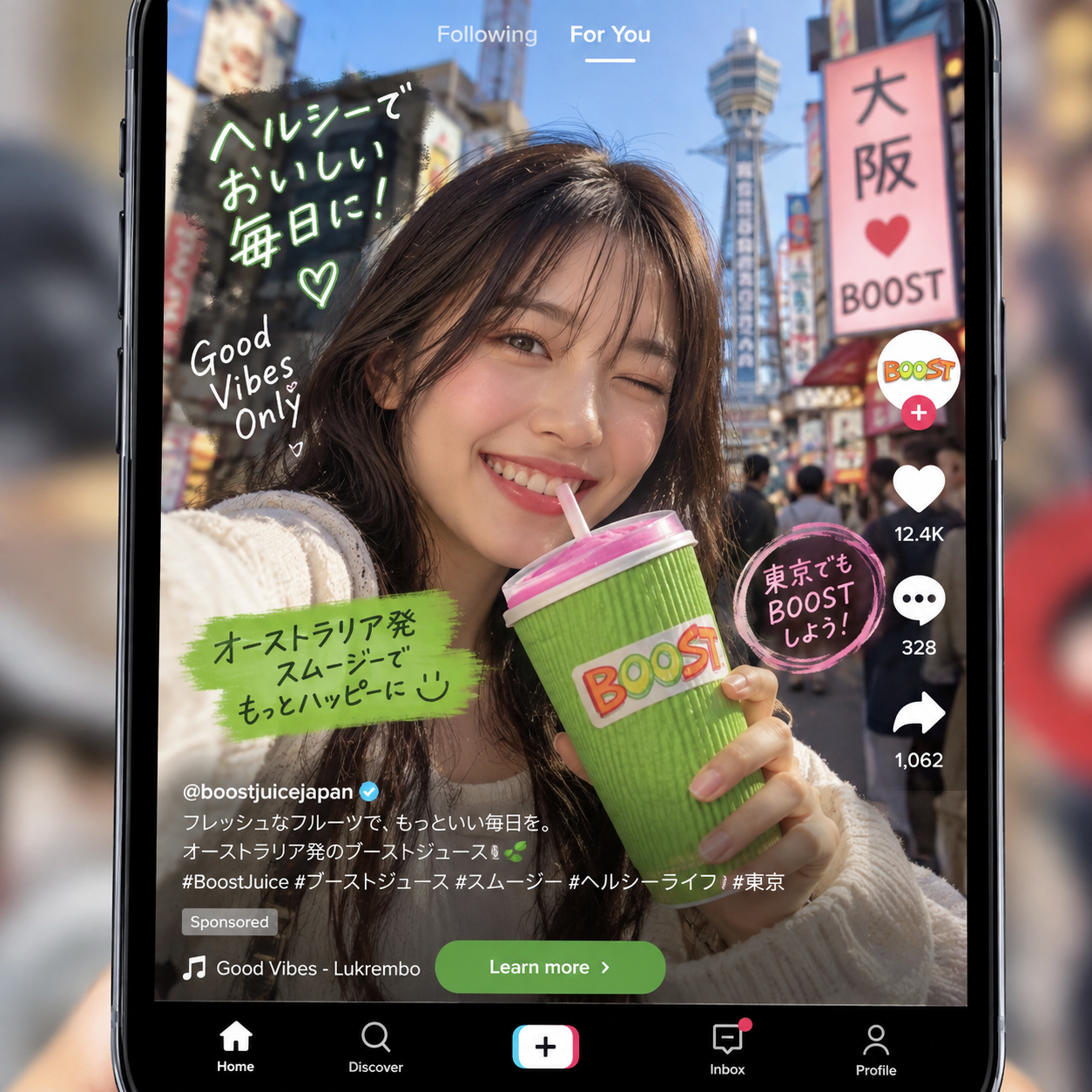
Example: Boost Juice could target young consumers in Japan through TikTok, using Japanese-language videos featuring local flavours and influencers, then track views, engagement and clicks to measure the campaign’s success.
Benefits and limitations
Benefits
- Can reach large international audiences quickly.
- Targeting technology reduces wasted advertising by focusing on selected customer groups.
- Visual and creator-led content can increase engagement and brand awareness.
- Campaign performance can be measured and adjusted in real time.
- Customer comments, shares and feedback provide immediate market information.
Limitations
- Platform preferences and availability differ between countries.
- Content that works in Australia may be culturally inappropriate or ineffective overseas.
- Algorithms and advertising costs can change, reducing campaign reach or increasing acquisition costs.
- Negative comments or poor campaign content can spread quickly.
- Businesses must manage privacy, advertising and data requirements in different markets.
Case study — Lorna Jane on TikTok
Lorna Jane, an Australian activewear brand, used TikTok as an increasingly important paid and organic marketing channel. Its campaign strategy used multiple pieces of short-form video creative and audience signals to move customers through different stages of the marketing funnel.
The campaign began by building engagement and website-content views, then added campaigns designed to encourage customers to add products to their cart and finally complete purchases. This allowed the advertising system to gather more data and improve targeting over time.
Lorna Jane also used creator-style content designed for customers interested in fashion, apparel and sport. TikTok reported strong improvements in conversion performance and return on advertising spend, and the brand later applied the approach more broadly in international markets.
The example shows how a global social-media campaign can combine targeting, platform algorithms, creative video, campaign analytics and ongoing optimisation rather than relying only on organic posts.

How to write this in an exam
A business can use a targeted social media campaign to market to customers in a global market. The campaign should identify an objective, target overseas market, suitable platform, localised content and engagement strategy, then use analytics to measure results. For example, Boost Juice could target young consumers in Japan through TikTok using Japanese-language videos featuring local flavours and influencers. This is important because the campaign is more relevant to the selected audience. As a result, the business can increase international brand awareness, engagement and website traffic while using campaign data to improve future content and targeting.
🎧 Prefer listening?
If you prefer listening to the content in podcast format:
🎥 Prefer watching?
If you prefer watching the content in video format:
🃏 Flashcards
Card 1 of 10
🎮 Revision Games
💰 BME Millionaire
Climb the prize ladder. Use your lifelines wisely.
👔 Business Boss
Make 10 real management decisions. Every choice changes your KPIs — sometimes for better and worse.
⚡ 60 Second Showdown
A fast-paced 60-second challenge testing key BME knowledge under pressure.

Biz Fact: Amazon uses robots, barcode scanners, AI forecasting and real-time tracking to move millions of products through its global fulfilment network.
Past Exam Questions
Use these past exam questions to see how this dotpoint has been assessed. Pay close attention to the command term, the number of marks and whether the question is Section 1 or Section 2.
Section 1 Questions
2016 — Section 1 — Question 2(c) — 4 marks
Context
No specific business context is provided.
2(c): Using an example, explain two ways in which technology can be used to assist marketing in global markets. (4 marks)
Command term focus: Explain
Explain: show cause and effect by explaining how or why the technology is used and the result.
See the full command term guide here: Command Terms.
2(c) Sample answer
1. Targeted social media advertising: A business can use social-media advertising technology to target customers in particular countries using location, interests and online behaviour. For example, an Australian activewear business could target TikTok users in Japan who engage with fitness content. This is effective because advertising is shown to customers more likely to be interested in the product. As a result, the business can increase international brand awareness and website traffic while reducing wasted advertising.
2. E-commerce localisation: A business can use specific e-commerce technologies to display translated product information, local currency and familiar payment methods to overseas customers. For example, an Australian online retailer could show French customers a French-language store with prices in euros. This is effective because customers can understand the product and total price more easily. As a result, the business can reduce checkout friction and increase international sales.
2017 — Section 1 — Question 1(c) — 4 marks
Context
Foxtrot Transportable Housing, a company specialising in cyclone-proof, portable housing and granny flats, has expanded its Australian business to New Zealand, where it has decided to standardise its marketing mix. It is also keen to expand to Asia in the future.
1(c): Describe two ways in which Foxtrot Transportable Housing could use technology in global markets. (4 marks)
Command term focus: Describe
Describe: give the main characteristics or features with enough detail to show what each use is like.
See the full command term guide here: Command Terms.
1(c) Sample answer
1. E-commerce technology: Foxtrot could use a localised website for its New Zealand and future Asian markets. The website could display market-specific product information, local currency and translated content so overseas customers can understand housing models, prices and ordering information more easily.
2. Social media technology: Foxtrot could use targeted advertising on platforms such as Facebook, Instagram or TikTok to reach customers in selected New Zealand or Asian locations. It could use visual content, including videos and product demonstrations, to show the features of its cyclone-proof portable housing to potential overseas customers.
2020 — Section 1 — Question 1(d) — 5 marks
Context
When should a business go global? Australian businesses are competing in a complex world economy and it’s important that companies respond to the legal, cultural and economic environments of the countries in which they operate. These environmental factors can foster or hinder innovation, business operations, marketing and enterprise.
1(d): Propose how a business could use social media campaigns to enhance its marketing in the global environment. (5 marks)
Command term focus: Propose
Propose: put forward a clear, workable idea with enough detail to show how it would operate.
See the full command term guide here: Command Terms.
1(d) Sample answer
A business could create a market-specific social media campaign with the objective of increasing global brand awareness and website traffic. It should select a target overseas market and customer group, then choose a platform commonly used by that audience, such as TikTok, Instagram or YouTube.
The business could create localised videos, product demonstrations and creator content adapted to the market’s language and cultural expectations. Engagement could be encouraged through influencers, comments, polls, competitions and hashtags.
Campaign analytics should then measure reach, engagement, clicks and conversions. The business could increase spending on high-performing content and change weak advertisements, allowing the campaign to improve over time using customer data.
2021 — Section 1 — Question 2(d) — 3 marks
Context
Designing and manufacturing a product of quality requires businesses to be committed to careful planning and management.
2(d): Explain how technology is used in global markets to distribute products. (3 marks)
Command term focus: Explain
Explain: show cause and effect by explaining how or why the technology assists distribution and the result.
See the full command term guide here: Command Terms.
2(d) Sample answer
Technology can be used to distribute products globally through systems such as GPS tracking, RFID, barcodes, warehouse-management software and warehouse robots. These technologies allow a business to track products, update inventory records and monitor international shipments in real time. This is important because delays or stock problems can be identified earlier. As a result, the business can improve distribution reliability, inventory accuracy and communication with overseas customers.
2022 — Section 1 — Question 4(b) — 3 marks
Context
International business competitiveness involves using technologies effectively while also being able to mobilise and lead global teams.
4(b): Explain one way in which a local business can use e-commerce to gain international customers. (3 marks)
Command term focus: Explain
Explain: show cause and effect by explaining how or why the e-commerce technology attracts customers and the result.
See the full command term guide here: Command Terms.
4(b) Sample answer
A local business can use e-commerce technology to create a localised online store for overseas customers. The website can display translated product descriptions, local currency and familiar payment options. This is important because international customers can understand the product, price and checkout process more easily. As a result, the business can reduce barriers to purchasing and increase the number of international customers who complete an online sale.
2023 — Section 1 — Question 1(b) — 6 marks
Context
Exporting can bring opportunities and benefits to global businesses, but also has its challenges. Success comes from making the most of the opportunities while minimising the risks.
1(b): Outline, using an example for each, how an exporting business can use technology in global markets for the following. (6 marks)
E-commerce:
Distribution of products:
Command term focus: Outline
Outline: state the main point and briefly clarify it, including the required example.
See the full command term guide here: Command Terms.
1(b) Sample answer
E-commerce: An exporting business can use e-commerce technology to localise its online store for overseas customers through translated product information, local currency and international payment systems. For example, Petal & Pup can use an international e-commerce platform to provide customers in different countries with market-specific online shopping experiences.
Distribution of products: An exporting business can use distribution technologies such as GPS, RFID, barcodes and warehouse-management systems to monitor and move products through an international supply chain. For example, Pfizer used connected tracking devices to monitor the location and condition of vaccine shipments moving through its global distribution network.
Section 2 Questions
2019 — Section 2 — Question 7(c) — 3 marks
Case study / context
Health and fitness is a multimillion dollar industry. More and more people are aware of the importance of healthy eating and daily exercise. People of all ages spend money on gym memberships, personal training and group fitness classes, books, clothing, sporting equipment and much more.
Jettaya is a triathlete with a degree in sports and rehabilitation science and wants to profit from this expanding industry. She has recently created an online fitness program, healthy eating diet plan and clothing line so she can tap into the industry.
Jettaya understands the importance of being innovative to differentiate her product and service in this heavily saturated market. She realises that technology is a powerful tool for creating a profile for herself and to market her products and services in Australia and overseas. Jettaya has also conducted market research and has decided to manufacture her clothing line in China due to the cheaper labour costs and materials and the fact that the free trade agreement between China and Australia brings many benefits.
Jettaya realises that she needs to create a strategic vision and be innovative and creative for her business to become a success. She has come to you to ask for some advice and tips about how to create a successful global business.
7(c): Prepare a brief proposal for a social media campaign that uses technology and could help Jettaya grow her business in a global market. (3 marks)
Command term focus: Proposal
Proposal: provide a clear, workable campaign idea applied directly to Jettaya’s business.
See the full command term guide here: Command Terms.
7(c) Sample answer
Jettaya could launch a TikTok and Instagram fitness challenge aimed at young fitness customers in selected overseas markets. She could post short workout videos, healthy-eating tips and demonstrations of her clothing, using location and interest targeting so the paid campaign reaches users who engage with fitness and activewear content.
Jettaya could partner with local fitness creators in each target market and encourage customers to upload challenge videos using a campaign hashtag. Links in the content could direct customers to her online fitness program and clothing store.
She could then use platform analytics to monitor views, engagement, clicks and sales and increase advertising spend on the countries and content producing the strongest results.
2021 — Section 2 — Question 8(c) — 4 marks
Case study / context
In some parts of the world, people have been spending more time at home, which has led to increased spending on interior design. Market trends in Australia and Europe have seen a rise in expenditure on home accessories and decor such as new furniture, artwork and plants.
Matilda has operated a successful homewares store in Perth selling rugs, cushions, wall hangings and furniture. She also operates an online store selling her products around Australia. She has seen a surge in online sales over 2020 and early 2021, leading her to consider expanding her business.
After reading a Europen ecommerce report in 2020 stating that ‘European shoppers are spending more time shopping online’, Matilda has decided to provide the European market access to her online store. The article also mentioned that ‘online marketplaces in Europe have attracted significant traffic and seen high visitor engagement that has translated into sales’. She understands that her products, processes and services need to be innovative. She wants to ensure that her products are unique, luxurious and of the highest quality. Her processes in terms of her website, ordering and delivery need to be seamless and her customer service will need to be excellent in order to stand out from competitors. Matilda has decided that she also needs to investigate technology that is available to assist her to successfully sell her products to the European market. She is willing to invest money into her business operations in order to ensure that she has the best opportunity to be profitable in her expansion.
Matilda also needs to evaluate her competitive position in the international market to see whether she will be able to compete successfully. She has come to you (as a business advisor) to ask for advice.
8(c): Assess the way in which technology can assist Matilda to expand into the European market. (4 marks)
Command term focus: Assess
Assess: make a judgement, support it with evidence and finish with a clear conclusion.
See the full command term guide here: Command Terms.
8(c) Sample answer
Technology would be highly important to Matilda’s expansion into Europe because it can support both international e-commerce and distribution. Her online store could use localisation technology to display European customers with appropriate currencies, translated product information and familiar payment methods. This would make the ordering process easier and more professional for customers who cannot visit her Perth store.
Matilda could also integrate her website with inventory, warehouse and shipment-tracking systems. This would allow stock levels to update as European orders are placed and allow customers to receive delivery information for rugs, cushions, wall hangings and furniture travelling long distances. This could improve fulfilment reliability and customer service, which Matilda considers important for competing against established European retailers.
However, technology alone would not guarantee success. Matilda would face implementation costs, international freight and returns issues, and the need to protect customer and payment data. Poor translations or incorrect local settings could also reduce customer trust.
Overall, technology would be essential to Matilda’s European expansion because her strategy depends on a seamless online customer experience and reliable international fulfilment. Its value would be greatest if the systems are properly localised, integrated and supported by effective logistics and customer service.
2022 — Section 2 — Question 9(a) — 3 marks
Case study / context
The demand for good-quality online education has increased in recent years, especially in geographic areas where accessing physical learning campuses has been challenging. It is estimated that by 2025, one billion students from around the globe will be actively seeking education and skill development, especially in business and entrepreneurship. In Australia, education counts as one of the nation’s largest export industries. Globally, the online learning industry is increasing rapidly, with many regional education hubs being established by competing international learning institutions.
EduOz.com is a technology-based business that specialises in developing online courses for people wanting to enhance their business skills and knowledge. These courses, currently written in English, comprise a set of individual topic modules with written content, videos and learning activities that relate to starting up a business enterprise. Domestically, EduOz.com has been successful in attracting a strong customer base. It now wants to expand its reach globally by introducing its online courses into foreign markets. The focus of EduOz.com is on becoming a global brand leader in business skill development for budding entrepreneurs around the world who want to start their own businesses.
In developing its online products, EduOz.com is aware that it needs to take into consideration various cultural issues, business regulations and local industry rivalry. The developers are unsure whether to create courses in different languages or to remain with their current courses written in English. Course content could be modified to reflect the diverse cultures, economic environments, government policies and legal requirements of a variety of countries. Currently, prospective students need to have a basic level of understanding of English literacy and numeracy to complete the current courses. EduOz.com needs to invest time and research into developing course content addressing business practices in the countries where it intends to sell its courses. It is also considering whether it should re-brand its products by creating a new name and catchy slogan for its entry into this market.
9(a): Propose a social media campaign idea that EduOz.com could develop to launch its business in a global market. (3 marks)
Command term focus: Propose
Propose: put forward a clear, workable idea with enough detail to show how it would operate.
See the full command term guide here: Command Terms.
9(a) Sample answer
EduOz.com could launch a “Start Your Business Anywhere” campaign with the objective of generating awareness and course registrations in selected overseas markets. It could target aspiring entrepreneurs in a specific country through TikTok, Instagram or YouTube using location, language and interest targeting.
Localised short videos could feature practical business tips from its course modules, translated subtitles and local business creators promoting a free introductory lesson. Engagement could be encouraged through comments, Q&As and links to register for the sample course.
EduOz.com could then use analytics to measure views, engagement, clicks, free-trial registrations and paid enrolments, using the results to improve future content and advertising spending.