
U4.18 — Adapting Leadership Styles in a Cross-Cultural Setting
Overview
Dotpoint 18: adapting leadership styles in a cross-cultural setting.
Cross-cultural leadership is the process of leading employees or teams whose expectations may differ because of language, communication norms, attitudes to authority, relationship expectations, decision-making preferences and sources of motivation.
In Year 11, U2.20 — Key Features of Leadership Styles introduced the main characteristics, benefits and limitations of autocratic, participative and situational leadership. This Unit 4 dotpoint goes further: the focus is on how those styles may need to be adapted when leading across cultures.
The three leadership styles are:
- autocratic — the leader makes decisions independently and gives clear direction
- participative — the leader involves employees in discussion and decision-making
- situational — the leader changes their approach according to the task, urgency, team and cultural setting

👑 Autocratic leadership in a cross-cultural setting
What is autocratic leadership?
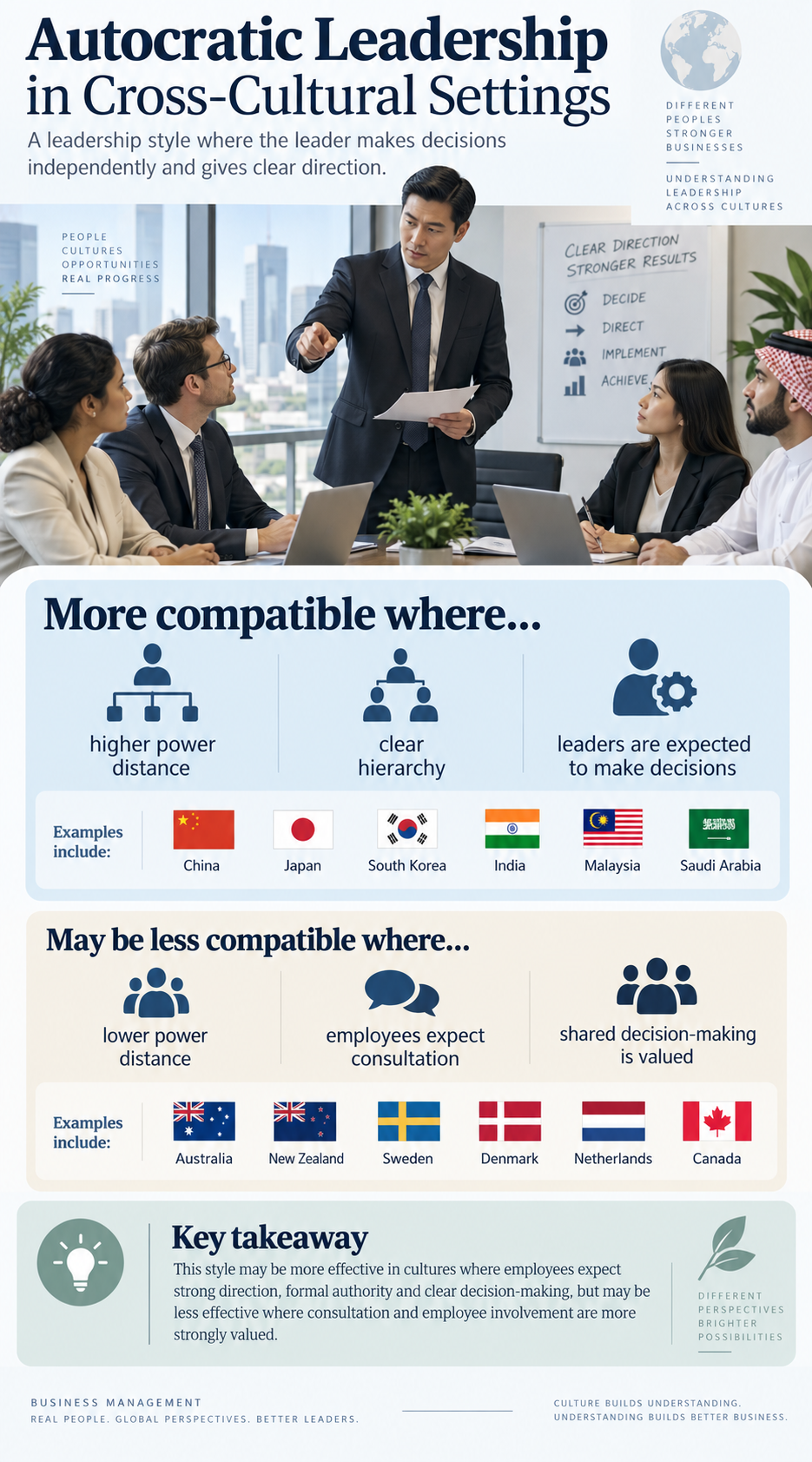
Autocratic leadership is a style in which the leader makes decisions independently, communicates clear instructions and expects employees to follow directions with limited consultation.
In a cross-cultural setting, the leader may still need the speed, clarity and control of an autocratic approach, but the way instructions, feedback and authority are communicated may need to change.
A leader should not assume that every employee from a particular country will respond in the same way. Cultural knowledge provides useful clues, but effective leaders also learn the expectations of the actual team and individuals they are leading.
Why autocratic leadership may need to be adapted
Expectations about authority
Some employees may expect a leader to be clearly authoritative and decisive, while others may expect a more egalitarian relationship and greater opportunity to question decisions.
Adaptation: retain clear accountability, but explain who makes the decision, why the decision is required and where employee input is still welcome.
Communication style
Very direct instructions may be valued for clarity in one setting but interpreted as rude, aggressive or disrespectful in another.
Adaptation: keep instructions precise while adjusting tone, language, pace and the level of explanation.
Feedback and saving face
Public criticism may cause embarrassment or damage trust in teams where preserving dignity and relationships is especially important.
Adaptation: give corrective feedback privately and respectfully while keeping performance standards clear.
Consultation and employee voice
Employees with specialist knowledge may become frustrated if an autocratic leader never asks for their ideas, particularly in professional, creative or technically complex work.
Adaptation: collect information or opinions before the leader makes the final decision.
Relationship and trust expectations
In some settings, employees and business partners may expect relationships and trust to be established before accepting strong direction.
Adaptation: invest time in relationship-building and explain the purpose behind instructions rather than relying only on positional authority.
When autocratic leadership may be most suitable
- Emergency or crisis situations — rapid decisions are more important than lengthy consultation.
- Safety-critical work — employees must follow clear procedures in areas such as manufacturing, mining, aviation or construction.
- New or inexperienced employees — staff may initially require clear instructions, close supervision and defined expectations.
- Strict quality or legal requirements — the business may need consistent compliance across different countries.
- Time-sensitive implementation — a global project may require one clear decision-maker to coordinate action quickly.
Important: a leader should not choose autocratic leadership simply because they assume a national culture “likes hierarchy”. The task, employee experience and actual team expectations still matter.
Benefits and limitations in a cross-cultural setting
Benefits
- Provides clear direction when language differences or uncertainty could otherwise create confusion.
- Allows fast decisions in crises, safety incidents and highly time-sensitive situations.
- Can create consistent standards across global operations.
- May suit inexperienced employees who need greater guidance and structure.
Limitations
- Can reduce employee voice, creativity and local market insight.
- Direct communication may be interpreted differently across cultures.
- Employees may feel disrespected if decisions are imposed without explanation.
- Overuse may damage trust, motivation and commitment in diverse teams.
Applied example — global manufacturing safety incident
An Australian manager leading a culturally diverse overseas manufacturing team discovers a machinery fault that creates an immediate safety risk. In this situation, an autocratic approach is appropriate because production must stop immediately and there is no time for a group discussion.
However, the leader can still adapt the style cross-culturally. Instructions should be simple, translated where necessary and communicated respectfully. Once the immediate danger is controlled, the leader can privately explain the reason for the shutdown and invite employees to contribute local knowledge about what caused the problem.
This preserves the speed and accountability of autocratic leadership while reducing misunderstanding and showing respect for the diverse workforce.

How to write this in an exam
Autocratic leadership involves the leader making decisions independently and giving employees clear instructions with limited consultation. In a cross-cultural setting, the leader could adapt by retaining clear direction but explaining decisions respectfully and inviting feedback where time allows. This is important because employees may have different expectations about authority, consultation and communication. As a result, the leader can maintain speed and accountability while reducing misunderstanding and improving employee acceptance.
🤝 Participative leadership in a cross-cultural setting
What is participative leadership?
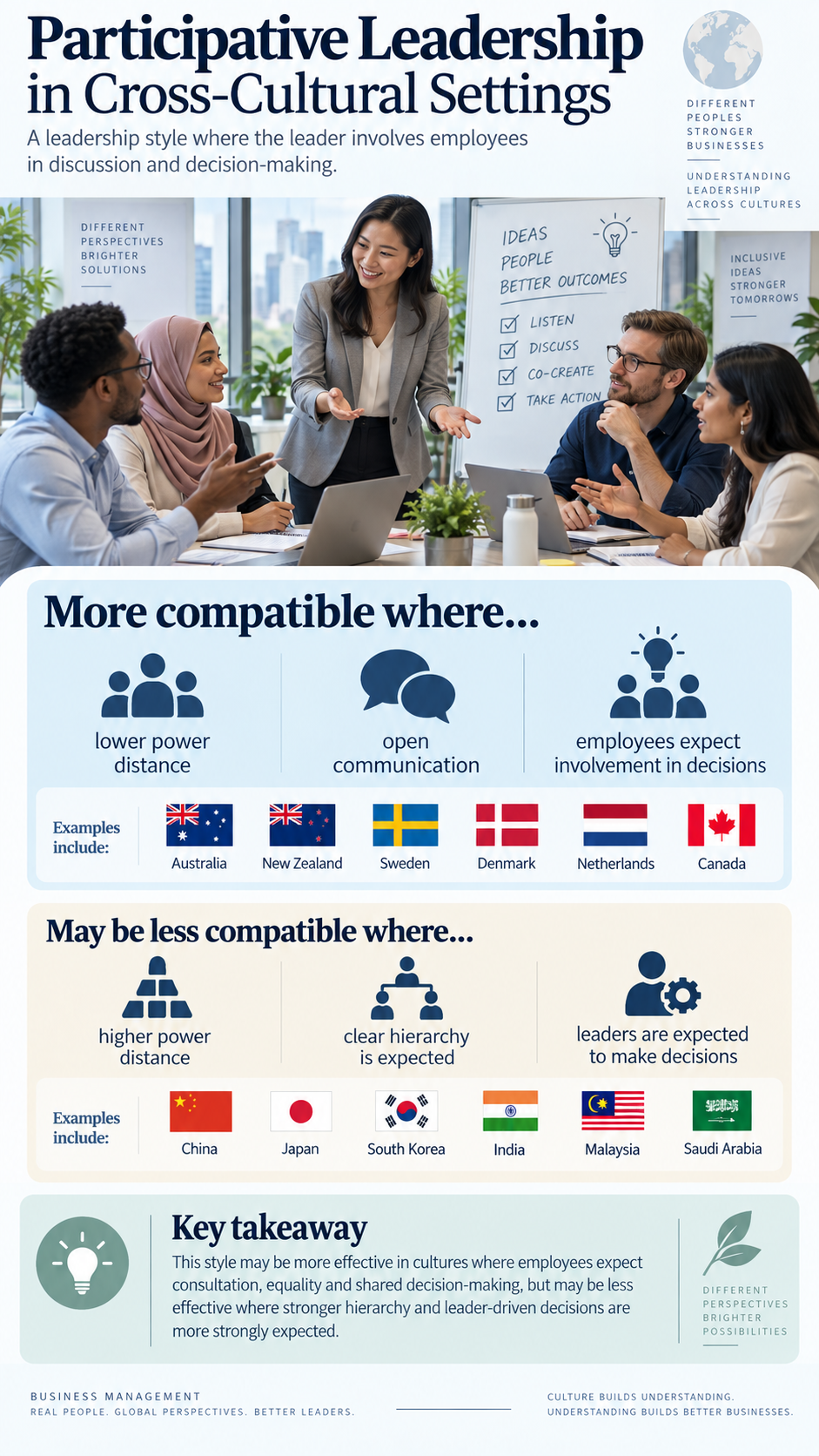
Participative leadership is a style in which the leader involves employees in discussion and problem-solving, seeks their ideas and feedback, and considers their input before making a final decision.
It can be especially valuable in cross-cultural teams because employees from different backgrounds may contribute local knowledge, language skills, market understanding and different perspectives.
However, participative leadership also needs adaptation. Simply asking “Does anyone have any ideas?” in a large meeting may not create genuine participation if some employees are uncomfortable disagreeing with a senior manager or speaking publicly.
How participative leadership can be adapted cross-culturally
Create more than one way to contribute
Some employees may readily speak in meetings while others prefer to reflect before responding.
Adaptation: combine meetings with written feedback, anonymous surveys, one-to-one conversations or digital collaboration tools.
Use smaller groups or private consultation
Employees may be reluctant to challenge a senior leader publicly, particularly where hierarchy is strongly respected.
Adaptation: use small-group discussion or private conversations before the main meeting.
Clarify that disagreement is acceptable
Employees may not know whether the leader genuinely wants different opinions or is only being polite.
Adaptation: explicitly explain that constructive disagreement and alternative ideas are welcome.
Manage language differences
Fluent speakers can dominate discussion even when other employees have stronger technical or local knowledge.
Adaptation: provide agendas early, allow preparation time, use plain language and offer translation or written follow-up where required.
Clarify how the final decision will be made
Participation can create frustration if employees believe consultation means everyone will get their preferred outcome.
Adaptation: explain what is open for consultation, who makes the final decision and how employee input will be used.
When participative leadership may be most suitable
- Experienced or specialist employees — staff have useful technical knowledge the leader may not possess.
- Global product development and innovation — different cultural perspectives can improve ideas and identify local customer needs.
- Strategic alliances, mergers and joint ventures — consultation can build trust and reduce the feeling that one partner is imposing decisions on another.
- Change management — employees may be more willing to support changes they have helped shape.
- Complex problems with no obvious answer — diverse knowledge can improve the quality of the final decision.
Benefits and limitations in a cross-cultural setting
Benefits
- Captures local knowledge and different cultural perspectives.
- Can improve creativity and decision quality.
- Builds trust, inclusion and employee ownership.
- Can improve acceptance of international change, alliances or new procedures.
Limitations
- Decision-making can be slower when many views must be considered.
- Some employees may be uncomfortable openly challenging senior leaders.
- Language differences can affect who participates most confidently.
- Different expectations about consensus can create frustration or delay.
Applied example — Australian software business entering Japan
Imagine an Australian software business developing a new product for Japanese customers. A participative leader could involve Australian developers and Japanese employees in product and marketing decisions because the Japanese team may understand local customer expectations, language and business practices that the Australian manager does not.
To adapt the style, the leader could distribute questions before meetings, collect written ideas, use smaller discussions and allow employees to provide feedback privately. This reduces the pressure on employees who may be less comfortable openly disagreeing with a senior manager in a large meeting.
The result is still participative leadership, but the method of participation is adapted so more employees can contribute effectively.

How to write this in an exam
Participative leadership involves employees contributing ideas and feedback before the leader makes the final decision. In a cross-cultural setting, the leader could adapt by using smaller-group discussions, private consultation or written feedback rather than relying only on open meetings. This is important because employees may differ in their willingness to challenge authority or speak publicly. As a result, the business can gain more local knowledge and diverse ideas while improving trust and employee commitment.
🔄 Situational leadership in a cross-cultural setting
What is situational leadership?
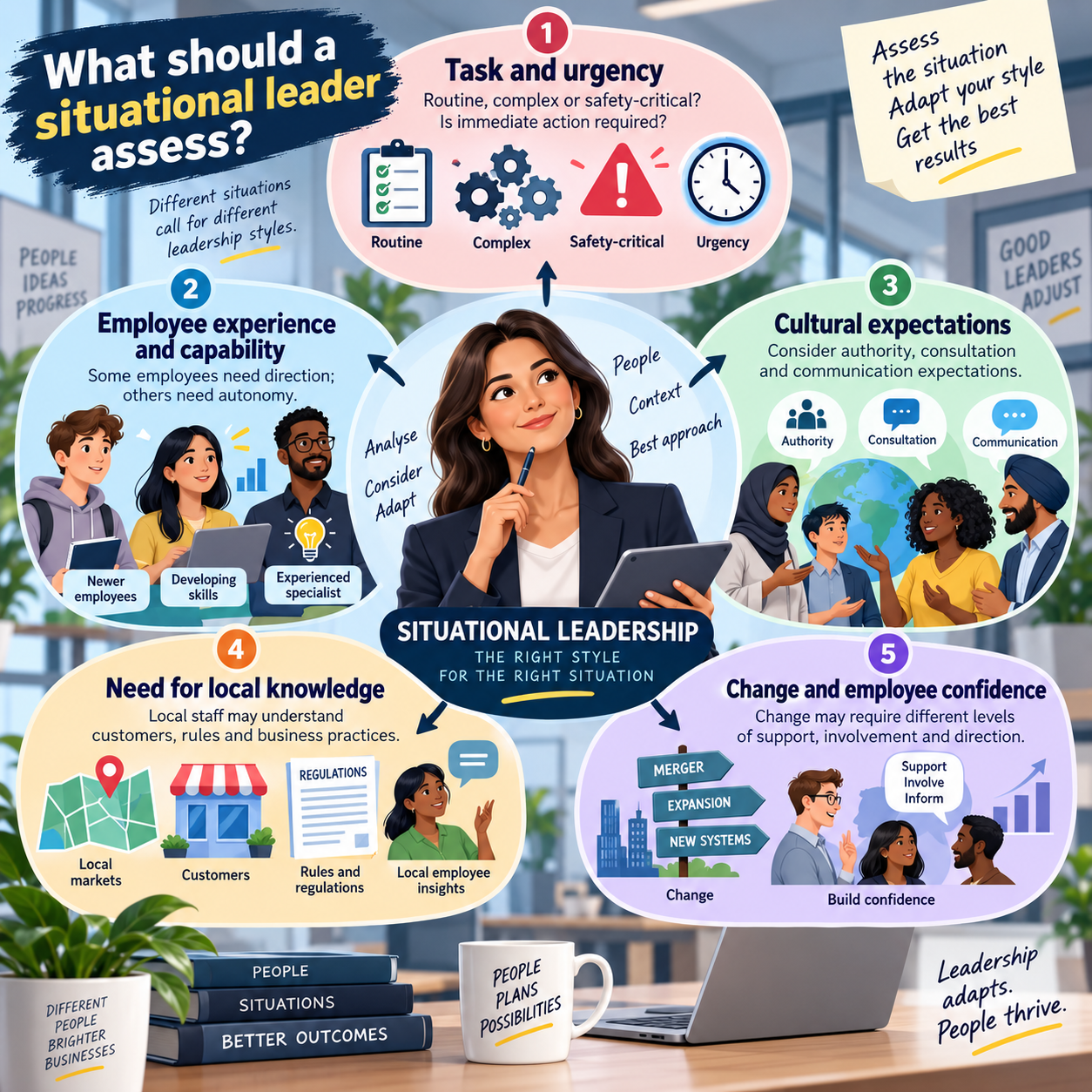
Situational leadership is a flexible leadership style in which the leader changes their approach according to the task, urgency, employee experience, team needs and cultural setting.
In a cross-cultural workplace, situational leadership is especially useful because the same approach may not suit every employee, task or location. A leader may need to be more directive in one situation and more participative or supportive in another.
The aim is not to keep changing style randomly. Effective situational leadership requires the leader to diagnose the situation, select the most suitable approach and explain the change clearly.
What should a situational leader assess?
Task and urgency
Is the decision routine, complex or safety-critical? Is there time for consultation, or is immediate action required?
Employee experience and capability
Inexperienced employees may need clearer direction, while experienced specialists may benefit from greater autonomy and consultation.
Cultural expectations
The leader should consider expectations about authority, consultation, feedback, relationships and communication without stereotyping individual employees.
Need for local knowledge
A leader entering a foreign market may need more participative input from employees who understand customers, regulations or local business practices.
Change and employee confidence
During mergers, restructuring or global expansion, employees may require different amounts of information, support, involvement and direction.
Matching the style to the cross-cultural situation
| Situation | Likely approach | Why |
|---|---|---|
| Immediate safety incident | More autocratic | Speed and clear instructions are required. |
| New employees unfamiliar with procedures | More directive at first | Employees need structure, explanation and close guidance. |
| Experienced multicultural innovation team | More participative | Different expertise and cultural perspectives can improve the decision. |
| Global merger causing employee anxiety | Directive + participative/supportive | The leader needs to provide clear direction while also listening, explaining and building acceptance. |
| Foreign market where the leader lacks local knowledge | More participative | Local employees can provide market, language and cultural insight. |
| Critical deadline after consultation is complete | More decisive/autocratic | The leader may need to finalise the decision and coordinate fast execution. |
Benefits and limitations in a cross-cultural setting
Benefits
- Allows leadership to match the task, urgency and employee needs.
- Can respond to different expectations about authority and participation.
- Balances clear direction with employee involvement.
- Can improve trust, change acceptance and performance in diverse teams.
Limitations
- Requires strong judgement and cultural intelligence from the leader.
- Frequent changes may appear inconsistent or unfair.
- Employees may become confused if the reason for changing style is not explained.
- The leader may misread cultural or individual expectations and choose the wrong approach.
Applied example — international merger
An Australian manager helping integrate a newly merged overseas business could use situational leadership rather than applying one style to every issue.
For safety procedures, legal requirements or urgent production problems, the manager may use clear autocratic direction. When redesigning workflows or adapting products for the local market, the manager could use participative methods because experienced local employees have useful knowledge. Employees who are anxious about the merger may also need more explanation and supportive communication.
The value of situational leadership is that the manager can preserve necessary standards while adjusting how much direction, consultation and support is used in each situation.

Memory hook
AUTOCRATIC = leader decides.
PARTICIPATIVE = leader consults.
SITUATIONAL = leader adjusts.
How to write this in an exam
Situational leadership involves changing the leadership approach according to the task, employee capability and circumstances. In a cross-cultural setting, a manager could use more autocratic direction when safety or urgency requires immediate action, but shift toward participative leadership when experienced local employees can contribute valuable cultural or market knowledge. This is important because one leadership approach may not suit every employee or situation. As a result, the leader can improve communication, trust and performance while still meeting business objectives.
🎧 Prefer listening?
If you prefer listening to the content in podcast format:
🎥 Prefer watching?
If you prefer watching the content in video format:
🃏 Flashcards
Card 1 of 12
🎮 Revision Games
💰 BME Millionaire
Climb the prize ladder. Use your lifelines wisely.
👔 Business Boss
Make 10 real management decisions. Every choice changes your KPIs — sometimes for better and worse.
⚡ 60 Second Showdown
A fast-paced 60-second challenge testing key BME knowledge under pressure.

Biz Fact: Disneyland Paris had to adjust elements of its American management approach to better suit European employees.
Past Exam Questions
Use these past exam questions to see how this dotpoint has been assessed. Pay close attention to the command term, the number of marks and whether the question is Section 1 or Section 2.
Section 1 Questions
2017 — Section 1 — Question 3(a) — 3 marks
Context
The board of MIXT Enterprises is looking to expand operations internationally and employ a new management team.
3(a): Describe one leadership style and why it may need to be adapted in a cross-cultural setting. (3 marks)
Command term focus: Describe
Describe: give the main characteristics or features with enough detail to show what it is like.
See the full command term guide here: Command Terms.
3(a) Sample answer
Autocratic leadership is a style in which the leader makes decisions independently, gives clear instructions and allows limited employee input. It may need to be adapted in a cross-cultural setting because employees can have different expectations about authority, consultation and communication. For example, a MIXT manager could retain final decision-making authority but explain decisions more respectfully and invite feedback where appropriate so overseas employees understand and accept the direction being given.
2018 — Section 1 — Question 1(b) — 2 marks
Context
Great leaders have vision and integrity and can be described as being outstanding strategic planners. However, these leadership qualities are sometimes not enough for successful business decision-making in a global environment. It is equally important for leaders to be ethical to ensure long-term management success in their businesses.
1(b): Describe why a global business leader might adapt their autocratic leadership style in a cross-cultural setting. (2 marks)
Command term focus: Describe
Describe: give the main characteristics or features with enough detail to show what it is like.
See the full command term guide here: Command Terms.
1(b) Sample answer
A global leader may need to adapt an autocratic style because employees from different cultural backgrounds may have different expectations about hierarchy, consultation and how directly a manager should communicate. A leader who gives orders in exactly the same way everywhere may therefore create misunderstanding or resentment, so they may need to adjust their communication and allow appropriate employee input while still retaining final authority.
2024 — Section 1 — Question 5(b) — 4 marks
Context
A culturally-aware leader who performs well in cross-cultural settings requires certain leadership styles and traits.
5(b): Discuss how an autocratic leadership style can be adapted to a cross-cultural setting. (4 marks)
Command term focus: Discuss
Discuss: examine relevant advantages and disadvantages or points for and against, then weigh them up.
See the full command term guide here: Command Terms.
5(b) Sample answer
One way an autocratic leader can adapt is to retain clear authority but increase explanation and respectful two-way communication. The leader may still make the final decision, which preserves speed and accountability, but explain why the decision is necessary and invite questions. This can reduce misunderstanding where employees have different expectations about authority. However, consultation may make some decisions slower, so it should be limited when urgency or safety requires immediate action.
A second adaptation is to change the way feedback and instructions are delivered. For example, corrective feedback could be given privately rather than through blunt public criticism, while instructions may be simplified or translated where language differences exist. This can protect trust and employee dignity without weakening performance standards. However, if the leader becomes so cautious that expectations are unclear, the original advantage of autocratic leadership — decisive direction — may be lost.
Section 2 Questions
2020 — Section 2 — Question 8(c) — 8 marks
Case study / context
Joho and Pez are entrepreneurs and partners in a successful broadcast media business, specialising in the production of podcasts. Beginning as a small independent outlet with a handful of programs made in-house, it has now grown to be a business with more than 20 employees.
By entering into a global strategic alliance, Joho and Pez will continue to grow their business. It will provide the opportunity to increase profits and gain access to more resources, expertise and funding. There is also potential in a global strategic alliance to have access to a diverse labour force and reduce marketing, research and development costs.
In a global strategic alliance, Joho and Pez and their employees will need to respond to different communication protocols, ethical practices, cultural beliefs and levels of education. It is anticipated that the workplace will be far more diverse in a global strategic alliance.
Joho and Pez are acutely aware of how any change to the structure of their business will have an impact on their employees. They pride themselves on maintaining a positive staff culture and seek to continually improve the work environment. They are aware staff may be resistant to the change at first; therefore, Joho and Pez will need to provide structure, information and guidance to prepare their employees for this change.
8(c): Describe participative and autocratic leadership styles and explain how Joho and Pez could adapt one of these styles in a cross-cultural setting. (8 marks)
Command term focus
Describe: give the main characteristics or features of each leadership style.
Explain: show cause and effect by explaining why or how the adaptation works and the result. Section 2 requires application.
See the full command term guide here: Command Terms.
8(c) Sample answer
Participative leadership is a style in which the leader involves employees in discussion and problem-solving, seeks their ideas and feedback, and considers their input before making a final decision. Communication is mainly two-way and employees have greater influence over decisions.
Autocratic leadership is a style in which the leader makes decisions independently, gives clear instructions and expects employees to follow directions with limited consultation. Authority is more centralised and communication is usually more one-way.
Joho and Pez could adapt a participative leadership style when working within the global strategic alliance by changing how employee input is collected. Rather than relying only on open group discussions, they could provide agendas in advance, use smaller multicultural working groups and allow written or private feedback. This is important because employees from different cultural backgrounds may vary in their willingness to disagree publicly with a senior leader, their confidence using a shared language and their expectations about hierarchy. Using several consultation methods would allow Joho and Pez to gain ideas from employees who may otherwise remain silent.
This adaptation would also help Joho and Pez manage resistance to the alliance. Employees from both organisations could contribute ideas about communication protocols, work practices and the implementation of change. As a result, Joho and Pez could gain cultural and operational knowledge from the diverse workforce while increasing trust, employee ownership and acceptance of the new alliance. They should still explain who has final decision authority so participation does not create confusion or excessive delays.
2021 — Section 2 — Question 6(b) — 6 marks
Case study / context
Laffitaya is an Australian business that produces high-end hiking and camping clothing. The clothing offers protection from all weather elements that hikers may encounter. It offers insulation, breathable technology, waterproof performance and is lightweight for all hiking and camping conditions. The manufacturing process of the clothing is labour intensive to ensure the garments meet the quality controls of Laffitaya’s management.
The Chief Executive Officer (CEO) of Laffitaya, Quinn, is looking to expand into the Asian market by merging with a Singaporean outdoor supplies business, ExDex Outdoors. The news of the merger has caused many employees in both businesses to be nervous, as they have heard rumours about potential job losses, leadership restructuring and changes to policy in relation to leave entitlements and daily procedures. There has also been talk of increased financial costs associated with the merger, which is creating concern among employees.
Harrison, the operations manager at Laffitaya, is travelling to Singapore to meet with the team at ExDex Outdoors to implement the processes that are used in Australia to ensure the highest standards are maintained in the production of the clothing. Harrison is very efficient and always meets quality control targets. He is also known for his direct nature and tends to talk down to staff, making decisions alone rather than having open communication with his team.
Laffitaya’s CEO, Quinn, is concerned that Harrison may not be aware of cultural considerations required to conduct successful business negotiations in Singapore. Quinn has therefore organised a meeting with Harrison to discuss potential communication strategies to ensure that the best outcome for Laffitaya is achieved.
6(b): Explain two benefits of Harrison adapting his leadership style from autocratic to situational. (6 marks)
Command term focus: Explain
Explain: show cause and effect by explaining why or how something happens and the result. Section 2 requires application.
See the full command term guide here: Command Terms.
6(b) Sample answer
Benefit 1 — improved communication and trust: By moving from a fixed autocratic approach to situational leadership, Harrison could remain directive when quality or safety standards require clear instructions but use a more participative and respectful approach when discussing how Australian procedures should operate in Singapore. This is important because ExDex employees may interpret Harrison’s direct manner differently and may be less willing to cooperate if they feel talked down to or ignored. As a result, adapting the amount of direction and consultation could reduce misunderstanding, build trust and make employees more willing to accept the merger and new procedures.
Benefit 2 — better use of local knowledge and stronger implementation: Situational leadership would allow Harrison to involve experienced ExDex employees when their knowledge of Singaporean work practices, employees and production conditions is useful, while still taking firm control when a quality problem requires immediate action. This is important because local employees may identify practical issues that Harrison cannot see from an Australian perspective. As a result, Laffitaya could adapt its processes more effectively, maintain its quality standards and improve employee ownership of the changes, increasing the likelihood that the merger is implemented successfully.