
U1.01 — Types of Business Ownership in Small to Medium Enterprises (SMEs)
Overview
Dotpoint 1: types of business ownership in small to medium enterprises (SMEs).
A business ownership structure refers to the legal form of a business and determines who owns the business, how it is controlled, how profits are distributed and the legal responsibilities of the owners.
When starting a business, choosing the most appropriate ownership structure is an important decision because each structure has different advantages, disadvantages, costs and legal requirements.
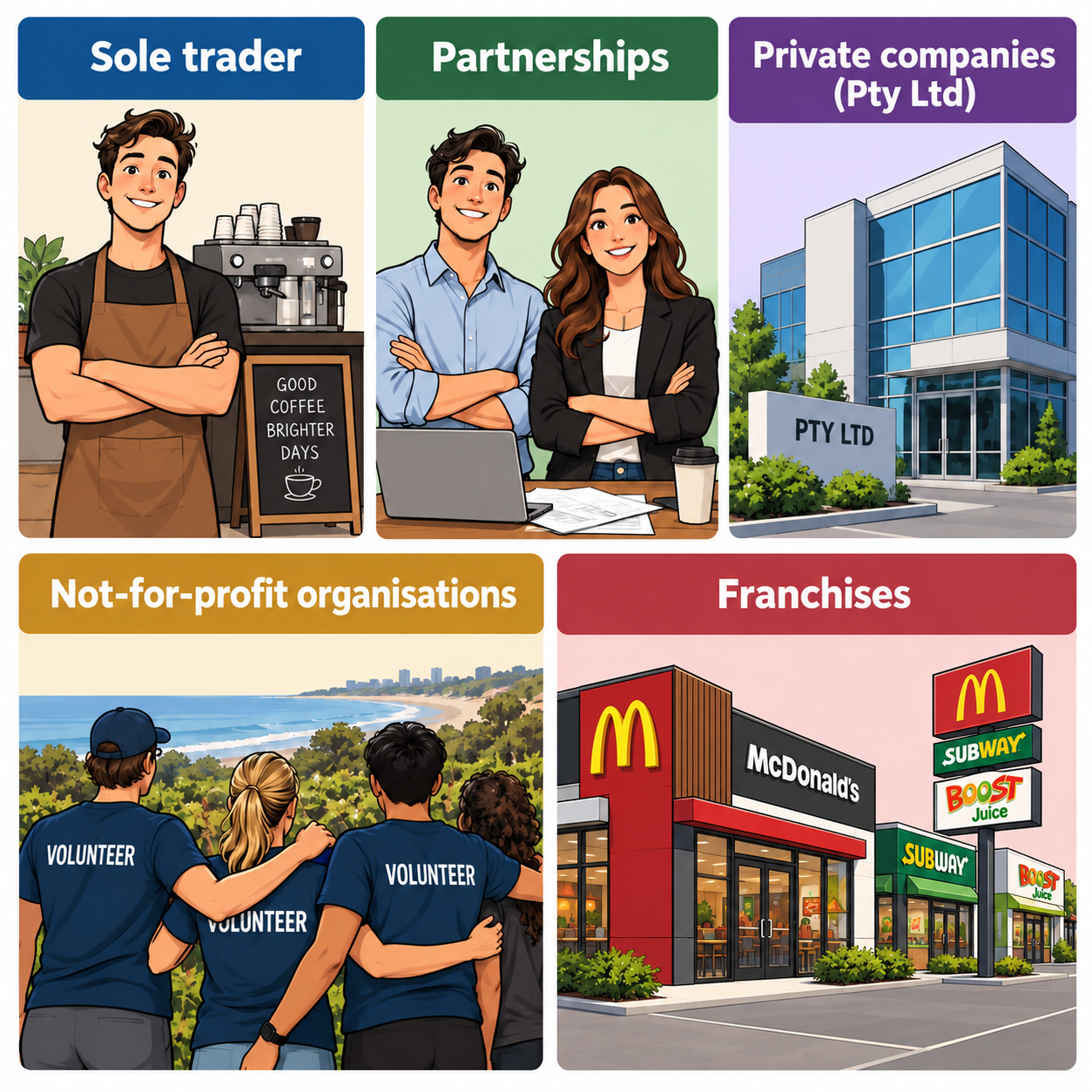
For small and medium-sized enterprises (SMEs), the main forms of business ownership include:
- Sole traders
- Partnerships
- Private companies (Pty Ltd)
- Not-for-profit organisations
- Franchises
SMEs in Australia
SME stands for Small to Medium Enterprise. In Australia, business size is commonly grouped using employee numbers, and an SME is commonly defined as a business with fewer than 200 employees.
Business size categories and SME snapshot
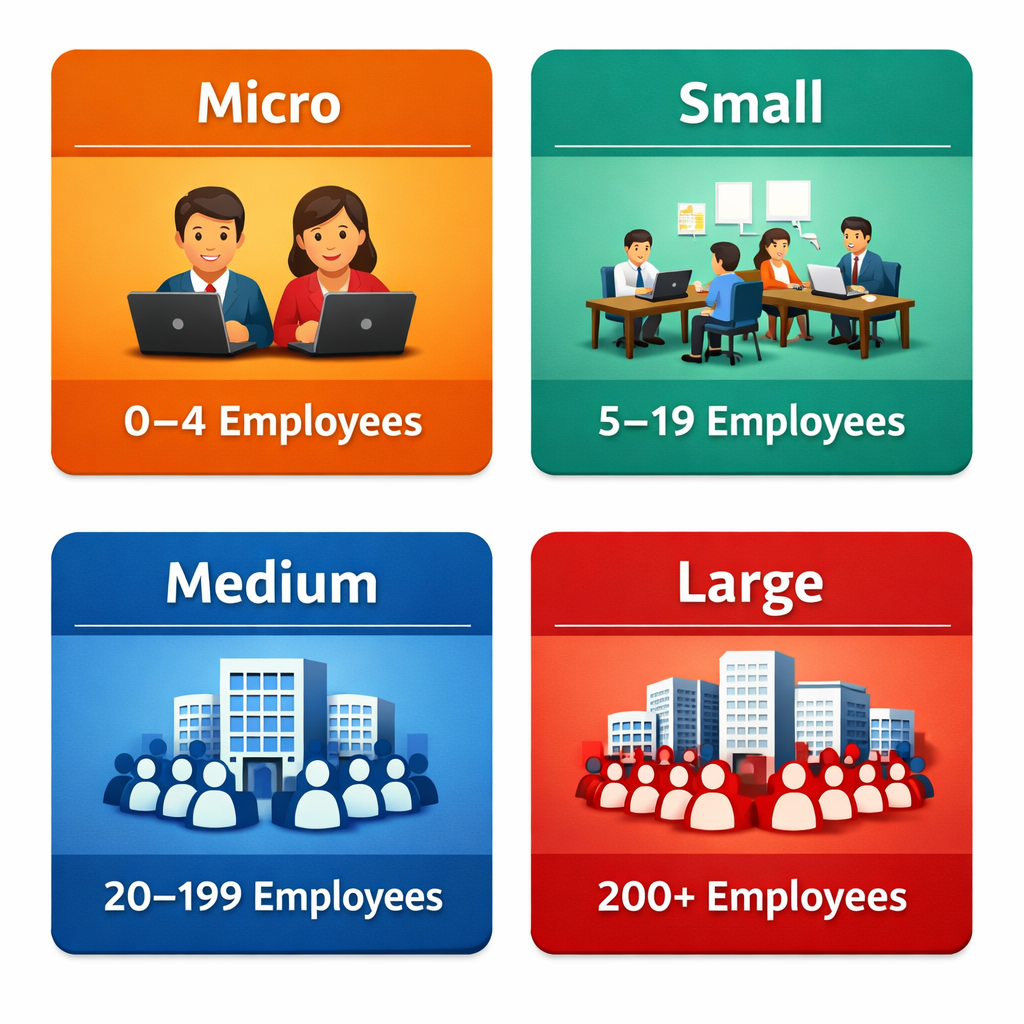
Australian businesses are commonly grouped by the number of employees they have:
- Micro: 0–4 employees
- Small: 5–19 employees
- Medium: 20–199 employees
- Large: 200+ employees
SMEs include micro, small and medium businesses.
SME snapshot (Australia)
- About 2.73 million actively trading businesses exist in Australia.
- Around 97% of all Australian businesses are small businesses (0–19 employees).
- Small businesses contribute roughly one-third of Australia’s GDP (over $590 billion).
- SMEs (small & medium) employ over 5 million people, around 42% of private-sector employment.
ATO context (turnover test)
In some tax contexts, the ATO uses turnover. A business is generally treated as a small business entity if its aggregated turnover is under $10 million.
Common SME characteristics
Small and medium-sized enterprises (SMEs) operate on a much smaller scale than large multinational businesses such as BHP, Apple or Google. As a result, the way they are managed and operate can be quite different.
- Owner-managed: owners are closely involved in daily operations and major decisions.
- Limited resources: smaller budgets, fewer staff, and less bargaining power than large businesses.
- Cash-flow sensitive: slow trading periods can quickly affect rent, wages, and supplier payments.
- Local focus: many SMEs operate in a suburb, region, or Perth-wide market.
- Flexible: SMEs can often change prices, products, or promotions quickly.
WA examples of SMEs
- Local cafés and restaurants
- Trades operating across Perth suburbs (electricians, plumbers, roof carpenters)
- Local gyms and fitness studios
- Family-run retail stores in shopping strips
- Small medical and allied health clinics (physio, dental, podiatry)
- Online WA micro-brands selling products Australia-wide (skincare, apparel, handmade goods)
Sole trader
Sole trader: a business owned and run by one person. The owner makes decisions and receives the profits (even if staff are employed).
Key characteristics
- No separate legal entity: the owner and the business are legally the same, so business debts, contracts, and legal claims attach to the owner personally.
- Tax treatment: business profit is included in the owner’s personal income tax return (the business is not taxed as a separate entity).
- Unlimited Liability: the owner is personally responsible for all business debts; if the business cannot pay, personal assets (e.g., savings, car, and potentially the family home depending on circumstances and security) can be used to repay creditors.
- Fast decisions: the owner can quickly change prices, suppliers, products, or trading hours without needing approval from others.
- Common in services: often based on the owner’s skill, reputation, and customer relationships.

- Low cost and fewer formalities to start.
- Full control over decisions and direction.
- Owner keeps all profits after tax.
- Simple structure to operate and change over time.
- Close customer relationships can build loyalty quickly.
- Unlimited Liability: there is no legal separation between owner and business, so personal assets can be used to cover business debts and legal claims if the business fails.
- Limited access to finance compared to companies (lenders often assess the owner’s personal financial position).
- Workload pressure because the owner covers many roles (operations, marketing, admin, and customer service).
- Business may slow if the owner is sick or away because key skills/decisions sit with one person.
- Growth can be limited unless the structure changes (e.g., incorporating as a Pty Ltd).
WA examples
- Independent tradies across Perth (electrician, plumber, roof carpenter, painter)
- Mobile businesses (dog groomer, car detailing, coffee van)
- Solo professionals (photographer, tutor, personal trainer)
- Market stall operators (Fremantle Markets, Subiaco Farmers Market)
- Home-based businesses (cakes/catering, online reselling, handmade craft orders)
Example of how to write this in an exam
A sole trader is a business owned and operated by one person, with the owner and the business treated as the same legal entity. One advantage is that the owner has complete control over decision-making, so changes to prices, suppliers, products or trading hours can be made quickly without needing approval from other owners. The owner also keeps all profits after tax. However, a major limitation is unlimited liability. Because there is no legal separation between the owner and the business, the owner is personally responsible for business debts and legal claims. If the business cannot meet its obligations, personal assets such as savings or a vehicle may be used to repay creditors. This makes a sole trader simple and flexible to operate, but financially riskier for the owner.
Partnership
Partnership: two or more people operating a business together and sharing profits, responsibilities, and decision-making.
Key characteristics
- Shared ownership: partners contribute money, skills, and labour, and share profits in an agreed ratio (often set out in a partnership agreement).
- Governed by legislation: in WA, partnerships operate under the Partnership Act 1895 (WA).
- Binding actions: contracts entered into by one partner are legally binding on the entire partnership, making all partners responsible for the obligations (even if the other partners were not present when the contract was signed).
- Tax treatment: the partnership reports total profit/loss for the business, then this amount is allocated to partners according to the agreed profit-sharing ratio; each partner includes their share in their personal tax return and pays tax at personal income tax rates.
- Unlimited Liability: partners can be personally responsible for partnership debts; if the business cannot pay, creditors may pursue partners’ personal assets to recover money owed.
Silent Partner
A silent partner is a partner who invests money in the business but does not take part in day-to-day management.
- In a general partnership → the silent partner still has unlimited liability and can lose personal assets for business debts.
- Not being involved does not reduce this responsibility.
- In a limited partnership → liability can be limited to the amount invested, provided the silent partner stays out of management.
- Lower set-up costs than a company.
- More finance than a sole trader (multiple owners contribute).
- Shared workload and ability to specialise roles.
- More ideas and skills for decision-making.
- Can appear more stable to customers and suppliers.
- Profits must be shared.
- Disagreements can slow decisions or damage relationships.
- Unlimited Liability: partners are not protected by a separate legal entity, so personal assets can be used to repay partnership debts if the business cannot meet its obligations.
- Changes in partners can be complex (exit, buy-outs, disputes).
- Decision-making can be slower than a sole trader if partners disagree.
WA examples
- Accounting firms and small law firms in Perth (partners share client bases)
- Medical or dental practices owned by multiple practitioners
- Family-run hospitality venues (two siblings or spouses co-owning)
- Small building companies where two tradespeople co-own the business
- Creative agencies (design/video) run by two co-founders
Example of how to write this in an exam
A partnership is a business owned by two or more people who share ownership, responsibilities, decision-making and profits. One advantage is that each partner can contribute finance, skills and experience, giving the business access to more resources than a sole trader and allowing the workload to be divided between the owners. This can also improve decision-making because more than one person contributes ideas. However, a major limitation of a general partnership is unlimited liability. Partners can be personally responsible for partnership debts, and one partner may enter into a contract that legally binds the entire partnership. Therefore, a poor decision by one partner can create financial consequences for the others, making trust and a clear partnership agreement important.
Private company (Pty Ltd)
Private company (Pty Ltd): a company that is a separate legal entity, owned by shareholders and managed by directors.
Key characteristics
- Separate legal identity: the company is legally separate from its owners, so it can own assets, sign contracts, borrow money, and be sued in its own name (not in the owners’ personal names).
- Limited Liability: because the company is a separate legal entity, shareholders’ financial loss is generally limited to what they invested (e.g., the value of their shares); creditors usually cannot automatically take shareholders’ personal assets to pay company debts.
- Ownership via shares: shareholders invest by purchasing shares and may receive profits as dividends (or profits may be reinvested for growth).
- Different to a public company: a public company can raise funds from the public and may be listed on the ASX. A private company is not listed and does not sell shares to the general public.
- More regulation: directors have legal duties and the company must meet ASIC/ATO requirements.
- Limited Liability: personal assets are generally protected because the company is legally separate; owners usually risk only their investment in the company (not their personal property) if the business fails.
- Easier to attract finance and investment for growth.
- More credibility with banks, suppliers, and contracts.
- The business can continue even if owners change.
- Clear structure supports employing staff and expanding operations.
- More expensive to establish and operate.
- More paperwork and reporting than simpler structures.
- Directors carry legal duties and potential penalties.
- Some information is public (ASIC registers).
- Accounting and taxation are more complex.
WA/Australian examples
- The Little Posy Co. (Perth-based delivery business)
- Bathers Beach House (Fremantle hospitality business)
- Construction businesses in Perth that employ multiple crews (builders, plumbing companies)
- WA tech start-ups in Perth (often use Pty Ltd to attract investors)

Example of how to write this in an exam
A private company (Pty Ltd) is a separate legal entity owned by shareholders and managed by directors. One major advantage is limited liability. Because the company is legally separate from its owners, shareholders generally risk only the amount they have invested and their personal assets are usually protected from company debts. A company can also make it easier to attract finance, employ staff and continue operating when ownership changes. However, a private company is more expensive and complex to establish and operate than a sole trader or partnership. Directors must meet legal duties and the business must comply with additional ASIC, accounting, taxation and reporting requirements. Therefore, the structure provides greater protection and growth potential, but with higher costs and administration.
Not-for-profit organisation
Not-for-profit: an organisation that exists to achieve a community purpose, and reinvests any surplus back into its mission rather than paying profits to owners.
Key characteristics
- No owners: not-for-profits are governed by a board or committee.
- Surplus reinvested: any “profit” is used to improve services, facilities, or programs.
- Funding mix: can include membership fees, fundraising, sponsorship, grants, donations, and service revenue.
- High accountability: strong expectations for transparency, especially with grants/donations.
- Volunteer involvement: many rely on volunteers, but some employ paid staff as well.
- Strong public trust and community support.
- May access grants, donations, and tax concessions.
- Clear mission can create loyal stakeholders.
- Volunteers can lower costs and boost community engagement.
- Creates long-term community outcomes.
- Funding can be unpredictable (grants and donations vary).
- Governance can slow decisions.
- Harder to pay competitive wages (staff retention challenge).
- Often limited capacity to expand without extra funding.
- Detailed reporting requirements for funders and regulators.
WA examples
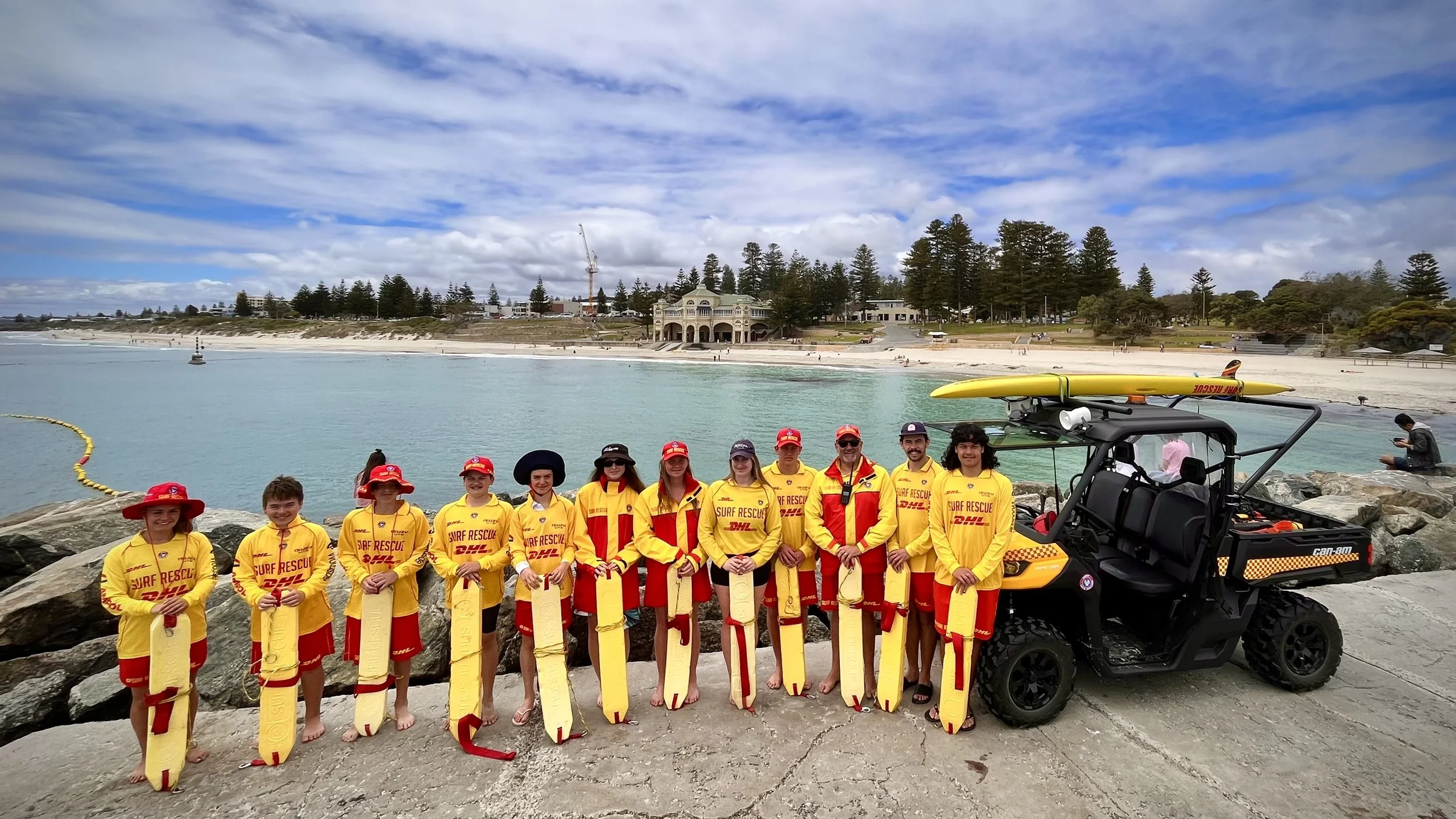
- Surf Life Saving clubs (Cottesloe, Scarborough, Sorrento)
- Suburban sporting clubs (AFL, netball, cricket, hockey)
- Local community groups (youth services, disability support, mental health support)
- Charities that operate op shops and services across Perth
Example of how to write this in an exam
A not-for-profit organisation exists to achieve a community or social purpose rather than distribute profit to owners. Any surplus earned is reinvested into the organisation’s services, facilities or programs. One advantage is that a strong community purpose can build public trust and attract volunteers, donations, sponsorship and government grants, helping the organisation deliver services at a lower cost. However, a limitation is that funding can be unpredictable because grants and donations may change from year to year. This can make it difficult to plan long-term expansion, employ additional staff or maintain services. As a result, not-for-profits may have strong community support but can face financial uncertainty.
Franchise
Franchise: a business arrangement where a franchisee buys the right to operate under a franchisor’s brand and business system in return for fees and ongoing royalties.
Key characteristics
- Brand + system: franchisees follow established procedures to keep products and service consistent.
- Fees: usually pay an upfront fee plus ongoing royalties and marketing contributions.
- Support: franchisors often provide training, advertising, suppliers, and ongoing guidance.
- Less independence: franchisees must follow rules about branding, products, and operations.
- Regulated: franchising in Australia is regulated under the Franchising Code of Conduct.
- Instant brand recognition and customer trust.
- Training and support reduces start-up mistakes.
- National marketing campaigns can drive demand.
- Approved suppliers make ordering easier.
- Often lower risk than building an unknown new brand.
- High start-up costs and ongoing fees reduce profit.
- Limited flexibility and creativity.
- Must follow strict rules and procedures.
- Reputation depends on the whole franchise network.
- Long contracts can make it difficult to exit early.
WA examples
- Food and drink: Boost Juice, Subway, Domino’s, Grill’d, Nando’s
- Fitness: Anytime Fitness, Snap Fitness, F45
- Services: Jim’s Mowing, Jim’s Cleaning, Poolwerx, Hire A Hubby
- Retail and convenience: 7-Eleven, The Coffee Club, Bakers Delight

Example of how to write this in an exam
A franchise is a business arrangement where a franchisee pays for the right to operate using the franchisor’s established brand, products and business system. One advantage is that the franchisee starts with an existing brand, proven operating procedures, training, supplier arrangements and marketing support. This can reduce some of the risk involved in starting an entirely new business and may help attract customers more quickly. However, the franchisee has less independence because they must follow the franchisor’s rules about products, branding and operations. They also usually pay an upfront franchise fee, ongoing royalties and marketing contributions. These costs can reduce profit, while the actions of other franchisees can affect the reputation of the whole network.
Summary table — quick comparison
| Type | What it is | Liability | Profits | WA examples |
|---|---|---|---|---|
| Sole trader | One person owns and runs the business (the owner and business are legally the same). | Unlimited — the owner is personally responsible for debts; personal assets can be used to repay creditors if the business cannot pay. | The owner keeps all profits after tax. |
|
| Partnership | Two or more owners share responsibility and profit, usually under a partnership agreement. | Unlimited/shared — partners can be personally responsible for partnership debts; personal assets may be pursued if the business cannot meet obligations. | Profit is shared between partners (as agreed) and taxed as personal income. |
|
| Pty Ltd | Separate legal entity owned by shareholders, managed by directors. | Limited — shareholders usually risk only their investment; creditors typically pursue the company’s assets rather than owners’ personal assets. | Profits can be reinvested or paid to shareholders as dividends. |
|
| Not-for-profit | Runs to achieve a mission; any surplus is reinvested back into services or programs. | Varies (often limited) depending on structure. | Surplus is reinvested into the organisation’s purpose. |
|
| Franchise | Franchisee runs an outlet using the franchisor’s brand and operating system. | Varies (depends on franchisee’s legal structure). | Franchisee keeps profit after royalties and required fees. |
|
🎧 Prefer listening?
If you prefer listening to the content in Podcast format:
🎥 Prefer watching?
If you prefer watching the content in video format:
🃏 Flashcards
Card 1 of 13
🎮 Revision Games
💰 BME Millionaire
Climb the prize ladder by mastering business ownership structures.
🏗️ Business Builder
Complete five Australian SME projects by choosing the ownership structure that best fits each brief.
⚡ 60 Second Showdown
A varied 60-second challenge covering ownership structures, liability and key characteristics.
Biz Fact: In Australia, small and micro businesses (0–19 employees) make up over 95% of all businesses.