
General U1.05 - The Relationship Between Business Growth and Innovation
Overview
Dotpoint 5: the relationship between business growth and innovation.
Business growth is an increase in the size, scale or performance of a business over time. It may be shown through higher sales, increased profit, more customers, a larger workforce, greater market share or expansion into new markets.
Innovation can support business growth by helping a business create better products and services, improve efficiency, reach new customers and strengthen its competitive position.
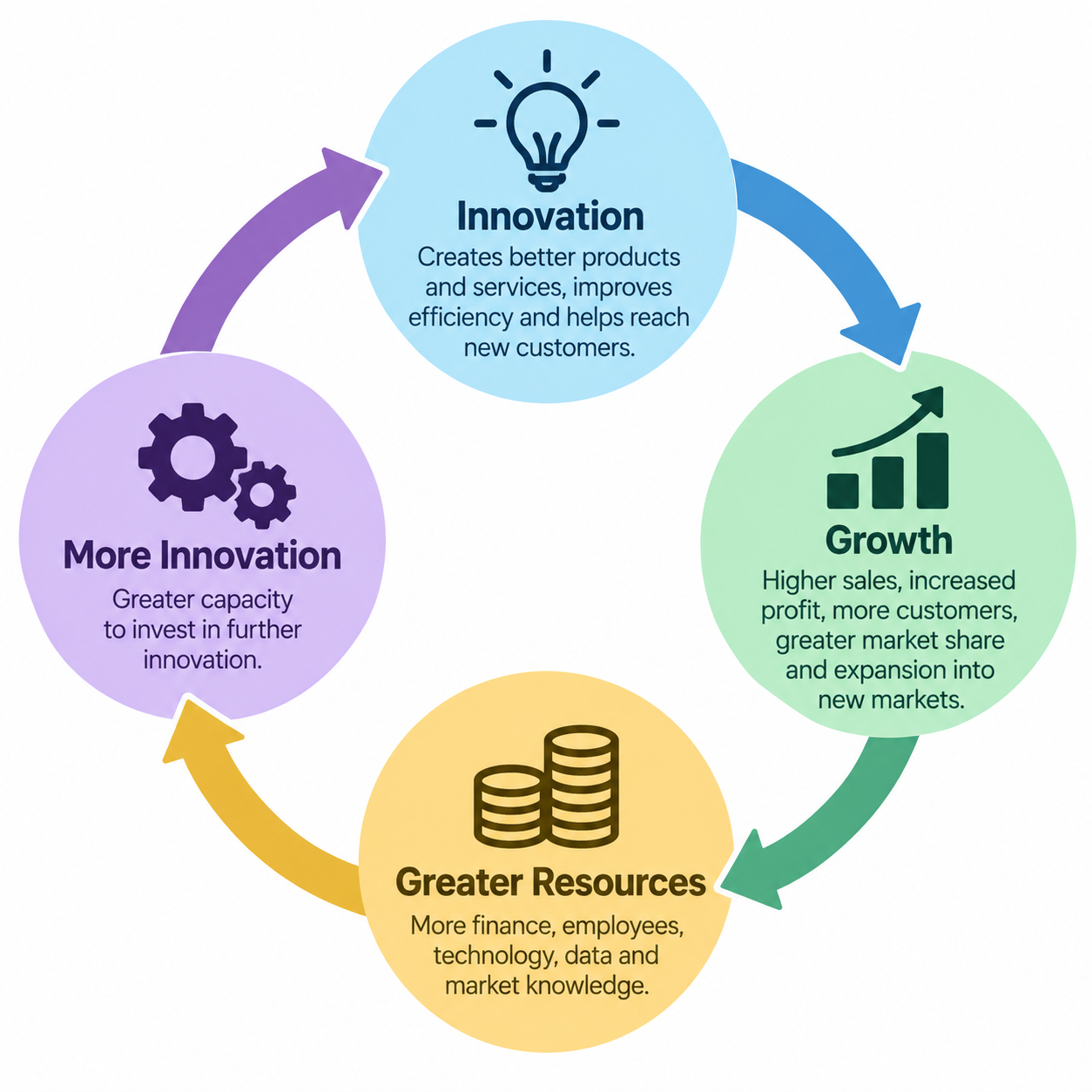
The relationship also works in the opposite direction. As a business grows, it may gain more finance, employees, technology, data and market knowledge, giving it greater capacity to invest in further innovation.
This creates a potential cycle: Innovation → Growth → Greater Resources → More Innovation. However, the relationship is not automatic. Innovation involves cost and risk, and business growth can create pressure if the business expands faster than it can manage.

How innovation can lead to business growth
Innovation can create new pathways for growth
Innovation can help a business grow when it creates greater value for customers or improves the way the business operates. If customers respond positively, the business may attract more buyers, increase sales, enter new markets or operate at a larger scale.
The most important link is the cause-and-effect relationship: innovation changes something about the business, that change improves customer value or business performance, and this can contribute to growth.
The examples below show four common ways innovation can support business growth.
Cochlear: innovation supporting global growth
Cochlear is an Australian hearing-technology company that has grown by continually improving cochlear implant technology, sound processors, connectivity and hearing-care services.
The business invests heavily in research and development to improve hearing outcomes, ease of use and connected care. Its ongoing innovation has helped it build a major international presence, with products sold in more than 180 countries and a workforce of more than 4,200 employees.
Cause and effect: continued product and service innovation improved the value offered to customers → Cochlear reached more patients and markets around the world → the business grew in scale and revenue → greater scale provided more resources for further research and development.

How business growth can encourage further innovation
Growth can increase a business’s capacity to innovate
As a business grows, it may gain more financial and human resources. Higher sales and profits can provide money for research, technology, new equipment and product development. A larger workforce can also bring specialist knowledge and new ideas.
Growth can therefore make innovation easier because the business may have more resources available to experiment, test ideas and absorb the cost of unsuccessful trials.
The examples below show how growth can create the capacity for further innovation.
Fortescue: growth creating resources for innovation
Fortescue built a large-scale iron ore business in Western Australia. The scale and financial strength of its mining operations have provided a base for investment in new technologies and renewable-energy infrastructure.
Fortescue now invests in areas such as battery technology, renewable energy systems, autonomous equipment and lower-emissions industrial technology. In 2026, the company announced major new investment in Pilbara renewable-energy infrastructure and continued construction of large solar and battery projects.
Cause and effect: growth in the core mining business increased financial capacity and operational scale → the business could invest more heavily in technology and energy innovation → successful innovation may improve future efficiency and create new growth opportunities.

The two-way relationship between growth and innovation
A reinforcing cycle
Innovation and growth can reinforce each other over time. Innovation may create growth, and growth may then provide the resources for further innovation.
This is why the relationship is described as two-way. Neither factor always comes first, and businesses can move through the cycle several times as they develop.
Why innovation does not always create growth
Innovation creates an opportunity for growth, not a guarantee
A business may spend money developing an innovation that customers do not want, that costs too much to produce or that competitors copy quickly. The innovation may also be introduced at the wrong time or be poorly marketed.
For innovation to contribute to growth, it needs to create enough value for customers or improve business performance strongly enough to justify the cost and risk involved.
Why innovation does not always lead to growth
- Weak customer demand – customers may not value the innovation enough to buy it.
- High development cost – research, technology or launch costs may exceed the extra revenue or savings created.
- Implementation problems – new systems may create disruption, training needs or technical issues that reduce performance.
- Competitor response – competitors may imitate the idea, improve their own offer or reduce prices.
How business growth can be recognised
Growth can appear in several different ways
Business growth is not limited to opening more stores. A business can grow through higher sales, more customers, greater profit, a larger workforce, increased production capacity, rising market share or expansion into new geographic markets.
When examining the effect of innovation, students should identify the specific form of growth that may occur rather than simply saying “the business will grow”.

🎧 Prefer listening?
If you prefer listening to the content in podcast format:
🎥 Prefer watching?
If you prefer watching the content in video format:
🧑🏫 Class Activities
Hands-on activities
These activities are designed to help you apply the full content to real businesses through research, decision-making and practical classroom tasks.
How this section could be used: teachers could place students into small groups and allocate different activities, ask students to complete one or two activities each week, or use the activities at the end of each syllabus point so groups can take turns completing and presenting one task to the class. Activities can also be used as extension work, revision, or as a starting point for short class discussions.

1. Build the Cause-and-Effect Chain
Your group is given four innovations. For each one, build a complete chain showing how the innovation could lead to a specific form of business growth.
- A café introduces mobile pre-ordering.
- A clothing brand launches a recycled-material range.
- A gym introduces virtual personal training.
- A warehouse installs automated stock tracking.
For each scenario, use this structure: Innovation → immediate effect → customer/business impact → type of growth. Your final growth measure must be specific, such as sales, customers, profit, capacity or market share.
2. Cochlear Growth Investigation
Research how Cochlear has grown through continued innovation in hearing technology. Use Cochlear’s own website or another reliable source.
- Identify two significant product or service innovations developed by Cochlear.
- Find one current measure of Cochlear’s growth, such as countries served, workforce size or revenue.
- Explain how one innovation may have helped Cochlear reach more customers or markets.
- Explain how Cochlear’s growth may have provided more resources for further research and development.
- Present the relationship as a visual cycle rather than a simple list.
3. Fortescue: Growth Funding Innovation
Fortescue grew into a major WA iron ore producer and is now investing heavily in energy and industrial technology.
- Identify one Fortescue innovation or technology project.
- Explain what resources a large mining business can use to fund innovation.
- Explain how successful innovation could improve future efficiency or create new growth opportunities.
- Identify one risk if a major innovation project does not deliver the expected result.
Finish with: write a four-sentence explanation showing the two-way relationship between growth and innovation.
4. Does This Count as Growth?
For each scenario, identify the specific measure of business growth and explain whether the business is genuinely growing.
- Sales rise from $800,000 to $1.1 million, but profit falls.
- Customer numbers rise by 25% while average spending stays unchanged.
- A business opens in two new states but total sales stay flat.
- Automation allows output to rise by 40% with the same workforce.
- Market share rises from 8% to 12%.
Discuss why one measure alone may not always tell the whole story.
5. Innovation Failure Review
A local food business spends $120,000 developing an app. Customer research is limited, downloads are low and the app does not increase sales.
- Explain why the innovation did not automatically create growth.
- Identify two possible causes of the weak result.
- Recommend two actions the business should have taken before committing the full amount.
- Explain how a failed innovation could restrict future growth if it reduces available finance.
6. Growth and Innovation Strategy
A small Perth sportswear business has grown steadily and now has $250,000 available for expansion. It has strong customer loyalty but increasing competition from national brands.
Your group must recommend how the business should use its growth to support further innovation.
- Propose one product, process, marketing or service innovation.
- Explain how the business’s current growth makes the innovation more achievable.
- Explain how the innovation could create further growth.
- Identify one financial or operational risk.
- Recommend whether the business should proceed and justify your decision.
✍️ Short Answer Questions
Practice questions
Answer each question before opening the sample answer. Marks are based on the command term and the number of separate points requested.
Show sample answer
Business growth is an increase in the size, scale or performance of a business over time.
Show sample answer
Two measures are sales revenue and market share.
Show sample answer
A business may introduce a new or improved product that better meets customer needs. This can attract new customers or encourage existing customers to buy more because the product offers greater value than competing alternatives. As a result, sales revenue, customer numbers or market share may increase, creating business growth.
Show sample answer
Business growth may increase sales revenue, profit and the resources available to the business. This gives the business greater capacity to invest in research, specialist employees, technology or new product development. As a result, a growing business may be able to test and introduce further innovations that would have been too expensive or risky when it was smaller.
Show sample answer
A business could introduce automation that allows products to be made faster with fewer delays. This means more units can be produced using the same amount of time or labour. As a result, production capacity increases, allowing the business to meet higher demand and potentially increase sales.
Show sample answer
Cochlear can use innovation to improve hearing technology, connectivity and customer outcomes. This can increase the value of its products and services, helping the business reach more customers and international markets. As the business grows, it may gain more revenue, specialist employees and research capability. These additional resources can then support further research and development, leading to more innovation. The relationship is reinforcing because innovation can produce growth, while growth can increase the capacity to innovate again.
Show sample answer
An innovation may fail to create growth if customers do not value it enough to change their purchasing behaviour. This means the business may incur development and launch costs without generating enough additional sales or savings to recover those costs. As a result, profit and available finance may fall rather than increase, limiting business growth.
Show sample answer
Advantages: First, innovation may help a business attract new customers by creating a stronger or more convenient offer. Second, process innovation may reduce costs or increase capacity, improving profitability and allowing the business to expand.
Disadvantages: First, innovation can require significant spending on research, equipment, technology or marketing before the result is known. Second, the innovation may fail if customer demand is weak or competitors respond quickly, meaning the business may lose money rather than grow.
Show sample answer
I recommend reinvesting some of the additional profit into innovation where the business has identified a genuine customer or operational need. This is because growth gives the business greater financial capacity to test new products, processes or services without relying entirely on external finance. As a result, successful innovation could improve competitiveness and create further growth, while testing ideas on a manageable scale can reduce the risk of wasting the new resources.
Show sample answer
Advantage: innovation can support long-term growth by helping a business respond to changing customer needs, improve efficiency and differentiate itself from competitors. This can protect sales and create new growth opportunities.
Disadvantage: innovation is costly and uncertain, and some businesses may grow through strong execution, increased demand, geographic expansion or better use of an existing successful offer without introducing major innovations.
Judgement: innovation is not the only possible source of growth, but it becomes increasingly important when customer preferences, technology or competition are changing. Businesses that never improve their offer or operations may find it difficult to sustain growth over the long term.
🃏 Flashcards
Card 1 of 11
🎮 Revision Games
💰 BME Millionaire
Climb the prize ladder by linking innovation, business growth, resources and real business outcomes.
🧪 Growth Cycle Lab
Analyse ten business scenarios and decide how innovation and growth are linked.
⚡ 60 Second Showdown
A rapid-fire sprint through growth measures, innovation effects, risks and business scenarios.

Biz Fact: Amazon started with books – Amazon used online retail innovation to grow from selling books into one of the world's largest businesses.