
General U1.06 - The Environments of Business
Overview
Dotpoint 6: the environments of business.
Business environments are the internal and external surroundings that influence how a business operates, makes decisions and responds to change.
Every business is affected by forces inside and outside the organisation. Some factors are broad and beyond the business’s control, while others are much closer to day-to-day operations or can be directly managed by the business itself.
The three business environments are:
1. Macro environment
2. Operating environment
3. Internal environment
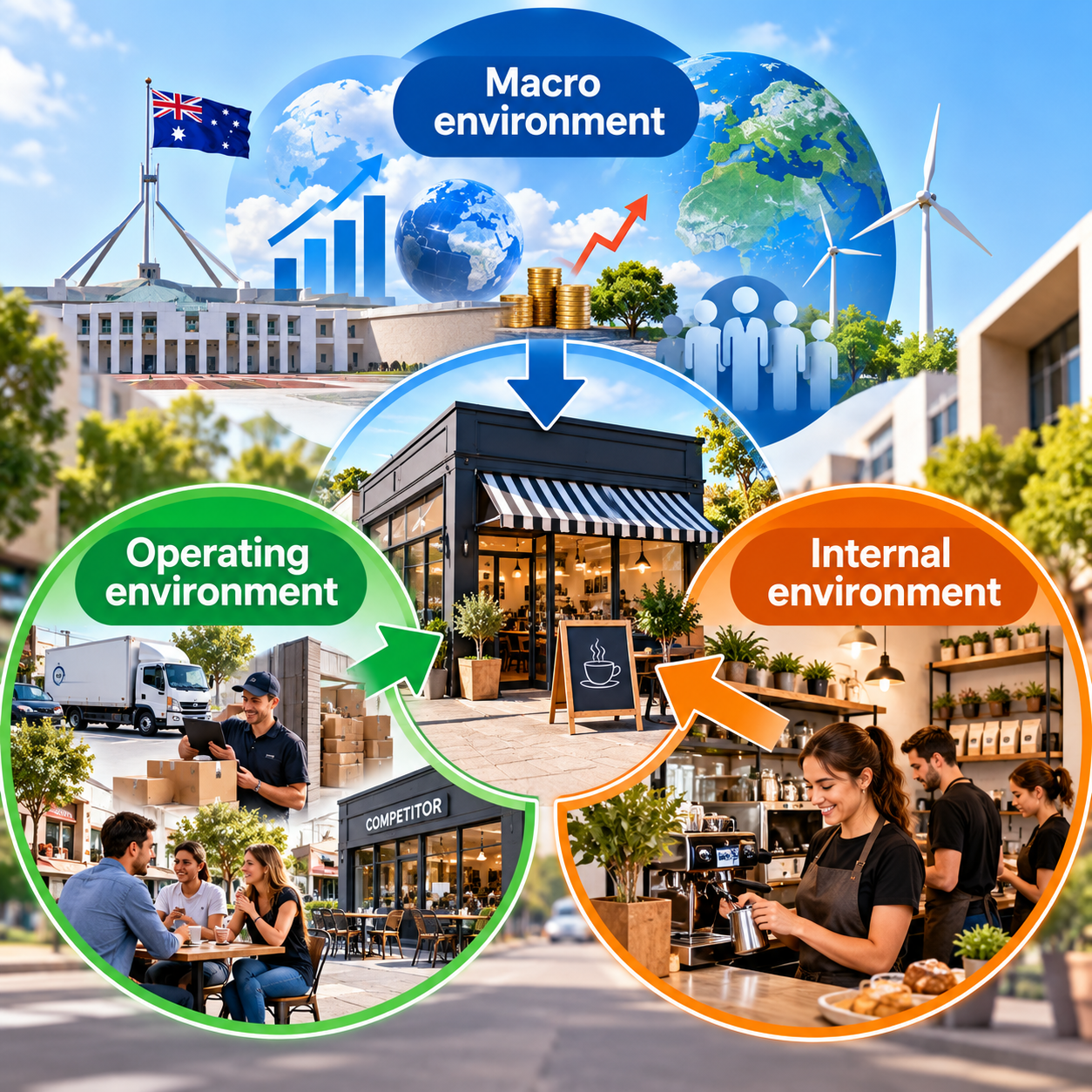
The macro environment
The macro environment includes large external forces that can affect many businesses across an industry, region or economy. Individual businesses have little or no direct control over these forces.
A business therefore needs to monitor, anticipate and respond to changes in the macro environment rather than trying to control them.
A useful way to organise these influences is the PESTLE framework: political, economic, sociocultural, technological, legal and environmental factors.
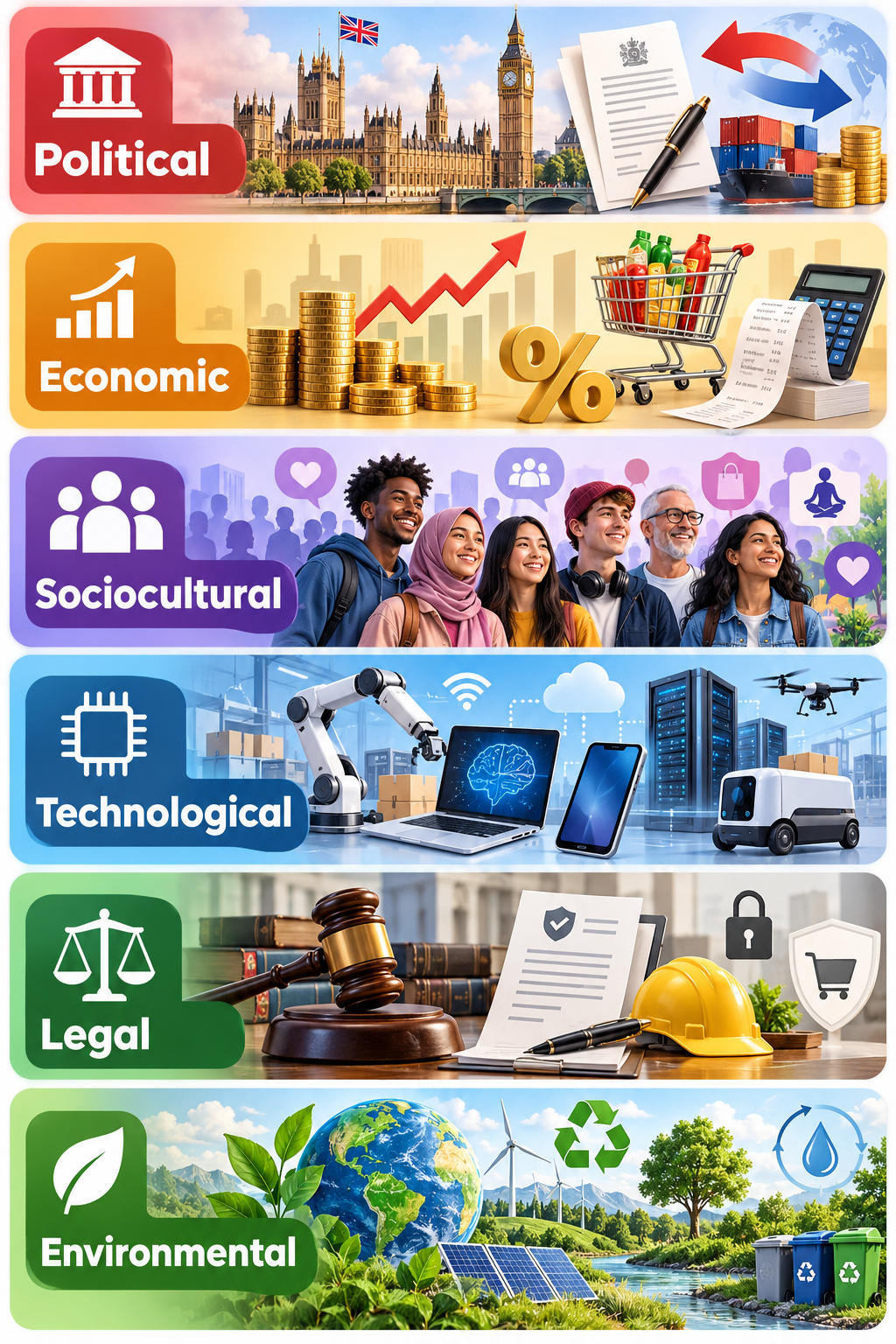
Example: interest rates and a small landscaping business
If interest rates rise, households may reduce spending on non-essential services such as large garden renovations. This can reduce demand for landscaping work because customers may delay projects or choose cheaper options. The landscaping business cannot control interest rates, but it may respond by offering smaller packages, adjusting prices or focusing on lower-cost maintenance services.
Key idea
The macro environment affects the business from the outside. The business cannot directly control these forces, but strong managers monitor them and adjust decisions when conditions change.
The operating environment
The operating environment includes external stakeholders and organisations that have a direct effect on the business’s day-to-day activities.
Unlike broad macro forces, these groups are much closer to the business. The business may be able to influence them through relationships, pricing, service, negotiation or marketing, but it cannot fully control their decisions.
The examples below show the main groups within the operating environment.
How to recognise it
- The factor is outside the business.
- It interacts directly with day-to-day operations.
- The business can often influence it, but cannot fully control it.
- It usually involves a stakeholder or organisation close to the business.

Example: a local café
A café may face rising prices from its coffee-bean supplier, a new competitor opening nearby and customers demanding faster takeaway service. These operating-environment pressures directly affect daily decisions. The café might negotiate with suppliers, improve service speed or introduce a loyalty program, but it cannot force suppliers, competitors or customers to behave in a particular way.
The internal environment
The internal environment includes factors inside the business that management can directly influence or control.
These factors shape how effectively the business performs, how employees work together and how consistently products or services are delivered.
The examples below show important parts of the internal environment.

Example: improving customer service
If a retailer receives complaints about poor service, management can train employees, improve rosters, set clearer service standards and change internal procedures. Because these factors are inside the business, management has much greater control over them than it has over macro or operating factors.
Control, influence and response
The key difference between the three environments
The environments can be distinguished by the level of control a business has over the factors within them.
This is one of the most important ideas in the dotpoint because it helps explain why businesses respond differently to different types of pressure.
The business monitors and responds to broad external forces.
Management can directly change many internal systems, resources and behaviours.
How the environments interact
Business environments do not operate separately
A change in one environment can create effects in another. Managers therefore need to look at how external and internal factors connect rather than treating each environment as a separate box.
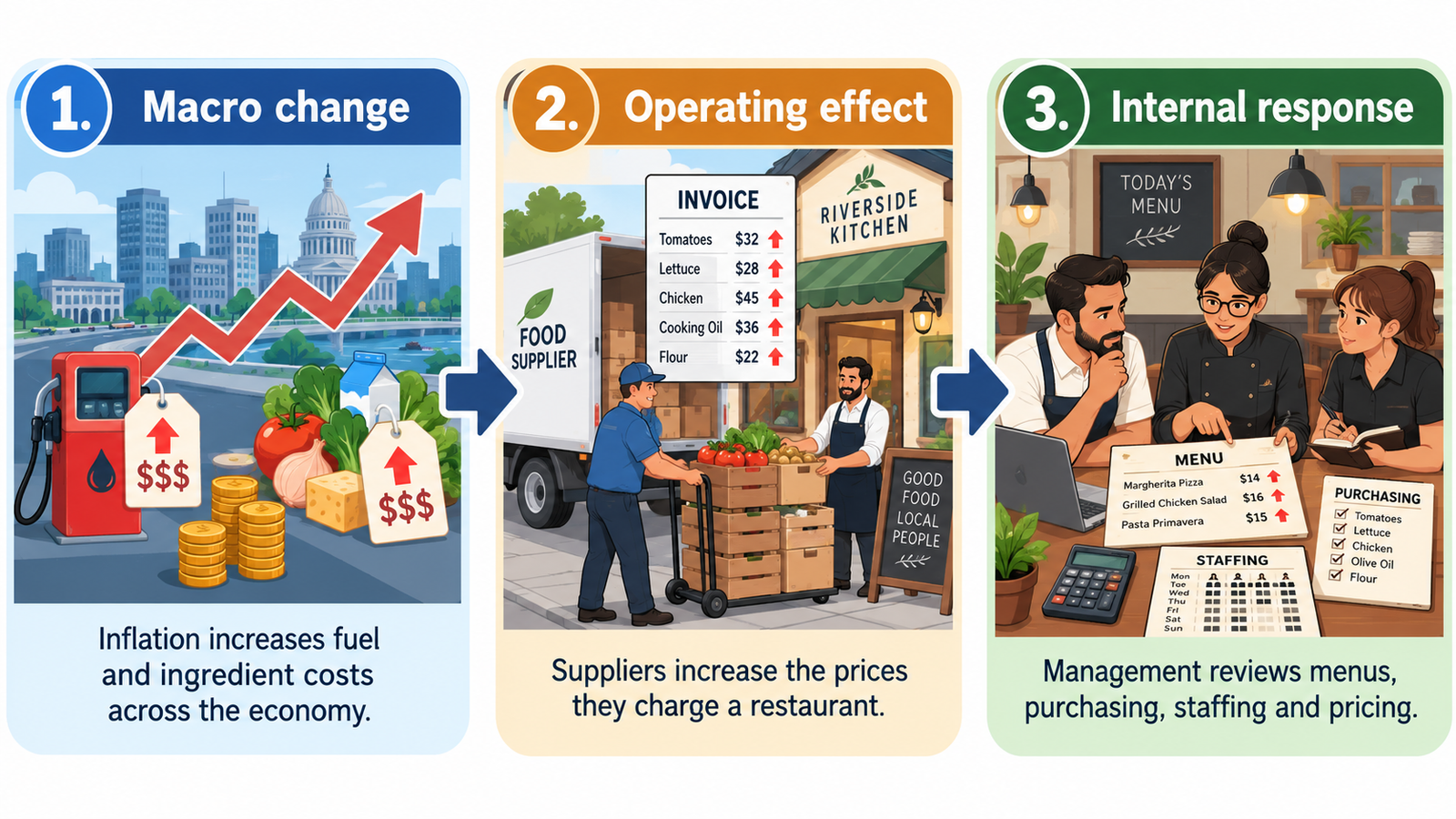
Why this matters
This example shows how a change in one environment can flow through the others. Inflation begins as a macro-environment pressure, which can cause suppliers in the operating environment to raise the prices they charge the restaurant. Management then responds internally by reviewing purchasing, menus, staffing or prices. The environments therefore interact, and managers need to understand the chain of effects rather than looking at each environment in isolation.
🎧 Prefer listening?
If you prefer listening to the content in podcast format:
🎥 Prefer watching?
If you prefer watching the content in video format:
🧑🏫 Class Activities
Hands-on activities
These activities are designed to help you apply the full content to real businesses through research, decision-making and practical classroom tasks.
How this section could be used: teachers could place students into small groups and allocate different activities, ask students to complete one or two activities each week, or use the activities at the end of each syllabus point so groups can take turns completing and presenting one task to the class. Activities can also be used as extension work, revision, or as a starting point for short class discussions.

1. Sort the Environment
Your group receives twelve business factors. Sort each one into the macro, operating or internal environment.
- Interest rates rise.
- A major competitor opens nearby.
- Employee morale falls.
- A supplier increases delivery fees.
- New privacy laws are introduced.
- Management changes the staff roster.
- Customers demand more sustainable packaging.
- Inflation increases input costs.
- The business upgrades its accounting software.
- A bank rejects a loan application.
- New AI technology becomes available.
- The business introduces a new customer-service policy.
Output: create an A3 classification poster with three labelled columns: Macro, Operating and Internal. Place all 12 factors into the correct column, then add three short written explanations for factors that could easily be confused.
2. Café Environment Scan
A busy suburban café is experiencing rising ingredient prices, a new competitor, complaints about slow service and increased demand for plant-based meals.
- Identify one macro factor.
- Identify two operating factors.
- Identify one internal factor.
- Explain the likely effect of each factor on the café.
- Recommend one response for each environment.
Output: complete a one-page group response sheet with four headings: Factor, Environment, Likely Effect and Recommended Response. Be ready to give a two-minute oral explanation of your group’s most important recommendation.
3. Build a PESTLE Scan
Choose a business or industry that your class knows well. Create a simple PESTLE scan showing one relevant factor under each heading.
- Political
- Economic
- Sociocultural
- Technological
- Legal
- Environmental
For each factor, add one sentence explaining how it could affect business decisions, costs, demand or operations. Rank the six factors from most important to least important for the business.
4. Control, Influence or Respond?
For each scenario, decide whether the business can control it, influence it or mainly respond to it.
- Employee training
- A competitor’s price cut
- National inflation
- Supplier contract terms
- Workplace culture
- Customer preferences
- Government regulation
- Internal safety procedures
Output: create a three-column table labelled Control, Influence and Respond. Sort each scenario into the correct column and write a one-sentence explanation underneath showing why control is highest internally and lowest in the macro environment.
5. Environment Chain Reaction
Your group must show how one external change can flow through all three environments.
Choose one starting point:
- inflation rises sharply;
- a new technology enters the market;
- new workplace legislation is introduced;
- consumer demand shifts towards sustainability.
Create a chain using this structure: Macro change → Operating effect → Internal response → Possible business outcome. Output: produce a landscape flowchart and deliver a 60-second oral explanation walking the class through each link in the chain.
6. Business Environment Strategy Meeting
You manage a growing local sportswear retailer. Interest rates have risen, a national competitor has opened nearby, one supplier is becoming unreliable and staff turnover has increased.
- Classify each issue into the correct environment.
- Explain the likely effect of each issue.
- Identify what the business can control, influence or only respond to.
- Develop one realistic management response for each issue.
- Decide which issue should receive the highest priority and justify your decision.
Output: prepare a one-slide management briefing and give a two-minute team presentation explaining your priority issue and recommended responses.
✍️ Short Answer Questions
Practice questions
Answer each question before opening the sample answer. Marks are based on the command term and the number of separate points requested.
Show sample answer
The macro environment includes broad external forces that affect businesses but are beyond their direct control.
Show sample answer
The operating environment contains external stakeholders such as customers, suppliers and competitors that directly interact with the business. The internal environment contains factors inside the business, such as employees, management, culture and resources, that management can directly influence or control.
Show sample answer
Economic factors include influences such as interest rates, inflation and unemployment, which can change customer spending and business costs. Technological factors include new technologies such as automation or AI, which can create opportunities for greater efficiency but may also require businesses to invest in new systems or skills.
Show sample answer
Higher interest rates increase the cost of borrowing for households. This can reduce the amount some customers are willing or able to borrow for a new home, lowering demand for building contracts. As a result, the home-building business may experience fewer sales and may need to delay expansion or adjust its pricing and product range.
Show sample answer
An unreliable supplier may deliver ingredients late or fail to provide the required quantity or quality. This can prevent the restaurant from preparing some menu items consistently, creating delays or disappointing customers. As a result, customer satisfaction and sales may fall unless the restaurant finds another supplier or changes its purchasing arrangements.
Show sample answer
Poor employee training is an internal-environment problem because management can directly influence staff skills and preparation. Employees who are not properly trained may make more mistakes, work less efficiently or provide weaker customer service. As a result, costs may rise, customer satisfaction may fall and the business’s overall performance may decline.
Show sample answer
A new technology may allow businesses to operate faster, more accurately or at lower cost. If competitors begin adopting the technology, the business may need to respond to protect its competitiveness. Management may therefore invest in new equipment or software and retrain employees to use it. This changes the internal environment by altering resources, employee skills and procedures, showing how a macro change can create internal business responses.
Show sample answer
Advantages: First, monitoring the macro environment can help a business identify threats such as rising costs or new regulation before they create serious problems. Second, it can reveal opportunities such as new technology or changing customer trends, allowing the business to respond earlier than competitors.
Disadvantages: First, monitoring broad external forces takes time and may require research or specialist advice. Second, managers may still make poor predictions because macro conditions can change quickly and are outside the business’s control.
Show sample answer
I recommend that the café first strengthen its value rather than automatically matching every price cut. The competitor is part of the operating environment, so the café cannot control its prices but can influence customers through service, quality, loyalty offers or a clearer point of difference. In this case, improving value may protect customer loyalty without damaging profit margins. As a result, the café can respond competitively while avoiding an unnecessary price war.
Show sample answer
Advantage of focusing on the internal environment: management has much greater control over employees, resources, culture and procedures, so improvements can be implemented directly and may quickly improve productivity or customer service.
Disadvantage: a strong internal environment cannot remove major external threats such as falling demand, new laws, inflation or aggressive competitors. A business that ignores external conditions may still perform poorly even if it is well managed internally.
Judgement: the internal environment is essential because it determines how effectively the business operates and responds, but long-term success depends on understanding all three environments. The strongest businesses manage what they can control internally while continuously adapting to operating and macro pressures.
🃏 Flashcards
Card 1 of 11
🎮 Revision Games
💰 BME Millionaire
Climb the prize ladder by classifying macro, operating and internal environments through realistic business scenarios.
🧪 Environment Scanner
Classify twelve business pressures and decide whether they belong to the macro, operating or internal environment.
⚡ 60 Second Showdown
A rapid-fire sprint through business environments, control levels, PESTLE factors and realistic scenarios.

Biz Fact: KFC ran out of chicken! – In 2018, hundreds of UK KFC restaurants closed temporarily when delivery problems left them without their most important ingredient. (Operating environment)