
General U1.09 - Legal Requirements in Setting Up Sole Traders and Partnerships
Overview
Dotpoint 9: legal requirements in setting up sole traders and partnerships.
Legal requirements are the registrations, rules and formal arrangements a business must consider when it is established so that it can operate lawfully and meet government obligations.
A sole trader and a partnership are both relatively simple business structures, but they are not set up in exactly the same way. The owner must identify the correct structure first, then complete the registrations and legal steps that apply.
This dotpoint focuses on six setup requirements:
1. Australian Business Number (ABN)
2. Business name
3. Business registration
4. Partnership Act 1895 (WA)
5. Partnership agreement
6. Registration of Tax File Number (TFN)

Australian Business Number (ABN)
Giving the business an official identifier
An Australian Business Number (ABN) is a unique 11-digit number used to identify a business when dealing with government, customers and other businesses.
Applying for an ABN is free through the Australian Business Register. Most businesses use an ABN because it is needed for important activities such as registering a business name and registering for GST.

👤 Sole trader
The individual applies for an ABN for the sole-trader business. The business is not a separate legal entity from the owner.
🤝 Partnership
The partnership needs its own ABN. This ABN identifies the partnership rather than simply using one partner’s individual ABN.
Example: two very different ABNs
Mia starts Mia Rossi Photography as a sole trader and applies for an ABN for her business activities. Later, Noah and Lily establish Coastal Garden Co as a partnership. The partnership applies for its own ABN because it is the partnership that carries on the business.

Do not confuse ABN with TFN
An ABN identifies the business. A TFN identifies a person or organisation within the tax system. They are different numbers with different purposes.
Official reference: Australian Business Register
Business name
The name customers see
A business name is the name a business operates under and presents to customers.
A business name must generally be registered with ASIC when the business trades under a name that is different from the legal name of the owner or owners.
Cost: Registering a business name is not free. ASIC charges a registration fee for either a 1-year or 3-year registration period. These government fees are indexed and can change over time, so the current amount should be checked with ASIC when registering.
“Amelia Chen” can trade under that personal name without registering a separate business name. Sole trader using a trading name
“Amelia’s Coastal Cakes” must be registered as a business name.
“Amelia Chen and Lucas Hall” does not require a separate business-name registration. Partnership using a trading name
“Coastal Cake Studio” must be registered as a business name.

Example: same owners, different requirement
If partners Olivia Tran and Jack Brown trade as “Olivia Tran and Jack Brown”, they can operate under the partners’ personal names. If they want customers to know the business as North Beach Electrical, that business name must be registered.
Registration is not the same as owning a trade mark
A trade mark is a form of legal protection for a brand name, logo, phrase or other sign that distinguishes a business’s goods or services from others in the market.
Registering a business name allows the business to trade under that name. It does not automatically give the owner the same exclusive legal protection as a registered trade mark.
Official reference: ASIC – Register a business name
Business registration
Business registration is a process, not one magic form
For a sole trader or ordinary partnership, “business registration” means completing the registrations that apply to the chosen structure. This can include an ABN, a business name and tax registrations.
A sole trader or ordinary partnership is not registered as a company. Company registration is a different process for businesses that choose a company structure.
Cost: There is no single fee called a “sole trader registration fee” or “partnership registration fee”. The total setup cost depends on which registrations apply. An ABN is free, while business-name registration and some industry licences or permits may involve fees.
Key business registration steps
Licences and permits can still apply
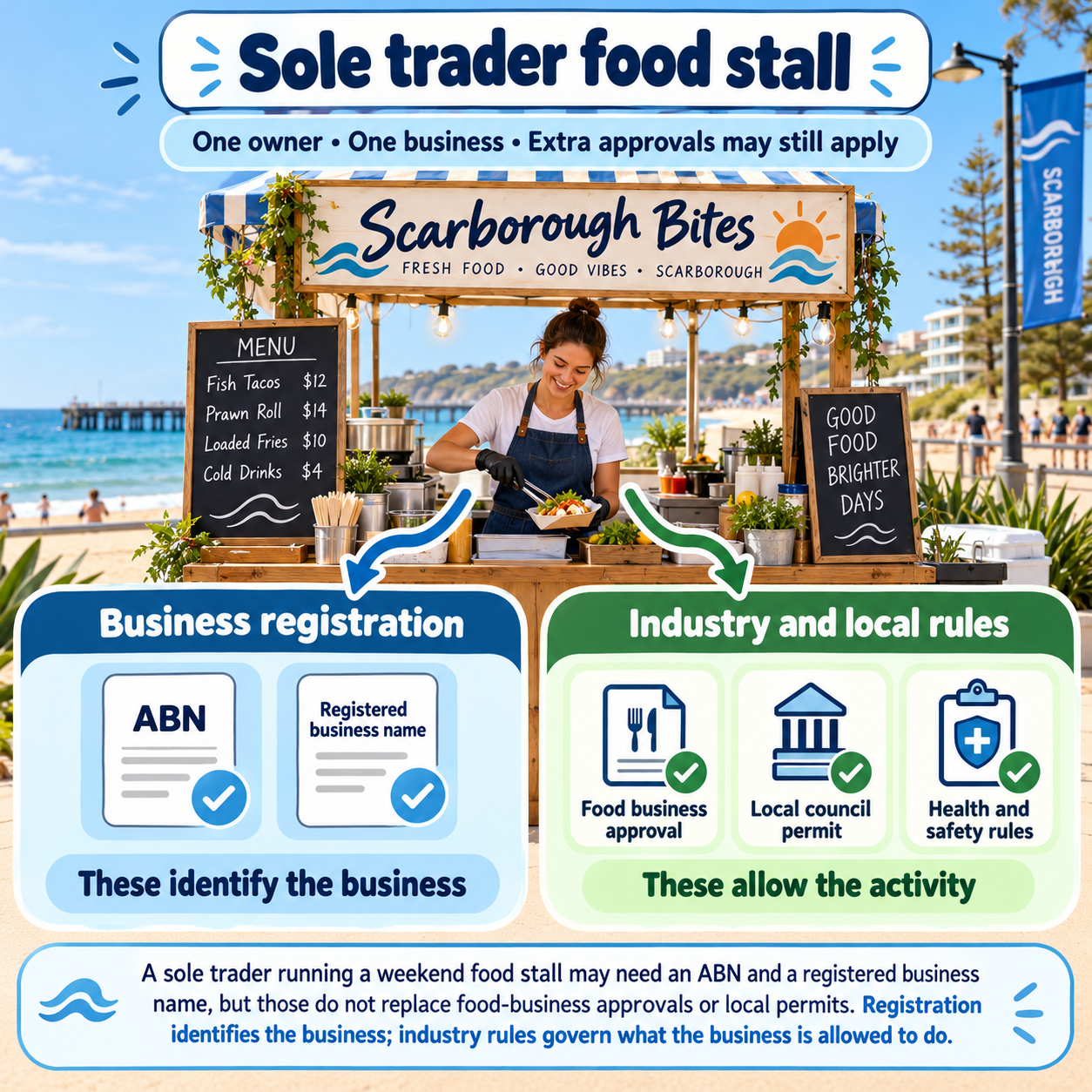
Completing the registrations above does not mean every business is automatically ready to operate. A café, builder, electrician, childcare service or other regulated activity may need additional licences or permits depending on the industry and location.
Example: a Scarborough food stall
A sole trader setting up a weekend food stall may need an ABN and a registered business name, but that does not replace any food-business approvals or local permits required for the activity. Registration identifies the business; industry rules govern what the business is allowed to do.
Official reference: business.gov.au – Work out your business registrations
Partnership Act 1895 (WA)
The WA legal framework for partnerships
In Western Australia, partnerships are governed by the Partnership Act 1895 (WA). The Act provides legal rules about the relationship between partners and how a partnership operates.
The Act becomes especially important where the partners have not clearly agreed on their own arrangements.
Key rules under the Partnership Act 1895 (WA)

A powerful default rule
Section 34 provides that, subject to any agreement between the partners, partners are entitled to share equally in capital and profits and must contribute equally towards losses.
This matters because two partners may contribute very different amounts of money or time. If they want a different arrangement, it should be agreed clearly rather than assumed.
The Act and the agreement work together
The Partnership Act 1895 (WA) is legislation. A partnership agreement is the partners’ own written arrangement. The agreement can set out how the partners want to manage many issues, while the Act provides the legal framework and default rules.
Official reference: WA Legislation – Partnership Act 1895
Partnership agreement
Putting the partners’ expectations in writing
A partnership agreement is a written agreement between the partners that sets out how the business will be owned, managed and financially organised.
A written agreement is not compulsory for an ordinary partnership, but it is strongly recommended because it creates clear expectations before problems arise.
What a partnership agreement should cover
Example: the café partnership that plans ahead
Sam contributes $80,000 to a café partnership and manages the kitchen. Priya contributes $40,000 and manages marketing and administration. Their written agreement states how profits will be shared, which decisions require both partners and how one partner can leave the business. This reduces the risk that each person is working from a different set of assumptions.

Why “we’re friends” is not a business system
Strong personal relationships do not remove the need for clear business arrangements. Disputes can arise over money, workload, decision-making or exit plans. A written agreement makes the expectations visible before those disagreements become expensive.
Official reference: business.gov.au – Partnership
Registration of tax file number (TFN)
The tax-system identifier
A tax file number (TFN) is a unique number used within the Australian tax system. The TFN requirement depends on the business structure.
Cost: Applying for a TFN through the Australian Government is free.
👤 Sole trader
A sole trader generally uses their individual TFN for both personal and business tax dealings. Business income and expenses are included in the individual’s tax return.
🤝 Partnership
A partnership needs a separate TFN. The partnership lodges its own partnership tax return, and each partner reports their share of the partnership income or loss in their own tax return.
Example: why one partner’s TFN is not enough
Ella and Zoe establish a design partnership. They cannot simply choose Ella’s personal TFN and treat it as the partnership’s tax identity. The partnership obtains its own TFN because the partnership must lodge a partnership tax return before the partners include their shares in their individual tax returns.
ABN and TFN answer different questions
ABN: “Which business is this?” TFN: “Which person or organisation is this in the tax system?” Knowing the difference prevents one of the most common setup mistakes.
Official reference: business.gov.au – Register for a TFN
🎧 Prefer listening?
If you prefer listening to the content in podcast format:
🎥 Prefer watching?
If you prefer watching the content in video format:
🧑🏫 Class Activities
Hands-on activities
These activities are designed to help you apply the full content to real businesses through research, decision-making and practical classroom tasks.
How this section could be used: teachers could place students into small groups and allocate different activities, ask students to complete one or two activities each week, or use the activities at the end of each syllabus point so groups can take turns completing and presenting one task to the class. Activities can also be used as extension work, revision, or as a starting point for short class discussions.

1. Sole Trader Setup Desk
Amelia wants to start a mobile dog-grooming business in Perth as a sole trader under the name West Coast Woof Wash.
- Identify whether she needs an ABN.
- Decide whether the business name must be registered.
- Identify which TFN she uses.
- Explain what “business registration” would involve for this structure.
- Identify one additional licence or permit she should investigate depending on how the business operates.
Output: create a five-step setup checklist titled “Ready to Launch: West Coast Woof Wash”. For each step, state Requirement, Action and Why It Applies.
2. Build the Partnership Agreement
Two friends are opening a small café. One contributes $90,000 and will work full-time. The other contributes $45,000 and will manage marketing two days per week.
- Decide how profits could be shared.
- Allocate management responsibilities.
- Decide which decisions require both partners.
- Create a dispute-resolution process.
- Decide what happens if one partner wants to leave.
Output: produce a one-page partnership agreement summary with the headings Contributions, Profit Sharing, Roles, Decisions, Disputes and Exit. Finish with one sentence explaining why the agreement reduces risk.
3. Register the Name or Not?
Classify each example as Business name registration required or Not required.
- Sole trader Jordan Patel trades as “Jordan Patel”.
- Sole trader Jordan Patel trades as “JP Mobile Repairs”.
- Partners Grace Lee and Oliver Hart trade as “Grace Lee and Oliver Hart”.
- The same partners trade as “Harbour Accounting”.
- Sole trader Ruby Chen trades as “Ruby Chen Photography”.
- Partners Noah King and Zara Ali trade as “King & Ali Garden Care”.
Output: create a six-row classification table with the headings Business, Register Name? and Reason. Your reason must refer to whether the trading name matches the legal personal name or names.
4. ABN or TFN?
Your teacher reads a series of statements. Decide whether each statement describes an ABN, a TFN, both or neither.
- It is an 11-digit business identifier.
- A partnership needs its own one.
- A sole trader can use their individual one.
- It is used within the tax system.
- It is needed to register a business name.
- It proves the business owns its trade mark.
Output: create a four-column sorting sheet labelled ABN, TFN, Both and Neither. Place each statement in the correct column and add a one-sentence definition of ABN and TFN at the bottom.
5. Partnership Dispute File
A WA partnership has no written agreement. One partner contributes most of the money and assumes they should receive 70% of the profits. The other partner believes profits should be shared equally.
- Explain why the Partnership Act 1895 (WA) matters.
- Identify the default rule that becomes relevant.
- Explain how a partnership agreement could have prevented the dispute.
- Recommend what the partners should agree in writing for the future.
Output: prepare a one-page case file with four boxes: The Dispute, Relevant Law, Why the Problem Occurred and Future Agreement. Be ready to explain your recommendation in 60 seconds.
6. Launch a Perth Business
Your group chooses one of these businesses: mobile car detailing, tutoring service, landscaping business, market-stall food business or graphic-design studio.
- Choose whether it will be a sole trader or partnership.
- Create a legal business name.
- Explain the ABN requirement.
- Explain the TFN requirement.
- If it is a partnership, explain the role of the Act and agreement.
- Identify one additional licence or permit that may need investigation.
Output: create a one-slide “Business Launch Compliance Plan” showing the structure, business name, required registrations, partnership requirements if relevant and one extra licence/permit to investigate. Deliver a 90-second group briefing.
✍️ Short Answer Questions
Practice questions
Answer each question before opening the sample answer. Use the command term carefully and apply the requirement to the business structure described.
Show sample answer
An Australian Business Number is a unique 11-digit number used to identify a business when dealing with government and other organisations.
Show sample answer
A sole trader must register a business name when the business trades under a name other than the owner’s own first name and surname. For example, Mia Rossi would not need to register “Mia Rossi”, but would need to register “Mia Rossi Coastal Photography”.
Show sample answer
First, the sole trader may apply for an ABN, which identifies the business and is used for activities such as invoicing, tax registrations and business-name registration. Second, if the owner trades under a name other than their own personal name, the business name must be registered with ASIC.
Show sample answer
A partnership is treated separately for tax-reporting purposes and must lodge a partnership tax return. This means the partnership needs its own TFN to identify it within the tax system rather than using one individual partner’s TFN. As a result, the partnership can report its total income and expenses before each partner includes their share of the profit or loss in their own tax return.
Show sample answer
A partnership agreement can state how profits are shared, which partner performs each role and how major decisions are made. This gives the partners a common set of written expectations rather than relying on different assumptions. As a result, disagreements are less likely to arise and there is a clearer process for resolving them if they do occur.
Show sample answer
Without a written agreement, the friends may have different expectations about how much work each person should do or how profits should be divided. This can create conflict because one partner may believe their larger contribution deserves a larger return while the other relies on the default legal position. Disagreement may then delay decisions about staffing, finance or expansion. This can damage the working relationship and reduce the café’s performance because management time is spent resolving internal disputes rather than operating the business.
Show sample answer
The Act provides default rules that apply subject to any agreement between the partners. For example, the Act provides for partners to share equally in capital and profits and contribute equally to losses unless they have agreed otherwise. This means partners who want a different split should record it clearly. As a result, the Act can determine the outcome where the partners have left an important issue unresolved.
Show sample answer
Advantages: First, an agreement can clarify profit sharing, roles and decision-making so each partner knows what is expected. Second, it can include procedures for disputes, adding or removing partners and ending the partnership, reducing uncertainty when circumstances change.
Disadvantages: First, creating a detailed agreement may involve time and professional legal costs during setup. Second, no agreement can predict every future problem, so the partners may still need to negotiate or obtain advice when unexpected circumstances arise.
Show sample answer
I recommend that Noah and Ava establish the partnership’s registrations and written arrangements before trading. Because “North Coast Design Studio” is not simply both partners’ personal names, they should register the business name, and the partnership should have its own ABN and TFN. This will provide the correct business and tax identifiers while a written partnership agreement can clarify roles and profit sharing. As a result, the business is more likely to begin with clear legal and management arrangements.
Show sample answer
Advantage: strong trust between the partners may make early communication and decision-making easier because both people already know each other well and may share similar goals for the business.
Disadvantage: trust does not guarantee that the partners will agree about contributions, workload, profit sharing, major decisions or what happens if one person wants to leave. Without a clear written arrangement, the partnership may need to rely more heavily on default legal rules or resolve disagreements after they have already damaged the working relationship.
Judgement: the friends should still create a written partnership agreement. A strong friendship can help the partnership, but a written agreement makes important expectations visible and provides a clearer process when circumstances change or the partners disagree.
🃏 Flashcards
Card 1 of 12
🎮 Revision Games
💰 BME Millionaire
Climb the prize ladder by mastering ABNs, TFNs, business names, WA partnership law and setup decisions.
🗂️ Registration Desk
Process twelve new-business files and select the legal requirement that best solves each setup issue.
⚡ 60 Second Showdown
A rapid-fire sprint through structures, identifiers, registrations, agreements and WA partnership rules.
Biz Fact: Registering a business name does not automatically give a business exclusive ownership of that brand. A registered trade mark provides a different form of legal protection, so “business name registered” and “brand legally protected” are not the same thing.