
General U1.10 - The Importance of Identifying Potential Customers and Competitors
Overview
Dotpoint 10: the importance of identifying potential customers and competitors.
Potential customers are people or organisations that may be willing and able to buy a business’s product or service.
Competitors are businesses offering the same or similar products or services, or alternative ways of satisfying the same customer need.
Identifying potential customers helps the business understand who may buy, what they value and whether enough demand may exist.
Identifying competitors helps the business understand what customers can already choose, where competitors are strong or weak, and where an opportunity may exist.

Potential customers
Why identifying potential customers matters
A business should identify its potential customers before making major decisions because different customers have different needs, budgets, preferences and buying habits.
If the owner understands who is most likely to buy, the business can design an offer that is more relevant to those customers rather than trying to appeal to everyone.
The main reasons this matters are:
- Understand customer needs: the business can identify the problem customers want solved or the benefit they value most.
- Estimate likely demand: the owner can judge whether enough people may be willing to buy to make the idea worthwhile.
- Reduce wasted resources: research can stop the business spending heavily on an offer that customers do not value.
- Make better business decisions: customer information can guide later decisions about what is offered, what customers may be willing to pay, where they buy and how the business communicates with them.

What should a small business learn about potential customers?
The business does not need to know every individual customer. It needs enough information to build a realistic picture of the people or organisations most likely to buy.
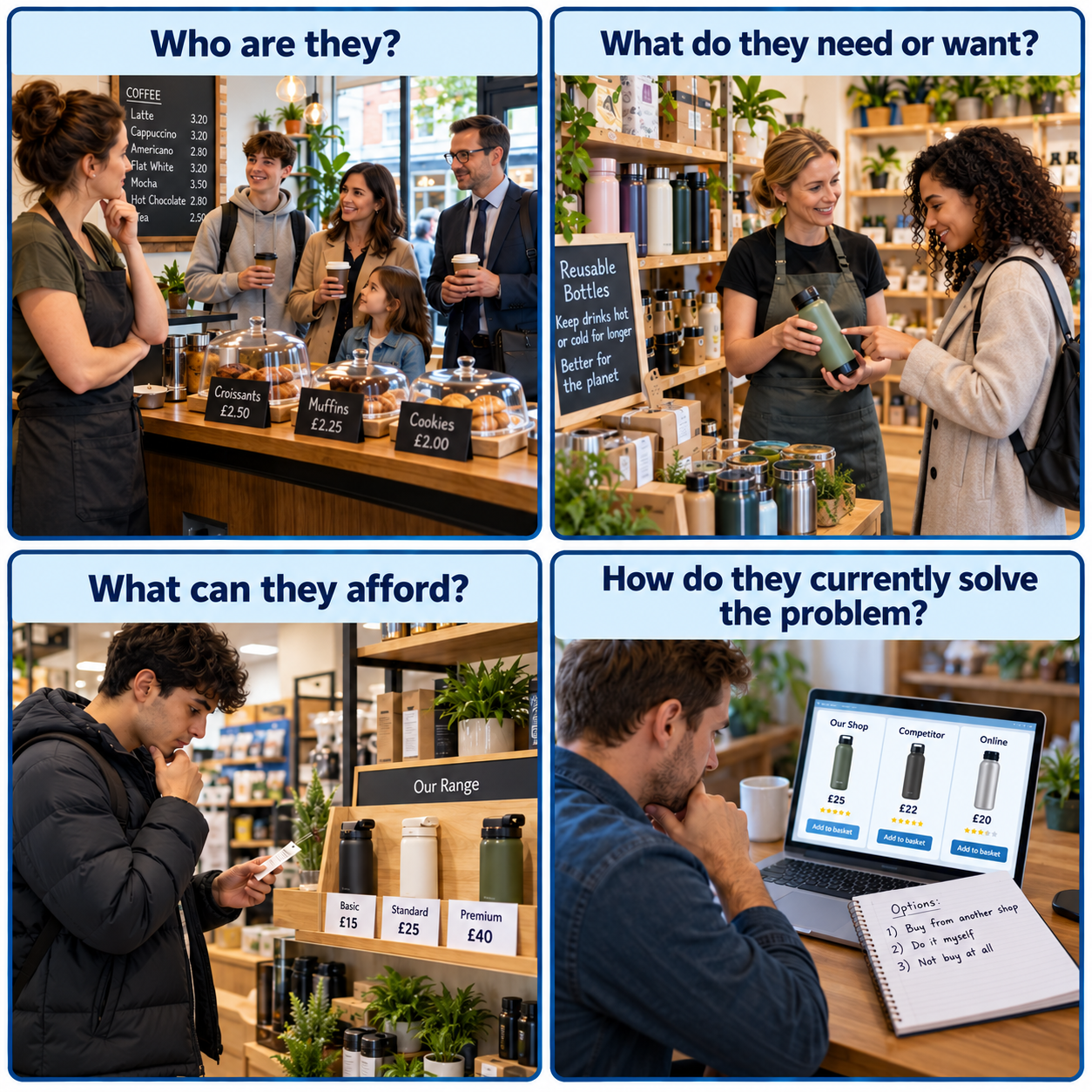
Useful questions include:
- Who are they? Age, location, occupation, household type, business type or other characteristics may help describe likely customers.
- What do they need or want? What problem are they trying to solve, and what benefit are they seeking?
- What can they afford? Customers may value an idea but still be unwilling or unable to pay the planned price.
- How do they currently solve the problem? Customers may already use another business, do the task themselves or choose not to buy at all.
Case study: a Perth mobile dog-grooming business
A new mobile dog-grooming business in Perth identifies busy dog owners as its most likely customers. These customers may value convenience because they do not want to transport their dog to a grooming salon or wait around for an appointment.
By recognising this need, the business can offer home visits and appointment times that fit around work and family commitments. This makes the service more relevant to the people most likely to buy it, increasing the likelihood of bookings and reducing the risk of designing a service that customers do not value.

The danger of assuming “everyone is a customer”
A business that tries to sell to everyone may struggle to make clear decisions because different customers want different things. Identifying the most likely customers helps the owner focus limited time, money and resources on the people most likely to buy.
A useful way to think about the process is shown below:

Competitors
Why identifying competitors matters
Competitors influence the choices available to customers. A new business therefore needs to understand what other businesses already offer before deciding how it will attract customers.
Competitor information can reveal whether the market is crowded, where existing businesses are strong, where customers appear dissatisfied and where a new business may be able to offer something different or better.
The main reasons this information is useful are:
- Understand existing choices: the business can see what customers already receive from other providers.
- Compare strengths and weaknesses: the owner can compare areas such as quality, convenience, service, reputation, location and value.
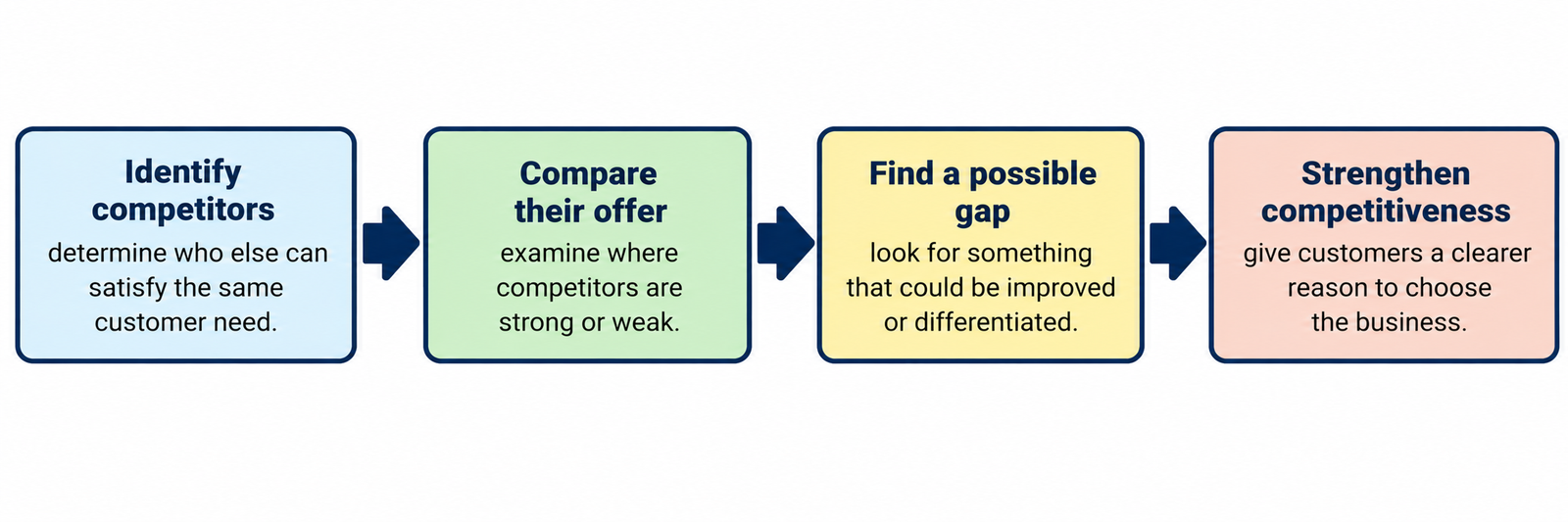
- Identify gaps: competitor research may reveal an unmet need or an area where existing businesses perform poorly.
- Build a competitive advantage: the business can look for a reason customers may choose it instead of available alternatives.
Direct and indirect competitors
Not every competitor sells exactly the same product. Businesses need to think about all realistic alternatives available to the customer.
| Type | Meaning | Small-business example |
|---|---|---|
| Direct competitor | A business offering the same or a very similar product or service to similar customers. |
• A Scarborough burger shop competing with another nearby burger shop. • A local hairdresser competing with another salon in the same suburb. • A tutoring business competing with another tutoring provider offering the same subjects. • A small gym competing with another gym targeting similar members. |
| Indirect competitor | A business offering a different product or service that can satisfy the same customer need. |
• A burger shop competing with nearby pizza, sushi or other takeaway businesses for the same dinner purchase. • A gym competing with home workout apps or outdoor boot camps for customers wanting exercise. • A tutoring business competing with study apps, school homework clubs or free online lessons. • A cinema competing with streaming services, gaming and other entertainment choices for customers’ leisure time. |
Case study: a new Perth tutoring business
A new Perth tutoring business offering Year 11 and 12 support would face direct competition from established providers such as Kip McGrath and Cluey Learning, along with smaller local tutors offering face-to-face lessons. It may also face indirect competition from services such as Khan Academy, school homework clubs and free online revision resources.
By comparing these alternatives, the owner may find that some competitors focus on general tutoring while others operate mainly online. This could reveal an opportunity to specialise in WA curriculum support, offer flexible home visits or provide small-group sessions. If these features match what students and parents value, the business has a clearer reason for customers to choose it over existing options.

Competitor research is not about copying
The purpose is to understand the market and make better decisions. Simply copying an existing competitor may give customers little reason to switch. The stronger question is: what could this business do that customers value?
A useful way to use competitor information is shown below:
🎧 Prefer listening?
Why Customer Apathy Is Your Biggest Competitor
🎥 Prefer watching?
🧑🏫 Class Activities
Hands-on activities
These activities are designed to help you apply the full content to real businesses through research, decision-making and practical classroom tasks.
How this section could be used: teachers could place students into small groups and allocate different activities, ask students to complete one or two activities each week, or use the activities at the end of each syllabus point so groups can take turns completing and presenting one task to the class. Activities can also be used as extension work, revision, or as a starting point for short class discussions.

1. Build the Customer Profile
A new Perth meal-preparation business plans to deliver healthy ready-made lunches to busy office workers and university students.
- Identify the most likely potential customers.
- Describe two needs or problems those customers may have.
- Explain what may influence whether they buy.
- Identify one group that is unlikely to be a strong customer and explain why.
Output: create a one-page customer profile with the headings Likely Customer, Needs, Buying Factors and Unlikely Customer. Finish with one sentence explaining why this information matters before launch.
2. Competitor Safari
Choose a small business category in your local area, such as cafés, gyms, tutoring, hairdressers, takeaway food or lawn care.
- Find three real competitors.
- Compare what they offer.
- Identify one apparent strength and weakness for each.
- Identify one possible gap a new business could target.
Output: create a three-row competitor comparison table with the headings Competitor, What They Offer, Strength, Weakness and Possible Gap.
3. Direct or Indirect?
A new burger shop is opening near a busy shopping precinct.
- List three direct competitors.
- List three indirect competitors.
- Explain why each indirect competitor still matters.
- Decide which competitor presents the greatest threat and explain why.
Output: create a two-column competitor map labelled Direct Competitors and Indirect Competitors. Add a final box identifying the greatest competitive threat.
4. Would You Open Here?
A student wants to open a healthy smoothie kiosk near a school, gym and train station. There are already two cafés, a convenience store and a juice bar nearby.
- Identify likely potential customers.
- Identify the main direct and indirect competitors.
- Identify one possible opportunity and one major threat.
- Recommend whether the student should investigate the idea further.
Output: prepare a one-slide launch decision showing Potential Customers, Competitors, Opportunity, Threat and Recommendation.
5. Find the Gap
Choose one small-business market in Perth and investigate what customers currently receive.
- Identify at least three competitors or substitutes.
- Look for repeated customer complaints, missing services or areas of inconvenience.
- Propose one realistic way a new business could respond.
- Explain why customers may value the difference.
Output: create a one-page gap-in-the-market sheet with the headings Existing Alternatives, Customer Problem, Market Gap, Proposed Response and Why Customers May Choose It.
6. Customer + Competitor Launch Brief
Your group creates a small-business idea that could realistically operate in Perth.
- Identify the potential customers.
- Explain two important customer needs.
- Identify two direct and two indirect competitors.
- Identify one gap or advantage the new business could pursue.
- Recommend whether the idea should proceed to further planning.
Output: prepare a one-slide market brief and deliver a 90-second pitch explaining why the customer and competitor evidence supports, or does not support, the idea.
✍️ Short Answer Questions
Practice questions
Answer each question before opening the sample answer. Marks are based on the command term and the number of separate points requested.
Show sample answer
A potential customer is a person or organisation that may be willing and able to buy a business’s product or service.
Show sample answer
A competitor is a business offering the same or similar product or service, or another way of satisfying the same customer need.
Show sample answer
First, identifying potential customers helps the business understand the needs and preferences of the people most likely to buy. Second, it helps the owner estimate whether enough demand may exist before committing significant money and resources to the idea.
Show sample answer
The owner could identify busy dog owners who value the convenience of grooming at home. This would allow the business to design its service around a group that has a clear reason to buy. As a result, the owner is less likely to spend money launching a service that does not match the needs of likely customers.
Show sample answer
The café could compare nearby competitors to identify what customers already receive and where those businesses are strong or weak. This may reveal an unmet need such as faster takeaway service or a different style of food. As a result, the café can make decisions that give customers a clearer reason to choose it rather than simply copying existing businesses.
Show sample answer
A direct competitor sells the same or a very similar product or service to similar customers, such as two local burger shops. An indirect competitor offers a different product or service that can satisfy the same customer need, such as a pizza shop competing with a burger shop for a customer’s dinner purchase. This means a business must consider more than businesses that look exactly like itself.
Show sample answer
If the tutoring business misunderstands what students and parents value, it may offer subjects, times or delivery methods that do not suit them. This can reduce demand because customers may choose alternative tutors or online support that better meets their needs. Weak bookings then reduce revenue. This can create cash-flow pressure and make it harder for the business to cover its operating costs or continue trading.
Show sample answer
Advantages: First, competitor research can reveal what customers already receive, helping the owner identify gaps or weaknesses. Second, it can reduce the risk of entering a market with an offer that is too similar to well-established alternatives.
Disadvantages: First, competitor information may quickly become outdated if prices, services or promotions change. Second, focusing too heavily on competitors may cause the owner to copy existing businesses rather than concentrating on the needs of customers.
Show sample answer
I recommend investigating the idea further rather than immediately opening the kiosk. The nearby gym and train station may provide a strong group of potential customers seeking convenient food and drinks, but the existing cafés, convenience store and juice bar create significant competition. This means the student should first identify whether customers have an unmet need that the existing businesses do not satisfy. As a result, the decision would be based on evidence rather than assuming that high foot traffic automatically guarantees demand.
Show sample answer
Potential customers: one advantage of focusing on customers is that they ultimately determine whether the business generates sales. Understanding their needs can help the owner create an offer people actually value. However, customer information alone may not reveal whether another business already satisfies those needs very effectively.
Competitors: one advantage of competitor research is that it shows the alternatives available to customers and can reveal possible gaps in the market. However, concentrating too heavily on competitors may cause the business to copy them rather than respond to what customers genuinely want.
Judgement: identifying potential customers is slightly more important because a business cannot succeed without sufficient demand. However, the strongest startup decisions combine both forms of information because customer needs show what people may value, while competitor information shows how difficult it may be to win those customers.
🃏 Flashcards
Card 1 of 12
🎮 Revision Games
💰 BME Millionaire
Climb the prize ladder by mastering customers, competitors, market gaps and realistic small-business scenarios.
🗺️ Market Mapper
Classify twelve business clues and decide whether they reveal customer information, competitor information or a market opportunity.
⚡ 60 Second Showdown
A rapid-fire sprint through customer needs, direct and indirect competitors, market gaps and startup decisions.

Biz Fact: Netflix competes with YouTube, video games and social media because they all compete for consumers' free time.