
U3.05 — Host Country and Home Government Incentives for International Trade
Overview
Dotpoint 5: host country and home government incentives for international trade.
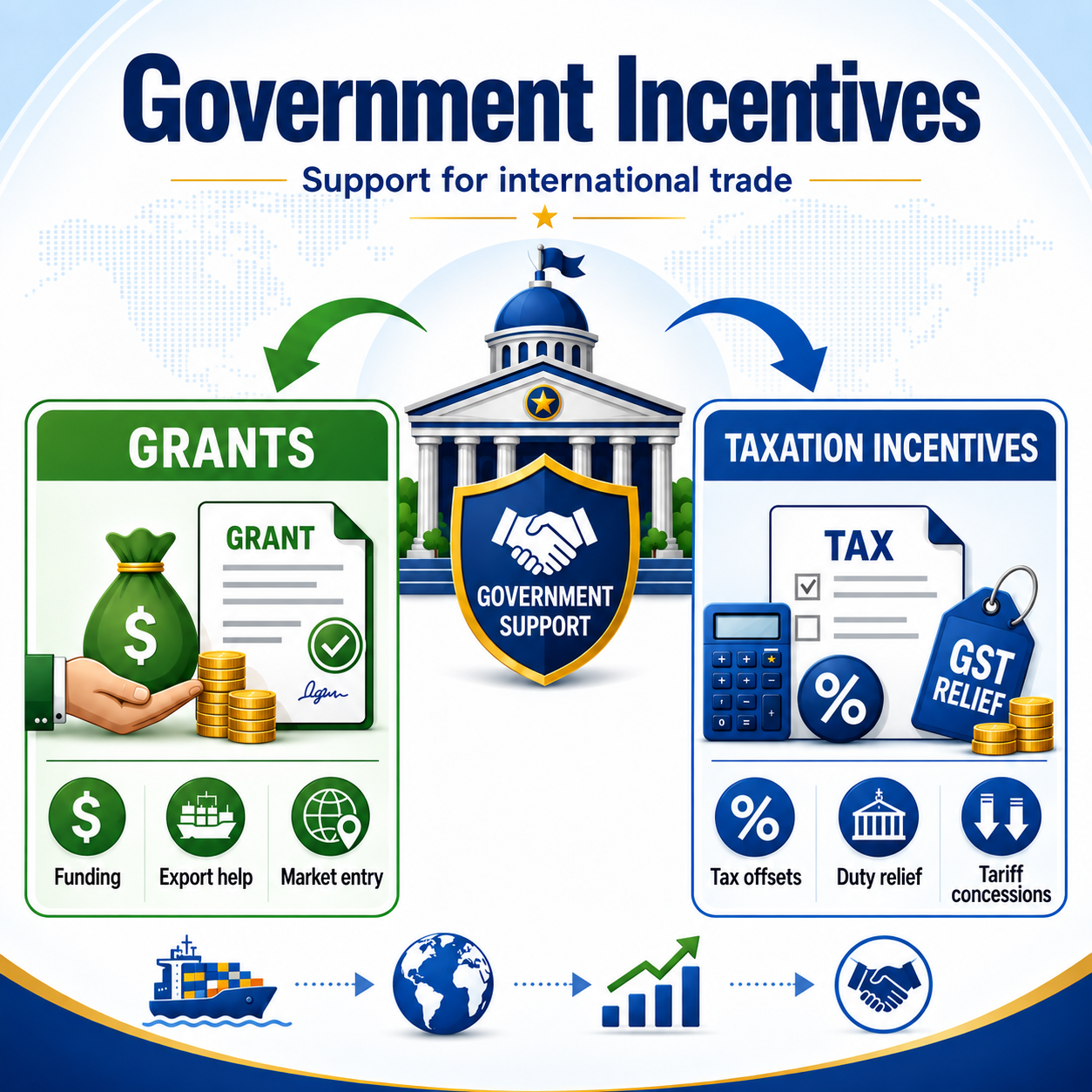
Government incentives are support measures used by governments to encourage businesses to trade internationally, export products, enter overseas markets, attract investment or establish operations in a particular country.
This syllabus dotpoint focuses on two main types of incentives:
- grants — direct funding or financial assistance that can reduce the cost of exporting or setting up overseas
- taxation incentives — tax offsets, tax reductions, duty relief, GST relief, and tariff concessions that reduce trade-related costs
These incentives can be looked at from two perspectives: the home government, which is the business’s own government, and the host country, which is the overseas country the business wants to enter.
🏛️ Home government vs host country
Two perspectives on government incentives
Home government incentives
Home government incentives are provided by the government of the country where the business is based.
For an Australian business, the home government is the Australian Government. These incentives are designed to help Australian businesses become exporters, grow international sales and compete overseas.
Example: an Australian business applying for an Australian export grant to help promote its products overseas.

Host country incentives
Host country incentives are provided by the overseas country the business wants to enter or operate in.
If an Australian business expands into Vietnam, Vietnam is the host country. These incentives are designed to attract foreign businesses, jobs, investment, technology and skills.
Example: Vietnam offering a grant, tax concession or land rent reduction to attract a technology business to open a branch there.

Why countries offer these incentives
Governments provide incentives because international trade can create wider economic benefits for the country offering the support.
- Economic growth: more trade and investment can increase production and national income.
- Job creation: exporting and foreign investment can create jobs in industries such as manufacturing, services, logistics, tourism and technology.
- Foreign direct investment: host countries can attract overseas businesses, capital, infrastructure and new business activity.
- Innovation and skills: incentives can encourage businesses to bring new technology, research, training and expertise into the economy.
- Global competitiveness: home governments can help their businesses compete against overseas firms.
- Trade relationships: stronger trade links can improve long-term economic and diplomatic relationships between countries.
Exam tip
If the question says home government, write about support from the Australian Government for Australian businesses. If the question says host country, write about support from the overseas country the business is entering.
💵🧾 Grants and taxation as incentives for international trade
Grants are financial payments or funding support provided by a government. They can help businesses cover some of the costs of exporting, marketing overseas, attending trade shows, training staff, establishing an overseas branch or investing in a host country.
How grants encourage international trade
Lowering the cost of entering overseas markets
Entering a new international market can be expensive. Businesses may need to pay for overseas marketing, trade fairs, translation, legal advice, product adaptation, export training, market research and travel.
Trade result: grants reduce the upfront cost of exporting, making it easier for businesses to test or enter overseas markets.
Helping smaller businesses compete globally
Large multinational businesses often have enough money to expand overseas. Smaller businesses may need government support because international expansion can be risky and expensive.
Trade result: grants can help smaller businesses promote their products and compete with larger global firms.
Attracting foreign businesses into the host country
A host country may offer grants to encourage overseas businesses to establish operations there. This may include funding for high-tech industries, manufacturing, clean energy, research, training or regional development.
Host country result: grants can attract foreign direct investment, jobs, skills and technology into the economy.

Taxation incentives reduce the tax burden or tax-related costs faced by a business. For international trade, this can include tax offsets, reduced company tax, import duty relief, GST relief, tariff concessions or exemptions from certain taxes.
How taxation incentives encourage international trade
Reducing costs
Tax incentives can reduce the cost of producing, importing, exporting or operating overseas. This can make international trade more financially attractive.
Business result: lower costs can improve cash flow, profit margins and competitiveness.
Encouraging investment and innovation
Tax incentives can encourage businesses to invest in research, product development, technology, new equipment and export-ready innovation.
Business result: this can help businesses develop products or services that are more competitive in global markets.
Attracting foreign businesses into a host country
A host country may reduce company tax, offer tax holidays, reduce land rent, reduce import duties or create special economic zones to attract overseas businesses.
Host country result: this can attract foreign direct investment, jobs, skills and technology.

🇦🇺 Home government incentives for Australian businesses
For an Australian business, the home government is the Australian Government. Home government incentives are designed to help Australian businesses become exporters, grow international sales and compete overseas.
Australian grants and financial support
Export Market Development Grants — EMDG
Type: grant.
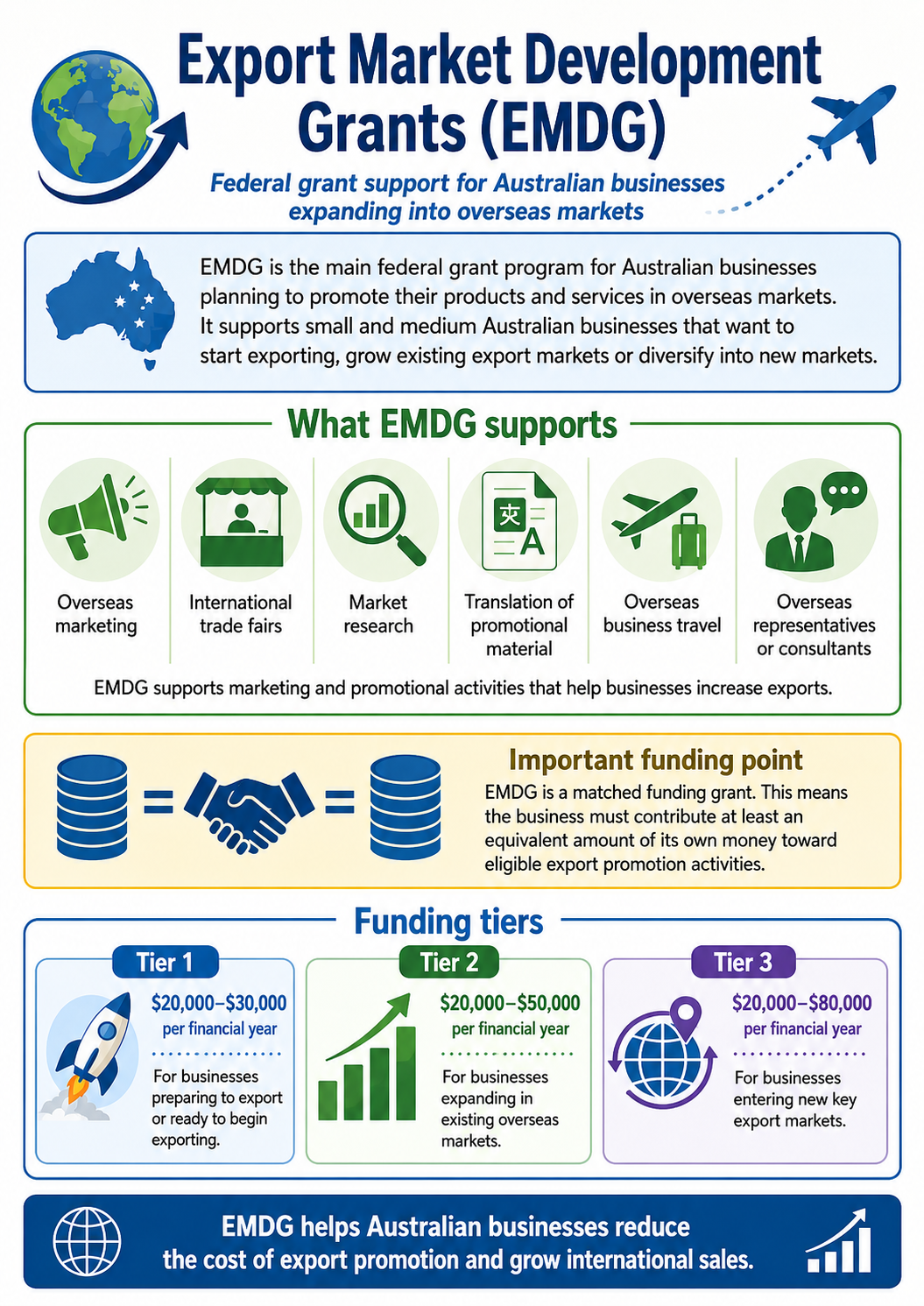
EMDG is the main federal grant program for Australian businesses planning to promote their products and services in overseas markets. It supports small and medium Australian businesses that want to start exporting, grow existing export markets or diversify into new markets.
EMDG supports marketing and promotional activities that help businesses increase exports. This may include overseas marketing, attending international trade fairs, market research, translation of promotional material, overseas business travel and engaging overseas representatives or consultants.
Important funding point: EMDG is a matched funding grant. This means the business must contribute at least an equivalent amount of its own money toward eligible export promotion activities.
Tier 1 — $20,000–$30,000 per financial year: for businesses preparing to export or ready to begin exporting.
Tier 2 — $20,000–$50,000 per financial year: for businesses expanding in existing overseas markets.
Tier 3 — $20,000–$80,000 per financial year: for businesses entering new key export markets.
Business result: EMDG lowers the cost of export promotion, making it easier for Australian businesses to find overseas customers and grow international sales.
Case study: Plantagenet Wines received an EMDG grant to help expand into Asian markets. The funding supported overseas market development and export promotion, helping the business grow international sales.
Export Finance Australia
Type: finance support rather than a direct grant.
Export Finance Australia supports Australian exporters by helping businesses access finance for export-related transactions and international expansion.
This can include loans, guarantees, bonds and insurance products. For example, a guarantee can help a business’s bank approve finance for an export contract when the business does not have enough security.
Business result: finance support can help Australian businesses accept larger export orders, manage cash flow and expand into overseas markets.

Austrade advice and export support
Type: information and trade support.
Austrade provides support to help Australian businesses understand export opportunities, prepare for overseas markets and connect with international trade information.
This is not always a direct cash payment, but it can still encourage international trade because reliable information reduces the risk of entering unfamiliar markets.
Business result: businesses can make better decisions about market selection, export readiness and international promotion.

State-based and industry-specific grants
Type: grant.
Not all export grants are federal. Some grants are offered by state governments or specific industries, and these may open and close depending on government priorities and funding rounds.
Examples: WA Access Asia Business Grants can support WA businesses expanding export and trade activity in Asian markets. Defence Industry Development Grants may support eligible defence businesses building export capability. WA Market Access Grants can support eligible health and medical life-science businesses attending major international conferences and business events.
Business result: these grants can reduce the cost of overseas market development, export promotion, conference attendance or industry-specific international expansion.
Australian taxation incentives
Tradex Scheme
Type: taxation / duty incentive.
The Tradex Scheme provides an upfront exemption from Customs duty and GST on eligible imported goods that will later be exported.
This can help a business that imports inputs, components, packaging or goods into Australia and then exports the finished product or eligible goods overseas.
For example, CSL may import specialist ingredients or packaging, manufacture medicines in Australia and export those medicines overseas. Eligible imported inputs incorporated into exported products could receive duty and GST relief under Tradex.
Another example is Breville. If imported parts, components or accessories are used in products that are later exported, eligible imported inputs could potentially qualify for Tradex relief.
Business result: the business does not have to pay some tax-related costs upfront, which improves cash flow and can make exporting more competitive.

Research and Development Tax Incentive
Type: taxation incentive.
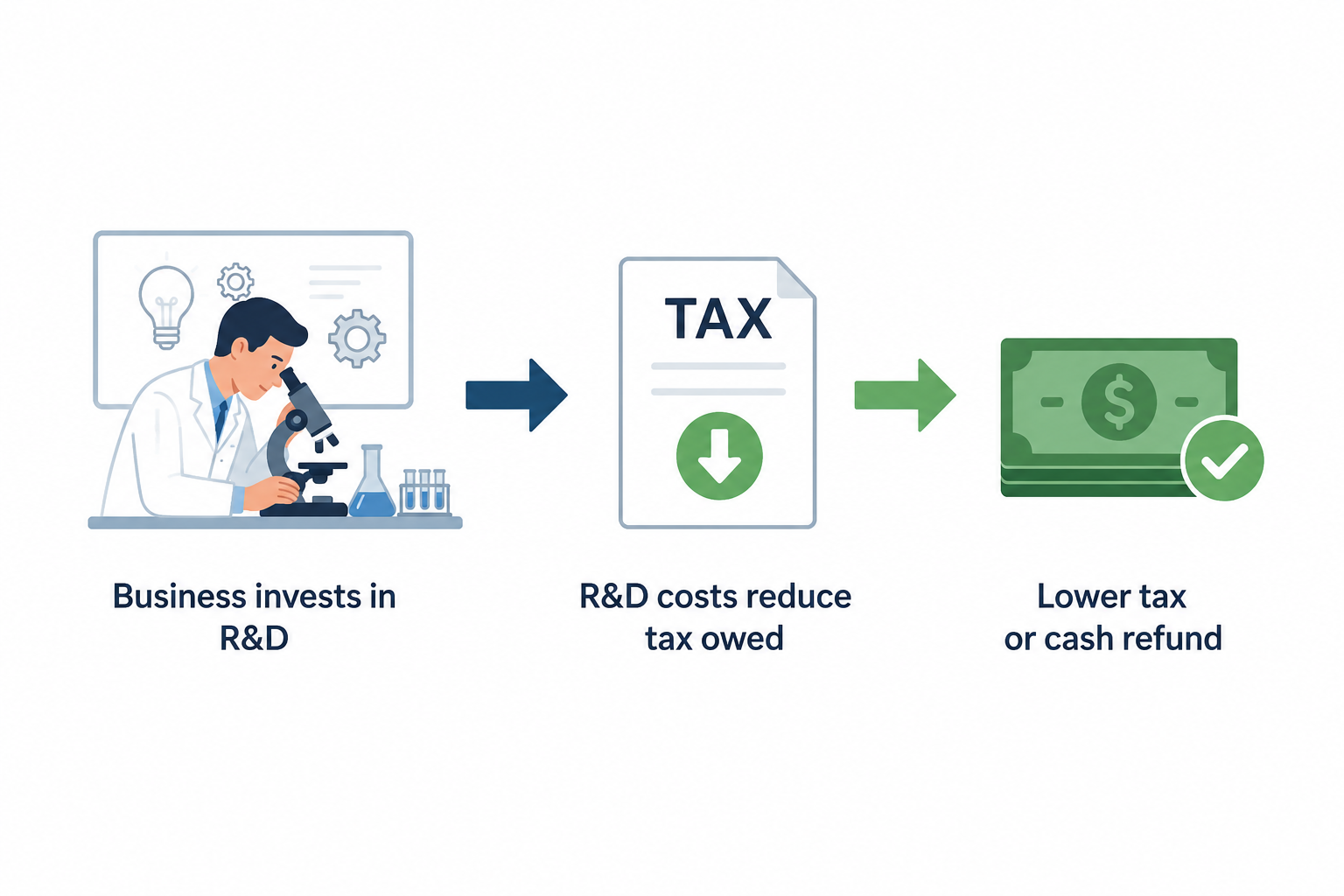
The R&D Tax Incentive supports eligible research and development by offsetting some R&D costs through the tax system.
The government uses this incentive because research and development can lead to new products, better technology, improved production methods and stronger exports.
How it works: instead of giving the business a grant upfront, the government allows eligible R&D spending to reduce the tax the business owes. For some smaller companies, the incentive may also provide a cash refund depending on the company’s tax position.
Simple example: an Australian business spends $1 million developing a new battery. With the R&D Tax Incentive, it may receive a tax offset that reduces the real cost of the project. This makes it easier for the business to keep investing in innovation.
Business result: the business has more support to innovate, which can improve product quality, technology and competitiveness in international markets.
Free trade agreements and tariff reductions
Type: tariff / trade cost incentive.
Free trade agreements can reduce or remove tariffs on eligible goods traded between countries. This is not a grant, but it can reduce tax-like trade costs and improve market access.
Business result: lower tariffs can make Australian exports cheaper for overseas customers and make international trade more attractive.
Best answers for this syllabus dotpoint
Because the syllabus specifically says grants and taxation, the safest home government examples are usually:
Grant: Export Market Development Grants.
Taxation: Tradex Scheme, R&D Tax Incentive, tariff/duty concessions or tax-related support.
How to write about a grant in an exam
A home government grant such as EMDG can encourage Australian businesses to engage in international trade. This occurs because the grant can help cover some of the costs of export promotion and overseas marketing. This will lead to lower upfront costs for the business, making it easier to enter or grow in an overseas market.
How to write about taxation in an exam
A taxation incentive can encourage international trade by reducing the cost of exporting. For example, the Tradex Scheme can allow eligible imported goods to enter Australia without upfront Customs duty and GST if those goods are later exported. This improves cash flow and can make the business more competitive when selling into overseas markets.
🌏 Host country incentives for overseas expansion
A host country may offer incentives to attract foreign businesses. These incentives are often used to encourage foreign direct investment, job creation, technology transfer, exports and development in priority industries or regions.
Host country grants and financial support
Establishment grants
Type: grant.
A host country may provide direct funding to encourage a foreign business to establish an office, factory, branch or regional headquarters.
Country-specific example: Singapore uses investment attraction programs and business development support to encourage technology and regional headquarters activity. An Australian software or cloud services business expanding into Singapore may benefit from grants or support designed to attract high-growth businesses.
Business result: this reduces the cost of setting up in the host country and may make one country more attractive than another.

Training and employment grants
Type: grant or wage support.
A host country may offer funding to businesses that hire local workers, train staff or build skills in priority industries.
Country-specific example: Singapore provides workforce and skills programs to support training and business capability. An Australian business expanding into Singapore may find that training support reduces the cost of developing local staff.
Business result: this can reduce labour training costs and encourage the business to employ local workers.
Innovation, technology or clean energy grants
Type: grant.
A host country may provide grants for industries it wants to grow, such as technology, cloud services, renewable energy, advanced manufacturing, health or education.
Country-specific example: Canva has built a major international workforce in the Philippines. A host country that provides technology, training or digital-business incentives could make this kind of overseas expansion more attractive by lowering the cost of hiring, training or operating in that market.
Business result: this can reduce the cost of investment and encourage businesses to bring new technology into the host country.
Host country taxation incentives
Company tax reductions or tax holidays
Type: taxation incentive.
A host country may offer a lower company tax rate or a period where the business pays little or no company tax.
Country-specific example: Thailand’s Board of Investment promotes tax and non-tax incentives to Australian and New Zealand investors considering operations in Thailand. These incentives can make Thailand more attractive for manufacturing, technology or regional operations.
Business result: this increases after-tax profit and makes the host country more attractive as an expansion location.

Import duty exemptions
Type: taxation / tariff incentive.
A host country may reduce or remove import duties on equipment, machinery, technology or inputs needed to establish operations.
Country-specific example: Malaysia offers investment incentives in sectors such as manufacturing, including tax incentives that can support approved investment projects. An Australian manufacturer entering Malaysia could benefit if eligible equipment or operations receive tax or duty concessions.
Business result: this lowers start-up costs because the business can bring in equipment or technology more cheaply.
Special economic zones and land rent concessions
Type: tax and cost incentive.
Some countries offer special economic zones, high-tech parks, reduced land rent or faster approvals to attract foreign businesses.
Country-specific example: Vietnam uses industrial parks and high-tech zones to attract foreign investment. An Australian technology or manufacturing business entering Vietnam may consider these zones because they can reduce set-up costs and provide infrastructure support.
Business result: this can lower establishment costs and make operations easier to set up in the host country.
How to write about a host country grant in an exam
A host country grant can encourage international trade by reducing the cost of setting up overseas. For example, an establishment grant offered by Singapore could reduce the cost for an Australian software business to open a regional office in Singapore. This will lead to the host country becoming a more attractive location for international expansion.
How to write about a host country taxation incentive in an exam
A host country taxation incentive can encourage international trade by increasing the financial return from operating overseas. For example, a reduced company tax rate or tax holiday would allow an overseas branch to keep more after-tax profit. This will lead to lower operating costs and may encourage the business to invest in that host country.
🎧 Prefer listening?
If you prefer listening to the content in podcast format:
🎥 Prefer watching?
If you prefer watching the content in video format:
🃏 Flashcards
Card 1 of 9
🎮 Revision Games
💰 BME Millionaire
Climb the prize ladder. Use your lifelines wisely.
👔 Business Boss
Make 10 trade decisions. Balance export growth, investment, cash flow, competitiveness and government support.
⚡ 60 Second Showdown
A varied 60-second challenge covering home and host governments, grants and taxation incentives.

Biz Fact: HealthGuard used EMDG grants worth $30,000 per year to promote its products overseas, with exports now making up around 80% of the company's business.
Past Exam Questions
Use these past exam questions to see how this dotpoint has been assessed. Pay close attention to the command term, the number of marks and whether the question is Section 1 or Section 2.
Section 1 Questions
2017 — Section 1 — Question 5(b) — 4 marks
Context
The didgeridoo is a hollow eucalyptus hardwood wind instrument between one and three metres in length. Original didgeridoos have been crafted and decorated by Indigenous Australians for over 1500 years. It is still played throughout Australia today. The didgeridoo is taught in more music schools in Switzerland than anywhere else in the world. The most similar instrument to the didgeridoo is the Swiss horn.
5(b): Outline two home government incentives for international trade. (4 marks)
One:
Two:
Command term focus: Outline
Outline: state the main point for each home government incentive and provide brief clarification.
See the full command term guide here: Command Terms.
5(b) Sample answer
One: A home government incentive is an export grant, such as the Export Market Development Grants program. This could help an Australian business promoting Indigenous Australian didgeridoos overseas pay for export marketing, trade events or promotional material in markets such as Switzerland. This would make it easier and less expensive for the business to reach international music schools and overseas customers.
Two: A second home government incentive is a taxation incentive, such as the Tradex Scheme. If a didgeridoo business imported eligible packaging or materials that were later used for products exported overseas, Tradex could provide upfront Customs duty and GST relief. This would improve cash flow and reduce trade-related costs, making international sales more financially attractive.
2018 — Section 1 — Question 4(c) — 4 marks
Context
Question 4 focuses on free trade agreements.
4(c): Describe two incentives that the Australian Government provides to encourage international trade. (4 marks)
One:
Two:
Command term focus: Describe
Describe: give the main characteristics or features of two Australian Government incentives.
See the full command term guide here: Command Terms.
4(c) Sample answer
One: The Australian Government can provide export grants, such as EMDG, to help businesses promote their products in overseas markets. This encourages international trade by reducing the cost of export marketing and helping businesses find overseas customers.
Two: The Australian Government can provide tax-related incentives such as the Tradex Scheme, which gives eligible businesses upfront relief from Customs duty and GST on goods imported for export. This improves cash flow and makes exporting more financially attractive.
2020 — Section 1 — Question 3(c) — 3 marks
Context
Globalisation can be described as the spread of products, technology, information and jobs across borders and cultures.
3(c): Explain one home government incentive for Australian businesses engaging in international trade. (3 marks)
Command term focus: Explain
Explain: show cause and effect by explaining how one home government incentive encourages international trade and the result.
See the full command term guide here: Command Terms.
3(c) Sample answer
One home government incentive is the Export Market Development Grants program. This incentive helps Australian businesses pay for export marketing and promotional activities, such as overseas advertising, trade fairs, translation or market research. This means the business faces lower upfront costs and less financial risk when trying to reach overseas customers, which will lead to a greater chance of testing the market, building international brand awareness and increasing export sales over time.
2025 — Section 1 — Question 2(c) — 4 marks
Context
Australian businesses that focus on developing home grown products, ethical practices and government grants for international expansion can unlock significant opportunities.
2(c): Describe two home government incentives an Australian business could apply for when planning to participate in international trade. (4 marks)
One:
Two:
Command term focus: Describe
Describe: give the main characteristics of two home government incentives available to an Australian business.
See the full command term guide here: Command Terms.
2(c) Sample answer
One: An Australian business could apply for an export grant such as EMDG. This provides funding support for export marketing and promotion, helping the business reduce the cost of entering overseas markets.
Two: An Australian business could apply for tax-related support such as the Tradex Scheme if it imports goods that will later be exported. This provides upfront Customs duty and GST relief, improving cash flow and making international trade more affordable.
Section 2 Questions
2022 — Section 2 — Question 8(b) — 4 marks
Case study / context
Starting in 2010 as a café in Perth, Jensenze has since grown to five branches around the metropolitan area. Owners Kath and Lao attribute the success of their business to the growing demand for their organic fruit juices. Jensenze has been producing these juices from locally sourced ingredients and Kath’s own recipes. Jensenze has also developed a website for customers to order their products online.
The popularity of these products has increased in recent years as a result of many of their customers switching to healthier diets and lifestyles. Kath says “there has been so much in the news regarding the health benefits of organic fruit juices. The ingredients used in the production of our fruit juices are grown with no pesticides. More importantly, organic juices are a rich source of antioxidants and Vitamins A and C. The antioxidants play an important role in strengthening bones and promoting better vision. Our customers are totally on board with living a healthy lifestyle and are reaping the benefits.” Lao adds “Over the past two years, we have seen an increase in online orders for our fruit juices and, given the success and growth of our business, we are now thinking of selling our products to a global market”.
Kath and Lao met while at university in New Zealand and often travel back to visit friends. The samples of their organic juices they have taken with them on these visits have been well received. During these visits, Kath and Lao have also noticed a lack of organic fruit juices on the market and have been wondering if they should consider filling this gap. Their friends often ask them if they would set up a café in New Zealand, mentioning that Australia has an ongoing free trade agreement with the country. After giving it much thought, Kath and Lao are ready to venture into the New Zealand market to sell their organic fruit juices. At this stage, they are unsure if they should begin selling their products online or start up their first café in New Zealand.
Referring to the case study and your own knowledge, answer the questions below.
8(b): Describe two government incentives that encourage Australian businesses to engage in international trade. (4 marks)
Command term focus: Describe
Describe: give the main characteristics of two government incentives. Section 2 requires application to Jensenze.
See the full command term guide here: Command Terms.
8(b) Sample answer
One incentive is an export grant such as EMDG. Jensenze could use this type of home government support to help pay for promoting its organic juices in New Zealand, such as online marketing, export promotion or building brand awareness. This would reduce the cost of entering the New Zealand market.
A second incentive is tax or tariff-related support. For example, government trade arrangements and taxation concessions can reduce the cost of trading across borders. If Jensenze faces lower trade costs when selling Australian-made organic juices into New Zealand, this may make exporting more financially attractive than relying only on its Perth café branches.
2024 — Section 2 — Question 7(c) — 6 marks
Case study / context
Jessica and Lexi, who are based in Western Australia, own a start-up technology company called Jesi Technical Solutions (JTS). The business specialises in cloud storage, and the owners are planning to expand overseas. To facilitate this plan, Jessica has analysed consumer spending and tax considerations across many regions. She has selected Southeast Asia as their initial foreign market due to its strong demand for cloud storage, particularly within the rapidly growing online shopping sector. Jessica and Lexi are also aware of the generous home and host government incentives for foreign trade. They have discovered that Vietnam, one of the next-generation Asian high-growth economies, is offering a significant grant of up to USD 700 000 for new technology businesses. Jessica and Lexi are thinking of using this grant to establish their first Southeast Asian branch.
As a start-up, Jessica and Lexi are analysing the impacts of globalisation carefully. By opening offices in emerging markets and hiring local talent, they plan to make a contribution to global prosperity. To ensure a positive global image, the business adheres to the World Trade Organisation’s international trade regulations. Jessica and Lexi encourage both their employees and consumers to share information and work together to spread new technologies around the world. Their commitment to cross-border collaboration enhances technological progress beyond their business mission.
When making global business decisions, Jessica and Lexi place a strong emphasis on ethical considerations. Central to their approach is a commitment to environmental sustainability, driving them to constantly explore and adopt eco-friendly practices within their operations. Moreover, they meticulously assess the ethical implications of outsourcing and employing workers from different countries and strive to uphold fairness and integrity across their entire supply chain. This dedication to ethical conduct not only aligns with their values, but also fosters trust and transparency in their business practices on a global scale.
Refer to the case study and your own knowledge to answer the questions below.
7(c): Explain two incentives provided by the host country and home government for international trade that JTS could consider. (6 marks)
Command term focus: Explain
Explain: show cause and effect for one host-country incentive and one home-government incentive. Section 2 requires application to JTS.
See the full command term guide here: Command Terms.
7(c) Sample answer
One host country incentive JTS could consider is the Vietnam grant of up to USD 700 000 for new technology businesses. This is a host country incentive because Vietnam is trying to attract foreign technology businesses to establish operations there. This would reduce JTS’s start-up costs when opening its first Southeast Asian branch, which would lower the financial risk of expansion and make Vietnam more attractive than other possible markets. As a result, JTS may be more likely to establish operations in Vietnam, hire local workers and use the grant to support its cloud storage expansion into Southeast Asia.
One home government incentive JTS could consider is an Australian export grant such as EMDG. This is a home government incentive because it comes from the Australian Government to support Australian businesses expanding overseas. JTS could use this type of support to help promote its cloud storage services in Southeast Asia, such as through overseas marketing, market research or building international customer relationships. This would reduce JTS’s promotional costs and improve its chance of attracting overseas customers, increasing export revenue and building a stronger international presence.