
U1.24 — Features of Organisational Structures
Overview
Dotpoint 24: features of organisational structures, including: chain of command, span of control and delegation
An organisational structure is not just about where employees sit in a diagram. It determines how authority, supervision and decision-making operate throughout the business.
The three features examined in this dotpoint are:
- Chain of command
- Span of control
- Delegation
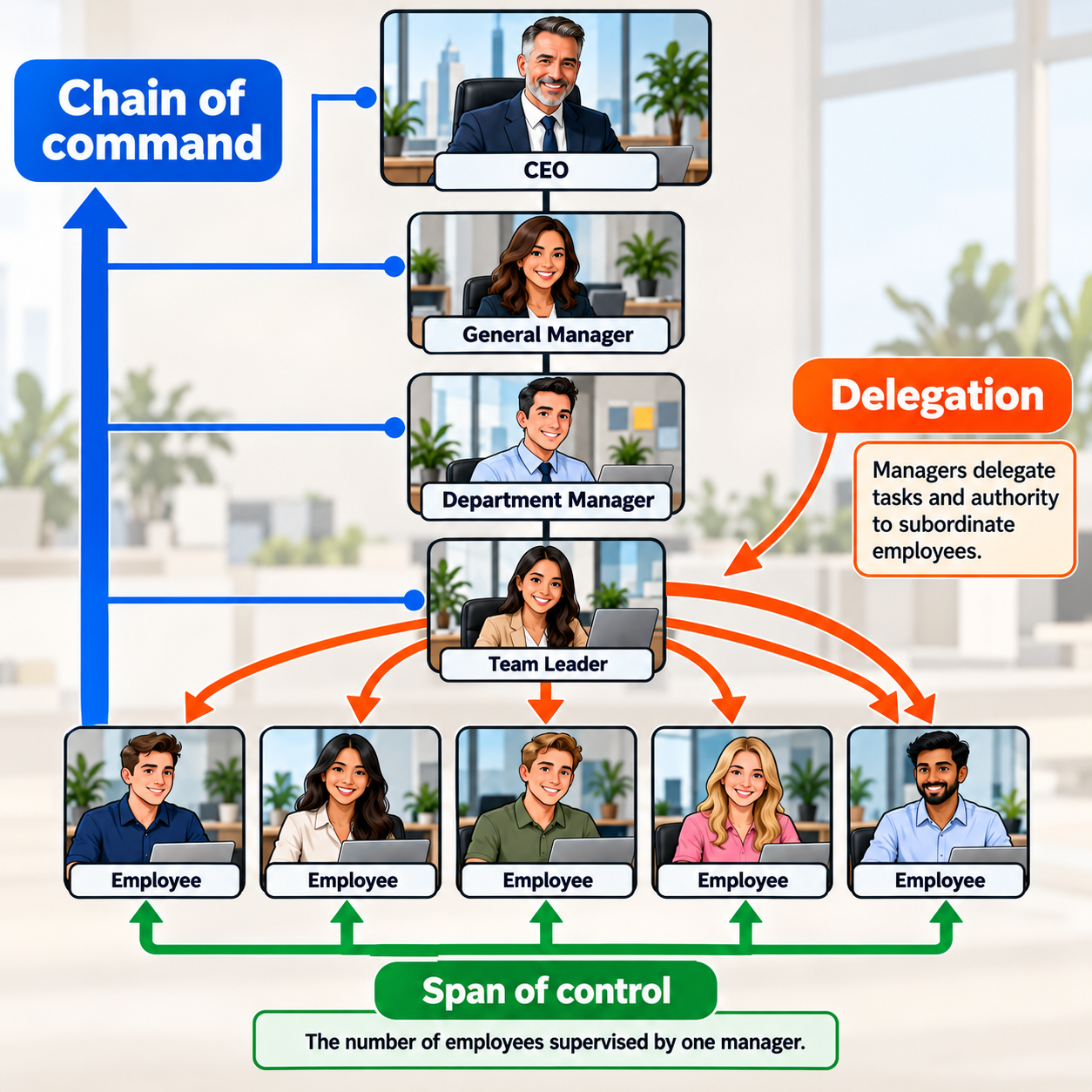
⛓️ Chain of Command
Chain of command is the line of authority and responsibility that shows who reports to whom and how instructions and decisions move through the business.
Why chain of command matters
A clear chain of command reduces confusion because employees know who they report to, who can approve decisions and who is accountable for particular areas of the business.
This becomes especially important when problems occur. If employees know exactly who has authority, an issue can be directed to the correct manager rather than being passed around the organisation.
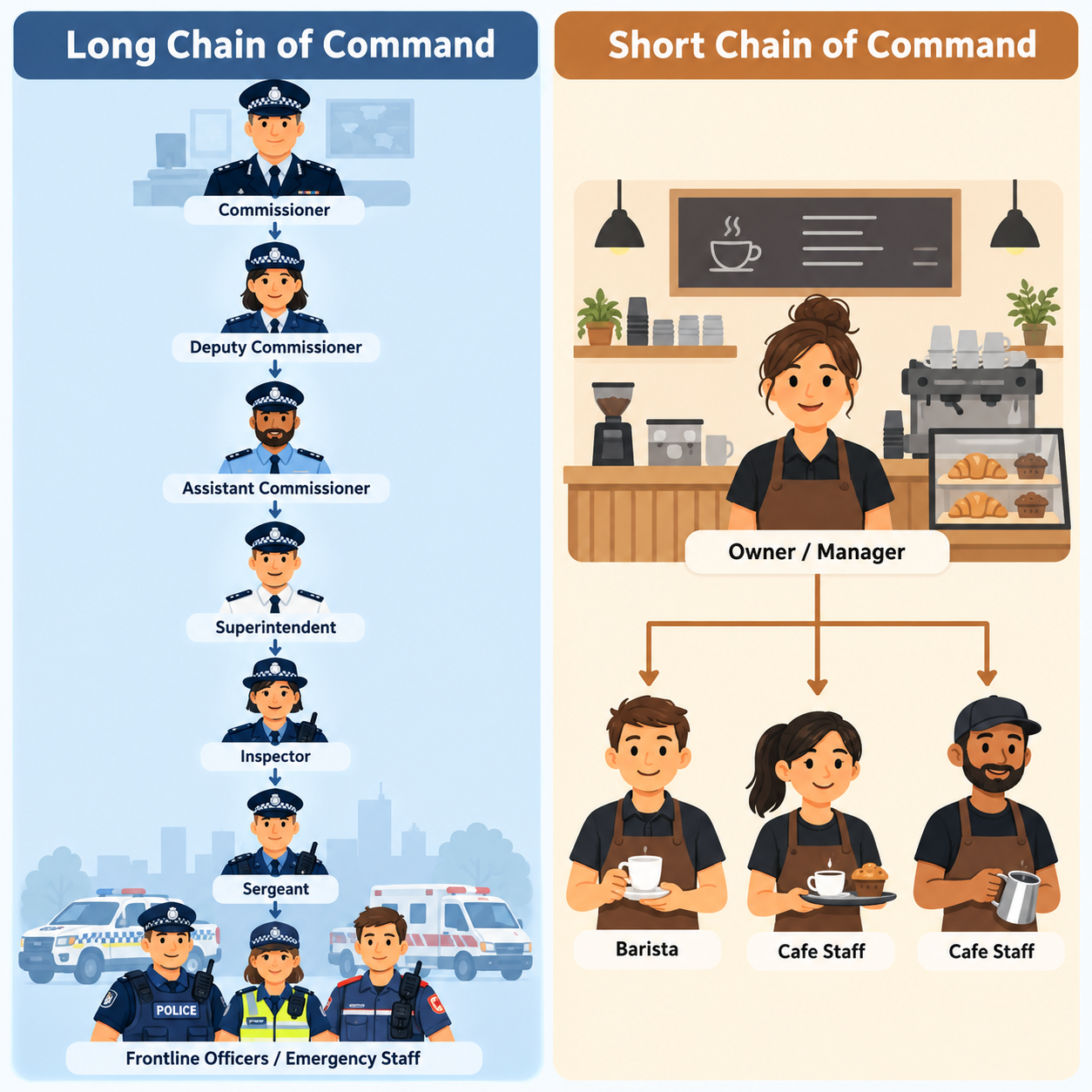
Long vs short chain of command
A long chain of command has more management layers between top management and frontline employees.
A short chain of command has fewer management layers, meaning information and decisions pass through fewer people.
The number of layers creates a trade-off between control and speed. More layers can strengthen supervision and formal approval, but they can also make communication and decision-making slower.
Long chain of command
Advantages
- Clear reporting lines: employees know exactly who has authority over them.
- Specialised management: different management levels can focus on particular areas of responsibility.
- Consistent decisions: important decisions may pass through senior managers before being implemented.
- Greater control: useful in high-risk environments where procedures and approvals need to be closely monitored.
Disadvantages
- Slower communication: messages must travel through more levels before reaching the right person.
- Delayed decisions: employees may need approval from several levels of management before acting.
- Information distortion: messages may be changed or simplified as they pass through several people.
- Higher costs: additional management levels increase salary and administration costs.
Short chain of command
Advantages
- Faster communication: information passes through fewer management levels.
- Quicker decisions: fewer approvals may be required.
- More direct access to managers: frontline employees can provide feedback more easily.
- Lower management costs: fewer management positions may be required.
Disadvantages
- Manager overload: fewer managers may need to handle more responsibility.
- Less formal control: decisions may vary if expectations and responsibilities are not clear.
- Unclear authority: employees may become unsure who approves decisions if roles are poorly defined.
- Less suitable for some high-risk industries: strict safety or compliance requirements may require clearer layers of authority.
Examples
- WA Police / emergency services: often use a longer chain of command because clear authority is important in high-risk situations.
- Small cafés / small trades: usually have a short chain of command because the owner may communicate directly with employees and make decisions quickly.
Example of how to write this in an exam
A short chain of command occurs when there are relatively few management levels between senior management and frontline employees. For example, in a small café an employee may report directly to the owner rather than through several supervisors and managers. Because information travels through fewer people, the employee can report a customer complaint or operational problem directly to the person with authority to make a decision. This can improve communication speed and allow the business to respond more quickly to customers. However, having fewer management levels can place greater responsibility on the owner or existing managers, which may result in manager overload as the business grows.
📏 Span of Control
Span of control is the number of employees a manager or supervisor can directly manage.
Narrow span of control means a manager directly supervises a relatively small number of employees.
Wide span of control means a manager directly supervises a relatively large number of employees.
When Is a Narrow or Wide Span of Control Most Appropriate?
There is no single ideal span of control. The most appropriate span depends on how much supervision employees need.
| Narrow Span of Control | Wide Span of Control |
|---|---|
| Most appropriate when: employees need a high level of supervision and support. | Most appropriate when: employees can work independently with limited supervision. |
| Work is complex, skilled, risky or regularly changing. | Work is routine, predictable and easy to standardise. |
| Employees may be new or inexperienced and require more coaching. | Employees are often experienced and confident in their roles. |
| Managers need more time to provide feedback, approvals, problem-solving and safety checks. | Managers can supervise more employees because fewer decisions require their direct involvement. |
| Result: fewer employees report to each manager. | Result: more employees report to each manager. |
More supervision needed → narrower span
Less supervision needed → wider span
Example
A manager supervising new apprentices on a construction site may need a narrow span because the work involves safety risks, regular guidance and close checking.
A manager supervising experienced employees completing routine warehouse picking tasks may be able to use a wider span because the work follows established procedures and requires less direct supervision.
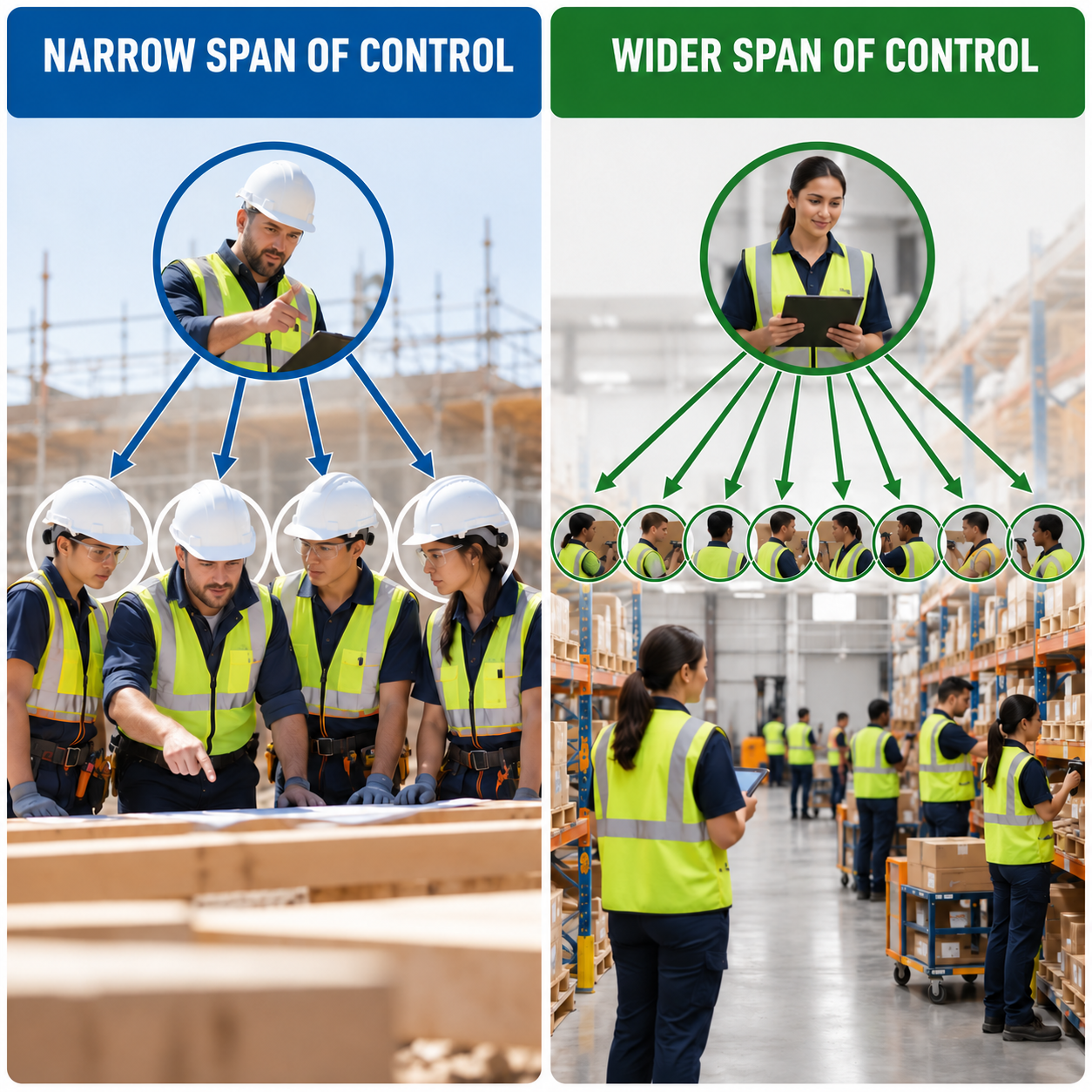
Narrow span of control
Advantages
- Closer supervision: managers can give employees more individual attention.
- Greater support: problems can be identified and corrected quickly.
- Clear accountability: managers have a stronger understanding of what each employee is doing.
- Can support motivation: employees may feel better supported by their manager.
Disadvantages
- Higher costs: more managers are required to supervise the workforce.
- Micromanagement: employees may feel they are being monitored too closely.
- Reduced autonomy: employees may rely heavily on managers rather than making their own decisions.
Wide span of control
Advantages
- Lower management costs: fewer managers are required.
- Flatter structure: fewer management positions can shorten communication channels.
- Greater employee autonomy: employees are expected to solve more problems independently.
- Efficient for routine operations: large groups can be managed where work is standardised.
Disadvantages
- Less individual supervision: managers have less time for each employee.
- Communication problems: managers may struggle to communicate effectively with a very large team.
- Reduced accountability: it can become harder to monitor individual performance.
- Less support: employees may need to solve problems without immediate management assistance.
A strong memory tool: MOST
Span of control is influenced by MOST:
- M — Manager: experienced managers may be capable of supervising more employees.
- O — Organisational culture: control-focused cultures may use narrower spans, while trust-based cultures may allow wider spans.
- S — Subordinates: skilled and experienced employees generally require less supervision.
- T — Task: complex, risky or urgent tasks generally require closer supervision.
Examples
- Bunnings warehouse team leaders: may manage a wider span where roles are routine, structured and supported by clear procedures.
- Surgical theatre / emergency department shift leaders: usually require a narrower span because the work is high-risk, time-critical and mistakes can have serious consequences.
Example of how to write this in an exam
A narrow span of control occurs when a manager directly supervises a relatively small number of employees. This is appropriate when employees require a high level of support or when work is complex, risky or regularly changing. For example, a construction supervisor managing new apprentices may use a narrow span because inexperienced employees require frequent instructions, safety checks and feedback. Having fewer employees under the supervisor allows more time to monitor each apprentice, which can reduce mistakes and improve workplace safety. However, maintaining a narrow span across the business requires more supervisors or managers, increasing labour and management costs.
🧩 Delegation
Delegation is the assignment of responsibility and/or authority to another person to complete a task.
How delegation works
Delegation shifts some responsibility or decision-making downward to another employee.
For example, a store manager may allow a shift supervisor to resolve customer complaints without asking the manager each time.
This can speed up decisions because the person closest to the problem has the authority to act immediately.
Responsibility does not remove accountability
The manager who delegates remains accountable for the final outcome.
This means a manager cannot simply hand over a task and ignore what happens. They still need to choose an appropriate employee, provide instructions and monitor the result.

Why businesses delegate
- Develop employee skills: employees gain experience by taking responsibility for more important tasks.
- Build motivation and trust: employees may feel valued when managers trust them with greater responsibility.
- Speed up decisions: not every decision has to move upward through management.
- Free managers for higher-priority work: managers can spend more time on planning, strategy and major problems.
When delegation goes wrong
Delegation can create frustration if:
- employees are not trained or confident
- tasks and expectations are unclear
- managers delegate work but not enough authority to complete it
- employees feel they are doing management-level work without recognition or reward
Retail example
A retail manager may delegate:
- rostering to a senior team member
- handling customer complaints to a shift supervisor
- stock ordering to a department leader
This can speed up everyday operations because decisions can be made by employees who are already close to the task. However, the manager remains accountable if the decision creates problems.

Example of how to write this in an exam
Delegation occurs when a manager assigns responsibility and/or authority to another employee to complete a task. For example, a retail store manager may delegate the authority to handle routine customer complaints to a shift supervisor. This means the supervisor can make decisions such as resolving minor service issues without waiting for the store manager to become available. As a result, customer problems can be solved faster and the store manager is able to focus on higher-priority responsibilities such as staffing, performance and overall operations. Delegation can also develop the supervisor's skills and increase motivation because they are trusted with greater responsibility. However, the manager remains accountable for the final outcome and must ensure the employee is properly trained and has enough authority to perform the delegated task effectively.
🔗 Bringing the Three Features Together
The three features work together rather than operating separately.
Chain of command
Determines who reports to whom and where formal authority sits.
Span of control
Determines how many employees each manager must supervise and support.
Delegation
Determines how much responsibility and authority managers pass to other employees.
If a business wants speed and flexibility
Businesses operating in fast-changing markets often want decisions made quickly and close to the customer.
To support this, they may use:
- a shorter chain of command so messages and decisions travel through fewer management levels
- a wider span of control, where appropriate to maintain a flatter structure
- greater delegation so employees and team leaders can act without waiting for senior management approval
This approach works best when employees are skilled, roles are clear and managers continue to monitor performance.
If a business needs strict control and safety
Some organisations prioritise safety, compliance and consistent procedures over decision-making speed.
They may prefer:
- a longer chain of command with clearly defined reporting and approval processes
- a narrower span of control so managers can supervise employees more closely
- careful delegation supported by training, procedures and sign-off requirements
The consequence may be slower decision-making, but the business gains stronger control, accountability and consistency.
🏙️ Perth Case Study — Amazon Warehouse Operations
Chain of command
- Site leadership sets targets and oversees overall operations.
- Area managers run sections such as receiving, picking, packing and dispatch.
- Team leaders and shift supervisors manage employees on the warehouse floor and report issues upwards.
If there is a safety hazard, scanning problem, late truck or production bottleneck, employees need to know immediately who to report the issue to and who has authority to respond.
Span of control
- Routine tasks such as scanning, packing and sorting may allow a wider span because tasks are standardised and measurable.
- Higher-risk or fast-changing areas such as machinery zones, loading bays or peak periods may require a narrower span so managers can provide closer supervision.
If one supervisor manages too many employees, communication and coaching may decline. This can increase errors and reduce both productivity and safety.
Delegation
- Team leaders may be delegated responsibility for meeting hourly targets in their zone.
- Shift supervisors may be delegated authority to move employees between areas when demand changes.
- Safety representatives may be delegated responsibility to report hazards and stop unsafe work.
Delegation keeps operations moving because employees do not need to wait for senior managers before every decision. However, senior management remains accountable for outcomes such as safety, productivity and delivery performance.

🎧 Prefer listening?
If you prefer listening to the content in Podcast format:
🎥 Prefer watching?
If you prefer watching the content in video format:
🃏 Flashcards
Card 1 of 23
🎮 Revision Games
💰 BME Millionaire
Climb the ladder by mastering organisational structure features.
🧩 Feature Match
Identify chain of command, span of control or delegation.
⚡ 60 Second Showdown
Rapid-fire questions across all three features.

Biz Fact: Microsoft commonly uses wider spans of control, reflecting highly skilled employees who require less direct supervision.