
U4.11 — Key Features of Strategic Plans
Overview
Dotpoint 11: key features of strategic plans.
Strategic plans are long-term plans that guide a business’ direction, objectives, decision-making, resource allocation, implementation and performance evaluation.
This is one of the larger dotpoints in Unit 4, and almost every exam over the past decade has included a question on one or more key features of a strategic plan.
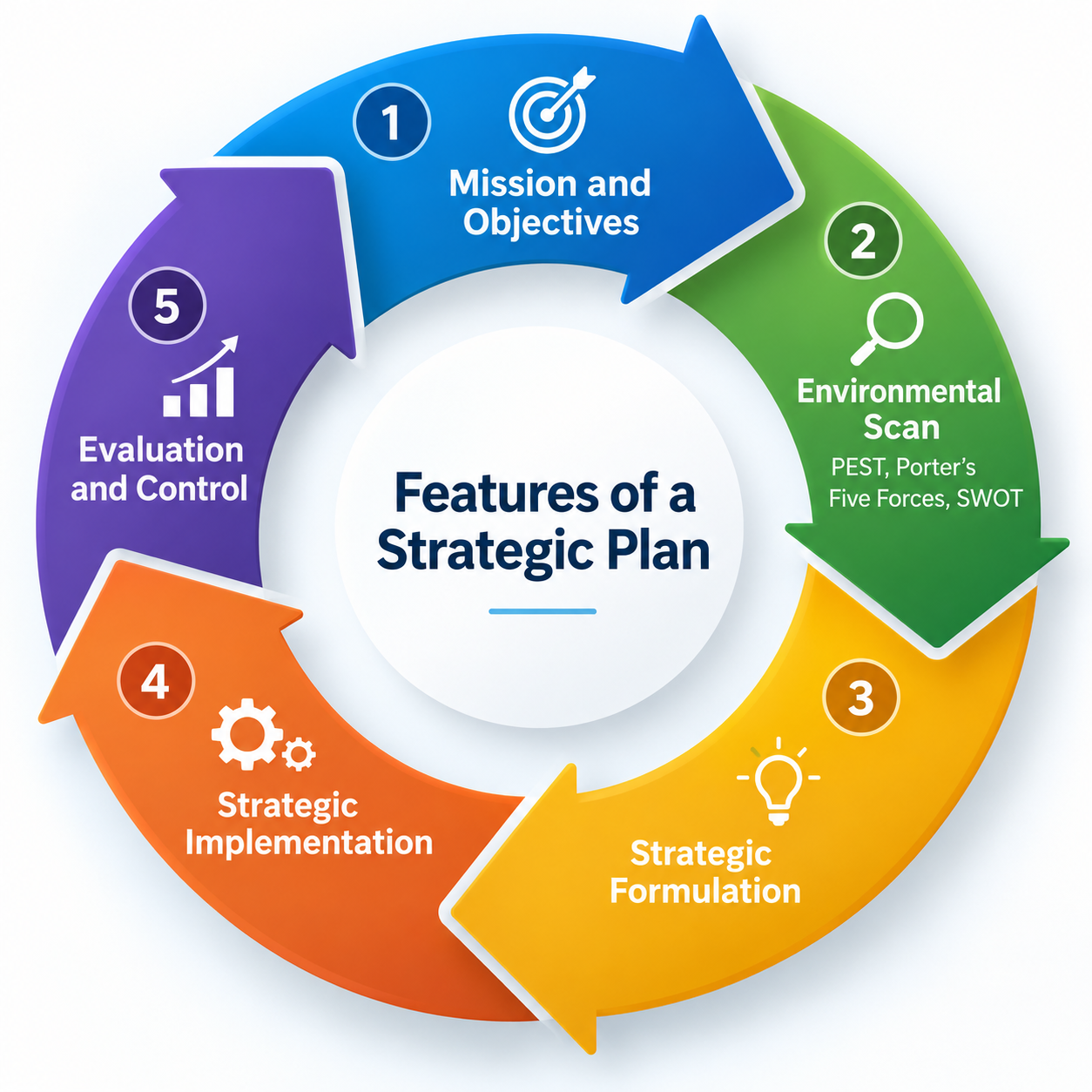
The key features of strategic plans are:
- mission and objectives
- environmental scan using PEST, Porter’s Five Forces and SWOT
- strategic formulation
- strategic implementation
- evaluation and control
🎯 Mission and objectives
What are mission and objectives?
A mission statement explains the broad purpose of the business. It describes what the business exists to do, who it serves and the general direction it wants to follow.
Objectives are specific goals the business wants to achieve. Objectives should be clear enough to guide decisions and allow performance to be measured.
In a strategic plan, the mission gives the business its overall direction, while objectives turn that broad direction into specific targets.
Mission and objectives guide decisions about products, markets, finance, staffing, marketing and expansion. Without clear objectives, a business may waste resources on activities that do not support its long-term direction.

Common types of objectives
Growth objectives
Expanding into new markets, increasing sales, opening new locations or reaching more customers.
Profit objectives
Increasing revenue, reducing costs or improving profit margins.
Market objectives
Increasing market share, building brand awareness or improving customer loyalty.
Operational objectives
Improving productivity, quality, delivery times, technology use or efficiency.
Social objectives
Improving ethical practice, sustainability, community impact or employee wellbeing.
Global objectives
Entering an overseas market, gaining international suppliers or becoming a global brand.

Example of how to write this in an exam
A mission statement gives a business a broad sense of purpose, while an objective gives the business a specific target to achieve. For example, Bondi Sands could have the mission “to deliver premium Australian skincare and self-tanning products to customers around the world”. A suitable objective could be “to increase sales in the United Kingdom and United States by 15% over the next two years”. This would help guide marketing, production and expansion decisions as part of the strategic plan.
🔍 Environmental scan
What is an environmental scan?
An environmental scan is the process of analysing internal and external factors that may affect the business’ ability to achieve its objectives.
It helps the business understand the market before choosing a strategy. This is important because global businesses may face different economic conditions, laws, cultures, technologies, competitors, suppliers, buyers and risks in each country.
The three environmental scans in this dotpoint are PEST, Porter’s Five Forces and SWOT.
🌏 PEST analysis
What is PEST?
PEST analysis is an external environmental scan used to analyse the macro-environment of a business.
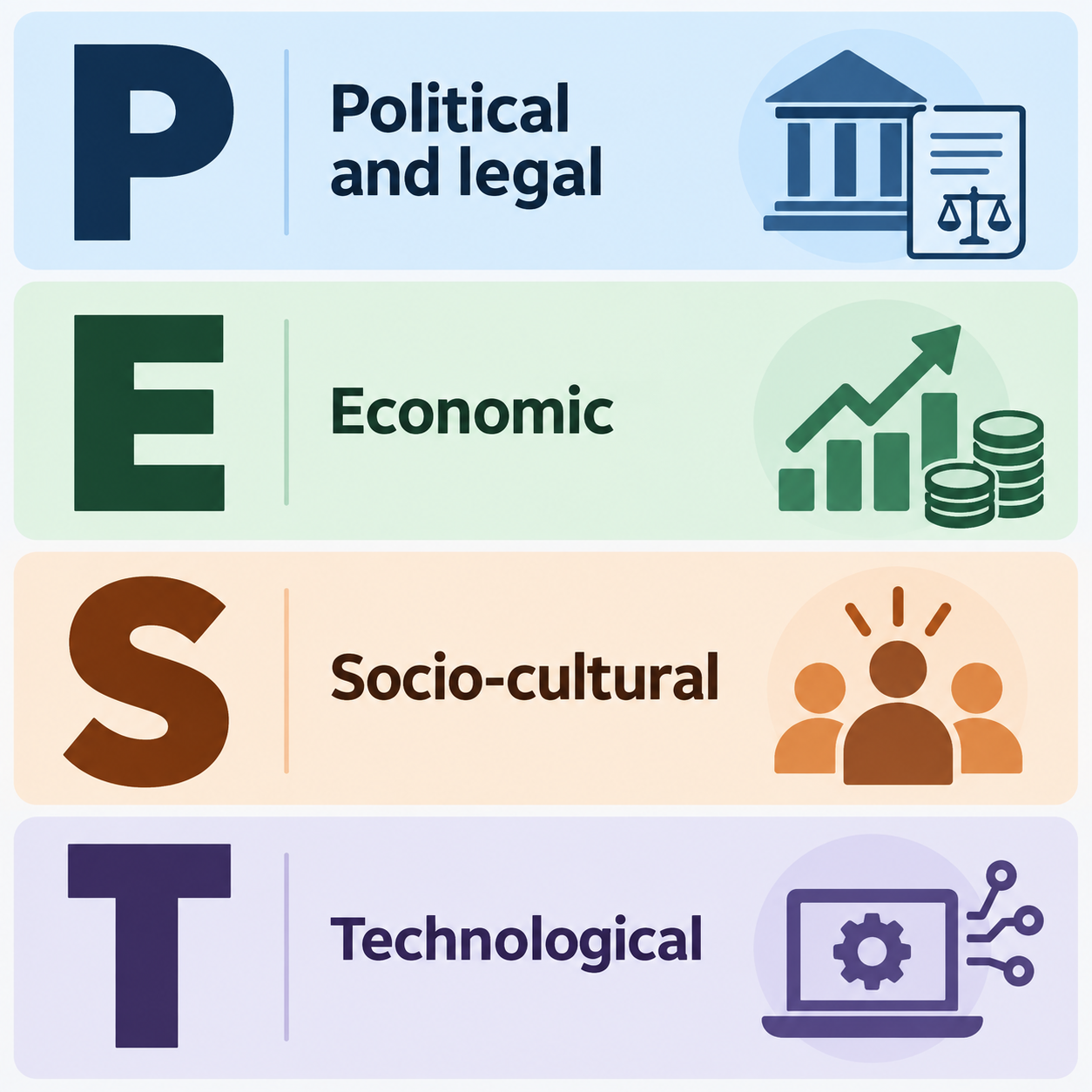
It examines political and legal, economic, socio-cultural and technological factors that may create opportunities or threats for the business.
Students have been asked to construct full PEST analyses in past exams for 8 to 12 marks, so strong answers need more than a definition. Each factor must be linked to the case study and explained as an opportunity, threat or operational consideration.
PEST links to previous dotpoints
| PEST | Previous dotpoint link | Main topics covered in those dotpoints | Extra things to consider in a PEST answer |
|---|---|---|---|
| P | U4.07 — Political Factors | Stability of foreign governments and the relationship of foreign governments with the Australian Government. | Legal rules, trade restrictions, tariffs, import regulations, taxation, licensing, employment law, product standards and whether government decisions could make expansion easier or harder. |
| E | U4.03 — Economic Factors | Economic activity, discretionary spending, interest rates and currency fluctuations. | Market size, household income, inflation, wage costs, unemployment, consumer confidence, transport costs, cost of inputs and whether the product is a necessity or discretionary purchase. |
| S | U4.01 — Cultural Considerations U4.02 — Ethical Practice |
Language, religion, social structures, customs, values, business etiquette, ILO labour standards, corporate social responsibility and environmental sustainability. | Demographics, lifestyle trends, health trends, customer tastes, social media behaviour, ethical expectations, attitudes to Australian brands and whether the business needs to adapt its product, packaging or promotion. |
| T | U4.09 — Impact of Technology | E-commerce, social media, logistics technology, cloud computing, inventory systems, AI customer support, security and privacy issues. | Digital infrastructure, internet access, online payment preferences, data protection rules, mobile app use, delivery tracking expectations, platform dependence and the technology used by competitors. |
How to build a strong PEST paragraph
1. Name the factor
Start with political/legal, economic, socio-cultural or technological.
2. Use case evidence
Refer to the actual business, country, market, product, customers or trend in the case study.
3. Explain the impact
Show how the factor affects costs, demand, risk, competitiveness, operations or expansion.
Example of how to write this in an exam
Technology example: Technology may create an opportunity for Cotton On when expanding into South-East Asia because the business can use e-commerce platforms, inventory systems and digital marketing to reach customers across multiple countries without needing a store in every location straight away. This means Cotton On can promote products through social media, process online orders efficiently and manage stock more accurately. As a result, technology can reduce expansion costs and help the business build brand awareness in global markets.
Economic example: Economic conditions may affect Breville if it is expanding into a market where consumer incomes and discretionary spending are rising. Stronger spending power would make customers more able and willing to buy small kitchen appliances, which could increase sales revenue. This means economic growth in the target market could make expansion more attractive because Breville may face stronger demand for its products.
⚔️ Porter’s Five Forces
What is Porter’s Five Forces?
Porter’s Five Forces is an external environmental scan used to analyse the level of competition within an industry.
It was developed by Michael Porter in 1979 and helps a business decide how difficult it may be to compete successfully in a particular market.
For an Australian business considering expansion into a global market, Porter’s Five Forces can be used to investigate the industry in the overseas country before entering it.
In simple terms, the business is asking: “If we enter this market, what competitive pressures will we face?”
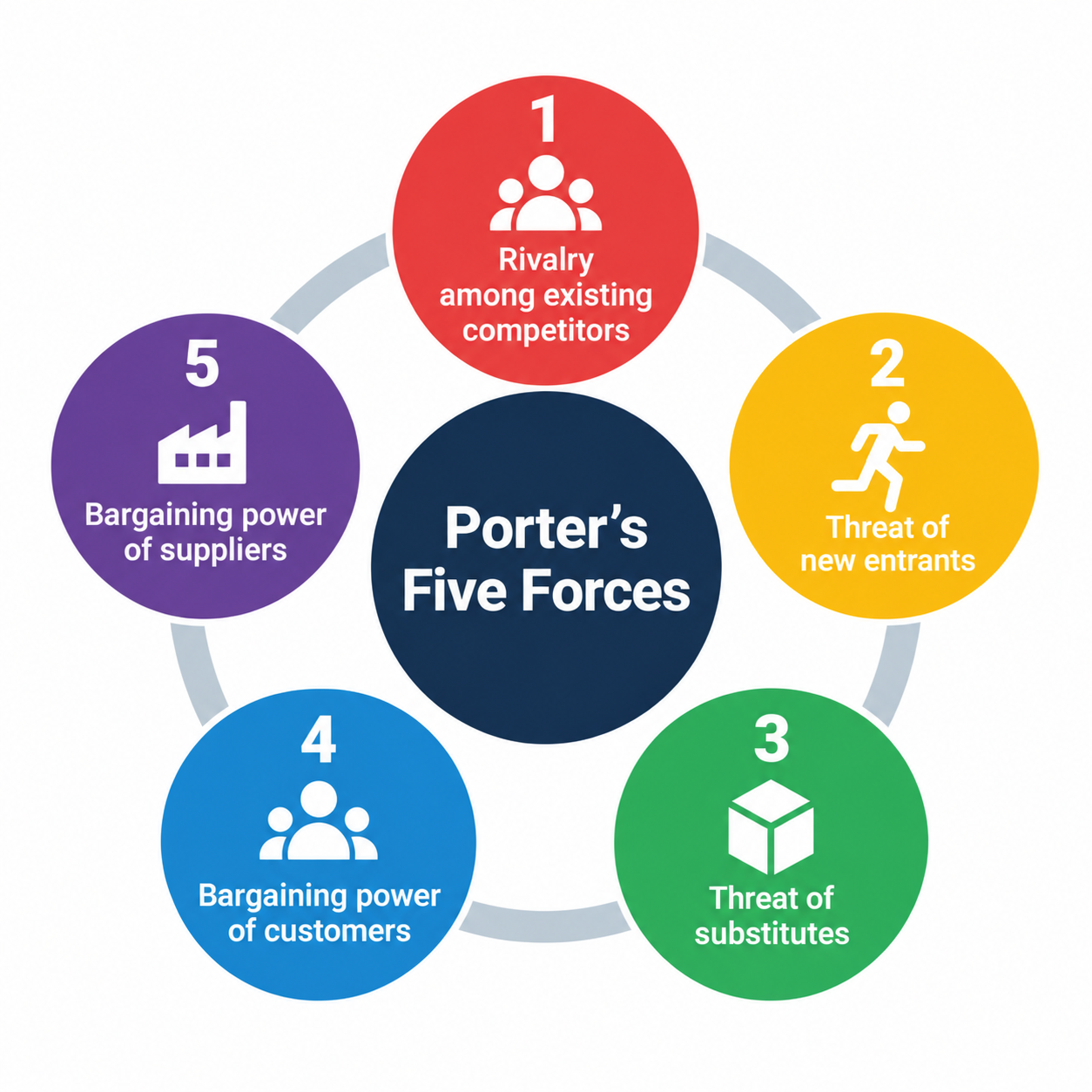
The five forces examine pressure from:
- existing competitors
- new competitors entering the market
- substitute products
- customers
- suppliers
Why this matters
The stronger these forces are, the more difficult it may be for the business to earn profits and gain market share.
Once the business has examined all five forces, it can judge whether the industry is attractive.
How does a business use Porter’s Five Forces?
Imagine Boost Juice is considering expanding into Japan.
Boost would not simply look at whether Japanese consumers like smoothies. It would also need to understand the competitive environment it would be entering.

The five forces in detail
1. Rivalry among competitors
What does it mean?
Rivalry refers to the level of competition between businesses already operating in the industry.
The business is trying to determine how difficult it will be to attract customers away from existing competitors.
Rivalry is likely to be high when:
- there are many competitors
- competitors sell similar products
- customers can easily switch between businesses
- businesses compete heavily on price
- advertising and promotions are common
Question to ask: “How difficult will it be to compete against businesses already in this market?”
Example — Boost Juice entering Japan: Boost could investigate the number of existing juice bars, smoothie businesses, cafés and health-drink chains operating in Japan. If there are many established competitors with strong brands and loyal customers, rivalry would be high.
Impact on Boost: High rivalry may force Boost to spend more on marketing, offer competitive prices and differentiate its products. Therefore, high rivalry could make the Japanese market less attractive because gaining customers and earning strong profits may be more difficult.
2. Threat of new entrants
What does it mean?
The threat of new entrants refers to how easy it is for new businesses to enter the industry in the future.
Even if competition is currently manageable, the business needs to consider whether many new competitors could quickly enter the market.
The threat is likely to be high when:
- start-up costs are low
- specialist technology is not required
- government regulations are limited
- customers are not loyal to existing brands
- businesses can easily copy the product
Question to ask: “Could other businesses easily enter this market and compete with us?”
Example — Boost Juice entering Japan: Opening a basic smoothie or juice store may not require extremely expensive technology or specialist equipment. This could make it relatively easy for independent juice businesses or international chains to enter the market.
Impact on Boost: A high threat of new entrants could increase competition in the future and make it harder for Boost to protect its market share. Therefore, Boost may need to build strong brand awareness, secure good locations and differentiate its products to create barriers to entry.
3. Threat of substitutes
What does it mean?
Substitutes are different products that satisfy the same customer need. They are not necessarily direct competitors.
The business is asking what customers could buy instead of its product.
The threat is likely to be high when:
- customers have many alternatives
- substitutes are cheaper
- substitutes are more convenient
- substitutes provide similar benefits
- customers can easily switch
Question to ask: “What else could customers buy instead of our product?”
Example — Boost Juice entering Japan: Boost does not only compete with other smoothie stores. Japanese consumers could instead purchase coffee, bottled drinks, bubble tea, convenience-store beverages, energy drinks or freshly prepared juices.
Impact on Boost: If substitutes are widely available and cheaper, Boost may have difficulty attracting customers or charging premium prices. Therefore, a high threat of substitutes could make the market less attractive and may require Boost to emphasise health, freshness, flavour or convenience.
4. Bargaining power of buyers
What does it mean?
Buyer power refers to the amount of influence customers have over the business.
Customers have greater power when they have many alternatives and can easily switch to another business.
Buyer power is likely to be high when:
- customers have many choices
- prices are easy to compare
- switching to another business is easy
- products are similar
- customers are very price sensitive
Question to ask: “How easily can customers choose another business?”
Example — Boost Juice entering Japan: A customer wanting a drink in Tokyo may have many nearby alternatives, including cafés, convenience stores, juice stores and vending machines. If the customer dislikes Boost’s price or product, they can easily buy somewhere else.
Impact on Boost: High buyer power may place pressure on Boost to keep prices competitive, provide high-quality products and deliver strong customer service. Therefore, high buyer power could reduce Boost’s ability to charge higher prices and may lower profit margins.
5. Bargaining power of suppliers
What does it mean?
Supplier power refers to the amount of influence businesses supplying inputs have over the business.
For Boost, suppliers may provide fruit, vegetables, yoghurt, packaging, equipment and other ingredients.
Supplier power is likely to be high when:
- there are only a few suppliers
- the input is specialised
- shortages exist
- switching suppliers is difficult
- the business depends heavily on a particular supplier
Question to ask: “How much control do suppliers have over our costs and supply?”
Example — Boost Juice entering Japan: Boost would need reliable suppliers of fresh fruit, ingredients, cups and other inputs. If only a small number of suppliers can provide particular ingredients at the quality Boost requires, those suppliers may have greater bargaining power.
Impact on Boost: Suppliers could increase prices or provide less favourable trading conditions. Therefore, high supplier power could increase Boost’s operating costs and reduce profitability.
Bringing the five forces together
Porter’s Five Forces is not five separate facts that a business memorises.
The purpose is to combine the five forces to answer one larger question:
“How attractive is this industry for the business to enter?”
An industry is generally more attractive when rivalry is low, the threat of new entrants is low, the threat of substitutes is low, buyer power is low and supplier power is low.
An industry is generally less attractive when several of the forces are high because the business may face more competitive pressure, higher costs, lower prices and weaker profit margins.
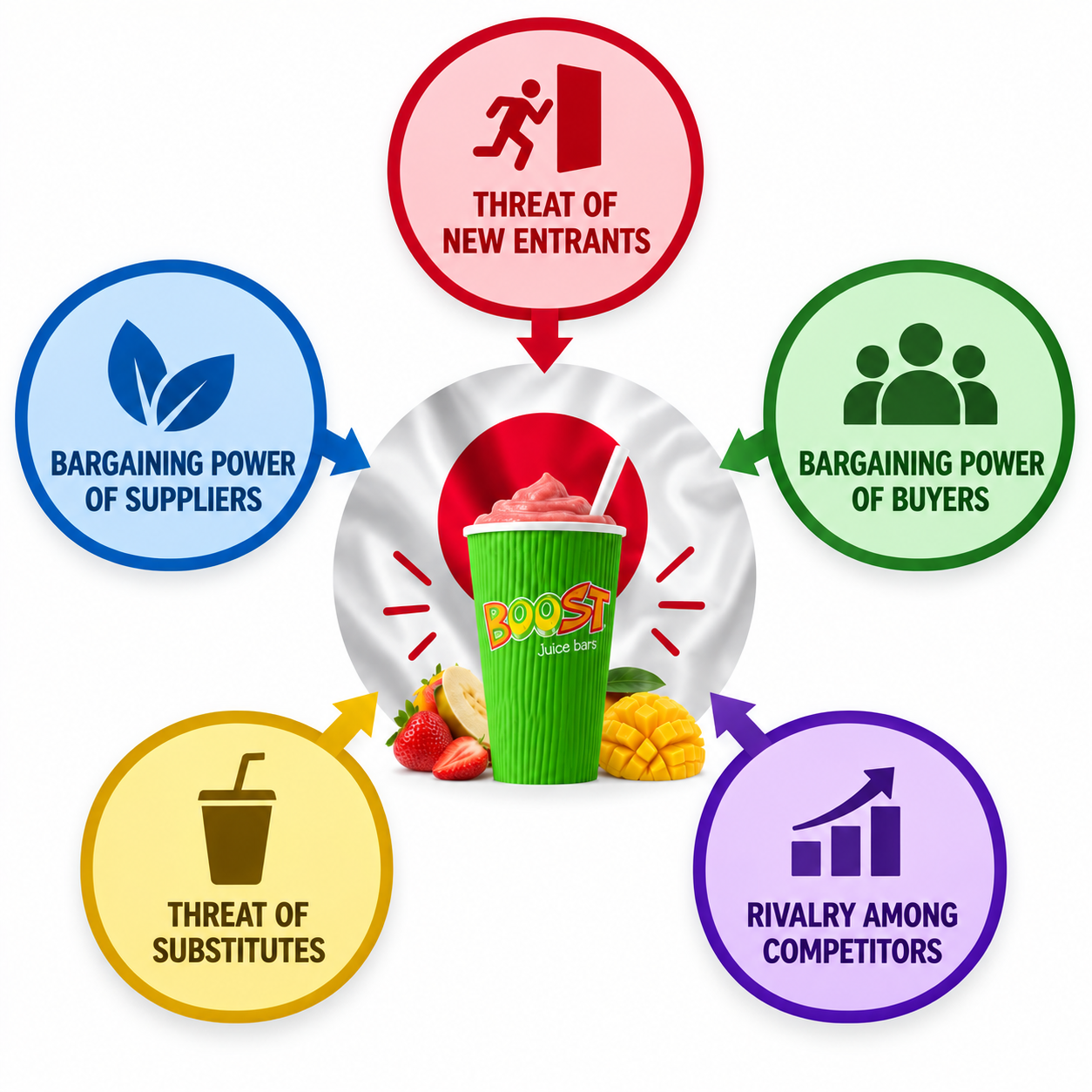
| Force | What Boost would investigate in Japan | If the force is high... |
|---|---|---|
| Rivalry | How many established juice, café and drink businesses already compete? | Boost may struggle to gain customers and may need greater promotion. |
| New entrants | How easy is it for other businesses to open competing drink stores? | Competition could increase further after Boost enters. |
| Substitutes | What other drinks could customers purchase instead? | Customers can easily switch away from Boost. |
| Buyers | How much choice do Japanese consumers have? | Boost may have less ability to increase prices. |
| Suppliers | How many reliable ingredient and packaging suppliers are available? | Boost may face higher input costs or supply problems. |
Example of how to write this in an exam
Threat of substitutes: The threat of substitutes for Boost Juice in Japan may be high because customers can choose many alternative drinks such as coffee, bubble tea, bottled juices and convenience-store beverages. This means customers may not need to buy from Boost if other drinks are cheaper or more convenient. As a result, Boost may need to differentiate itself through freshness, health benefits and flavour to attract customers.
Bargaining power of buyers: The bargaining power of buyers may also be high because Japanese consumers have many drink options and can easily switch to another seller if they are unhappy with the price or product. This could place pressure on Boost Juice to keep prices competitive and provide strong quality and service. Therefore, high buyer power may reduce profit margins and make expansion more difficult.
🧩 SWOT analysis
What is SWOT?
SWOT analysis is an environmental scan that examines the business’ strengths, weaknesses, opportunities and threats.
Strengths and weaknesses are usually internal factors, while opportunities and threats are usually external factors.
SWOT helps a business decide whether its internal capabilities match the external market conditions. It is especially useful before strategic formulation because it helps the business decide which strategy is realistic.
Past exams have asked students to prepare a SWOT analysis worth up to 12 marks, so students need to be able to write more than just one-word dotpoints. Each part should be applied clearly to the case study or business.
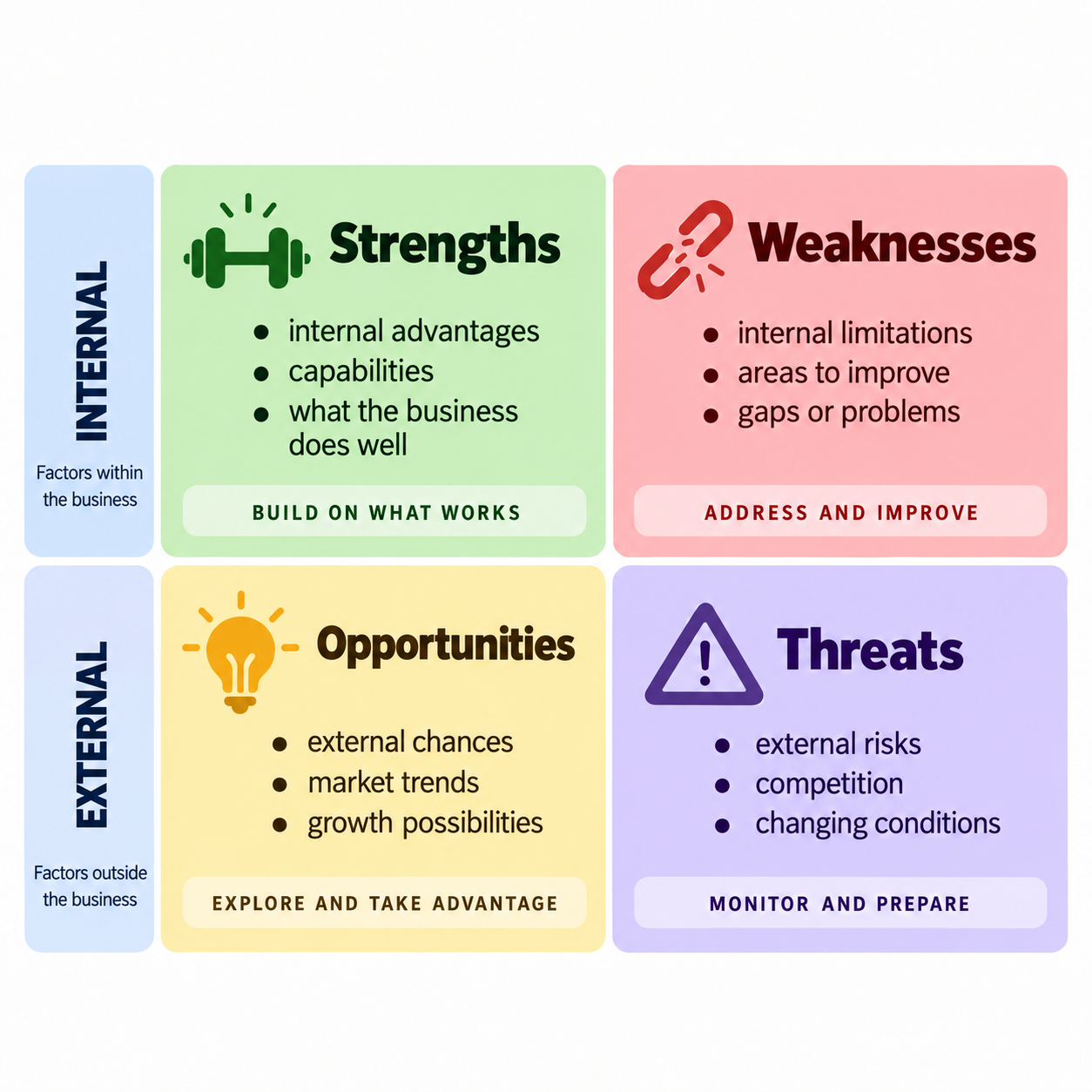
SWOT analysis breakdown
Strengths
Meaning: Internal advantages that give the business a competitive edge.
Summary: Strengths show what the business can use to support its strategy.
Examples:
- Brand reputation: customers already know and trust the business.
- Skilled employees: staff have the knowledge needed to carry out the strategy.
- Financial resources: the business has funds available for expansion.
- Technology: systems help the business sell, communicate or operate efficiently.
- Product quality: the product is reliable, unique or highly valued.
Application question: What does the business already do well?
Weaknesses
Meaning: Internal limitations that may hold the business back.
Summary: Weaknesses show what the business may need to improve or manage carefully.
Examples:
- Limited finance: expansion may be difficult to fund.
- Lack of experience: managers may not understand the new market.
- Poor systems: technology or operations may not support growth.
- Staff shortages: the business may not have enough skilled employees.
- Weak distribution: products may be difficult to deliver efficiently.
Application question: What could hold the business back?
Opportunities
Meaning: External situations the business could benefit from.
Summary: Opportunities show favourable conditions outside the business that may support growth.
Examples:
- Market growth: demand in the industry is increasing.
- Changing tastes: customers want products similar to what the business offers.
- Technology: e-commerce or social media creates new ways to reach customers.
- Trade agreements: lower barriers may make global expansion easier.
- New customer segments: the business can target a group it has not served before.
Application question: What external situation could the business take advantage of?
Threats
Meaning: External risks that could damage the business.
Summary: Threats show outside pressures that may reduce success or increase risk.
Examples:
- Competitors: rival businesses may already have strong market share.
- Regulation: laws or compliance requirements may increase costs.
- Currency movements: exchange rate changes may affect prices or profit.
- Changing tastes: customers may move away from the business’ products.
- Supply issues: shortages or unreliable suppliers may disrupt operations.
Application question: What external issue could damage the business?
How SWOT helps
SWOT helps a business match its strengths to opportunities, reduce weaknesses and prepare for threats before choosing a strategy.
Common mistake
Students often write generic SWOT points. Strong answers use case study evidence, classify points correctly and explain why each point matters to the business.
Example of how to write this in an exam (Bondi Sands expanding overseas)
Weakness example: One weakness for Bondi Sands may be that it is smaller than some major global beauty companies. This means the business may have less finance, fewer distribution networks and less market knowledge in some overseas markets. As a result, Bondi Sands could find it harder to expand quickly or compete strongly against larger international brands.
Opportunity example: One opportunity for Bondi Sands is the growing overseas demand for skincare and self-tanning products. This could allow the business to increase export sales and build a stronger presence in international retailers and online channels. Therefore, global market growth may create an opportunity for Bondi Sands to expand and increase revenue.

🧠 Strategic formulation
What is strategic formulation?
Strategic formulation is the process of developing and choosing the strategies the business will use to achieve its objectives.
It occurs after the business has clarified its mission and objectives and completed its environmental scan.
In simple terms, strategic formulation is where the business decides, “What is the best strategy for us to follow?”
What happens during strategic formulation?
1. Review objectives
The business checks what it is trying to achieve before choosing a strategy.
2. Use environmental scan findings
The business uses PEST, Porter’s Five Forces or SWOT to identify risks and opportunities.
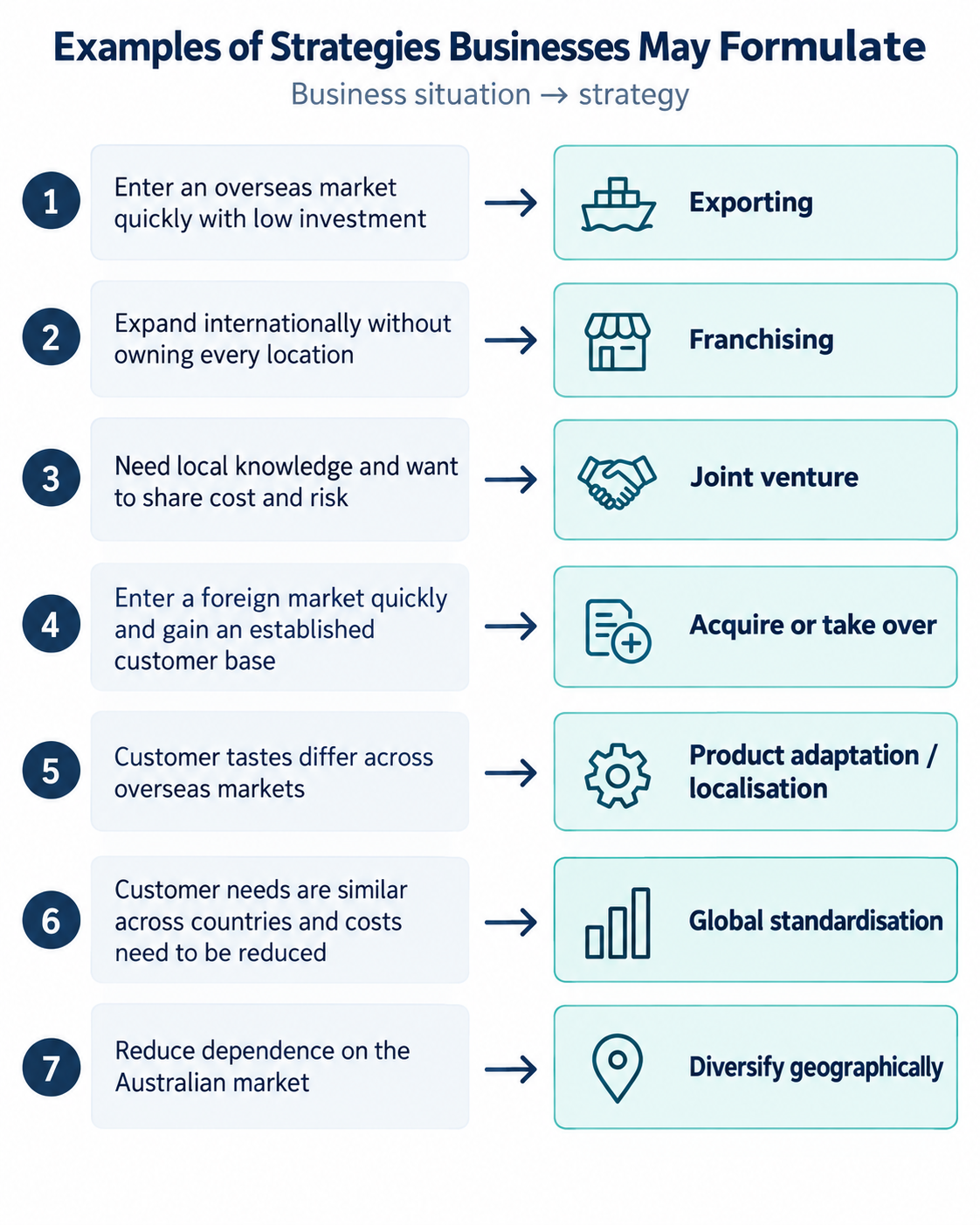
3. Compare strategy options
The business compares possible pathways, such as exporting, e-commerce, partnerships or new products.
4. Choose the best strategy
The business selects the option most likely to achieve its objectives.
5. Consider resources
The business checks whether it has the finance, staff, skills and systems needed.
6. Prepare for implementation
The business begins turning the chosen strategy into practical actions.
Example of how to write this in an exam
Strategic formulation is important because it helps a business choose the best strategy to achieve its objectives. For example, Rio Tinto may use strategic formulation when deciding how to expand its mining operations. It could compare strategies such as opening a new mine, expanding an existing mine or acquiring another mining business. Rio Tinto would then choose the strategy that best supports its long-term growth and profitability.
🛠️ Strategic implementation
What is strategic implementation?
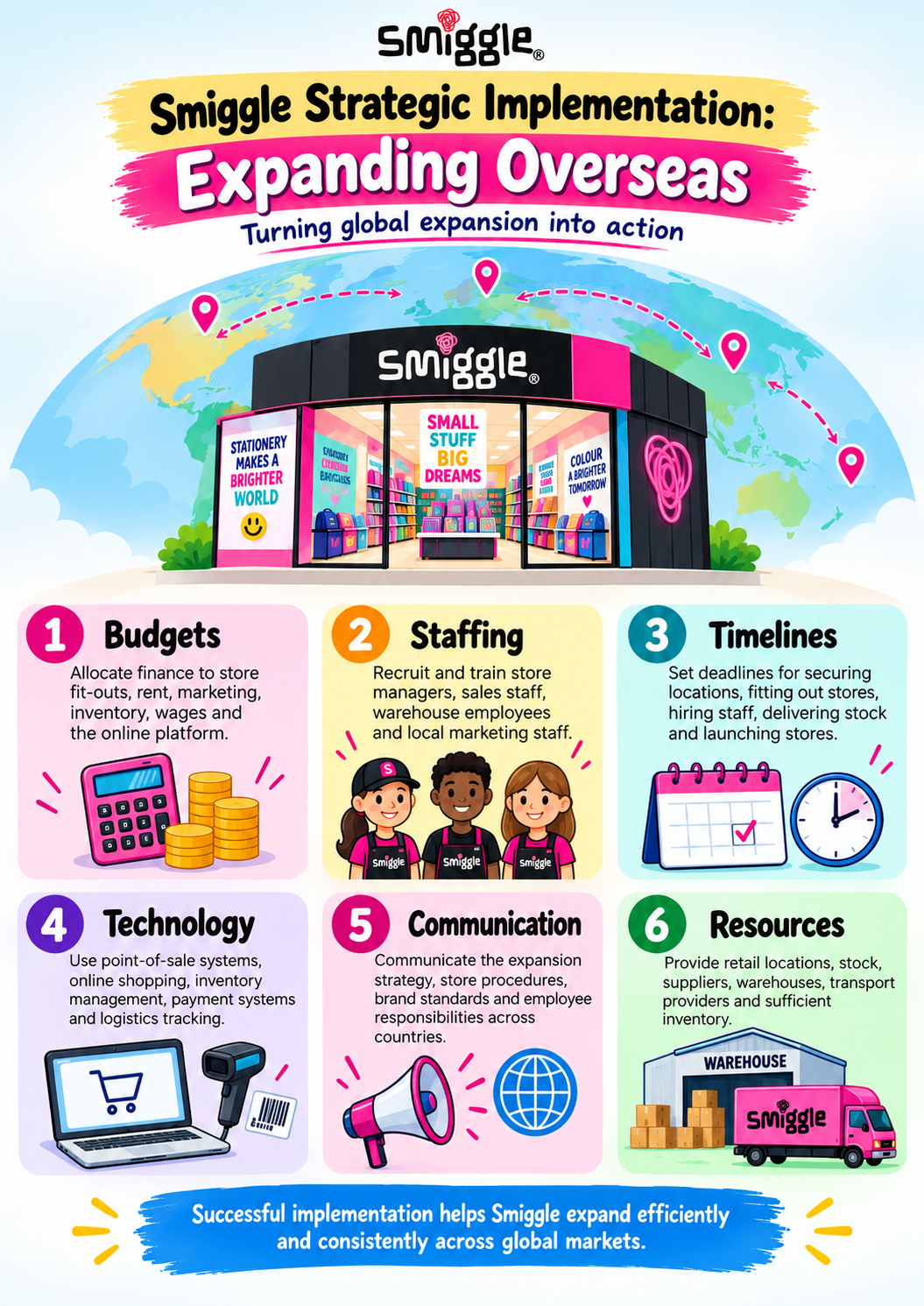
Strategic implementation is the process of putting a chosen strategy into action by organising the people, finance, technology, resources, tasks and timelines needed to achieve the business’s objectives.
Implementation turns the strategic plan into day-to-day business activity. For example, a business expanding overseas may need to recruit and train staff, arrange suppliers and logistics, develop its website, adapt marketing and allocate budgets.
Effective implementation helps the business carry out its strategy successfully, while poor implementation can lead to delays, higher costs, staff resistance, confusion and failure to achieve objectives.
What implementation requires
Budgets
Finance must be allocated to marketing, staffing, technology, production and expansion activities.
Staffing
The business may need to recruit, train or redeploy employees.
Timelines
Clear deadlines help the business track whether tasks are being completed on time.
Technology
Systems may be needed for e-commerce, communication, inventory, logistics or customer support.
Communication
Managers and employees need to understand what is changing and what their roles are.
Resources
The business must ensure it has the equipment, suppliers, facilities and capabilities required.
Example of how to write this in an exam
Strategic implementation is the process of putting a chosen strategy into action. For example, if Smiggle wanted to expand further into an overseas market, it would need to organise store locations, store fit-outs, staffing, supplier arrangements, logistics, inventory systems, marketing, budgets and timelines. This would turn the overseas expansion strategy into practical day-to-day business activity and help Smiggle maintain a consistent brand experience while reducing the risk of delays, cost blowouts or poor customer service.
📊 Evaluation and control
Evaluation
Evaluation is the process of measuring and assessing the performance of a strategy to determine whether the business is achieving its objectives.
This involves collecting performance data and comparing actual results with the targets set in the strategic plan.
Businesses may evaluate performance using measures such as sales revenue, profit, market share, customer satisfaction, costs, website traffic, productivity and number of new customers.
Control
Control is the process of taking corrective action when actual performance differs from planned performance.
If evaluation shows that the strategy is not achieving its objectives, managers may change the way the strategy is being implemented or, if necessary, change the strategy itself.
Corrective action could include changing prices, increasing promotion, reducing costs, staff training, changing suppliers, improving technology, reallocating resources or modifying the strategy.
The key difference
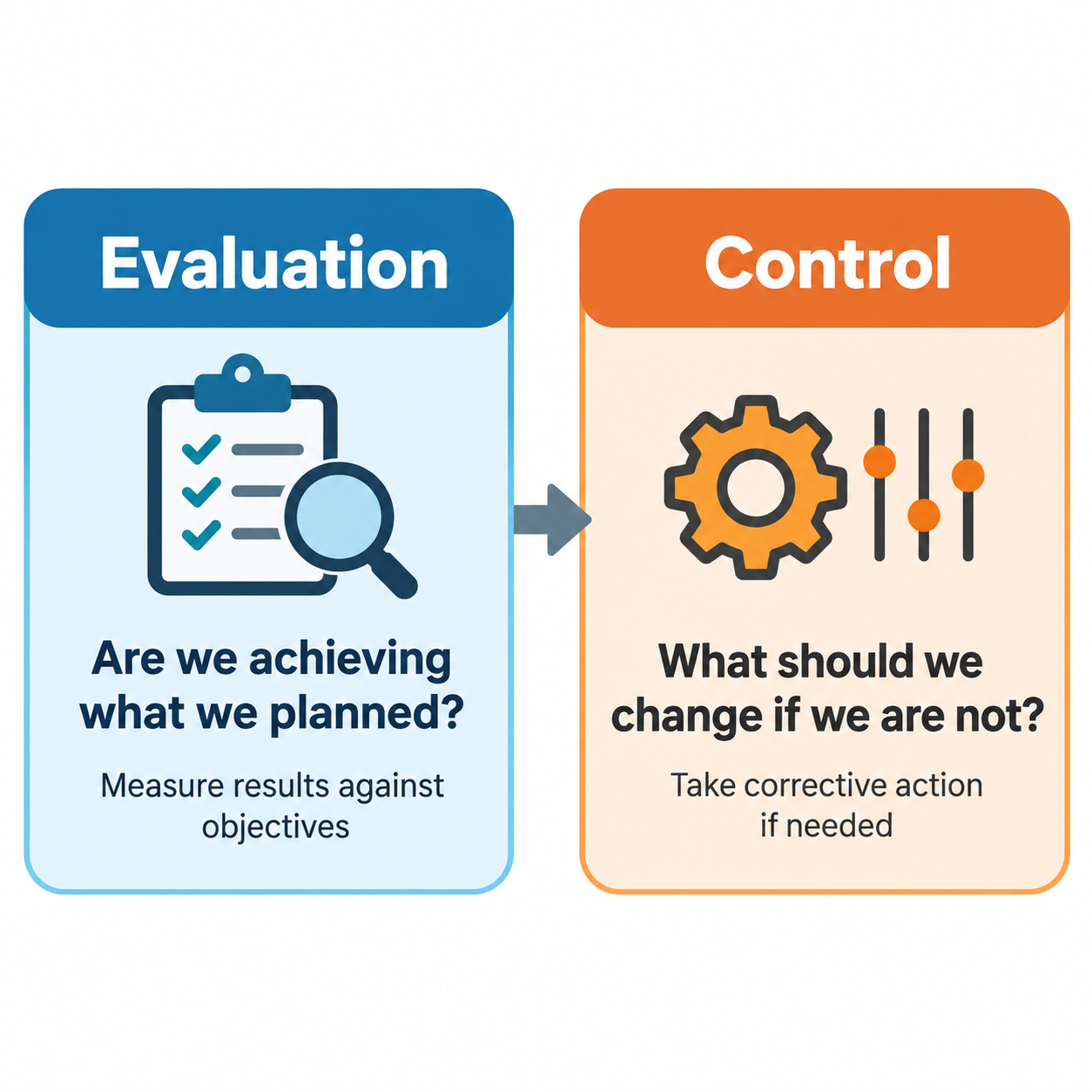
Evaluation asks:
“Are we achieving what we planned?”
Control asks:
“What should we change if we are not?”
Example of how to write this in an exam
Evaluation and control would be required because a business needs to check whether its strategy is achieving its objectives and make changes if performance is below expectations. For example, if Domino’s launched a new online ordering strategy in an overseas market, it could evaluate sales revenue, delivery times, customer reviews, website traffic and repeat orders. If results were weak, Domino’s could control the strategy by changing promotions, improving delivery systems, training staff or adjusting prices. This would help Domino’s improve the strategy before more resources are wasted and increase the chance that the online expansion achieves its sales and customer service objectives.
🎧 Prefer listening?
If you prefer listening to the content in podcast format:
🎥 Prefer watching?
If you prefer watching the content in video format:
🃏 Flashcards
Card 1 of 21
🎮 Revision Games
💰 BME Millionaire
Climb the prize ladder. Use your lifelines wisely.
👔 Business Boss
Make 10 strategic planning decisions. Your five planning KPIs rise or fall with every choice.
⚡ 60 Second Showdown
A varied 60-second challenge using snap judgements, categories, battles and quick decisions.

Biz Fact: Starbucks closed 61 Australian stores in 2008, leaving only 23 open, after its rapid expansion strategy failed to generate strong enough performance.
Past Exam Questions
Use these past exam questions to see how this dotpoint has been assessed. Pay close attention to the command term, the number of marks and whether the question is Section 1 or Section 2.
Section 1 Questions
2016 — Section 1 — Question 4(a), 4(b), 4(c) — 10 marks
Questions
4(a): Describe the following two features of a strategic plan:
● strategic implementation
● control and evaluation. (4 marks)
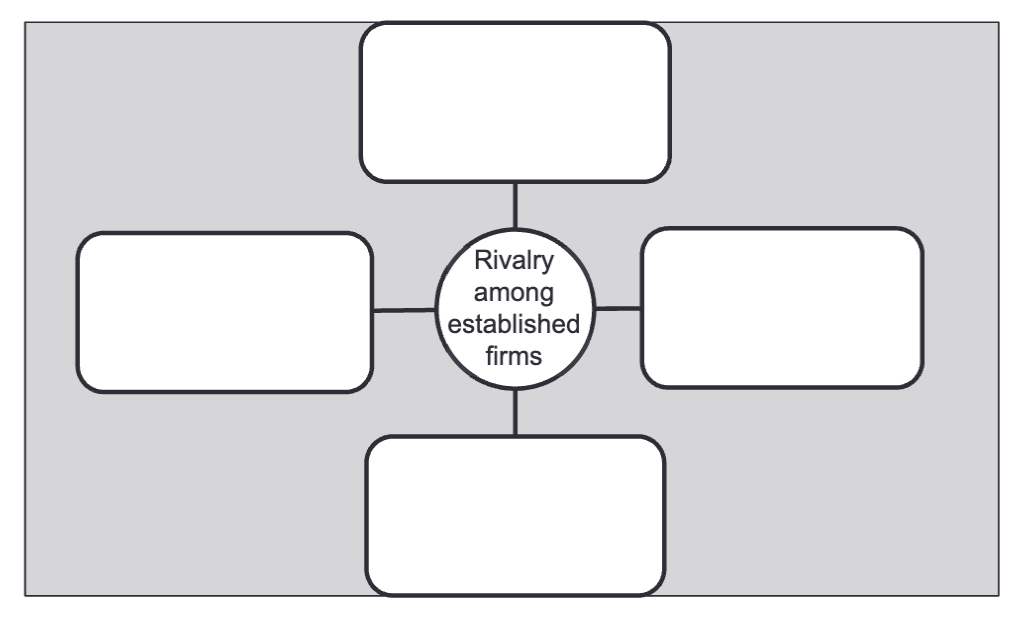
4(b): Label the forces in the diagram of Porter’s Five Forces model below. (4 marks)
4(c): Define Porter’s rivalry force. (2 marks)
Command term focus
Describe: give the main characteristics or features. Label: name the required parts correctly. Define: give the precise meaning.
See the full command term guide here: Command Terms.
4(a) / 4(b) / 4(c) Sample answers
(a) Strategic implementation is the process of putting the chosen strategy into action. This may involve allocating budgets, assigning staff, setting timelines, training employees and organising resources so the strategic plan can be carried out.
Control and evaluation involves measuring actual performance against planned objectives and taking corrective action if results are not meeting expectations. This helps the business identify problems and adjust its strategy before more resources are wasted.
(b) As rivalry among competitors is already shown in the diagram, the remaining four forces are threat of new entrants, threat of substitutes, bargaining power of buyers and bargaining power of suppliers.
(c) Porter’s rivalry force refers to the level of competition between existing businesses in an industry. High rivalry may lead to price competition, increased advertising, product innovation and pressure on profit margins.
2023 — Section 1 — Question 4(b) — 3 marks
Context
Strategic management is a key element to consider when operating in global markets.
4(b): Name and describe the environmental scan that can be used to analyse the macro-environment of a business. (3 marks)
Command term focus: Name and describe
Name and describe: identify the correct scan, then give its main characteristics or features.
See the full command term guide here: Command Terms.
4(b) Sample answer
The environmental scan used to analyse the macro-environment is PEST analysis. PEST examines political and legal, economic, socio-cultural and technological factors that may affect a business. It helps a business identify external opportunities and threats before choosing a strategy.
Section 2 Questions
2017 — Section 2 — Question 9(a) and 9(c) — 14 marks
Case study / context
Amy Wong plans to grow her business by importing quality silk products from China. Silk is used to manufacture a wide range of products. Amy has undertaken market research and identified the silk-bedding market, including silk quilts and pillows, as having significant growth potential. While popular for centuries in China, her research shows that silk-bedding products are now becoming better known in Western markets.
The increasing popularity of silk and its associated reputation has developed due to a combination of factors, including its excellent thermal properties, light weight, resistance to insects and natural hypoallergenic properties. Also, silk does not require any processing chemicals during its manufacturing process. Consequently, it is considered an environmentally-friendly product.
Amy thinks that growth in Western markets, customer demand for natural products, introduction of free trade agreements (FTAs) and the increase in production of quality silk products from China provides the basis for a successful global business. Given the scope of potential changes to her current business, Amy may need to review her strategic plan.
Questions:
9(a): Explain the purpose of the strategic planning process and why it is important for a growing business such as hers. Include in your answer the key features of a strategic plan. (6 marks)
9(c): Construct a PEST analysis for Amy’s business. (8 marks)
Command term focus
Explain: show cause and effect by explaining why or how and the result. Construct: build a complete structured response using case evidence.
See the full command term guide here: Command Terms.
9(a) / 9(c) Sample answers
The purpose of the strategic planning process is to give Amy’s business a clear long-term direction and decide how it will achieve its growth objectives. This is important because Amy is considering importing silk products from China and targeting Western markets, which would involve new customers, suppliers, competitors, costs and risks. As a result, strategic planning would help Amy make more informed decisions before committing time and money to the silk-bedding market, reducing the chance of choosing a strategy that is poorly matched to customer demand or global market conditions.
Key features of a strategic plan include a mission and objectives, an environmental scan, strategic formulation, strategic implementation, and evaluation and control. These features would help Amy set goals, analyse the market, choose a strategy, put the plan into action and measure whether her silk-bedding expansion is successful.
Political and legal: The introduction of free trade agreements may create an opportunity for Amy because FTAs can reduce trade barriers and make it easier or cheaper to import quality silk products from China. This directly affects business operations because lower barriers may reduce import costs and make supply arrangements more viable. However, Amy would still need to consider legal systems such as product standards, labelling requirements and import regulations because non-compliance could delay sales, increase costs or damage customer confidence.
Economic: Amy’s research shows growth in Western markets and increased production of quality silk products from China, which suggests favourable economic activity and stronger market demand. Because silk bedding is likely to be a discretionary product, Amy must also consider whether consumers have enough disposable income and willingness to pay for premium silk quilts and pillows. If demand is strong, expansion may increase sales revenue, but if exchange rates, import costs or price sensitivity are unfavourable, Amy’s profit margins could be reduced.
Socio-cultural: Customer demand for natural and environmentally-friendly products creates an opportunity because silk is described as light weight, insect resistant, hypoallergenic and free from processing chemicals. This links to socio-cultural values and ethical expectations because customers in Western markets may prefer products seen as natural, healthy and environmentally responsible. As a result, Amy could position silk bedding as a premium sustainable product, helping her differentiate from synthetic bedding competitors and build stronger customer appeal.
Technological: Technology may support Amy’s global business by allowing her to use e-commerce, digital marketing, online payment systems and supplier communication tools. This could help her promote silk bedding to Western customers, take online orders and coordinate with Chinese suppliers more efficiently. As a result, technology could reduce the need for a large physical store network, improve communication across global markets and make it easier for Amy to test demand before committing to larger expansion.
2018 — Section 2 — Question 7(d) — 8 marks
Case study / context
Daisy has been operating a surf and yoga camp in the small beach town of Yallingup in Western Australia. She is very happy with the success of the business, which attracts both local and international tourists. She is thinking of expanding to Bali, Indonesia. This appears to be an ideal location, due to its popularity as a holiday destination, the availability of affordable flights, diverse culture, good surf and the fact that there are already established surf and yoga camps successfully operating in Bali. Daisy has also learned the Indonesian language during her past visits to Bali. She decides she needs to assess the strategic direction of her business and will need to consider whether it is worth expanding overseas.
Through market research, Daisy has discovered Bali has a multi-religious population, with a rich dance and music culture. She has also found that it is important to build relationships before starting business negotiations. Australia and Indonesia are strategic partners and cooperate in a range of areas, including politics, economics, tourism and education.
7(d): As part of the strategic planning process, prepare a SWOT analysis for Daisy’s surf and yoga camp. (8 marks)
Command term focus: Prepare
Prepare: produce a complete structured SWOT using relevant case evidence in each section.
See the full command term guide here: Command Terms.
7(d) Sample answer
Strengths: Daisy already operates a successful surf and yoga camp in Yallingup, which is an internal strength because it shows she has experience running this type of business and understands the needs of surf and yoga customers. Her current business attracts local and international tourists, so she may already understand tourism markets and how to create an appealing customer experience. Daisy has also learned the Indonesian language during past visits to Bali, which could help communication with local suppliers, staff and business contacts.
Weaknesses: Daisy has not yet operated a business overseas, which is an internal weakness because she may lack experience with Indonesian legal systems, employment rules, taxation, suppliers and cultural expectations. Expanding to Bali may also require additional finance, staff and management time, which could place pressure on the existing Yallingup business. These weaknesses may make strategic implementation more difficult if Daisy is not prepared for the extra complexity of operating in a global market.
Opportunities: Bali is a popular holiday destination with affordable flights, good surf, diverse culture and a strong tourism industry, which is an external opportunity because it may create demand for Daisy’s surf and yoga camp. Australia and Indonesia are strategic partners and cooperate in areas such as tourism and education, which may support business confidence. These opportunities could help Daisy attract Australian and international tourists who are already interested in Bali as a travel destination.
Threats: There are already established surf and yoga camps operating successfully in Bali, which is an external threat because Daisy may face strong rivalry among competitors for customers, staff and locations. Cultural and religious differences may also create threats if Daisy does not adapt her business practices appropriately or fails to build relationships before negotiations. These threats could make expansion risky because Daisy may struggle to gain market share if competitors are already well known.
2018 — Section 2 — Question 8(d) — 8 marks
Case study / context
Watch Out Clothing, located in Western Australia, is a very successful clothing business that commenced trading and enjoyed significant growth during the mining expansion. Its business vision is to produce innovative, high quality clothing and personal protective equipment. Its range of clothing includes high-vision safety shirts, jackets and work boots at reasonable prices. Innovations in its clothing range include breathable fibres, quick drying fabrics and flame-resistant technology.
The owners are considering expanding into the Asian market as a result of the downturn of the mining industry in Western Australia. Singapore’s construction industry has experienced a strong growth period and has similar occupational safety and health laws that require workers to wear personal protective clothing. Watch Out Clothing is aware of the long-standing business relationships between Singapore and Australia. To ensure the quality of the innovative products manufactured by Watch Out Clothing, operations would remain in Australia.
8(d): Construct a political and legal, economic, socio-cultural and technological (PEST) analysis to assess the viability of Watch Out Clothing expanding its operations into Singapore. (8 marks)
Command term focus: Construct
Construct: build a complete PEST analysis by applying all four external factors to the case.
See the full command term guide here: Command Terms.
8(d) Sample answer
Political and legal: Singapore has similar occupational safety and health laws requiring workers to wear protective clothing, which creates an opportunity for Watch Out Clothing because its high-visibility shirts, jackets and work boots already match this legal requirement. The long-standing relationship between Australia and Singapore may also make expansion more stable and predictable. As a result, political and legal conditions may support the viability of selling protective clothing into Singapore because the business is entering a market where regulation creates demand for its products.
Economic: Singapore’s construction industry has experienced strong growth, which shows favourable economic activity in a target industry that uses personal protective clothing. This may increase demand for Watch Out Clothing’s products and help the business offset weaker sales caused by the downturn in Western Australia’s mining industry. As a result, the economic environment in Singapore may create a stronger customer base and improve the chance of export success.
Socio-cultural: Workers and construction businesses in Singapore may value safe, high-quality and reasonably priced protective clothing because workplace safety is important in the construction industry. However, Watch Out Clothing may need to understand local business etiquette, buyer expectations and relationship-building practices when selling into Singapore. If it adapts its communication and sales approach to local expectations, it may be more likely to gain trust and secure repeat customers.
Technological: Watch Out Clothing’s breathable fibres, quick drying fabrics and flame-resistant technology may help differentiate it from competitors in Singapore. Keeping operations in Australia may also help maintain quality control over these innovative products. As a result, technology and innovation may increase the appeal of Watch Out Clothing’s products and support its competitiveness in the Singapore market.
2019 — Section 2 — Question 9(b) and 9(c) — 12 marks
Case study / context
Aussie-Homestead Foods has been supplying the restaurant and retail markets for several years. After reading the following article, its management is considering the establishment of a native foods division and is currently in discussions with potential buyers in other countries.
Native bush food demand outstripping supply
The demand for Australian native foods across the country is by far exceeding supply, according to the industry’s peak body, Australian Native Food and Botanicals (ANFAB), who is encouraging new producers to enter the industry and existing growers to plant more crops. A spokesperson says, “We’re a supply-poor industry at the moment. The buyers are there; Asia is our neighbour and their interest in our native food products for culinary use is huge”.
An Australian exporter has been growing finger limes on her property at Possum Creek, in the far north coast of New South Wales, for more than 15 years. She started exporting her crop to the European Union (EU) 10 years ago. There has also been Asian interest in finger limes coming from Korea, Taiwan, Singapore and Hong Kong. “The fine food market in Asia has just gone nuts, absolutely nuts, and it’s a lot closer to home”, she said.
Established native food growers say there is plenty of room for growth in the industry. One grower who has been in the industry since 2000 exports lemon myrtle around the world. Korea is his biggest market for herbal tea, with some further interest from Japan and France. The potential for growth in the industry is limitless. Another Australian exporter says about her products, “The potential for our native plant products is enormous and everybody and anybody, especially foreigners who taste or see the food, fall in love with the food instantly”.
Questions:
9(b): Propose a mission statement and one key objective for Aussie-Homestead Foods’ native foods division as part of its strategic plan to enter this export industry. (4 marks)
9(c): Analyse the features of the bargaining power of suppliers and the threat of new entrants listed in Porter’s Five Forces Model in relation to Aussie-Homestead Foods exporting products to Asia. (8 marks)
Command term focus
Propose: put forward a clear, workable idea with enough detail to show how it would operate. Analyse: explain linked relationships and draw out the implication.
See the full command term guide here: Command Terms.
9(b) / 9(c) Sample answers
Mission statement: To provide high-quality Australian native food products to local and international customers while promoting the unique value of Australian bush foods.
Key objective: To establish a native foods division and secure export sales to at least two Asian markets within two years.
Bargaining power of suppliers: The bargaining power of suppliers may be high because the Australian native foods industry is currently supply-poor, with demand exceeding the amount growers can provide. This gives suppliers of products such as finger limes and lemon myrtle greater power to increase prices or choose which buyers they supply. Higher input prices would increase Aussie-Homestead Foods’ costs of exporting to Asia, which could reduce its profit margins or force the business to charge higher prices. Limited supply may also make it difficult for the business to obtain enough products to meet growing Asian demand. Over time, this could restrict Aussie-Homestead Foods’ ability to expand successfully in Asia because it may be unable to supply customers consistently or remain price competitive.
Threat of new entrants: The threat of new entrants may increase because strong demand for Australian native foods is attracting interest in the industry, while ANFAB is encouraging new producers to enter and existing growers to expand production. As more businesses enter the native foods industry, Aussie-Homestead Foods may face greater competition for overseas buyers in markets such as Korea, Singapore and Hong Kong. Increased competition could place pressure on the business to lower prices, improve quality or differentiate its products in order to attract and retain customers. Over time, this could make it harder for Aussie-Homestead Foods to gain market share and establish a strong position in Asia, so entering early and building strong buyer relationships may improve its chances of long-term success.
2020 — Section 2 — Question 6(b) and 6(c) — 16 marks
Case study / context
Ted and Roshan have recently completed their commerce degrees, majoring in tourism management. While at university, they have been operating a small tour company that organises weekend trips away for international students. Their tours have become popular and, since finishing university, they are keen to grow their business.
On their trips away, Ted and Roshan had many conversations with Singaporean students, who explained Perth’s appeal. Besides having top ranked universities, Perth has great weather and is only a five-hour flight from Singapore. The Singapore dollar and the Australian dollar are almost equal in value and Western Australia offers a huge choice of international cuisines. Ted and Roshan also learnt most Singaporeans speak English and that Singapore is one of the most tech savvy countries in the world.
The article also stated Singaporeans were big social media users, with most tourists flocking to tourist destinations they had seen on Instagram with people posing for selfies at places such as Cottesloe Beach, Wave Rock, the Pinnacles and, for the ultimate selfie, with a quokka at Rottnest Island.
During their research, Ted and Roshan discovered that Australia and Singapore enjoy a strong two-way investment relationship and that Singapore is Australia’s largest trade and investment partner in South-East Asia, having the Singapore-Australia Free Trade Agreement (SAFTA). They also read on the Department of Foreign Affairs and Trade (DFAT) website that Singapore is Australia’s sixth largest inbound tourism market and, in the year ending December 2019, Singaporean visitors spent $1.528 billion. Australia and Singapore also hold regular tourism talks and have established a framework for collaboration on research, data-sharing, and market insights to strengthen tourism collaboration.
Questions:
6(b): Explain to Ted and Roshan the importance of strategic formulation and describe how they could implement this process to ensure their business’ success. (4 marks)
6(c): Complete a PEST analysis for Ted and Roshan’s proposed business. (12 marks)
Command term focus
Explain: show cause and effect by explaining why or how and the result. Complete: provide all required PEST factors with application.
See the full command term guide here: Command Terms.
6(b) / 6(c) Sample answers
Strategic formulation is important because it helps Ted and Roshan choose the best strategy to grow their tour company rather than expanding without a clear plan. They could use their research on Singaporean tourists, social media use, SAFTA and Perth’s appeal to compare options such as Singapore-focused tour packages, Instagram marketing, university partnerships or online booking systems. This would help them choose the strategy most likely to attract Singaporean tourists and support long-term growth.
They could implement the chosen strategy by setting budgets, developing social media campaigns, building partnerships with universities or travel groups, training guides and measuring bookings from Singaporean tourists. This would help turn their strategy into practical actions that support business success.
Political and legal: Australia and Singapore have a strong two-way investment relationship and the Singapore-Australia Free Trade Agreement, which may make tourism links and business activity more stable. Australia and Singapore also hold regular tourism talks and have a framework for collaboration on research, data-sharing and market insights. This could help Ted and Roshan target Singaporean tourists with greater confidence because the political relationship and trade links between the two countries support tourism activity.
Economic: Singaporeans spent $1.528 billion in Australia in the year ending December 2019, suggesting strong economic activity and spending potential in this tourism market. The Singapore dollar and Australian dollar being almost equal may also make pricing easier for customers to understand. This means Singaporean tourists may be more willing and able to purchase Perth-based tours, improving the revenue potential of Ted and Roshan’s business.
Socio-cultural: Singaporean students identified Perth’s weather, universities, international cuisines and nearby tourism destinations as appealing. Most Singaporeans speak English, which may reduce communication barriers, and Singaporean tourists are described as interested in Instagram-worthy destinations. This could allow the business to adapt its tour packages and promotion to suit Singaporean tastes, values and travel behaviour.
Technological: Singapore is described as tech savvy and Singaporeans are big social media users. The case also states that many tourists visit destinations they have seen on Instagram, such as Cottesloe Beach, Wave Rock, the Pinnacles and Rottnest Island. This creates an opportunity for Ted and Roshan to use social media campaigns, online booking systems and digital advertising to build awareness and increase bookings from Singaporean tourists.
2021 — Section 2 — Question 8(d) — 9 marks
Case study / context
In some parts of the world, people have been spending more time at home, which has led to increased spending on interior design. Market trends in Australia and Europe have seen a rise in expenditure on home accessories and decor such as new furniture, artwork and plants.
Matilda has operated a successful homewares store in Perth selling rugs, cushions, wall hangings and furniture. She also operates an online store selling her products around Australia. She has seen a surge in online sales over 2020 and early 2021, leading her to consider expanding her business.
After reading a European ecommerce report in 2020 stating that ‘European shoppers are spending more time shopping online’, Matilda has decided to provide the European market access to her online store. The article also mentioned that ‘online marketplaces in Europe have attracted significant traffic and seen high visitor engagement that has translated into sales’.
She understands that her products, processes and services need to be innovative. She wants to ensure that her products are unique, luxurious and of the highest quality. Her processes in terms of her website, ordering and delivery need to be seamless and her customer service will need to be excellent in order to stand out from competitors. Matilda has decided that she also needs to investigate technology that is available to assist her to successfully sell her products to the European market. She is willing to invest money into her business operations in order to ensure that she has the best opportunity to be profitable in her expansion.
Matilda also needs to evaluate her competitive position in the international market to see whether she will be able to compete successfully. She has come to you (as a business advisor) to ask for advice.
8(d): Discuss what Matilda needs to consider if she were to expand to Europe, applying the following forces from Porter’s Five Forces:
● availability of substitutes
● bargaining power of buyers
and advise whether she should expand her online business into Europe. (9 marks)
Command term focus: Discuss and advise
Discuss: develop relevant points for and against and weigh them up. Advise: recommend what should be done, explain why and state the likely effect.
See the full command term guide here: Command Terms.
8(d) Sample answer
Availability of substitutes: A benefit for Matilda is that her products are intended to be unique, luxurious and high quality, which may help reduce the impact of substitutes because customers may not see cheaper homewares as equal replacements. The increase in spending on home accessories and decor also suggests there is demand for products like rugs, cushions, wall hangings and furniture. However, a limitation is that European customers may have many substitute options, including local furniture stores, online marketplaces, cheaper decor brands and other luxury home accessory businesses. This means customers could easily choose another product if Matilda’s prices, delivery times or designs are not attractive.
Bargaining power of buyers: A benefit is that European shoppers are spending more time shopping online, and online marketplaces have attracted significant traffic and sales, which may give Matilda access to a large customer base. If her website, ordering, delivery and customer service are seamless, she may be able to satisfy buyer expectations. However, a limitation is that buyer power is likely to be high because online shoppers can easily compare prices, reviews, delivery times, product quality and customer service across many websites. This may pressure Matilda to invest heavily in technology, customer service and reliable delivery to remain competitive.
Advice: Matilda should expand into Europe, but only through a careful online strategy rather than a major physical expansion. This is because the growth in European online shopping and homewares spending creates a clear opportunity, but substitutes and buyer power mean she must differentiate her products and provide a strong online experience. This recommendation would allow Matilda to test European demand while limiting risk, and if sales, customer reviews and delivery performance are positive, she could then increase investment in the European market.
2022 — Section 2 — Question 7(c) and 7(d) — 15 marks
Case study / context
Natasha has completed an online horticulture course and is keen to start up her own business helping people build and manage their own vegetable gardens. Natasha believes her business will be successful due to the recent growth in the number of people wanting fresh produce that they can grow at home. Friends have told her about Freelancer, the world’s largest freelancing, outsourcing and crowdsourcing marketplace. It connects freelancers and those who want to hire them.
During her research about the use of online platforms, Natasha has found information about the ‘gig economy’. The gig economy is the use of online platforms like Uber and Freelancer to instantaneously connect consumers with service providers to deliver goods and services. In 2019, 7.1% of Australians had worked, or tried to find work, in the gig economy, with Airtasker, Uber, Freelancer, Uber Eats and Deliveroo being the top five platforms with registered workers. The benefits for entrepreneurs in a gig economy include low barriers to entry, no requirement for qualifications or experience, flexible working hours and a low-risk opportunity to run a business. However, the online platforms hold all the power, often taking a high commission. The income is uncertain and the long-term sustainability of work is questionable.
Natasha previously worked in marketing, so she has a good understanding of how to promote her business. However, she has never managed her own business and is not confident with the financial and legal aspects of business operations. To differentiate her business from competitors, Natasha is planning to be innovative in the way she provides her service by having a weekly podcast and a YouTube channel. She is planning to provide her clients with information about the most up-to-date self-watering technology, the best plant covers to protect gardens from pests and the most effective composting technology. She eventually wants to offer a membership to her website that will include online tutorials for people to learn about organic food gardening. Natasha believes starting up her business on Freelancer is a great way to test the business idea without having to over-invest. In the process, she hopes to use social media content to develop her business idea and grow a customer base.
Questions:
7(c): Prepare a SWOT analysis for Natasha using Freelancer to start her business, and evaluate whether it is a viable idea. (12 marks)
7(d): Explain how evaluation and control will be required to form part of Natasha’s strategic plan if her business is to succeed. (3 marks)
Command term focus
Prepare: produce a structured SWOT. Evaluate: make a supported judgement. Explain: show cause and effect by explaining why or how and the result.
See the full command term guide here: Command Terms.
7(c) / 7(d) Sample answers
Strengths: Natasha has completed an online horticulture course, which is an internal strength because it gives her knowledge that can be used to help customers build and manage vegetable gardens. She also has marketing experience, which may help her promote her services through social media, podcasts and YouTube. Her plan to provide information about self-watering technology, plant covers and composting technology may also help her create a more innovative service than basic gardening support.
Weaknesses: Natasha has never managed her own business and is not confident with the financial and legal aspects of business operations, which are internal weaknesses. This could lead to poor pricing, weak cash flow management or compliance problems. She may also be heavily dependent on her own skills and time when starting out, which could limit how many customers she can serve and make strategic implementation more difficult.
Opportunities: There is recent growth in the number of people wanting fresh produce they can grow at home, which is an external opportunity because it may increase demand for Natasha’s vegetable garden service. Freelancer also provides low barriers to entry, flexible working and a low-risk way to test the business idea without over-investing. Her eventual plan for online tutorials and a membership website could create an opportunity to grow beyond one-off Freelancer jobs and build a more sustainable customer base.
Threats: Freelancer and other gig economy platforms may hold significant bargaining power and charge high commissions, which is an external threat because it could reduce Natasha’s income. The case also states that income in the gig economy is uncertain and the long-term sustainability of work is questionable. This means Natasha may struggle to rely on Freelancer as a stable long-term business model, especially if there are many competing gardening or home service providers on the platform.
Evaluation and control: Natasha will need to evaluate results such as customer bookings, income, commission costs, customer reviews and social media growth. If performance is below expectations, she could control the strategy by changing prices, improving online content, completing financial training or shifting customers from Freelancer to her own membership website. This would help Natasha correct problems early and improve the likelihood that her business becomes sustainable rather than remaining dependent on uncertain gig economy work.
2025 — Section 2 — Question 9(d) — 7 marks
Case study / context
Fizzology, an Australian soft drink company, specialises in a variety of flavoured drinks and is seeking to adapt and change its product range to meet new market trends. The current consumer market is looking for healthier options and seeking businesses that are seen to be environmentally-conscious and sustainable in their manufacturing and packaging.
Fizzology wants to conduct research and development to innovate their current products and invent new product ranges. It is looking into creating a kombucha range, fizzy flavoured tea drinks and reduced sugar in their popular Fizzology flavoured soft drinks. They are hoping that by investing in innovation of their products, it will create an opportunity to revitalise their sales in Australia and also provide an opportunity for the business to expand their new product lines globally.
Some members of senior management are not entirely convinced the time and investment into innovation is a wise move. They have seen other drink companies already launch kombucha and sugar-free drinks and they believe there are already strong competitors in the market. Some middle managers are also resistant to the change, concerned about job losses, changes to work routines and pressure to learn new skills and information about the new products. To manage this resistance to change, Fizzology is turning to Kotter’s 8 Step change management model. The business wants to highlight to team members the importance of adapting to consumer tastes and trends and to demonstrate the long-term benefits of being an environmentally-conscious business.
Hoping to convince the Fizzology management team of this change in the business, some team members are working towards having a plan in place to complete the research, investment and innovation to launch their new products internationally in the summer of 2027. Fizzology is aware that even though there are big brand names worldwide in the soft drink market, there is massive revenue potential and the number of potential customers is huge.
9(d): Using Porter’s Five Forces framework, outline how the three forces of the threat of new entrants, the bargaining power of buyers and rivalry among competitors could impact Fizzology’s expansion. Make a recommendation as to whether or not Fizzology should expand. (7 marks)
Command term focus: Outline and recommend
Outline: state the main impact of each force and briefly clarify it. Recommend: make a clear choice and explain why.
See the full command term guide here: Command Terms.
9(d) Sample answer
Threat of new entrants: The threat of new entrants may be high because the healthier drinks market, including kombucha, fizzy tea and reduced-sugar drinks, may attract many businesses trying to respond to the same consumer trends. This could make it harder for Fizzology to gain market share unless it differentiates its products through innovation, sustainability and strong branding.
Bargaining power of buyers: Buyer power may be high because customers looking for healthier and environmentally-conscious drinks can choose from many brands and compare taste, price, sugar content and packaging. This may pressure Fizzology to keep prices competitive while offering strong product quality and sustainability features.
Rivalry among competitors: Rivalry is likely to be strong because senior managers have identified that other drink companies have already launched kombucha and sugar-free drinks. Big global soft drink brands may also have more finance, marketing power and distribution networks, making international expansion more difficult.
Recommendation: Fizzology should expand internationally, but only after completing research and development, testing the new products and clearly differentiating them from existing kombucha, sugar-free and healthier drink competitors. This recommendation is appropriate because the global market has massive revenue potential and strong demand for healthier, environmentally-conscious products, but launching too quickly would expose Fizzology to intense rivalry and strong buyer power. By delaying full expansion until the products are tested and positioned clearly, Fizzology would improve its chance of gaining customers, protecting profit margins and achieving a successful international launch in 2027.